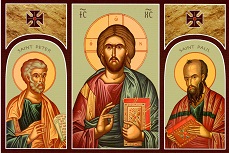
Wonder at the One who is the Word

Sermon (audio)
Download Sermon
Download Bulletin

Sermon for Christmas Eve

Hebrews 1:1-12  +  John 1:1-14

Some of you may know what those Greek letters say on the front of your service folder. The first letter is an omicron. Omicron has been getting a lot of attention lately. But it’s just a letter of the Greek alphabet: “little o.” That little mark above the omicron puts an “h” sound in front of the “o,” so, “ho,” which just means “the.” The next five letters, lambda, omicron, gamma, omicron, sigma are the English letters L O G O S. “Logos,” which is the word for “Word.” Ho Logos. The Word. The Word became flesh. The breathtaking truth of Christmas is that the baby Boy who lay in Bethlehem’s manger was the Word, Ho Logos, who was in the beginning, and who was with God.

He’s called the Word, like the word that is born from a person’s heart and mind and mouth. Now, sometimes our words don’t reflect what’s really in our hearts. Sometimes our words are false, lying words, spoken to cover up sin rather than to express the truth. But “the Word,” Ho Logos, isn’t like that. He is the perfect representation of who God the Father is, the express image of His person, as the writer to the Hebrews puts it. Whatever we see Jesus doing in the Scriptures, whatever we hear Him saying, whatever anger or indignation, whatever compassion or love we see in Jesus, expresses perfectly the character and the will of God the Father. So when we see Ho Logos, the Word, lying in a manger, we learn to what great lengths our God is willing to go in order to save us from our sins. He who was in the beginning and was with God, He who is the true Word of God, became flesh, and was born, not in a king’s palace or in a celebrity’s mansion, but in a place where animals came to feed.

But Ho Logos wasn’t only with God. St. John tells us that the Word was God. And he explains that relationship a little later, saying that Ho Logos is the Only-Begotten of the Father, or, as He’s simply called throughout the New Testament, He is and always has been the Son of God, eternally born of God the Father, so that there was never a time when He didn’t exist. He was in the beginning, true God from true God, the Alpha and the Omega, the Beginning and the End. But as to His human nature, He was born in time, born of a virgin mother who miraculously conceived by the overshadowing power of the Holy Spirit.

As God, the Word is responsible for the creation of all things. All things were made through Him. But now the Creator has joined Himself to His creation, has taken on human flesh. The Author of the story has entered the story, so that He might save His fallen creatures.

And fallen we are! Every one of us! The human race is corrupt, twisted. We have some memory of what is right and wrong, some nebulous sense of who the true God is. But by nature, no one truly knows Him, or truly worships Him as God. No one, by nature, fears or loves Him or trusts in Him or listens to Him. Our Creator has revealed Himself in the holy Bible, but who takes it seriously anymore, much less literally? Our Creator has told us what is good and right in His Ten Commandments, but the world rejects them, or keeps the ones it feels like keeping, when it feels like keeping them, and even then, it’s only superficial obedience. Like condemned criminals waiting for execution, our whole race had been cast into darkness and death.

But, St. John writes, in Him was life, and that life was the light of men. Life was lying in the manger, as a present from God the Father, not to His children, but to His enemies. To all who stood condemned before God, to all who were dead in trespasses and sins, He offered life! He offered His own life! One day He would literally offer it up on a cross in payment for the world’s sins. And now, risen from the dead, He offers life instead of death to all who believe in Him. To all who were trapped in the darkness of ignorance and unbelief and the filthiness of sin, He was a light shining in a dark place, even from His birth, offering sure and unchanging truth about who God is and how alone God can be reconciled to sinful man, only by entering His light. Only through repentance and the forgiveness of sins. The light shines in the darkness.

And the darkness has not comprehended it. Most didn’t want the light. His own human race, His own Jewish people didn’t want Him, or His light, or His life. Most still don’t. The truth of Christmas, the meaning of Christmas is being preached here this evening and at faithful churches around the world today and tomorrow. But the seats are nowhere near full. He came to his own, and his own people did not receive him. And why not? St. John reveals the answer just two chapters later: This is the condemnation, that the light has come into the world, and men loved darkness rather than light, because their deeds were evil. For everyone practicing evil hates the light and does not come to the light, lest his deeds should be exposed.

But the rejection of Christ isn’t the whole story. But all who did receive him, to them he gave the right to become children of God, to those who believe in his name, children who are born, not of blood, nor of the will of the flesh, nor of the will of a man, but of God. Christ the Word who was with God, Christ the Word who is God, Christ the Creator, the Life and the Light of men, was received by some. He was received first by Mary herself, then by Elizabeth and John the Baptist and Zacharias, then by Joseph, then by the shepherds, then by Simeon and Anna, then by the wise men, and on and on through the ages. The Christmas story has been told and believed, together with the Good Friday story and the Easter story. And those who believe are invited to be baptized and to be accepted as children of God, born again of water and the Spirit.

The Word became flesh and dwelled among us for a time. Those who believed in Him when He was here on earth beheld His glory, not only on the Mount of Transfiguration where His face shone like the sun, but also in the little Child in the manger and in the bloody Man hanging from the cross. The glory of God, the glory of Ho Logos was seen with the eyes of faith, just as it’s seen now with the same eyes of faith whenever the Gospel is preached. We see the glory of God in His relentless desire to save fallen man by becoming Man. We see the grace and truth of Ho Logos, lying in the manger.

Tonight and tomorrow, we celebrate the birth of the Word of God into the world, given to us, spoken to us by the heavenly Father. Oh, come, let us adore Him, Christ the Lord, Ho Logos of God! Amen.

Posted in Sermons | Tagged , , | Comments Off on Wonder at the One who is the Word

The Lord’s Prayer: Amen

Sermon (audio)
Download Sermon
Download Bulletin

Small Catechism Review

The Lord’s Prayer: Amen

This evening we finish up our discussion of the Lord’s Prayer, even as we finish up the Advent season. We end them both with that neat little word that says so much: Amen! (And as we’ve noted before, it can pronounced Aee-men or Ah-men.)

Amen! What does this mean? That I should be certain that these petitions are acceptable to the Father in heaven and are heard by Him; for He Himself has commanded us so to pray and has promised to hear us. Amen, Amen, which means: Yes, yes, it shall be so.

Amen is a word of certainty. It’s a Hebrew word that means, “faithful,” “firm,” “trustworthy,” “true.” Jesus used the word often. Some translations leave it as is, “Amen, Amen, I tell you.” Some say, “truly, truly I tell you.” Some, like the NKJV, say, “Most assuredly I say to you.” The children of Israel were to say, “Amen!” after each of the curses Moses pronounced on those who broke the covenant God had made with them. Each of the four Gospels (in the King James tradition of manuscripts) concludes with the word Amen. St. Paul and St. Peter use it after doxologies and benedictions in their Epistles. And St. John uses it throughout the book of Revelation.

Some of the Greek manuscripts of St. Mattew’s Gospel add the Amen to the Lord’s prayer, along with that famous doxology, “For thine is the kingdom, and the power, and the glory, forever.” Other manuscripts don’t include it, but it probably does belong there. In any case, it’s a fitting ending to any prayer, but especially to the Lord’s Prayer, because, as Luther points out in the explanation, God Himself has commanded us so to pray and has promised to hear us. So, yes, Amen, we should be certain that these petitions are acceptable to our Father in heaven. And yes, Amen, we should be certain that He will do what we are asking Him to do in each one of the seven petitions.

We add it to the First Petition: Our Father, Hallowed be Thy name! Amen! Yes, yes, it shall be so!

We add it to the Second Petition: Thy kingdom come! Amen! Yes, yes, it shall be so!

We add it to the Third Petition: Thy will be done, on earth as it is in heaven. Amen! Yes, yes, it shall be so!

We add it to the Fourth Petition: Give us this day our daily bread. Amen! Yes, yes, it shall be so!

We add it to the Fifth Petition: Forgive us our trespasses, as we forgive those who trespass against us. Amen! Yes, yes, it shall be so!

We add it to the Sixth Petition: Lead us not into temptation. Amen! Yes, yes, it shall be so!

And we add it to the Seventh Petition: But deliver us from evil. Amen! Yes, yes, it shall be so! Amen! Faithful, firm, trustworthy, true.

It’s ironic, isn’t it?, that our study of Amen coincides this evening with our observance of St. Thomas’ day. His most famous moment in the Bible is the opposite of an Amen. When the other ten apostles told him, The Lord is risen! We have seen Him! Thomas should have added his Amen, because the Lord Himself had foretold His resurrection on the third day, and the apostles were reliable witnesses. Thomas was anything but certain. Instead, Yes, yes, it must be so!, his reply was, No, no, it cannot be so!

But he became certain, and that’s really the important thing and the thing for which we should remember Thomas and give thanks for Thomas. He became certain after He saw the Lord Jesus and the nail prints in His hands and the spear gash in His side. The Lord told him to stop being unbelieving and to start believing. And Thomas’ answer was as good as an Amen: My Lord and my God! And the martyr’s death he willingly endured at the end of his ministry was like a great Amen to the Gospel he had believed and confessed. He who believes and is baptized shall be saved! Amen, yes, yes, it shall be so!

That’s important for us to understand, because no Christian has a perfect faith that always trusts and never wavers. And many Christians have moments like Thomas, when we should know better than to doubt or disbelieve, and yet our flesh gets the better of us. We all start out as disbelievers, and many people go through long stretches of their lives as unbelievers, unwilling and unable to add their Amen to the Lord’s curses and to the Lord’s promises. But then the Holy Spirit changes their minds through His Word, as He changed Thomas’ mind through His appearance. And they and we are finally able to reply with a full-throated Amen, to the Lord’s Prayer, to the Gospel itself, and to all the promises God has made in His Word.

His promise to come the first time in humility, for redemption, was received by believers in the Old Testament with an Amen, Yes, yes, it shall be so. And their faith was rewarded at Christmas, and on Palm Sunday. The promise of Christ’s first Advent proved faithful, firm, trustworthy, and true. Only one promise remains to be kept: Jesus’ promise to come again, His promise of a second Advent. As we close out this Advent season, we sit and wait in hope for that second Advent, together with the Apostle John, who penned these final words of the Book of Revelation: He who testifies to these things says, “Surely I am coming quickly.” Amen. Even so, come, Lord Jesus! The grace of our Lord Jesus Christ be with you all. Amen.

Posted in Sermons | Tagged , , | Comments Off on The Lord’s Prayer: Amen

Not the preacher, but the preaching

Sermon (audio)
Download Sermon

Service(video)
[vimeo https://vimeo.com/658416774 w=540&h=360]
Download Service Download Bulletin

Sermon for Advent 4

Philippians 4:4-7  +  John 1:19-28

As I mentioned last week, we’re going to spend some time today focusing on the preaching of John the Baptist, as we always do on the 4th Sunday in Advent, because as we use this season to prepare our hearts and arrange our lives for Christ’s Second Advent, so the whole purpose of John’s ministry was to prepare the hearts of his hearers for Christ’s First Advent. Not for the Advent of His birth, obviously, but for His Advent, His “coming” onto the scene to begin His three-year ministry, which would lead up to His death and resurrection, which was the fulfillment of His first Advent. The truth is, we need the preparatory preaching that John offers as much today as the people in Israel did back then.

When a preacher steps forward into the limelight, as, for example, just about any televangelist or mega church preacher you’ve ever seen, they tend to focus on themselves, don’t they? Or even if they don’t, their hearers focus on them—how they’re dressed, how cool or hip they are, how charismatic, how “real,” how fiery, or how brilliant. They tend to draw attention to themselves. They often attempt to sell themselves, almost like a used car salesman, as they personally benefit from their “ministry.”

That certainly wasn’t the case with John the Baptist. Now, he was certainly different. He stood out from everyone else by living alone in the desert, by wearing his camel skin clothing and leather belt, by eating locusts and wild honey for his diet. And his preaching was certainly bold, and his baptizing was novel, and it got people’s attention. But as soon as John got people’s attention, he immediately pointed them away from himself, unlike so many preachers today.

I’ve used the example before of a road sign. You’re supposed to notice the road signs, especially the warning signs along the road. They’re supposed to get your attention. But only for a moment. Only so that you get the directions or the message that the sign was put there to communicate. Then you forget about the sign and focus on where the sign was pointing.

So it was with John. He got people’s attention for a moment, and then pointed away from himself. That surprised people. It surprised the priests and Levites who approached him in today’s Gospel. They thought he must be claiming great things for himself, gathering a group of supporters for himself with some cunning political aim. So they came as an official delegation sent from the Pharisees to ask him, Are you the Christ? They didn’t believe he was, or else they would have been out there listening to him, confessing their sins, being baptized, and doing what he said. No, they had come to challenge him, whoever he was claiming to be.

If John had wanted a following for himself, he could have said “Yes, I am!” But the Evangelist John makes it very clear to his readers that John never made such a claim about himself. He confessed, and did not deny, but confessed, “I am not the Christ.” Well, then, they figured, he must be making some other great claim for himself, if he’s out here taking it upon himself to preach and to baptize. “What then? Are you Elijah?” Some of the Jews wrongly interpreted Malachi’s prophecy that “Elijah will come” before the Christ, thinking that the man who had gone up into heaven in a chariot and a whirlwind would descend from heaven again. And he said, “I am not.” John wasn’t that Old Testament Elijah, although, as Jesus tells us elsewhere, he was the one referred to figuratively in that prophecy. “Are you the Prophet?” they asked. THE Prophet whom Moses wrote would come from among them, referring to the Christ. And he answered, “No.”

“Who are you, that we may give an answer to those who sent us? What do you say about yourself?” He said, “I am the voice of one crying out in the wilderness, ‘Make straight the way of the Lord,’ as the prophet Isaiah said.” Luke gives us more of Isaiah’s prophecy that was fulfilled in John the Baptist. He writes, The voice of one crying in the wilderness: ‘Prepare the way of the LORD; Make His paths straight. Every valley shall be filled And every mountain and hill brought low; The crooked places shall be made straight And the rough ways smooth; And all flesh shall see the salvation of God.’ ” That was John’s job, to straighten the road ahead of the Christ. That’s all. Not to make a name for himself or gain glory for himself. He was a voice, a voice that would carry out the work of a figurative road construction crew.

John wouldn’t do any plowing or bulldozing or repairing of roads. But with his voice, with his preaching, he would do that to men’s hearts by turning their attention to the Lord’s imminent arrival. Now, if you know that the Lord is coming soon, then there is no time for business as usual. He’s coming up the road. So consider how you live. Consider where your heart is, what your heart is focused on, what it’s attached to, what your desires are. Consider the works you have done and are doing. Are they works of obedience? Works of kindness and generosity, focused on the benefit of those around you? Or are they works of which you should be ashamed? Consider the plans you’re making for today and tomorrow and next year and beyond. Is this how you want the Lord to find you when He comes?

Where there are valleys—unrepented sins against God’s commandments, a heart and life that are engaged in shameful deeds—let there be repentance and a confession of sins to raise the valley up. Where there are mountains and hills—pride in how good and decent you are, and how lucky God is to have you in His family—let there be recognition that God doesn’t see you nearly as highly as you see yourself, and let there be repentance and a confession of sins to bring the mountain down, so that it’s level with everyone else. Where there are crooked places and rough places—sinful habits and harmful behavior and a haphazard treatment of God’s Word and Sacraments—let there be repentance and confession of sins to make your heart and your life straight and smooth for the coming Lord. And you will see—all flesh will see—the salvation of God.

Why? Because when God comes, when the Lord Christ comes and finds penitent hearts, neither secure in their sins nor proud of their own decency, then He can announce the good news, the Gospel, that He is the One who would pay (or now, has paid) for all sins on the cross. Then He can invite the weary and heavily burdened to come to Him and find peace and rest and forgiveness and salvation. But if He comes and finds people secure in their sins, or indifferent toward the things of God, or proud and arrogant, then He has nothing to offer but Law and accusation and condemnation.

So John was sent to get the people ready, as all ministers are still sent to get the people ready before Christ’s Second Coming. And we, like John, point away from ourselves. As John wore that strange camel skin garment, so we wear this strange clothing, these vestments, when we’re carrying out our ministry. Always remember why: only to draw your attention for a moment, like a road sign, so that you may see Christ in the preaching office He gave us so that we might preach Him and not ourselves.

“Oh,” the world says. “That’s all you are? A nobody? A voice? A road sign? Then why should we listen to you?” As the envoys said to John, “Why do you baptize, then, if you are not the Christ, nor Elijah, nor the prophet?” Why do administer this new Sacrament? John answered them, saying, “I baptize with water. But there stands among you one whom you do not know. It is he who comes after me, who is already ahead of me, whose sandal straps I am not worthy to untie.”

Why do I baptize? Why do I preach? So that you may not be destroyed due to your ignorance of who Jesus is. You dismiss Him at your peril. You think He will come and deal with all the other sinners out there, but you—you must be safe, because, well, you are you. No, it doesn’t work that way. There’s only one way to be safe and ready for the coming of the Mighty God, who comes with vengeance against His enemies. “I baptize with water.” It doesn’t hurt, although it does kill the Old Man. I baptize with water, not with destruction, not with consuming fire. He will do that when He comes, if He doesn’t find you already washed in a baptism of repentance for the forgiveness of sins.

Well, you here have been baptized. That’s good! That was a first and very important step. Now continue to listen to the preaching of the preacher who doesn’t matter, but whose preaching does, turning your attention from the preacher to the Christ who is preached, so that you may live daily in repentance and faith, doing works of kindness and generosity and love at all times, and rejoicing while you’re doing it. Isn’t that how you want the Lord to find you when He comes? May God mercifully grant it, for Jesus’ sake, by the power of His Holy Spirit. Amen.

Posted in Sermons | Tagged , , , | Comments Off on Not the preacher, but the preaching

The Seventh Petition of the Lord’s Prayer

Sermon (audio)
Download Sermon
Download Bulletin

Small Catechism Review

The Seventh Petition of the Lord’s Prayer

In any need, in any trouble, facing any hardship or any dire situation, there are two little prayers a Christian can always pray, two little prayers that capture and beautifully summarize everything we might ask of our Father in heaven. The first is, Lord, have mercy! The second is the 7th petition of the Lord’s Prayer. Our Father, Deliver us from evil! Two short prayers that take all our needs in this life and lump them all together in one simple but profound request. At another time, we’ll talk more about “Lord, have mercy!” This evening, our focus is the 7th Petition.

The 7th Petition of the Lord’s Prayer is, as Luther says, a summary of the first six petitions.

Deliver us from evil.

What does this mean?

We ask in this prayer, in summary, that the Father in heaven would deliver us from every sort of evil of body and soul, of property and honor; and finally, when our last hour comes, grant us a blessed end, and graciously take us from this valley of sorrow to Himself in heaven.

So, from what evils are we praying for deliverance?

We pray, Hallowed be Thy name! Deliver us from the evil of false doctrine and from the evil of bringing shame and disgrace to Your name, O Father in heaven, by leading ungodly lives as those who call ourselves Christians. Deliver us from the evil of blasphemy!

We pray, Thy kingdom come! Deliver us from the evil of perishing outside of Your kingdom, from the evil of being trapped in the devil’s kingdom, from the evil of being without Your Holy Spirit, from the evil of not knowing You rightly, from the evil of following the devil as our king instead of Christ Jesus, Your dear Son, who gave Himself for us so that we might live under Him in His kingdom.

We pray, Thy will be done! Deliver us from the evil of falling into the hands of the devil, the world, and our flesh! Deliver us from the evil of carrying out the devil’s will by loveless behavior, by rushing into sin, by distrusting Your good and gracious will for us, and for the Church, and for the world.

We pray, Give us this day our daily bread! Deliver us from the evil of scarcity and want, from the evil of not having what we need for today, from the evil of storm and tempest, from the evil of bad government and ungodly rulers, from the evil of going through this life without the companionship we need.

We pray, Forgive us our trespasses, as we forgive those who trespass against us! Deliver us from the evil of living under Your just condemnation for our sins! Deliver us from the evil of falling away from faith in Christ, from the evil of becoming Your enemy again, from the evil of losing the life and salvation You gave us when we were baptized in Your name! And deliver us from the evil of holding a grudge against those who have sinned against us and from the evil of losing Your forgiveness by despising Your forgiveness in failing to forgive others.

We pray, And lead us not into temptation! Deliver us from the evil of giving in to the temptations of the devil, the world, and our flesh! Deliver us from the evil of false belief, despair, and other great shame and vice! Deliver us from the evil of growing bitter under the cross! Deliver us from the evil of crumbling under adversity and from being defeated by our enemies instead of standing victorious in the end!

So, you see, that little prayer, Deliver us from evil!, really does cover just about every evil or bad thing we may encounter in this world. When you see the world crumbling, Deliver us from evil! When you think about all the things that threaten, Deliver us from evil! When you feel the weight of this world’s darkness pressing down on you, turn to our Father in heaven and pray, Deliver us from evil!

And He will. He’ll do it in any number of ways. He may keep some evil from touching you at all. He may lessen its effect on you or strengthen you sufficiently, so that you can bear up under it. He may take the evil away after allowing you to be tested for just long enough. And finally, He will take you out of this evil world entirely, out of this valley of sorrow to Himself in heaven, where no evil is allowed to enter, ever.

Lord, have mercy! Deliver us from evil! Those are two good little prayers to say at any time. They go right along with that third little prayer, our regular Advent prayer, that’s also always relevant: Come, Lord Jesus! Amen.

Posted in Sermons | Tagged , , | Comments Off on The Seventh Petition of the Lord’s Prayer

Blessed are those who are willing to wait

Sermon (audio)
Download Sermon

Service(video)
[vimeo https://vimeo.com/655933825 w=540&h=360]
Download Service Download Bulletin

Sermon for Advent 3 – Gaudete

1 Corinthians 4:1-5  +  Matthew 11:2-10

The last two Sundays in Advent introduce us to the preacher of Advent, John the Baptist. In today’s Gospel, Jesus calls him a prophet, and more than a prophet. A prophet, because John prepared the people of Israel for the Advent of Christ, preparing the way of the Lord by turning men’s hearts to the things of God, to the readiness of repentance and faith. A prophet, because he foretold the coming of the Christ. More than a prophet, because John himself was prophesied by the Old Testament prophets. More than a prophet, because when Jesus was ready to begin His ministry, John proclaimed, not as a prophet, but as a herald, “The Christ is here!”

Next week we’ll look deeper into John’s ministry and preaching. But this week, the Gospel turns our attention to the final days of John’s life, after his preaching and baptizing were done. It shows us a minister of God who has done exactly what he was sent to do, who willingly set aside the comforts of life and society because he was thoroughly devoted to the mission God had given him. But now he sits in prison for doing what was right, for doing the very thing God had sent him to do, for preaching the truth to King Herod. He’s facing the end of his life, and he’s confused, because he spent his short ministry zealously pointing people to Jesus as the Christ, as the One who was to come, and yet to this day, Jesus has not done a single thing John said he would do, at least, not that John can see. But, again, he does exactly the right thing. Instead of trying to figure it all out on his own, or worse, giving up on Jesus, he sends two of his own disciples to Jesus, to ask Him for clarity and for help.

Through his disciples, John asked Jesus the question that was pressing on his heart and mind, Are you the one who is to come, or should we expect another? Since the days of Adam and Eve, God had been announcing, through the Old Testament prophets, the coming of a Messiah, a one-of-a-kind Savior, a Man who would also be God, a Christ who would do a whole list of things: He would teach the people of Israel with divine authority. He would speak to them in parables. He would perform miracles of healing. He would preach good news to the poor. He would institute a New Covenant (or Testament). He would be rejected by the people. He would suffer and be put to death, as the Lamb of God, for the sins of the world. He would be raised from the dead. He would reign as a King and bring justice to the world and righteousness to Israel. He would gather people from all nations into His kingdom. He would pour out His Spirit on His Church. He would raise all the dead. He would create new heavens and a new earth. He would get rid of pain and suffering and sickness and death. He would gather His people Israel together to dwell in safety, and He would destroy the wicked forever. All of those things were prophesied about the coming Christ in the Old Testament, and many of those things were also preached by John the Baptist as things that Jesus, the Christ, would do.

But how much of it had Jesus actually done since He was baptized by John in the Jordan River? Not very much. And from Jesus’ words and actions, it didn’t seem like most of it was even part of the plan. Jesus was intentionally not running a political campaign, was not overthrowing the wicked, was not releasing His people, like John, from prison or from suffering at the hands of sinners. John had said about the Christ, He will baptize you with the Holy Spirit and fire. His winnowing fan is in His hand, and He will thoroughly clean out His threshing floor, and gather His wheat into the barn; but He will burn up the chaff with unquenchable fire. But where was the fire? Where was the winnowing fan, or the cleaning out, or the gathering of the wheat, or the burning up of the chaff? John expected all of those things from Jesus, not only because he had proclaimed it, but because the Old Testament Scriptures had proclaimed it. How could Jesus be the One who was to come if He wasn’t doing what He was supposed to do?

Here was Jesus’ answer that He gave John’s disciples to bring back to their teacher: Go and tell John what you hear and see. The blind receive their sight, and the lame walk; the lepers are cleansed, and the deaf hear; the dead are raised, and the poor have the gospel preached to them. You see, Jesus was doing some of the things that the coming Christ was supposed to do, and they weren’t little things. The miracles He was performing were unprecedented, and He performed them easily, usually with nothing more than a word. He performed them with grace and mercy—the grace and mercy that were so characteristic of God Himself. Even His preaching to the poor was in fulfillment of Isaiah’s prophecy about the Anointed One: The Spirit of the Lord GOD is upon Me, because the LORD has anointed Me to preach good tidings to the poor; He has sent Me to heal the brokenhearted, to proclaim liberty to the captives, and the opening of the prison to those who are bound; to proclaim the acceptable year of the LORD, and the day of vengeance of our God; to comfort all who mourn.

But what were the good tidings Jesus was preaching to the poor? That they’re going to become less poor? No, Jesus never raised anyone out of poverty. The good news was for the rich and the poor who were poor in spirit, for those who admitted that they were poor, miserable sinners, that they had nothing to offer to God. To them Jesus gave the handout of the free forgiveness of sins, to all who believed in Him. And what about this “proclaiming liberty to the captives” and “opening the prison to those who are bound”? Even as John was sitting in prison! Ah, but that’s the thing. Many of the things that the Coming One was supposed to do were to be done in a figurative way, in a spiritual way. Those who had turned away from God had become captives of sin, slaves of sin, as Jesus puts it elsewhere. But the Son of God had come to set them free through the forgiveness of their sins, because having your sins forgiven by God is like having the prison doors thrown open, no longer held captive by guilt or condemnation, no longer destined to rot in hell, but made a child of heaven.

So some of the things the Christ was supposed to do, He was doing, either literally or figuratively or both. He was literally giving sight to the blind and hearing to the deaf, cleansing to the lepers and life to the dead. But He was also doing those things for people on the inside, spiritually, removing spiritual blindness and deafness. He was preaching good news to the spiritually poor and freeing the spiritual captives from their slavery to the devil. These are the things Jesus wanted John’s disciples to witness for themselves and to go and tell John what they saw and what they heard.

And then He spoke a word of encouragement and of warning, Blessed is he who does not stumble over me. In other words, “I know I haven’t done all that you expected, all that I’m supposed to do. But I will, when the time is right and in the way that I intend. So don’t allow your expectations to dictate what I must do or when I must do it or how I must do it. The Scriptures will all be fulfilled wonderfully, perfectly. Don’t stumble over Me just because you don’t understand everything yet. You will be blessed if you don’t stumble, if you have patience. Because all will be fulfilled in due time.”

And more of it has been fulfilled since then. John proclaimed Jesus the Lamb of God who takes away the sin of the world. Jesus hadn’t yet been offered up as that sacrificial Lamb when John sent his disciples. But within a year or two, He would be, at just the right time and in just the right way. He hadn’t yet been raised from the dead, but He would be. He hadn’t yet instituted the New Testament in His blood, but He would, soon. He hadn’t yet poured out the Holy Spirit, but He would. He hadn’t yet gathered the Gentiles into His kingdom, but He was about to begin that lengthy task.

As for the rest, the other things we are to expect in the Coming One, in the Christ—for those things we still wait, for the judgment of the wicked, for justice for the righteous, for the removal of pain and suffering and sickness and death, for the creation of the new heavens and the new earth. Jesus will do those things, too, just as He has already done all the other things that were rightly expected of Him. He’ll do it at His Second Advent, when He comes again at the end of the age.

What do you expect from Jesus? Be careful not to lump together all the good things He has promised to those who love Him, as if He had to give it all at once, and make everything better all at once, and do everything He has promised to do all at once, or else He won’t do it at all. He has done enough, hasn’t He?, to prove that He is the Christ, and that He’s faithful and trustworthy and good? Blessed are those who are willing to wait. Blessed are those who patiently wait for Jesus to do the rest of the things Scripture says He will do. Blessed are those who see all that He has already done and who take comfort in His promise to come again, as He said He would, to accomplish all that remains to be done for the good of His Church, for the good of each baptized believer. Amen.

Posted in Sermons | Tagged , , | Comments Off on Blessed are those who are willing to wait