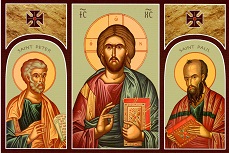
God’s mighty messengers, the holy angels

Sermon


Service

To download this video, press here to go to the download page. You may need to scroll down to see the download button.

Download Bulletin

Sermon for the Feast of St. Michael & All Angels

Revelation 12:7-12 + Matthew 18:1-11

On Monday, which was the actual feast of St. Michael, President Trump posted this on the White House website: According to sacred Scripture, when the Devil rebelled against God in Heaven, Saint Michael and his legion of angels cast Satan down to Earth—triumphantly reasserting God’s sovereignty over all creation. For 2,000 years, Christians have looked to Saint Michael the Archangel for protection, strength, and courage in times of conflict, distress, and doubt. In 1886, nearly 140 years ago, Pope Leo XIII, leader of the Roman Catholic Church, fearing for the future of the western world, introduced the legendary Prayer to Saint Michael, which is still recited to this day in churches and homes all across our Nation and throughout the world: Saint Michael the Archangel, defend us in battle. Be our defense against the wickedness and snares of the Devil. May God rebuke him, we humbly pray, and do thou, O Prince of the heavenly hosts, by the power of God, cast into hell Satan, and all the evil spirits, who prowl about the world seeking the ruin of souls. Amen.

On the one hand, it’s nice to see the government speaking positively about religion instead of persecuting it. But we should always think critically when a government official says something about God or the Bible, because they’re not good theologians. Consider what the president wrote and notice a couple of things. First, he tells the nation that St. Michael cast down Satan in the beginning, when the Devil rebelled, “reasserting God’s sovereignty over all creation.” But what you heard about Michael casting out the devil in tonight’s first lesson from Revelation 12 didn’t happen in connection with the devil’s rebellion. If we look at the context, we see that it happened in connection with the life, death, resurrection, and ascension of Christ Jesus. In fact, the vision is so full of symbolism that it would be unwise for us to think about that “battle in heaven” too literally in the first place. Nor was God’s sovereignty over all creation ever in question, needing to be “reasserted” by Michael and the angels. Nor are we ever taught in Holy Scripture to pray to any of the holy angels. Instead, we are taught over and over again to pray to God.

But, having said that, it is entirely appropriate to give thanks to God for the help and protection of the holy angels, and to pray to God that He would continue to send them to help us and to minister to us in our time need. Because there are many and great forces working against us in the spiritual realm. The devil is real. His demons are real. But so is Michael, and so are the holy angels, whom God employs to fight for us in ways that are almost always invisible to us.

Now there’s much we don’t know about angels, but there are some things we do know from Scripture. Angels don’t have flesh and blood as we do, but they can appear as men when they wish, like the two angels who accompanied the Lord in His visit to Abraham. We often picture angels with wings. That’s because Scripture describes them that way in several places, including how God Himself commanded Moses to depict them on the ark of the covenant and in the temple. Some of them are called “cherubim,” others “seraphim,” pictured as having either no wings, or two wings, or four wings, or six.

What do the angels do? Well, first and foremost, they worship God, their Creator, their Father, and their Lord. The seraphim are pictured doing that in Isaiah’s vision as they flew around God’s throne, calling out, Holy, holy, holy is the LORD of hosts; the whole earth is full of His glory! Or in Revelation, the angels join their voices with all creatures, singing, Worthy is the Lamb who was slain to receive power and riches and wisdom, and strength and honor and glory and blessing! The writer to the Hebrews tells us that when God brought His firstborn into the world, He says: Let all the angels of God worship Him. And they did. Remember when they appeared to the shepherds of Bethlehem, and a great multitude of the heavenly host appeared and sang, Glory to God in the highest! Peace on earth, goodwill to men!

Not only do the angels worship God, but they teach us to worship God together with them, with joy, with reverence, and with humble awe. There was a reason why God told Moses to place two cherubim on the mercy seat, the lid of the ark of the covenant, with their wings spread over the mercy seat, and with their faces staring down at it in reverence, just as there was a reason why God instructed Solomon to have two statues of angels made to stand guard in the most holy place in the temple, with other carved figures of angels placed in the walls of the Temple. God was teaching Israel to worship Him as the angels do. God was teaching them to imitate the worship of the angels, and that, when we worship God, the angels are present there, too, which is why, whenever we sing the Sanctus before Communion, we pray, “Therefore, with angels and archangels and with all the company of heaven, we laud and magnify Your glorious name!”

Now, if the angels worshiped God there at the mercy seat where He appeared, and in the temple, shouldn’t we worship Him a hundred times more? The angels worship Him as their Creator and Father. We worship Him, not only as our Creator and Father, but as our Redeemer and Savior. The sinless angels have never needed God’s mercy. We poor sinners need it at all times. God didn’t send His Son into angels’ flesh, but into ours. God didn’t give His Son into death for the angels, but for us men. God has not had to forgive the angels any sins, but He forgives ours daily. God has not brought the angels into the body of Christ, but He has made us members of Christ’s body. So may our worship not just imitate, but surpass that of the angels. We have far greater reasons to worship our God than they.

But the main purpose of the angels, the primary work they were created to do, at least as far as we’re told in Scripture, is to serve the people of God. As it says in Hebrews about the angels, Are they not all ministering spirits sent forth to minister for those who will inherit salvation?

There have been two main ways in which angels have served the Church. First, they were often God’s messengers to certain men, bringing the Word of God to people, here and there, in the Old Testament and in the New Testament. But such messages were rare. The chief and ongoing work of the angels is something that we never get to see, and that is, to guard and protect the people of God from dangers both seen and unseen, from attacks both spiritual and physical, both demonic and human. The angels are God’s instruments to keep us safe from harm.

Michael is said to be one of the chief angels, an “archangel.” His name itself is a word of praise, meaning, “Who is like God?” The prophet Daniel was told that Michael is “the great prince who stands watch over the sons of your people.” Whether “your people” was only a reference to the Old Testament nation of Israel or to all the people of God throughout the world for all time, we don’t even know. And it doesn’t really matter. Because, whether Michael is our archangel or whether it’s another, all the angels work together, at God’s command, to guard and protect the children of God.

All of this fits perfectly with what David wrote in Psalm 34, The angel of the LORD encamps all around those who fear Him and delivers them; and with what the Psalmist wrote in Psalm 91, Because you have made the LORD, who is my refuge, even the Most High, your dwelling place, no evil shall befall you, nor shall any plague come near your dwelling; for He shall give His angels charge over you, to keep you in all your ways. In their hands they shall bear you up, lest you dash your foot against a stone. The truth is, if we could only see all the dangers that surround us, and the spiritual battles being fought all around us, we would never stop giving thanks to God for the protection He gives us through these mighty messengers of His.

So take comfort in the angels’ presence and protection, whether you’re on land, on sea, or in the air, in your home or in the hospital, knowing that the angels are faithful servants of God, and mighty warriors against all that might bring us harm. And if any bad thing does happen to a child of God, we can know for certain that it was not a failure of the angels to protect us, or a failure of God to see to our protection. As St. Paul wrote, “We must enter the kingdom of God through many tribulations.” This is not yet Paradise, where we will be truly safe from all harm. We’re still on the battlefield here, still living in the realm of the prince of this world, still living in enemy territory, as it were. But if any bad thing happens, we have God’s promise that He allowed it to happen for a good purpose, for our eternal good, and for the good of His holy Church, even as it finally worked out well for poor Lazarus, who suffered much in this life, but whose soul was finally carried, by the angels, up to Paradise.

There will come a day when the troubles of this life are finally removed forever, and the angels will be there on that day, too. Jesus says, The Son of Man will come in His glory, and all His holy angels with Him. And, As the tares are gathered and burned in the fire, so it will be at the end of this age. The Son of Man will send out His angels, and they will gather out of His kingdom all things that offend, and those who practice lawlessness, and will cast them into the furnace of fire. At the same time, Jesus says, He will send His angels with a great sound of a trumpet, and they will gather together His elect from the four winds, from one end of heaven to the other.

Give thanks to God today for how He runs the universe to work all things together for good to those who love Him, including His use of these holy messengers of His, the mighty angels, our fellow servants of the God who is Father, Son, and Holy Spirit, who worship Him together with us and lend us their ministry and protection. We don’t see them now, but we will see them when Christ comes again. Until then, we will continue to pray in Luther’s Morning and Evening Prayers, “Let Your holy angel be with me, that the evil foe may have no power over me.” Amen.

Posted in Sermons | Tagged | Comments Off on God’s mighty messengers, the holy angels

If God is your God, you have nothing to worry about

(There is no recording of today’s service, due to technical difficulties. Only audio of the sermon is available.)

Sermon for Trinity 15

Galatians 5:25-6:10 + Matthew 6:24-34

You all know the First Commandment. The LORD God, the God of the Bible, the God who eventually sent His Son, Jesus Christ, into the world, said to the children of Israel on Mt. Sinai: I am the LORD your God, who brought you out of the land of Egypt, out of the house of bondage. You shall have no other gods before Me.

What does it mean to have a God? Luther provides a nice little answer in his Large Catechism: A god means that from which we are to expect all good and in which we are to take refuge in all distress. So, to have a God is nothing other than trusting and believing Him with the heart.

What does it mean to have other gods? It means to worship, or to trust in and take refuge in, an idol—things, or people, or angels, or demons—anyone or anything that is not the true God, who is Father, Son, and Holy Spirit. In fact, God goes on to spell it out for the children of Israel, what one form of idolatry looks like. He says, You shall not make for yourself a carved image—any likeness of anything that is in heaven above, or that is in the earth beneath, or that is in the water under the earth; you shall not bow down to them nor serve them. Making an idol, an image, a statue, a picture, and bowing down to it, or serving it as your god—that’s idolatry. That’s a sin against the First Commandment.

But, as Jesus teaches in today’s Gospel, there’s another, very common way to commit idolatry. And that form of idolatry is what leads to much of the worrying that people do from day to day. So we learn from Jesus to recognize that idolatry for what it is, to renounce it, and to make God your God. Because, if God is your God, you have nothing to worry about.

The form of idolatry that Jesus brings up is the idolatry of serving Mammon. Mammon is a word for money, wealth, and possessions. He says, No one can serve two lords. For either he will hate the one and love the other, or else he will be devoted to the one and despise the other. You cannot serve both God and Mammon.

What does it look like to serve Mammon? No one bows down to their wallet or prays to their possessions. But people do “serve” them. People do tend to “trust in them.” That means that, if you have wealth and possessions, you trust in them to keep you fed, to keep you clothed, to keep your retirement safe and comfortable. And, if you don’t have enough wealth and possessions, you serve them by going after them, coveting them, setting your heart on getting them, spending your days seeking them, working for them, so that, someday, you may have them and then trust in them to keep you fed, and clothed, and comfortable. And then, worse yet, if you can’t ever seem to get enough wealth and possessions to be satisfied—and few people can!—then your heart grows bitter, and fearful, and anxious, and full of worry, because you haven’t found the way yet to satisfy your “god” called Mammon.

Those who make Mammon their god, the thing in which they trust the most, the thing for which they work the most and covet the most, have much to worry about. Because their god doesn’t provide for them, doesn’t love them, doesn’t care about them at all. Their god doesn’t even acknowledge their existence. He has no control over the universe. Even if they acquire him for a time, he can easily slip away. And this god called Mammon can’t do a thing for a person after he or she dies. You can’t take Mammon with you into the grave, which is exactly where all who serve him will end up, in an earthly grave, and, worse, separated forever from the true God in eternal condemnation, for their incessant, persistent idolatry.

If you are among the servants of Mammon, repent. And if you are among the servants of the true God, which all believing Christians are, but have allowed yourself to be dragged away and enticed by Mammon and the service of it, and the resulting worry caused by it, repent. Repent. Acknowledge your attraction to and dependence on this false god, and the idolatry you’ve committed against the true God.

And, understand, it’s not I calling you to repentance for myself. It never is. It’s God, right now, calling you to repentance. I’m only His messenger. God wants to be a Father to you. So, first, He calls you away from your idolatry. He calls you to His Son, the Lord Jesus, whom He gave into death for your idolatry and for all your sins, in whom He promises that, when you come to Jesus for mercy, you’ll find a Father’s welcome, a Father’s forgiveness. A Father’s eternal inheritance in the world beyond this world. And, even more than that, you’ll find a Father’s lifelong care, a Father’s lifelong providence already here in this world, so that, if God is your God, you have nothing to worry about.

What Jesus says in these verses from the Sermon on the Mount, He does not say to all people, as they now are. He says it to those who have been made children of God. He says it, directly in the Sermon on the Mount, to those who were Jews under the Old Testament, and who, therefore, had the right to call God their Father. But now that Jesus, the true Son of God, has come, has died and risen again, He says it to those who believe in Him, to those who have been baptized in the name of the Father, and of the Son, and of the Holy Spirit, because only they have been given the right to be called children of God, have been given the right to call God their dear Father.

Therefore I say to you, stop worrying about your life, what you will eat, or what you will drink; or about your body, what you will wear. Is not life more than food, and the body more than clothing? In our superabundance here in the United States, most of us don’t worry too much about the bare essentials of food and clothing. It’s the extra stuff we tend to worry about. But we may still be faced with real financial challenges: medical bills, car repairs, mortgage payments, and rising costs of just about everything. Isn’t life more than food, and the body more than clothing—more than all these things? Yes, Jesus tells you. It is more than that.

But before He spells out what life is really for, He wants you to think about how God the Father provides for His soul-less creation—for His creation that doesn’t have an eternal soul, for His creation that He values but hasn’t elevated to the status of “children of God.” He provides for His whole creation. He cares for it. But He hasn’t sent His Son to die for it.

Look at the birds of the air! They do not sow, nor do they reap, nor do they gather into barns, yet your heavenly Father feeds them. Are you not much more valuable than they? As for clothing, Consider the lilies of the field, how they grow; they do not toil, nor do they spin. And yet I tell you, that even Solomon in all his glory was not dressed like one of these. Therefore, if God so clothes the grass of the field, which today stands and tomorrow is thrown into the oven, will he not much more clothe you, O you of little faith?

Are you not much more valuable than they? The answer is, yes you are! Will he not much more clothe you? The answer is, yes He will! God provides for the daily needs of flowers and birds, and animals, and grass, all of which perishes from one day to the next, none of which lasts into eternity, none of which the Son of God came to serve, none of which bears the illustrious title, “child of God.” But you, baptized believers, have been given that title, not only for this life, but for all eternity. If God provides for the perishable things of this creation, much more will He provide for His dear children, who are not only part of His creation, but whom He has redeemed for eternal life with the precious blood of His beloved Son. As Paul writes to the Roman Christians, He who did not spare His own Son, but delivered Him up for us all, how shall He not with Him also freely give us all things?

So. If God is your God, then stop worrying about your daily needs. Don’t act as if money and possessions were your god, or as if you yourself were your god. You have something far, far better than that. Do not worry, saying, ‘What shall we eat?’ or, ‘What shall we drink?’ or, ‘What shall we wear?’ For the Gentiles (that is, the unbelievers, those who don’t have God for a Father) chase after all these things, and your heavenly Father knows that you need them. You don’t have to inform Him of what you need. He knows it before you do. So let the unbelievers worry. Let those who serve Mammon for their god worry. As for you, if God is your God, you have nothing to worry about.

Instead of worrying about getting the things you need for this life, do as Jesus says. Seek first the kingdom of God and his righteousness. As believing children of the heavenly Father, you have already found the kingdom of God and His righteousness in Christ. Now “seek His kingdom” in making it the thing you live for. Remember? Life is more than food. Man does not live by bread alone but…by every Word that proceeds from the mouth of God. “Seek God’s kingdom” as you decide on and pursue a career. “Seek God’s kingdom” as you look for and then live with a godly spouse, and raise your family to seek God’s kingdom with you. “Seek God’s kingdom” by setting aside time to gather with your fellow Christians to praise our Father in heaven and to receive the ministry of His Word. “Seek God’s righteousness” by living in daily contrition and repentance, and by striving to walk with the Holy Spirit every day, as He guides you, through God’s Word, to know and to do what is right, and good, and true. And seek God’s kingdom and His righteousness first. First, before seeking anything else. First, before making anything else your priority, including where you’ll get food and clothing. Because Jesus makes a solemn promise here to all God’s children: Seek first the kingdom of God and his righteousness, and all these things will be added to you. All the things that you need for this body and life will be added, will be provided. If God is your God, you have nothing to worry about.

And so, Jesus concludes, do not worry about tomorrow, for tomorrow will worry about its own things. It is enough for each day to have its own trouble. What do we say in the Lord’s Prayer? Give us this day our daily bread. There’s Jesus, teaching us again not to worry about tomorrow’s bread, but to ask your heavenly Father today for today’s bread, and to trust in Him to provide it. Focus on today. And ask for God’s help today to stifle that annoying voice of the sinful flesh that keeps nagging, “Yeah, but, what about tomorrow? What about the next day? What about the rest of your life?” Just stop it. Whatever struggles you’re facing, if God is your God, you have nothing to worry about. If poverty comes, if sickness comes, when death finally comes, if God is your God, you have nothing to worry about. As we’re going to sing in a few moments, All depends on our possessing God’s abundant grace and blessing, though all earthly wealth depart. He who trusts with faith unshaken in his God is not forsaken and e’er keeps a dauntless heart. Let your heart be dauntless. Let your faith be unshaken and immovable, because, when God commands you to have no other gods, to trust in Him above all things, it’s only because He, above all things, is trust-worthy. As for God, His way is perfect; the word of the LORD is proven; He is a shield to all who trust in Him. Amen.

Posted in Sermons | Tagged , | Comments Off on If God is your God, you have nothing to worry about

Put your hope in the Hope of Israel

Sermon


Service

To download this video, press here to go to the download page. You may need to scroll down to see the download button.

Download Bulletin

Sermon for the week of Trinity 14

Jeremiah 17:13-14 + John 5:1-15

In the First Lesson tonight, you heard about one of the miracles Jesus performed, healing a man near the pool called Bethesda, in Jerusalem. It was no ordinary pool. According to John it was a healing pool, a pool to which God would send one of His angels, from time to time, to stir up the water and to heal whoever was first to step into the water. It sounds fantastical, but it isn’t really that surprising. Jerusalem was still, at that time, the city of God, His chosen dwelling place among men. The Israelites, at that time, were still the chosen people of God. So it isn’t that surprising that God would mercifully provide them with this miraculous place of healing.

But the healing God occasionally provided there, by the hand of an angel, for only one person at a time, was nothing compared to the true healing of the soul—and, eventually, the full healing of the body, too—that God offered to all Israel, and to all people, through the promised Christ. Physical ailments are the result of, and signs of, the spiritual ailment that infects us all, the disease of sin that corrupts our flesh, our very nature. So when Jesus went and healed those physical ailments, as He did in that First Lesson, it was always a sign that people should put their trust in Him as the Healer of sin, the Healer of their relationship with God. As we heard on Sunday, He is the Physician who came to heal the sick, who came to call sinners to repentance. Because with repentance comes the healing of the forgiveness of sins, eternal life, and salvation from sin, death, and the power of the devil.

The prophet Jeremiah knew that the Lord God was the source of that healing, and that the Lord would eventually send His Messiah to Israel, the Savior of Israel, the Savior of the world—Jesus, whose name means “Savior”—the only name under heaven given among men by which we must be saved. And so Jeremiah prayed, O LORD, the hope of Israel, all who forsake You shall be ashamed.

The LORD was Israel’s only and sure hope against their enemies, against famine, against sickness, against death itself. And now that Christ has come, remember that “Israel” no longer refers to that country in the Middle East. It refers to the Christian Church throughout the world. The Lord, and His Christ, is the hope of the Church—a sure hope who will not disappoint us—unless we forsake Him. All who forsake You shall be ashamed, put to shame, disappointed.

But forsaking the Lord, the God of Israel, was all too common among the Israelites in the days of Jeremiah, leading up to the Babylonian captivity. Israel forsook God by worshiping idols, and by trusting in men to save them, and by taking the words and promises of God out of context. How so? They took His promises of peace to Jerusalem to mean that they were safe from foreign invasion, regardless of whether or not they kept His covenant, regardless of whether or not they lived in repentance and faith. These same forms of forsaking the Lord are still common today. All those who reject Christ Jesus as Lord have already forsaken the true God. But how many idols have Christians gone after, too, whether it’s in the form of praying to the saints for help, or of putting their career and their earthly life ahead of God, or clinging to institutional churches that have abandoned the pure doctrine of God’s Word? How many Christians put their trust in manmade forms of worship, or in politicians, or in charismatic church leaders? How many Christians take the words and promises of God out of context, preaching “peace” and “forgiveness” without repentance, without recognizing and turning from sin? Just as Israel was put to shame and subjected to destruction and captivity, so all who forsake the Lord will be put to shame when Christ returns.

Those who depart from Me shall be written in the earth, because they have forsaken the LORD, the fountain of living waters. Now God speaks through Jeremiah. He warns that those who depart from Him, all who depart from Him, will be “written in the earth.” What does that mean? Well, just as the names of believers are “written in heaven,” as Jesus once put it, because, through faith in Christ, they are counted among the citizens of heaven and will inherit the heavenly kingdom one day, so all who depart from the true God, who is Father, Son, and Holy Spirit, will be written in the earth. They will not take part in the resurrection to eternal life. They will not see the heavenly kingdom, but will die an earthly death and then be raised to the second death of hell.

Why? Because the Lord alone is the fountain of living waters. He is life. He gives life, and health, and hope. Jesus tied Himself to the living waters of the pool of Bethesda (in John 5), to show that He is the true source of life and health. He promised the woman at the well (in John 4) that He would give her living water, if she asked Him for it. And two chapters later, also in John’s Gospel, Jesus will cry out, If anyone thirsts, let him come to Me and drink. He who believes in Me, as the Scripture has said, out of his heart will flow rivers of living water, referring specifically to the Holy Spirit who would dwell in the hearts of believers after the Day of Pentecost. To forsake the Lord God—to forsake Jesus as the Savior—is to abandon the only source of true life. But to come to Him, to remain with Him and in Him, is to receive life, and health, and hope that will never be put to shame, no matter how much death and darkness surround us in this evil world.

And so, in response to this, Jeremiah pleads: Heal me, O LORD, and I shall be healed; Save me, and I shall be saved, for You are my praise. If only the sick man lying by the Pool of Bethesda had known who was talking to him when Jesus asked, Do you want to be made well? He didn’t know who it was, so he complained about not having anyone to help him down to the pool. But the pool wasn’t the real answer. Jesus was, and is, the answer. Jesus was, and is, the Healer—the Healer of bodies, yes, for a brief time while He was here on earth, but much more than that, the Healer of souls, the Healer of guilt, the Healer of the breech between God and man. He is the only One through whom healing comes. And since all men are sick with sin and guilt, all men need the Healer, and are urged and invited by God to call upon the name of Jesus for that healing: Heal me, O LORD, and I shall be healed. Save me, and I shall be saved!

Let that be your constant prayer. Look nowhere else for healing. Look nowhere else for salvation. Look to the Lord Jesus Christ. Call upon His name. Put your hope in the Hope of Israel. And soon, when He comes again, you will find that, not only your soul, but also your body will be healed and made new. And you will see the Lord’s salvation in the eternal life of your new heavenly home. Amen.

Posted in Sermons | Tagged | Comments Off on Put your hope in the Hope of Israel

The danger of being more evangelical than Jesus

I was really happy to see so many good and true things said about Christ and Christianity at Charlie Kirk’s memorial. I was also very impressed with Erika Kirk: her attitude, her strength, her skill in communicating, and her desire to be Christ-like in these terrible circumstances. She is a role model for Christian women, in many ways.

Because it has received such massive attention around the world, I need to say something in response to something Erika said on stage, not in criticism of her, but of the poor teaching she has received from pastors who are supposed to know better. This post is not about Erika, but about bad pastors and teachers, including many who call themselves “Lutheran.”

Erika is being widely praised for saying this: “On the cross, our Savior said, ‘Father, forgive them, for they know not what they do.’ That young man. I forgive him.” People around the world are stunned and in awe of this. “Christ forgave from the cross! This is Christianity!” they think. Not exactly.

What did Jesus do from the cross? “And when they had come to the place called Calvary, there they crucified Him, and the criminals, one on the right hand and the other on the left. Then Jesus said, ‘Father, forgive them, for they do not know what they do.’” (Luke 23:33-34). Not, “I forgive you.” Not, “God forgives you.” He spoke not a word to those who had sinned and were sinning against Him. Instead, He prayed for them. He made intercession for sinners, asking that the Father might forgive them even this heinous crime of crucifying the Son of God.

A prayer that someone be forgiven is not the same as forgiving someone. By praying for these sinners, Jesus was perfectly in line with what Paul writes about God: “God wants all men to be saved and to come to a knowledge of the truth” (1 Tim. 2:4). He was doing exactly what He had told His disciples to do: “Love your enemies, bless those who curse you, do good to those who hate you, and pray for those who spitefully use you and persecute you, that you may be sons of your Father in heaven” (Matt. 5:44-45). Loving someone, praying for someone, is not the same thing as forgiving someone.

Jesus teaches His disciples whom they are to forgive and under what circumstances. “If your brother sins against you, rebuke him; and if he repents, forgive him” (Luke 17:3).

Does Jesus Himself follow His own counsel, or does He behave differently?

On some occasions, Jesus spoke for God, as God, to those who hadn’t sinned against Him personally, but against God. “Your sins are forgiven you,” He said to the paralyzed man who was brought before Him, “when He saw their faith” (Matt. 9:2). “Your sins are forgiven you,” He said to a sinful woman who washed His feet with her tears. “Your faith has saved you. Go in peace” (Luke 7:48,50).

He told two parables about forgiveness. In the parable of the Pharisee and the tax collector, it was the penitent tax collector who went home justified (that is, forgiven by God), rather than the Pharisee, who did not go home justified (that is, forgiven by God) (cf. Luke 18:14).

He told another parable about a man who owed an immeasurable debt to his king. The king sought to collect the debt, but when the man begged for mercy, the king forgave him the debt, and then expected him to forgive his fellow servant’s debt *when that servant acknowledged his debt and sought mercy from him.* The king did not simply forgive all the debts of all his subjects at once, but of the one, when the one asked him for mercy (cf. Matt. 18:23-35).

This is what it means when Jesus tells us to pray, “Forgive us our debts, as we forgive our debtors.” We are to forgive as God forgives, not differently than God forgives. When the one who has sinned against us repents and seeks forgiveness from us, we are to forgive them. “And if your brother sins against you seven times in a day, and seven times in a day returns to you, saying, ‘I repent,’ you shall forgive him” (Luke 17:4).

Many times, Jesus was sinned against personally. On no occasion did He speak forgiveness to those who were mistreating Him, while they were mistreating Him. When the Pharisees criticized and falsely accused Jesus, He never once replied, “I forgive you.” When the Jews were ridiculing Him on the cross, challenging Him to come down, He never once replied, “I forgive you.” When He stood before Pilate, who was about to unjustly condemn Him to death, Jesus didn’t say, “I forgive you.” He said, “The one who handed me over to you is guilty of a greater sin” (John 19:11).

But Jesus prayed on the cross for those who sinned against Him! How could His prayer not be answered? It was answered, on the Day of Pentecost, when Peter addressed the crowds in Jerusalem, some of whom were at least partially responsible for Jesus’ crucifixion. He did not proclaim, “I forgive you!” He did not proclaim, “God forgives you!” He said, “Repent and be baptized in the name of Jesus Christ *for the forgiveness of sins*” (Acts 2:38).

Stephen, the first Christian martyr, did exactly as Jesus did, when the Jews were unjustly stoning him to death. He prayed, “Lord, do not charge them with this sin” (Acts 7:60). And, in the case of at least one man who was there that day, the Lord answered his prayer.

Saul was there giving approval to Stephen’s stoning. He was not forgiven by Stephen or by God on that day. But he was forgiven later. When Jesus confronted Saul on the Damascus road, He did not say, “I already forgave you when Stephen prayed for you.” He said, “Saul, Saul, why do you persecute Me?” (Acts 9:4) When and how was Saul actually forgiven? When God sent his minister, Ananias, to speak the Word of God to Saul, who had, by that time, been humbled and brought to repentance, and then said, “Arise and be baptized, and wash away your sins, calling on the name of the Lord” (Acts 22:16).

Those who truly follow Jesus don’t seek to walk beside Him or ahead of Him. They walk behind Him, following in His footsteps. This movement that calls upon Christians to “forgive” all people, all the time, even when those people remain impenitent, is dangerous. It isn’t walking in the footsteps of Jesus. It is seeking a way that, at first, appears Christ-like, but, in reality, is a new and different way than Jesus walked.

What, then, should the Christian do when he is sinned against? As Jesus said, “If your brother sins against you, rebuke him. If he repents, forgive him.” Or, if a rebuke is not possible, then there are still other things we are instructed to do. Love your enemy. Have a heart of mercy toward your enemy. Let your enemy know that you are ready to forgive him, from the heart, if he seeks forgiveness from you.

And pray for the one who sinned against you, that God may forgive him—not immediately and directly, but by sending His Word to the offender and by working through His word to call the sinner to repentance and faith in Christ Jesus.

Again, I have absolutely no condemnation for Erika Kirk, only deep sympathy and a great deal of admiration and praise. But I have something against her pastors, and against all pastors who mislead the flock of Christ into false belief.

If Erika’s pastors had taught her properly to follow in Christ’s footsteps, then she might have said something like this: “That man, I want him to understand that what he did was wicked and wrong. Charlie did not deserve to be gunned down in cold blood, and my family did not deserve to be robbed of a husband and a father. But I also want him to know that I feel sorry for him, and that I am ready to forgive him, as God, through Christ, has forgiven me all my crimes against Him. If that man ever seeks my forgiveness, he will have it. But more importantly for his eternal soul, I hope and pray that he will repent before God and seek His forgiveness through Christ, who died for all our sins. For God so loved the world, that He gave His only-begotten Son, that whoever believes in Him should not perish but have everlasting life.”

It’s good to call for Christians to avoid hatred, vengeance, and bitterness. It’s important to call upon Christians to forgive, *when forgiveness is what God commands.* But what God commands is that we walk in the footsteps of Jesus, which does not always mean “forgiving.” To be evangelical *like* Jesus is the goal of every Christian. But there is great danger in trying to be more evangelical than Jesus. The danger is that, in the end, we create a subtly different Jesus in our hearts than the One who is revealed in Scripture. And that can be deadly, for us and for those who would learn of Christ through us.

Posted in Devotion | Comments Off on The danger of being more evangelical than Jesus

A sinner who was called to repentance

Sermon


Service

To download this video, press here to go to the download page. You may need to scroll down to see the download button.

Download Service Folder Download Bulletin

Sermon for the Feast of St. Matthew

Ephesians 4:7-14 + Matthew 9:9-13

Today, September 21st, is traditionally celebrated as St. Matthew’s feast day. You all know Matthew’s Gospel. It was likely the first one written, and it seems to have been written with a primarily Jewish readership in mind, with all its many quotes from the Old Testament proving that Jesus is, indeed, the promised Messiah who was sent to Israel, to fulfill God’s promises made to Abraham, Isaac, and Jacob, and to be the atoning sacrifice, not only for Israel’s sins, but for the sins of the world. It’s Matthew who gives us Jesus’ genealogy going back to David (from Joseph, His legal father), and then back to Abraham. It’s Matthew who tells us that Jesus was born in Bethlehem, who records the Sermon on the Mount, who recounts many parables and miracles of Jesus that aren’t recorded by the other Evangelists, who gives us the baptismal formula that is used in practically every Christian baptism: “In the name of the Father, and of the Son, and of the Holy Spirit.”

But what do we know about Matthew the man, the apostle? Very simply, the story of St. Matthew is a story of a sinner who was called to repentance, and to a life of taking up the cross to follow Jesus. It’s a story of God’s grace to sinners in general, and our Gospel today especially highlights Jesus as the great Physician and healer, not of physical ailments, but of spiritual ones; not a Physician for the healthy, but for the sick; not for those who have their own righteousness, but for those who are sinners in need of God’s forgiveness.

Before he was called to follow Jesus, Matthew tells us that he was a tax collector, or a “publican,” as the King James translated the word. We talked just a few weeks ago about the Jewish tax collectors back in Jesus’ day, but we’re going to review again today why the first century tax collector was so despised in his society. For all the complaints people have about the IRS or the county assessor or the tax man in general, it’s nothing like the way things were in the Roman Empire.

The tax collector back then in Israel was either in the service of King Herod or of some other Roman official, on behalf of Rome. He was considered a traitor, a sell-out to his own people. When collecting property taxes, he would often just invent the value of a piece of property and over-inflate it, overcharging his Jewish brother. Then, if a poor man couldn’t pay his taxes, the tax collector would loan him the money out of his own pocket—and then charge huge amounts of interest, which he would keep for himself. No one bothered taking the tax collectors to court over this, because the judges were usually bribed by the tax collection ring to give the tax collectors immunity. As a result, the whole profession was so tainted that tax collectors were often just excommunicated from the Jewish synagogue. Even their offerings were not accepted. They were ranked by the Jews below adulterers, below prostitutes—with violent criminals and murderers.

Now you understand, I hope, why it was such a big deal for Jesus to associate with tax collectors on a regular basis. Now you understand why it matters that St. Matthew was a tax collector when Jesus called him to become His companion, His friend, His student, and, eventually, one of His apostles, who form the very foundation on which the Christian Church is built (Eph. 2), and beyond that, one of the four men who would provide for all generations an account of Jesus’ life, death, and resurrection, and of the very words He spoke while He dwelled among us on earth. The choosing of Matthew, the tax collector, says something, not only about Matthew, but much more, about Jesus.

We don’t know how much Matthew had heard about Jesus before the events of today’s Gospel took place, or if there was more said on this day than is recorded, but from the brief words recorded here, we assume that Matthew must have heard some things about Jesus. We assume that he heard how Jesus had a reputation as one who welcomed sinners—without ever condoning their sin—as one who thought sinners were worth saving, worth rescuing, and even worth suffering for. In any case, Matthew had heard enough so that all it took now were these two words from Jesus, “Follow Me.” And Matthew did, from that day on.

Jesus’ reputation for welcoming sinners was confirmed by His choice of Matthew, so that, when Jesus went to that dinner at someone’s house (maybe Matthew’s house) after calling Matthew away from the tax office, it says that, behold, many tax collectors and sinners came and sat down with Him and His disciples. You can just imagine how tentative they must have felt at first. “We heard Jesus was a prophet from God. He couldn’t really want to be seen with us, could He? He knows who we are. What will He say to us?” So they slowly approach Him and His disciples. They see Matthew there with Him. Maybe it’ll be all right?

It was all right. It was just what Jesus wanted. They sat down with Jesus. What do you suppose He said to them as they ate together? I’ll tell you this: He didn’t just make small talk with them. He didn’t ignore their sins as if they weren’t worth talking about. He didn’t tell them that God loves them just the way they are. Instead, you can be sure He treated them with love, and that He did address their sins. And you can be sure that He called them to repent of their sins. And you can be sure that He spoke to them of God’s mercy, how God wanted to be a Father to them, wanted to be reconciled with them, and that Jesus Himself was the Person through whom all reconciliation comes. That’s how the conversation went, in a nutshell. You know that, because that’s the summary Jesus gave to the Pharisees who were there.

True to form, the Pharisees criticized Jesus—though they weren’t brave enough to speak to Him directly; they had to go through His disciples. Why does your Teacher eat with tax collectors and sinners? They really couldn’t figure out this whole “mercy thing,” could they? It was absolutely foreign to them, to think that a respected member of society might actually stoop down to sit together with people who had a sinful reputation. It was absolutely foreign, this idea of trying to rescue those sinners and win them back for God.

Jesus answers their question. Why does He eat with tax collectors and sinners? Because a physician is always surrounded by sick people. It’s the nature of his vocation. Jesus said to them, “Those who are well have no need of a physician, but those who are sick.” This is Jesus. This is how He wants to be known, as a physician who has come to help those who are sick—and nobody else. Not physical sickness, but spiritual sickness—the sickness of sin. As we discussed just last week, Jesus has come to be the Good Samaritan who sees the wounded, dying man on the side of the road and goes over to him to help. So also here, in Matthew’s Gospel, Jesus goes where the sinners are, not to condemn them, nor to deny their sickness, but to heal them.

But lest the Pharisees get the idea that they were well and had no need of Jesus, Jesus points them back to a passage from the Old Testament prophet Hosea: But go and learn what this means: ‘I desire mercy and not sacrifice.’ The Pharisees brought sacrifices to God, as if they could earn God’s favor by giving Him things. But all along, the chief thing God wanted, the way in which He truly wanted to be worshiped as God, was for a person to love Him, and to show mercy toward one’s neighbor. Mercy toward those who are needy, toward those who are lost. Mercy doesn’t mean you can save everyone. Most people simply refuse to be rescued from their sins. But mercy does mean wanting the lost to be saved, and rejoicing when they are. Mercy does mean you’re willing to sit down and speak God’s Word to those who have a sinful reputation. For all the offerings and tithes that the Pharisees brought, for all of their strict obedience to the laws, they neglected the most important part: mercy. And true mercy can only come from a heart that believes in the God of mercy and love.

But then, see how Jesus reaches out to the merciless Pharisees, too. He shows them that they lack the mercy God requires. He shows them they’re sinners, and then says this: For I did not come to call the righteous, but sinners, to repentance. Whether a person was a tax collector, or a harlot, or a proud, condescending Pharisee, whether a person is an adulterer, or an alcohol abuser, or a murderer, or a proud, condescending church member, no one is righteous in him or herself. All are sinners. But if you’re a sinner, and you recognize it, that means Jesus came for you, to die on the cross for you, to earn heaven for you, and to bring you into it.

It means He came to call you, who are sinners by nature, not to tell you your sins don’t matter, not to tell you it’s OK to keep living in sin, but to call you to “repentance,” as He says, to call you to recognize your sins against God’s holy commandments, to mourn over them, and to trust in Christ, that God will most certainly forgive you your sins for His sake, because He knew you and loved you, even before you were born. He suffered for you, He died for you, and He wants to associate with you, to sit down with you, to eat and drink with you.

Again, that’s the great gift we have been given here in the Sacrament. It’s Jesus, who knows exactly who you are and what you’ve done, and still wants to share this meal of His own body and blood, given and shed for you for the forgiveness of sins. But it’s for sinners only, not for good people. It’s for sinners only, who are sorry for their sins and want forgiveness from God for the sake of Christ, first in Holy Baptism, and then, repeatedly, in the Sacrament of Holy Communion. Here in the Sacrament, the Great Physician comes and heals you again, both by forgiving you your sins, and by strengthening you to say no to sin, and yes to mercy, yes to a new life of devotion to God and your neighbor, even yes to the cross, to bear your cross daily, to suffer pain and loss, hatred and persecution, for the sake of the Physician who has healed you.

That’s how Matthew’s life went. He left the tax office behind, took up his cross, and followed Jesus. Let us give thanks to God for the witness of St. Matthew, because through his Gospel, the Holy Spirit has taught us to know Christ our Savior, from his human genealogy and divine origins in chapter 1, to His resurrection and Great Commissioning of His apostles in chapter 28. Through Matthew’s Gospel, we have come to know this beautiful truth about Christ as the Great Physician who came to call sinners, like you and me, to repentance, and to a life of taking up our cross to follow Christ Jesus, our Lord. Let us heed His call every day. Amen.

Posted in Sermons | Tagged , | Comments Off on A sinner who was called to repentance