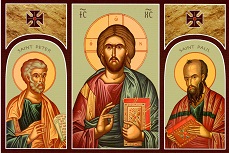
Four kinds of sinners

Sermon for Holy Tuesday

+  Luke 22:1-23:56  +

We’re presented with four kinds of sinners in the Passion History.

We have Peter, the devout disciple of Jesus, who fell away for a time, but then repented. Peter denied his Lord three times, and that, after Jesus warned him that he would and after Peter himself swore to Jesus, Lord, I am ready to go with You, both to prison and to death. Even if all the rest deny You, I never will. No doubt Peter was sincere when he spoke those words. But he spoke them out of pride—pride in his own ability to sustain his own faith—and pride went before the fall. When the moment of truth came, when the three moments of truth came, each time Peter turned away from Christ to save his own neck.

But then the rooster crowed and the Lord Jesus turned and looked right at Peter, and the words Jesus had spoken came back and pierced his soul like a knife. Confronted with the terrible reality of what he had done, Peter acknowledged his sin; he repented. Repentance includes both sorrow over sin and faith in Christ, who bore that sin on the cross. Peter went and wept bitterly over his sin. “What have I done?!?” But to that godly sorrow, faith was added, so that Peter turned again to Christ in his heart—to Christ who doesn’t save the deserving, but the undeserving. And so Peter was restored and forgiven.

Then we have Judas, the hypocrite who died in impenitence. Even before his betrayal, even before he chose to sell his Lord for thirty pieces of silver, Judas had become an impenitent thief, helping himself to the treasury of offerings people had given to Jesus. He was so angry at Jesus’ kindness, like His kindness shown to Mary when she anointed Him with that costly perfume, so angry and so greedy, that he sold Jesus to the highest bidder and betrayed the Son of Man with a kiss of phony friendship.

Luke doesn’t mention it, but the other Evangelists do: Judas was driven to remorse after he saw that his actions had led to Jesus’ death sentence. Apparently he thought it wouldn’t come to that. He was sorrowful over having betrayed innocent blood. But that wasn’t yet repentance, because he put no faith in that blood to cover his sins. He despaired of God’s mercy and imagined his sins to be more powerful, more important, more valuable than the blood of Christ. So he hanged himself and was condemned to hell.

Then we have the thieves on the cross, impenitent unbelievers at first, one of whom remained impenitent until he died, the other of whom repented on his “death bed,” as it were. They were both criminals. One of them, now facing imminent death for his trespasses, still wanted nothing to do with Jesus. He would rather go to hell than rely on the blood of Christ. But the other—the other sees the guiltless Lamb of God, or as the sign above His head read, “Jesus of Nazareth, the King of the Jews,” and he believes and seeks pity and pardon from that King. And he receives it! He finally enters into Christ’s kingdom, even there on the cross, and has Paradise promised to him before the day’s end.

Four men, all sinners from birth. Four men, none of whom deserved anything from God but condemnation. One, a devout believer who stumbled severely, but repented and was received back again. One, a hypocrite who finally recognized his sin of betrayal but still didn’t look to Christ for forgiveness. One, a thief who never acknowledged his sin nor believed in Jesus. One, a thief who finally did acknowledge his sin and believed in Jesus.

Two of these men—Peter and the one thief—were eternally saved. The other two were eternally condemned. What was the difference? Was it the desire of God that two of the four be damned? No, for God says, I have no pleasure in the death of the wicked, but that the wicked turn from his way and live. What was the difference? Was it that Christ didn’t do enough to make up for the sins of the two men? No, He Himself is the propitiation for our sins, and not for ours only but also for the whole world. What, then, was the difference? The difference was that Peter and the one thief were brought by the Holy Spirit to repentance, while Judas and the other thief resisted the working of the Holy Spirit, pointing them to Christ as their Savior. Two were saved by faith. Two were condemned in unbelief.

Who in the world isn’t like one of those four men? The believer who stumbles, the hypocrite who pretends to be a Christian but doesn’t believe, the heathen who is never converted and the heathen who finally is. Notice what we don’t have in the whole Passion History: the believer who never stumbles, the disciple who commits no sin. There is a lesson for us in this, and St. John summarizes it well in his first epistle: If we say that we have no sin, we deceive ourselves, and the truth is not in us. If we confess our sins, He is faithful and just to forgive us our sins and to cleanse us from all unrighteousness. Always know that God earnestly desires your repentance, not your death. And see in the Passion History how Jesus never, ever turned away the one who looked to Him for mercy, but, for the sake of His own suffering and death, always forgave and always restored. And He always will. Amen.


Posted in Sermons | Tagged | Comments Off on Four kinds of sinners

Father, Thy will be done

Sermon for Holy Monday

+  Mark 14:1-15:47  +

Let’s focus for a moment this evening on Jesus’ prayer in the Garden of Gethsemane. As Jesus told His disciples there in the Garden, My soul is exceedingly sorrowful, even to death. All alone the Son of God would bear the sins of the world. Before He does it, before He can do it, there’s something He must do: He has to pray. He prays: Abba, Father. “Abba” is just “Father” in Aramaic, the first language spoken by Jews at that time. St. Mark otherwise wrote in Greek, but here is this little Aramaic word thrown in to give us a vivid glimpse of Gethsemane, the first word that poured from Jesus’ lips, straight from the heart, in the agony of His soul. “Abba.” Father. No matter how painful the cross, no matter how difficult was the task before Him, Jesus knew that nothing could happen that was outside of the will and permission of His Father, who had declared twice that He was well-pleased with His beloved Son. So Jesus knows His prayer will be heard and will be pleasing to His Father, because it is uttered in faith. Abba, Father.

St. Paul writes to the Roman Christians, You received the Spirit of adoption by whom we cry out, “Abba, Father.” The Spirit of Jesus who lives in you enables you to pray just like Jesus, because you have been clothed with Him in Holy Baptism. So turn to your Father! Don’t neglect this beautiful gift called prayer! Jesus, the very Son of God, couldn’t go on, couldn’t face the cross without it. Don’t imagine for a moment that you can.

All things are possible for You, Jesus prayed. That’s at the heart of every prayer, or it should be: that God has the power to do anything, from small to big, from simple to miraculous. It’s possible for God to make the sun stand still in the sky. Or to cause the storm to be stilled, or to make the dead rise. Surely it was possible for God the Father to thwart the betrayal of Judas and the plans of the murderous Jews. Surely He could save His Son from condemnation and from crucifixion and from death.

Take this cup away from Me. This cup, this course upon which Jesus had been placed by His Father, was, of course, the very reason why Jesus had taken on human flesh in the first place. This course of betrayal, condemnation, crucifixion and death had been laid out for the Son of God since before the foundations of the world were laid. The Scriptures had to be fulfilled, and Jesus knew it. Indeed, Jesus had just a short time ago blessed the cup of the New Testament in His blood, which He had already given to His disciples to drink. He knew this cup was already poured out for Him. And yet still He prays, “Take it away from Me.”

Jesus earnestly prayed, “Take this cup away from Me.” But He just as earnestly added: Nevertheless, not what I will, but what You will. Jesus wouldn’t put the cup down without His Father’s permission. See, there are levels of willing or wanting. You may want, on some level, to be at home right now resting or getting housework done. But more than that, you wanted to come here to hear the Word of Christ. So, too, Jesus wanted to avoid the cross. But more than that, He wanted to do His Father’s will, to obey His Father, to serve His Father, and in the process, to serve us.

In the same way, the Father didn’t want His Son to suffer. But even more than that, He didn’t want us sinners to suffer eternally for our sins. He preferred our eternal salvation to saving Jesus from the cross. And so St. Paul can write: He who did not spare His own Son, but delivered Him up for us all, how shall He not with Him also freely give us all things? Who shall bring a charge against God’s elect? It is God who justifies. Who is he who condemns? Because Jesus yielded to His Father’s will in the Garden of Gethsemane, the answer to that question is, No one! Amen.

Posted in Sermons | Tagged | Comments Off on Father, Thy will be done

Consider the King and rejoice

Sermon (audio)
Download Sermon

Service(video)
[vimeo https://vimeo.com/330359823 w=540&h=360]
Download Service Download Bulletin

Sermon for Palm Sunday

Matthew 21:1-9  +  Philippians 2:5-11  +  Matthew 26:1-27:66

You’ve already heard a better sermon this morning than any pastor could ever preach, so instead of a sermon, let me simply encourage you: Consider the Passover that brought Jesus to Jerusalem one last time in humility. Consider Jesus, the true Passover Lamb, who went uncomplaining forth, in obedience to His Father’s will, to bear the sins of all, that His blood might mark the door of our hearts and keep us safe from everlasting death. Consider the upper room and the Garden of Gethsemane. Consider the denials, the desertion, and the betrayals of Jesus’ closest friends—men whom we still revere as men of God and apostles, except for Judas, who didn’t repent. Consider the trials of Jesus before the Jewish Sanhedrin and the Roman court. Consider His floggings, the purple robe, the crown of thorns, the mockery and abuse He endured. Consider the hatred He received at the hands of those He came to save. Consider Jesus’ crucifixion, death and burial.

And then, then go back again and consider how we began our service today. Consider the palm branches, and the donkey, and the King who sat upon it. Consider how great was His love for sinners, on display in His determination to ride into Jerusalem with the foreknowledge of all that would happen during that Holy Week. Consider the words of the prophet Zechariah, Rejoice greatly, O daughter of Zion! Shout, O daughter of Jerusalem! Behold, your King is coming to you; He is just and having salvation, lowly and riding on a donkey.

Let the world hate Jesus, if they want to. Let the world hate Christians. But you, Rejoice, O daughter of Zion! Rejoice, O Church of God! This is your King! This is your Shepherd and how desperately He seeks the lost! His suffering and death were not in vain, because here we are, still singing our Hosannas to the One who has rescued us from sin and from the power of death. Rejoice in Him, and pray that His Holy Spirit will build and fortify your faith this week as you hear His Word and receive the Sacrament by which you proclaim His death until He comes. Amen.


Posted in Sermons | Tagged , , , | Comments Off on Consider the King and rejoice

Vindication for Jesus and His people

Sermon (audio)
Download Sermon

Service(video)
[vimeo https://vimeo.com/328975435 w=540&h=360]
Download Service Download Bulletin

Sermon for Judica – Lent 5

Genesis 12:1-3  +  Hebrews 9:11-15  +  John 8:46-59

If a sinless man were to walk the earth, helping everyone who came to him for help, doing everything right, showing perfect love at all times, toward God and man…If that sinless man were to speak nothing but the truth, according to God’s holy word, always with the best of intentions and motives…If that sinless man were the wisest man who had ever lived and freely shared his wisdom, his knowledge, and all his gifts…If that sinless man were God Himself, come in the flesh…How do you think the world would receive such a man? That’s not a hard question to answer, is it?, because that Man did walk the earth about 2,000 years ago. And the world hated Him, call Him evil, and crucified Him. Because the world, as Jesus reveals in the Gospel and in the verses leading up to it, does not love God, does not fear God, does not hear God. The world is not on God’s side. It’s on the devil’s side.

Jesus drives home that point with His question to the Jews in the Gospel. Which of you convicts Me of sin? And if I tell the truth, why do you not believe Me? No one could convict Jesus of sin. No one could show from Scripture where He had made a single mistake, in word or deed. He was the sinless One. He was the truth-Teller. But they couldn’t handle the truth.

He told the truth about the requirements of God’s Law, centering on love and mercy. But it wasn’t the world’s kind of “love” where you encourage people in their bad behavior. It was the kind of love that loved God first, that acknowledged God’s creation, God’s design, and God’s commandments to be the perfection of love. It was the kind of love that told people who didn’t already acknowledge it that they were sinners who deserved death. But when people acknowledged their sin, He loved them by showing them mercy, by telling them how He, the eternal Son of God, had been sent by His Father into the world to save sinners. He offered them salvation for free, through faith in Him, and forgiveness to all who believed.

But most didn’t believe. They had dug in their heels in the devil’s kingdom and preferred to remain there.

He who is of God hears God’s words; therefore you do not hear, because you are not of God. This is what we heard St. John repeat in his Epistle on Wednesday evening. How can people be so twisted? How can they reject plain truth and common sense and all the miracles Jesus did on top of it? Because they were not of God. They were of the devil. And the devil lies. The devil deceives. The devil convinces his children that up is down and down is up, that good is evil and evil good.

But the devil’s children are famous for pretending to be God’s children, even as they pretend that God’s children are the devil’s children. Do we not say rightly that You are a Samaritan and have a demon? We’re the good people, and You disagree with us. Therefore, you must be a Samaritan—a heretic, basically. You must be a monster. You must be evil. We’re the real “Christ-like” people, Jesus. Not you. Ironic, isn’t it?

I do not have a demon; but I honor My Father, and you dishonor Me. And I do not seek My own glory; there is One who seeks and judges. Most assuredly, I say to you, if anyone keeps My word he shall never see death. Jesus isn’t the One working with the demons. It was those who rejected Him. And He warns them of the coming judgment. You won’t always be allowed to get away with mocking Jesus and dishonoring Jesus and opposing Jesus. For now, God doesn’t strike anyone down with lightning for such blasphemy. For now, the world is allowed to hate Jesus and His followers, because the world’s hatred of Jesus means He dies. And because He dies, He pays for the world’s sins and stands as the world’s Redeemer. And because He postpones His day of judgment—which means His people will be mistreated for a while longer—the Gospel is able to continue to be preached in the world, and more people will be rescued by it out of the devil’s kingdom. But the day will come when all who have opposed Jesus and His people will be struck down, not with lightning, but with everlasting fire, if they will not repent.

At the same time, even death can’t harm the one who keeps Jesus’ word. “He shall never see death.” The world’s opposition and the devil’s rage can’t do any permanent harm to believers in Jesus. Because the devil and the world may kill, but they can’t drag anyone to hell against the will of Jesus. And He wills that the one who believes in Him should be taken safely through death into His heavenly kingdom.

The Jews couldn’t stand that Jesus was saying such things, promising to keep people’s souls safe from death and to give eternal life. The greatest men who had ever lived—Abraham and the prophets—couldn’t escape death. So, to them, it was ridiculous that Jesus should promise such a thing. But at the end of our Gospel, He reveals why He has the power to make such promises: Most assuredly, I say to you, before Abraham was, I AM. Jesus wasn’t just the greatest man to ever live. He was and is and ever shall be the eternal God who called Abraham, who created the world, who will judge the world on the Last Day, who holds the power of life and death, who condemns to hell and who justifies to eternal life.

This claim on Jesus’ part made the world hate Him all the more. But it’s the very reason why we dare to put our faith in Him, because His word has convinced us that He’s telling the truth. And so we know that, no matter how much the world may hate us or how much we may yet suffer in the world, Jesus, the eternal God, will be there on the other side of death, to “vindicate” us.

That’s the name for this Sunday before Palm Sunday: Judica, “Judge me! Vindicate me, O God!” Prove me right and grant me justice against those who oppose me unjustly. That was the Messiah’ own prayer in Psalm 43. And just as God the Father vindicated His Son on Easter Sunday, so He will vindicate all those who trust in Christ Jesus on the day of His appearing. Amen.

Posted in Sermons | Tagged , , , | Comments Off on Vindication for Jesus and His people

Rejoice in the Bread that God gives

Sermon (audio)
Download Sermon

Service(video)
[vimeo https://vimeo.com/327597229 w=540&h=360]
Download Service Download Bulletin

Sermon for Laetare – Lent 4

Isaiah 49:8-13  +  Galatians 4:21-31  +  John 6:1-15

We have this little oasis set before us today on Laetare Sunday as we draw closer to Holy Week. Rejoice with Jerusalem and be glad for her, all you who love her! That isn’t talking about the capital city of Jerusalem anymore—the city in the nation of Israel. As you heard the Apostle Paul say in the Epistle today, the earthly city of Jerusalem is in bondage, like a slave woman, because for the most part its children, its inhabitants, are still under the terrible demands of God’s Law, still under wrath, still condemned by God for their sins. Whereas the Jerusalem that is from above is the Christian Church, in heaven and on earth, whose children, whose inhabitants trust in the promise of free remission of sins and grace for the sake of Christ Jesus. It’s for her peace that we pray. It’s with her that we rejoice. Rejoice with her and be glad, because Christ Jesus, the Bread of Life, the true Bread that comes down from heaven, dwells in the midst of her; because by faith in Christ we are children of that holy city, and we have every reason to rejoice in the mercy and love of Jesus, our heavenly Bread.

We see His mercy and love on display in our Gospel. He receives nothing from the multitudes but gives everything—tirelessly, lovingly and miraculously. He feeds His people with bread, and He promises far greater things, too, greater blessings and better bread, for those who want it from Him.

Thousands of people had followed Jesus, a good long walk away from the towns and villages of Galilee. 5,000 men, plus women and children. And right away we say, thousands?!? Where are the thousands today? We can’t even fill a small room with people who want to hear the word of Jesus! It’s true. But remember what happened the very next day after our text takes place. Jesus very directly spoke God’s Word to the thousands whom He had fed, presenting Himself as the true and only Savior sent from heaven. And what happened? John tells us, From that time many of His disciples went back and walked with Him no more. They were done with Jesus when His message didn’t fit what they wanted to hear. It got so bad, with so many people walking away, that Jesus asked His twelve apostles, Do you also want to go away?  But Simon Peter answered Him, “Lord, to whom shall we go? You have the words of eternal life. And we have come to believe and know that You are the Christ, the Son of the living God.” Let that be your response, too, even if we’re only a handful of people.

The thousands in Israel had seen many of Jesus’ miracles and wanted to see more. Many of them were also interested in His words and teaching, at least for a while. And after feeding them all day long with His words, Jesus Himself is the first one to think about their need to eat, their physical need for bread. Jesus was the first one to care and be concerned about them, before any of His disciples gave it a thought, before the multitudes themselves even noticed.

This is the kind of God you have—not a God who sits around in heaven minding His own business until you nag Him with your prayers and requests and needs. Jesus reveals to us a God who knows what you need even before you do and is thinking about it and planning for it without any worry or anxiety required on your part, even without our prayer.

But Jesus wants to test and teach His disciples at the same time. He wants to teach them not to doubt in the midst of scarcity and want, but to trust in Him and look to Him for help. He asks Philip, “Where shall we buy bread, that these may eat?” Now, what would have been the best possible answer? The best possible answer would have sounded like the Apostle John in Revelation when an angel asked him a question. John’s response, “Sir, you know.” Philip might have answered that way. “Lord, you know how best to provide for these people.” Or, “Lord, there is nowhere to buy bread for so many, but that’s no obstacle to You.” Instead, Philip relied too much on his human reason and concluded that it was impossible to feed so many.

Andrew looked for the best option he could find, which wasn’t much—a boy with five loaves of bread and two fish. “But what are they among so many?” Kind of a childish question when you’re talking to the very Son of God.

The Holy Spirit has recorded these words for us to highlight the imperfections in Jesus’ own apostles, because you’re bound to find the same imperfections in your faith, too. Jesus doesn’t cast them away, does He? He doesn’t even answer them harshly. He teaches them that they’re foolish not to trust Him by giving them yet another reason to trust Him. This is how He exercises their faith, and He does the same thing for us.

You’d think that by now we would have learned to trust Him in every need, in every trial and affliction. But in our weakness, which is further fanned into flame by the demons, we stumble and somehow start to think that Jesus just might prove less reliable this time. He won’t. Watch Jesus again. Watch Him take those five loaves of bread and two fish and turn them into thousands of loaves and thousands of fish, without breaking a sweat. Jesus feeds His people with bread until they’ve eaten and are satisfied, and there’s still bread left over.

When the 5,000 men saw this miracle, they did come to the right conclusion. “This is truly the Prophet who is to come into the world.” They were right about that, not only because they saw this great miracle, but because this miracle coincided with Old Testament prophecies like you heard today from Isaiah 49, “In an acceptable time I have heard You, And in the day of salvation I have helped You; “They shall feed along the roads, And their pastures shall be on all desolate heights. They shall neither hunger nor thirst, Neither heat nor sun shall strike them; For He who has mercy on them will lead them, Even by the springs of water He will guide them.”

Jesus is more than a miracle-worker. He is the promised Christ. The whole history of the world from the creation until that moment was pointing to Him, was taking place for the sake of Him and this coming in the flesh. The tragedy is that those very people who saw Him and ate His bread and heard His words stopped right there. They stopped at recognizing Him as the Prophet, or as the Christ-who-gives-us-free-bread. To them, the “day of salvation” meant not having to go home hungry that day, which is why they wanted to take Jesus and force Him to be their earthly king. But God intended so much more!

Because those people needed so much more. You need so much more. You need more than a Christ who provides temporary fixes to your broken lives. You need more than a Christ who makes this world a better place. You need more than a church that will simply tell you what you want to hear. You need so much more than a handout of bread.

What you need is the truth. What you need is for someone to come and provide to God the righteousness and obedience that His holy law requires, because you haven’t provided it. What you need is for someone else to be punished for your faithlessness and rebellion and sin, and to suffer God’s wrath so that you don’t have to. What you really need is bread for the soul, a constant supply of the forgiveness of sins, a shepherd, a guide, a God, a Savior.

Now hear again the words of Isaiah: “In an acceptable time I have heard You, And in the day of salvation I have helped You.” The Apostle Paul writes, “Now is the acceptable time; now is the day of salvation!” Not just there on that mountainside where Jesus provided a meal to those 5,000 people, but now, now as you hear the Word of Jesus Christ, the Son of God, the Son of Man, who provided righteousness where all you provided was sin, and who suffered for your sins so that you might be saved. Now, as you hear the truth proclaimed in this humble place, in this humble gathering. Now is the day of salvation.

Now Jesus provides other bread, a better meal—one that will sustain, not just your bodies, but also your souls; one that will grant you, not just a release from hunger, but a release from sin. It’s offered only to the hungry, to those who hunger and thirst for righteousness and who look to have their hunger filled by Christ alone.

Did you notice the similarities between John’s language in our Gospel and the language of the Lord’s Supper? And Jesus took the loaves, and when He had given thanks He distributed them to the disciples, and the disciples to those sitting down. And suddenly, that which was impossible—for five loaves of bread to feed 5,000 people—was made possible by the Word of Christ.

So it is, too, that this meal foreshadows the Meal you are given to eat and to drink in the Sacrament of the Altar, where Jesus does the impossible and gives His body with the bread and His blood with the wine—enough to give eternal life to all who eat and drink, from the time of the first Lord’s Supper until the day of His return.

This is your bread, O children of Jerusalem. This is your time to be fed by Jesus, who is the very Bread of Life. Jesus feeds His people with bread. Jesus feeds His people with Himself. And since He is the Righteous One, since He is the Son of God, since He is the death of sin and the Lord of Life, when He gives Himself to you, you take into yourself all that He is. And you have every reason to rejoice. Amen.

Posted in Sermons | Tagged , , , | Comments Off on Rejoice in the Bread that God gives