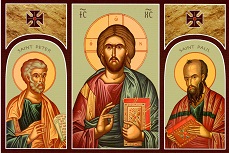
Joined to the Seed of Abraham through Circumcision

Sermon for the Feast of the Circumcision of Our Lord

Galatians 3:23-29  +  Luke 2:21

Merry 8th Day of Christmas, the day on which the little baby boy born to Mary was first injured, according to the Law of Moses, and the day on which He officially received His name: Jesus, which means, “Savior.” The injury He received was minor, of course—a ring of skin removed from a sensitive part of his little body. And the reference to His circumcision? One little verse in the Bible, the shortest Gospel text of the whole year. But the significance of Christ’s circumcision cannot be exaggerated. Because without it, He wouldn’t deserve the name He was given. Without it, no matter how much He would later suffer, no matter that He would die on a cross. Without His circumcision, He could not have been mankind’s Savior. So let’s consider this event that seems so trivial, but isn’t.

Our Bibles are neatly divided into the Old Testament and the New Testament. What was the Old Testament? It was God’s covenant or binding agreement, made with Abraham and his Seed, to be their God and to give them an everlasting inheritance. The sign of the covenant, the Sacrament of the Old Testament that a brought a person into the contract and made him an heir of the promises contained therein, was the act of circumcision. Obviously it only applied to the boys; as for the girls, the women, they were included in the Testament by their national connection to the male offspring of Abraham. And right away we may ask, why didn’t God devise a different sign or Sacrament so that the girls could be directly included, too? The answer is simple: the sign of circumcision was intended, first and foremost, to point every descendant of Abraham to a very special male descendant of his: to Jesus, the Christ.

Since the Christ was the promised Seed of Abraham, His circumcision was the one that truly mattered. Every other circumcision of every other little boy in Israel tied the little boy to the coming Christ. Every other descendant of Abraham, male and female, was only included in the Old Testament through their connection to the coming Christ.

But, as the Apostle Paul points out, that connection cannot be only physical and outward. It has to also be spiritual and inward. It has to include faith. A circumcised Israelite might as well have been uncircumcised if he didn’t believe in the promised Messiah alone to be able to stand before God as righteous. The physical offspring of Abraham who didn’t flee in faith to God’s promised Messiah weren’t actually the offspring of Abraham at all. The true Seed of Abraham is Christ Jesus and those who have faith in Christ Jesus.

The faith-connection to Christ Jesus no longer involves an outward circumcision. That sign was fulfilled when Jesus was circumcised and when He instituted the New Testament in His blood. But the faith-connection to Christ Jesus does include its own powerful sign and Sacrament: the sign of Holy Baptism. As Paul wrote in today’s Epistle, you are all sons of God through faith in Christ Jesus. For as many of you as were baptized into Christ have put on Christ. There is neither Jew nor Greek, there is neither slave nor free, there is neither male nor female; for you are all one in Christ Jesus. And if you are Christ’s, then you are Abraham’s seed, and heirs according to the promise.

Baptism makes each one of us, whether Jew or Gentile, male or female, a “son” of God. That is, it is God’s binding agreement with you to view you, to count you, and to treat you as His own Son, Jesus Christ. That means He views you with favor, because Jesus, as the Son of Man, earned His favor. He counts you righteous, because Jesus was righteous. He counts you as having paid for all your sins, because Jesus did pay for all your sins with His innocent suffering and death. He counts you as an heir of eternal life, because Jesus is the Heir of eternal life and of all things. He treats you as His own dear child, because Jesus is His own dear Child. Baptism, combined with faith, has brought you into Christ Jesus and clothed you with Him, as with a garment.

And so we celebrate this day, this feast of the Circumcision of Our Lord. Because the circumcision of the baby who was aptly named “Savior” enabled Him to inherit the promises made to Abraham, and then, in turn, to award that same inheritance to all who are circumcised in the better Sacrament of Holy Baptism. As Paul writes to the Colossians, In Him you were also circumcised with the circumcision made without hands, by putting off the body of the sins of the flesh, by the circumcision of Christ, buried with Him in baptism, in which you also were raised with Him through faith in the working of God, who raised Him from the dead. And you, being dead in your trespasses and the uncircumcision of your flesh, He has made alive together with Him, having forgiven you all trespasses, having wiped out the handwriting of requirements that was against us, which was contrary to us. And He has taken it out of the way, having nailed it to the cross.

Remember Jesus’ circumcision today, and also remember your own! And give thanks to the Lord for enduring this first bit of pain, so that you might be included in the salvation accomplished by the One named Jesus. Amen.


Posted in Sermons | Tagged , , | Comments Off on Joined to the Seed of Abraham through Circumcision

Christmas is also for the elderly

Sermon (audio)
Download Sermon

Service(video)
[vimeo https://vimeo.com/308815923 w=540&h=360]
Download Service Download Bulletin

Sermon for the Sunday after Christmas

Galatians 4:1-7  +  Luke 2:33-40

As we’ve been saying this week, the Christmas story is for everyone, right? Young and old, boys and girls, rich and poor—in the sense that Christ was, as Paul wrote in the Epistle, born of a woman—just like everyone, born under the Law, to redeem those who were under the Law—that is, everyone, both Jews who were under the Law of Moses and Gentiles who were under the moral Law since the beginning of creation, for everyone must answer to God for his every thought, word and deed, that we—that everyone!—might receive the adoption of sons. Believers recognize this and rejoice in it and have received the adoption of sons. Unbelievers still must be told, that they may come into the light of Christ by faith and be saved—a salvation which, as we said, is for everyone.

Children often receive the focus at Christmas, and that’s reasonable. The Savior of all became a little Child, reminding us that childhood is something good; He wants the little children to come to Him, to Him who was once a little child, just as they are, who had to grow up and increase in wisdom and stature, just as they do.

But if Christmas focuses on children, then the Sunday after Christmas focuses on the elderly. In our Gospel, we encounter two elderly believers who were born under the Law of Moses and were still, even at an old age, eagerly awaiting the promised liberation from the Law and the redemption that the Christ would bring. What do we learn from the elderly believers in today’s Gospel? What good can elderly Christians do?

First, we meet Simeon in the Temple, 40 days after the birth of Christ. Old Simeon had been “waiting for the Consolation of Israel,” Luke tells us, and was informed somehow by the Holy Spirit that he would see the Christ before he died—God’s gracious reward to him for a long life of faithful service. When Joseph, Mary, and Jesus entered the Temple that day, Simeon knew who Jesus was and rejoiced at seeing him, prompting him to speak the words which we know as the Song of Simeon, that is, the Nunc Dimittis, where Simeon gave thanks to God and told Him, I’m ready to go now, ready to depart in peace, because the Lord had fulfilled His Word. He had allowed Simeon to see the promised Messiah, the Savior sent from God for all people, the Light that would bring revelation to the Gentiles and glory to the people of Israel.

Then our Gospel begins. It says that Joseph and His mother marveled at those things which were spoken of Him. You know that song, Mary, did you know…? It recounts several of the miracles Jesus would one day perform and the saving work He would do. Some people get a little bent out of shape about the premise of it. Of course Mary knew!, they scream. How dare you ask?!? Well, she knew where Jesus came from; she knew that He was the promised Savior and she knew certain Old Testament prophecies about Him. But she didn’t know everything He would ever do, and she certainly didn’t comprehend all at once the mystery of the eternal Word lying in her arms or just how far-reaching the implications were of this Child’s birth. So, yes, she marveled, together with Joseph, at the words Simeon spoke, because that elderly believer revealed to her something she didn’t know, or at least, didn’t fully comprehend.

And then Simeon went on to speak: He blessed them, and said to Mary His mother, “Behold, this Child is destined for the fall and rising of many in Israel, and for a sign which will be spoken against (yes, a sword will pierce through your own soul also), that the thoughts of many hearts may be revealed.”

Destined for the fall and rising of many in Israel. Christ was, as the Prophet Isaiah had said, a sanctuary for some—a hiding place, a place of refuge. But also a stone of stumbling and a rock of offense to both the houses of Israel, as a trap and a snare to the inhabitants of Jerusalem. And many among them shall stumble; they shall fall and be broken, be snared and taken. Many would stumble over Jesus’ claim to be the world’s only Savior, His claim to be able to forgive sins, His claim to be sent from God and to be God. They would stumble over His humility and over His suffering and over His refusal to set up an earthly kingdom. They would stumble over the cross, because, they thought, the true Messiah would never let Himself be rejected and condemned and crucified.

But the reality is that the true Messiah came for the very purpose of being rejected, condemned, and crucified, as the Lamb of God who would pay for the world’s sins. Those who stumbled over Him fell into everlasting death. But those who found a sanctuary in Him from God’s wrath and from the righteous condemnation of the Law—they rose up to the adoption of sons and to inherit everlasting life. All of that lay in the future of the little baby lying in Simeon’s arms.

Destined for a sign which will be spoken against, that the thoughts of many hearts may be revealed. No mother wants to consider that her little baby will one day be hated, mocked, ridiculed, and slandered to his face or behind his back. But Simeon informed Mary that all such things were in the future for her little baby, and it’s still going on to this day. Here stands Christ in His Word, condemning adultery and sin in all its forms, speaking against it and condemning it and calling people to repentance, to faith, to a life of purity and chastity. But they continue to speak against Him, and so the thoughts of their hearts are revealed; they are the devil’s children.

Finally, Simeon warned Mary, a sword will pierce through your own soul, too. What pierces through a mother’s soul more sharply than when her dear child suffers, or worse yet, is tortured and killed? As Mary sat there at the foot of Jesus’ cross, together with the Apostle John, one wonders if she thought of Simeon at that moment and of his terrible prophecy. What was the point of it? Well, it prepared Mary for the kind of life her Son would lead. What’s more, it was God being utterly truthful and up-front with her, as He has also been with us, that believing in Him and following Him will not mean a peaceful, comfortable life on earth, for you or for your children, but a life of being hated by the world, even as Christ was hated, and a life of bearing the cross in His name.

All that was taught to Mary and Joseph and to us by the elderly believer Simeon.

Then in our Gospel we meet Anna, a prophetess, and apparently a well-known one. She was an old woman—either an 84-year-old widow or a roughly 105-year-old woman who had been a widow for 84 years (it’s hard to tell from the description of her in the text). The point is, she was very old and had been a widow for a very long time. For seven years of her young life she had lived as a dutiful wife, probably into her early twenties. But from her early twenties on, she spent her life, not chasing after men, not dwelling on her loneliness, not engaging in worldly activities, but serving God with fastings and prayers night and day. (Sounds nothing at all like what young ladies are expected to do today, does it?) At some point she had become a prophetess, chosen by God to reveal God’s Word to Israel, apparently right there in the Temple, telling people that the Christ was coming soon.

Then she, too, was rewarded for her many decades of faithful service to the Lord. The baby who is God arrives at the Temple to meet her. She gave thanks to the Lord, and then she spoke of the Child to all those who looked for redemption in Jerusalem. She was like the shepherds that way, wasn’t she? Remember, they made widely known the saying which was told them concerning this Child. They, to their acquaintances, and Anna to hers. And she surely had many after six to eight decades of serving the Lord in the Temple night and day. Her acquaintances were likely the faithful visitors of the Temple, where she spent so much of her time. All those decades—imagine the people she knew, the regular attendees at the sacrifices, the ones who had believed the Lord’s promises. To them she was now able to say, “Christ, the promised Redeemer, has been born! His name is Jesus!”

What do we learn from Simeon and Anna, these two elderly believers who were among the very first people whom we might call “Christians”? In addition to the things they revealed to us about Christ Himself, we learn how to live a long life of faithfulness, of devotion, of learning and clinging to God’s Word and trusting in His promises; a long life of waiting for the Christ to be revealed, never giving up hope, never abandoning God’s service, even if the world around us has abandoned it. We learn to keep praying and attending the Divine Service, not as an occasional practice, but as a lifelong, regular behavior. We learn to speak the Word of Christ to the people we know. And we learn to give thanks to God for revealing His salvation to us in Christ, whether early or late in life.

The service of these elderly saints has been preserved for us in the Holy Scriptures, that we might learn both from their words and from their examples. Christ was born for everyone, and if you continue to use the Means of Grace that He has provided so that you may know Him and have your faith in Him divinely sustained, then you, too, will be rewarded for your life of faithful service in God’s house. You’ll get to meet Jesus one day, not in terror as the rest of the world, but in thankfulness and joy, like Simeon and Anna. Amen.

Posted in Sermons | Tagged , , , | Comments Off on Christmas is also for the elderly

The faithful response to the Christmas story

Sermon for Christmas Day

Titus 3:4-7  +  Luke 2:15-20

Last night we talked about the Christmas story and how it’s for everyone. Many still haven’t heard it—at least, not told in a serious, factual kind of way. Others have heard it and still don’t believe it. But in our short Gospel this morning, we see the intended outcome God has for the telling of this story. We see in the shepherds of Bethlehem just what a faithful response looks like to hearing the story of the birth of Christ.

When the angels had gone away from them into heaven, the shepherds said to one another, “Let us now go to Bethlehem and see this thing that has come to pass, which the Lord has made known to us.”

Let’s go to Bethlehem! Why? Because they believed the angel’s word, that a Savior had been born to them, who is Christ the Lord. Faith itself was the first outcome of hearing the message. Notice they didn’t say, “Let’s go see if what the angel said is true!” No, they said, “Let’s go see this thing that has come to pass!” That’s the power of God’s Word.

Let’s go to Bethlehem! The first fruit and evidence of the shepherds’ faith was their desire to go see the Christ where He was. Let’s go!, they said. What would have happened if the shepherds had done what so many people are doing this morning? Many have heard that this day is about the birth of God’s Son. But they are content to have heard about it without going to see Him and to hear Him where He is, namely, in His holy Church, where two or three are gathered together in His name, where He holds out His forgiveness, His comfort, the whole reason for His birth, where He holds out the same body and blood here and now which were once laid in the manger. What if the shepherds had just stayed out in their fields? Surely you would say, they must not have believed the angel’s word. How could you take an opportunity, an invitation, to go to the place where your Savior is and turn it down?

Is it that we no longer believe that Jesus is present in His Church? Have we become convinced by the non-sacramental sects around us that Jesus is found elsewhere than in His Word and Sacraments? Or is it that we have grown tired of the presence of Christ? “He’ll be there again on Sunday. There’s no need to go see Him today.”

No, it isn’t enough to be told that there is a Savior who has come to the world to help you if you fail to go to where He is. But understand, going doesn’t make you good. You go because you know you’re not good. You go because here is the One who is good! And He’s taken on human flesh for the very purpose of being good for you. Let the shepherds’ reaction to the angel’s word kindle in us repentance for taking the Lord’s presence in His Church for granted. Let the shepherds’ reaction to the angel’s word move us to go to Christ for His forgiveness.

Let’s go to Bethlehem!, the shepherds said. And then, they actually went, and found the Babe, together with Mary and Joseph, just as the angel had said. The Word of the Lord was confirmed. The Savior is real. He’s not some spiritual or religious idea or ideal. He was really lying there, literally, lying in a manger, the eternal Word of God who was in the beginning with God and who was God, through whom all things were made. He was really lying there with flesh and blood and bones. He was precious as all newborn babies are. But this one was different—this one chose to be born. This one manufactured His own birth. This one is at once an hours-old baby and the eternal Creator-God.

As John writes in his Gospel, the Word became flesh and made His dwelling among us. What does that show? It shows us God’s great love for sinners. Because the only way for us, who have rebelled against Him, to be brought back into His family was for Him to become one of us, to be righteous in our place, to suffer and die in our place, so that He might reconcile us to His Father, make Him our Father by blessed adoption, and so make us true His true brothers.

After the shepherds found everything just as they had been told, They made widely known the saying which was told them concerning this Child. Another beautiful example for us. No one was standing there with a sword to their heads or with a threat, “You’d better get out there and tell people about Jesus!” No, the birth of this Child—and the fact that it had been mercifully and undeservedly revealed to them for their salvation—was all it took. They were now willing messengers to the people in their own lives. Not preachers sent to preach. But witnesses passing on vital information to their neighbors, as we discussed last night. Their message was very simple. Here’s what happened out in the fields. Here’s what the angel said. Here’s what we found in Bethlehem. That’s all. And that’s all there is for you to do most of the time. Tell people who no longer know the story of Christmas, here’s what it’s all about. Here’s what happened. Here’s what the angel said. Here’s what we’ve found in Jesus.

And the people whom the shepherds told marveled at what the shepherds said. Now, marveling doesn’t necessarily mean believing. For some, it may have been a, Wow, you all are crazy! For others, it may have been a, Wow, I wonder if it’s true. For still others, though, Wow, what a great gift God has given us! Praise be to God! There will be similar reactions today.

Mary, for her part, kept all these things (literally, these sayings) and pondered them in her heart. Mary, too, shows us the faithful response to the Christmas story. She may not have understood the significance of all that had happened, nor did she know everything that would happen. But she kept these things. She mulled them over. She thought about them and pondered them. That’s why we’ve come here this morning, because you can never ponder enough the gift that God gave to the world with the birth of His Son.

The shepherds returned to their flocks, finally, glorifying and praising God, both for the fact of Christ’s birth, in fulfillment of thousands of years of prophecy, and for revealing it to them. Because, as they said, God has made His Word known “to us.” It would have been useless to the shepherds had the Christ been born into the world and they hadn’t ever heard of it, or of its significance for them. Likewise the cross of Christ wouldn’t help us at all to be reconciled to God if we had never been told of it so that we could believe in Christ crucified and be saved. But it had been made known to the shepherds. And both the manger and the cross have been made known to us. And that is evidence, my friends, of God’s mercy and His desire that we, too, should be saved by this Christ Child.

The Christmas story—and the Good Friday and Easter story—has brought all of you here this morning. It caused you to say, “Let’s go to where Jesus is!” Your presence here today is faith’s response to the Christmas story. There’s only one more step to take as we approach the manger to see the Christ. Here His body and blood will be, for you, in just a few moments. And then we will behold the very same thing that the shepherds beheld when they went to Bethlehem: a Savior, who is Christ the Lord. Come, let us worship Him! Amen.

Posted in Sermons | Tagged , , | Comments Off on The faithful response to the Christmas story

A Christmas story for everyone

Sermon for Christmas Eve

+  Luke 2:1-14  +

It used to be that most people in our country—in our Western civilization!—knew the basic facts of Christmas. But I think that’s no longer true. For years the unbelieving world has been painting a picture of Christmas that has nothing to do with the birth of Christ, and finally, it looks like the world is succeeding in snuffing out the story from our collective knowledge—though never from the hearts of Christians. Still, it’s hard for us who have grown up in the Church to fathom—a world in which many people are ignorant about even the most basic facts of the Christmas story. Sure, they’re all still there, laid out in the Charlie Brown Christmas episode—the same reading you just heard this evening from Luke 2 is read at the end of that cartoon. But even that cartoon isn’t nearly as popular as it once was. We’ve entered a new Dark Age when it comes to knowing the basic facts of the Christian religion.

That’s a tragedy. But it’s also an opportunity. It’s an opportunity for us, as Christians, to tell people a story that, to them, is brand new. Or if not brand new, then told to them as a fairy tale that’s only as real as Santa Claus and his magical sleigh. In other words, they were told it was a children’s story, a piece of pious fiction, nothing more, with little place in our “progressive” society.

But we’re here this evening to repeat the facts of this story that we know so well, of this story that isn’t a fairy tale at all, but a record of historical events, and not just any historical events, but history-changing events that were planned and executed by the Creator of the world for the purpose of saving the world from its own beloved darkness, to bring all men into the Light of Christ. Let’s ponder again the facts of the Christmas story, this suddenly secret knowledge that Christians have which was never intended to be a secret. Because the Christmas story is a story for everyone.

About 2,000 years ago, somewhere between 5 BC and 1 BC—dating these ancient events more precisely than that becomes difficult—Caesar Augustus issued a decree. Caesar Augustus, the adopted son of Julius Caesar and the first emperor of the recently-formed Roman empire. A real historical figure, attested by all of secular history, along with Quirinius, the then governor of Syria—the same Syria that’s in the news today for the war going on there. Augustus never knew or worshiped the true God. He had no idea that the Old Testament prophet Micah had foretold Bethlehem as the birthplace of the Messiah, no idea that the Virgin Mary was carrying God’s Son in her womb or that Joseph belonged to the house and lineage of King David and so needed to be in Bethlehem with Mary for the birth of their Son. And yet, by God’s divine design, Augustus issued the decree that a census should be taken of the entire Roman world, forcing the holy family to make the 80-mile-or-so journey down to Bethlehem.

80 miles—roughly from here to Elephant Butte—may not seem like much. But 80 miles on foot with a 9-months-pregnant woman, possibly in chilly weather, was still quite a journey, even with the help of a donkey or two.

By the time they arrived in the little town of Bethlehem, the inn was already full. No one had room for Joseph and Mary, even though she was almost ready to give birth. The Bible doesn’t harp on that fact; it just presents it as the reality. Even this faithful couple, even this young virgin who so willingly consented to become the virgin-mother of God by the miraculous working of the Holy Spirit, was compelled by God to seek shelter outdoors, where a manger was, where animals feed, in a cave, in a stable. And that’s where God chose for the Virgin Mary to give birth to her firstborn Son. Not a single one of you would ever choose for your child to be born in such a way, in such a place. But this is exactly how God the Father wanted His precious Son to be born into the world, so that we might know, He did not come to live as an earthly lord and king, but to live as the lowliest of men, in order to save even the lowliest of men.

Then our story turns to some of those very lowliest of men—to a group of shepherds living out in the fields, keeping watch over their flock by night. Not kings. Not priests. Not rich men. But shepherds. Shepherds like King David had been a thousand years earlier, right there in Bethlehem, before God exalted him to be king over Israel. Now David’s Seed, David’s Offspring, David’s Son and true Heir had been born in the same city where David was born, and shepherds were the first to hear about it.

They heard it first from a single angel who stood before them, as the glory of the Lord shone brightly all around them. It was the “glory of the Lord” that appeared in cloud that led the children of Israel safely through the Red Sea. It was the glory of the Lord that rested on Mt. Sinai, that was like a consuming fire on the top of the mountain in the eyes of the children of Israel. It was the glory of the Lord that shone from Moses’ face and that filled the tabernacle and later the Temple in Jerusalem. And it was prophesied that the “glory of the Lord” would also accompany the Messiah’s Advent. And now, here it was, appearing to the shepherds of Bethlehem, signifying the Lord’s presence among men on earth.

The angel told them what had happened that night and explained the meaning of it, too. Do not be afraid, for behold, I bring you good tidings of great joy which will be to all people.

Good tidings of great joy for all people. When we consider the wickedness of this world, including the wickedness of the person staring back at each of us in the mirror, the very last thing God should have for the world is good tidings of great joy. Because while we may be able to fool ourselves into thinking that most people are good—or, at least, that I am good!—and that God came to save all these good people, the Scriptures paint a very different picture of mankind—of an entire human race gone bad, of a world in which there is no one righteous, no, not one, where no one is good at heart, but all are corrupted, self-centered and evil. Into a world that stood condemned before the court of God’s justice, He sent an angel to some shepherds with good tidings of great joy for all people.

For there is born to you this day in the city of David a Savior, who is Christ the Lord. Notice how similar their words were to the words you heard from Isaiah this evening: For unto us a Child is born, unto us a Son is given—given upon the throne of David and over His kingdom. The long-prophesied Son of David had come to the city of David. He is a Savior. A Savior, not from abuse at the hands of men, not from earthly poverty, not from an oppressive government, not from earthly suffering. But a Savior from sin, death, and the devil. A Savior from the just condemnation we deserve because of our sins, because He bore the condemnation for us on the cross when He grew up; a Savior from the permanence of death, because He died and rose again and promises everlasting life to all who believe in Him; and a Savior from the accusations of the devil, who would have every right to drag us to hell, except that the Savior, who is Christ the Lord, descended into hell and stripped the devil of his power, so that no one who believes in Him will ever experience the torments of hell.

Unto you He is born, the angel said, for which reason all of humanity has reason to celebrate on this night. Christ was born for everyone. Not one person from our race is excluded from God’s desire that all men should be saved and come to a knowledge of the truth. So let every man, woman, and child turn from sin and find free forgiveness and eternal salvation in the Child of Bethlehem!

After the one angel was done speaking, he was joined by a multitude of the heavenly host, praising God and saying, Glory to God in the highest, and on earth peace, goodwill toward men! If the holy angels could sing praise to God for His goodwill toward men, for bringing peace from on high down to earth in the Christmas gift that is His Son, surely we who are not holy of ourselves, but who are counted holy before God only by His grace, only through faith in Christ Jesus, have much more reason to sing, Glory to God in the highest! We thank You, Lord God, for offering us this undeserved peace through the birth and through the blood of Your Son, our Savior, who is Christ the Lord.

So, you see, we have a story to tell, a Christmas story for everyone. A story of God’s grace and love for sinners. A story of a Savior born for all. A story which comes with the power of God to convince people that it’s true. So never be afraid to ask your neighbor, have you heard the real story of Christmas? Some have, and disbelieve it. Others have, and do believe it. But still others haven’t even heard it. So this is your chance, every year, to be a Christmas angel and to spread a little bit of light into this dark world with the lifechanging story of Christmas. You don’t have to be a great storyteller. Your words can be as simple as the angel’s words: Unto you, on Christmas Eve, was born a Savior, who is Christ the Lord. Glory to God in the highest! Amen.

Posted in Sermons | Tagged , , | Comments Off on A Christmas story for everyone

Listen to the voice!

Sermon (audio)
Download Sermon

Service(video)
[vimeo https://vimeo.com/308001115 w=540&h=360]
Download Service Download Bulletin

Sermon for Rorate Coeli – Advent 4

Philippians 4:4-7  +  John 1:19-28

I don’t know if any of you follow the reality TV show called “The Voice.” It was a girl from Farmington who won the singing competition this year, Chevel Shepherd. This year, hers was the voice that captured the hearts of the judges and the audience of over 10 million viewers. Good for her! Her voice has made her famous! It’ll change her life, no doubt. But, of course, it won’t change the lives of anyone who listens to her voice. Her voice may be beautiful. But it has no power to save.

Not so when it comes to John the Baptist. In our Gospel, he claims to be “the voice” to which all men must listen, if they would be prepared for the Lord’s coming. And so, on this Sunday before Christmas, our final preparation to celebrate the birth of Christ and to receive the coming of Christ at the end of the age is to meditate on the words of St. John the Baptist, the prophet—the voice—sent by God to prepare the people of Israel for the arrival of His Son. God sends John’s voice to us still today to prepare us, not just for the coming Christ, but for the Christ who stands even now in our midst.

Now, of course, John prepared no one for Jesus’ birth, except maybe his mother Elizabeth as he leaped for joy in her womb when the newly-pregnant Virgin Mary came to visit her. But fast-forward some thirty years, and there was John, doing the work God gave him to do, on the banks of the Jordan River, preparing people for the public revealing of Jesus as the Christ. By this time, the events in Bethlehem at the time of Jesus’ birth had been all but forgotten, and the baby who was born there had disappeared, gone into hiding. The disturbance in Jerusalem over the coming of the wise men and the supposed birth of the Christ had long since faded from the minds of the Jews, and that was by design. The time of the Messiah’s public revelation hadn’t yet begun.

But that was all about to change. Here comes this prophet named John. He’s wearing clothes made of camel’s hair, with a leather belt around his waist. His food is locusts and wild honey. He doesn’t fit in, and he doesn’t intend to. He has been given a direct call from God to preach repentance, to administer baptism for the forgiveness of sins, and to proclaim the arrival of the Christ.

Repentance is neatly described for us in our Lutheran confessions like this: This is what true repentance means. Here a person needs to hear something like this, “You are all of no account, whether you are obvious sinners or saints in your own opinions. You have to become different from what you are now. You have to act differently than you are now acting, whether you are as great, wise, powerful, and holy as you can be. Here no one is godly…” John was to accuse all and convict them of being sinners. This is so they can know what they are before God and acknowledge that they are lost. So they can be prepared for the Lord to receive grace and to expect and accept from Him the forgiveness of sins.

This is the true preparation for the coming of Christ, to recognize that you are not good enough to win heaven or to avoid hell, no matter who you are or how good and decent a person you think you are. You need a Savior, and not a 50% or a 90% Savior, but a 100% Savior who will bear all your sins by Himself and who will provide 100% of the goodness and decency you need to stand before God.

That Savior is coming!, declared John. And then finally, one day, that Savior came. He walked right up to John at the banks of the Jordan and asked to be baptized. (We’ll save that account for another day.) Then He went off by Himself again for 40 days to be tempted in the wilderness. That’s when our Gospel account takes place, right at the end of those 40 days. During those 40 days, John’s message had shifted. He was still preaching repentance, still preaching baptism for the forgiveness of sins. But his message had changed from, “Christ is coming!,” to “Christ is here!”

That finally got the attention of the Jewish leaders. They sent a delegation to John, which you heard about in today’s Gospel, to ask him just who he was claiming to be. Apparently their first question to him was, “Are you the Christ?” The Apostle John tells us that John the Baptist denied that claim in no uncertain terms.

Are you Elijah? They meant by that, “Are you literally the prophet Elijah who has come back from the dead—or rather, back from heaven after being taken up in a whirlwind and a chariot of fire?” John denied being that Elijah, even though he was the figurative Elijah whom Malachi had prophesied would come to prepare the way for the Christ—the one who would come in the spirit and power of Elijah, as the angel Gabriel had foretold to John’s father Zacharias and as you heard Jesus declare last Sunday.

Are you the Prophet? They may have been referring to the Prophet Moses had prophesied would come back in Deuteronomy 18, referring to the Christ Himself. John denied being that Prophet, even though Jesus would later declare that John was, indeed, a prophet, and more than a prophet. You also heard that in last week’s Gospel.

Who are you, then?, they asked. I am ‘The voice.’ The voice of one crying in the wilderness: “Make straight the way of the LORD,” ’ as the prophet Isaiah said. In other words, John claims to be no one special in and of himself. He, like all true prophets of God, knows that and freely confesses it. “I am no one. I don’t matter. And yet you should listen to me, because God sent me. In fact, when you hear my voice, it is really the voice of God you are hearing. I am not just any voice, but the voice of the Lord crying out to you. He wants you to hear me when I call you to repentance, accusing all of you of sin and insisting that you must change, you must turn from your sins in contrition. You must turn humbly to the Lord for mercy. He also wants you to hear me announcing the grace of the coming Christ, so that you do let yourselves be baptized, so that you do trust in Christ for the forgiveness of sins. And He wants you to recognize me, John, as the very one whom the prophet Isaiah said would come ahead of the Lord.”

So it is with all the prophets and apostles and pastors whom Christ has sent. We are no one special—and we know it better than anyone. You should not follow us or join or stay at or leave a church because of us. But you should listen to us, not because we’re anything special, but because God has sent us so that you may hear His voice through our voice as we point out your sin and point you to Christ.

That’s what John did. The delegation sent from the Pharisees wanted to write John off. Why then do you baptize if you are not the Christ, nor Elijah, nor the Prophet? But John just kept pointing his finger away from himself. He points to the One who makes his baptism valid. He points to the One from whose name baptism derives its power. He points no longer to the coming Christ, but to the Christ who has come. I baptize with water, but there stands One among you whom you do not know. It is He who, coming after me, is preferred before me, whose sandal strap I am not worthy to loose.

A better translation might be, “It is He who, coming after me, has gotten ahead of me.” Jesus was born six months after John and began His ministry after John. But once He appears on the scene, He goes ahead of John and takes over; His teaching, His ministry has overtaken that of John. From now on, John will decrease, and Jesus will increase. From now on, John will be sending his disciples away to follow Jesus.

That’s the role of the faithful voice, never drawing attention to itself, but always and only to Christ. But there is power in that voice: power to actually change your heart, power to bring you to trust in Christ Jesus. He stood in the midst of the Jewish people for a time, but most of them didn’t know Him. The same Jesus now stands in our midst in a different but equally powerful way. He stands here in His Church, in His Word, in His Sacrament. He won’t deal with you directly, as He did when He walked the earth at the time of John—not until He comes again in judgment. Instead, He has instituted this office of the holy ministry to deal with you through the voice of His called servants. This is where you find Him until He comes again. Not tucked away in your heart. Not under your Christmas tree. Not sitting at the table with your family. Here He gives Himself to you. Here He speaks to you with His voice. Here He is, the one whose sandals even the great prophet John was unworthy to untie. Hear His voice today. And come to the Christ-Mass and spend it with Him this Tuesday. Here you’ll find Him, lying in the manger of His Word, offering to you again His body and blood, born of the Virgin Mary, given and shed for you for the forgiveness of sins. This is where Jesus will be again on Christmas, to help and to save you, to hear and to accept your songs of praise and worship. Oh, come let us adore Him, Christ the Lord! Amen.

Posted in Sermons | Tagged , , , | Comments Off on Listen to the voice!