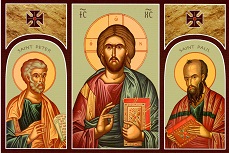
A sinner who was called to repentance

Sermon


Service

To download this video, press here to go to the download page. You may need to scroll down to see the download button.

Download Service Folder Download Bulletin

Sermon for the Feast of St. Matthew

Ephesians 4:7-14 + Matthew 9:9-13

Today, September 21st, is traditionally celebrated as St. Matthew’s feast day. You all know Matthew’s Gospel. It was likely the first one written, and it seems to have been written with a primarily Jewish readership in mind, with all its many quotes from the Old Testament proving that Jesus is, indeed, the promised Messiah who was sent to Israel, to fulfill God’s promises made to Abraham, Isaac, and Jacob, and to be the atoning sacrifice, not only for Israel’s sins, but for the sins of the world. It’s Matthew who gives us Jesus’ genealogy going back to David (from Joseph, His legal father), and then back to Abraham. It’s Matthew who tells us that Jesus was born in Bethlehem, who records the Sermon on the Mount, who recounts many parables and miracles of Jesus that aren’t recorded by the other Evangelists, who gives us the baptismal formula that is used in practically every Christian baptism: “In the name of the Father, and of the Son, and of the Holy Spirit.”

But what do we know about Matthew the man, the apostle? Very simply, the story of St. Matthew is a story of a sinner who was called to repentance, and to a life of taking up the cross to follow Jesus. It’s a story of God’s grace to sinners in general, and our Gospel today especially highlights Jesus as the great Physician and healer, not of physical ailments, but of spiritual ones; not a Physician for the healthy, but for the sick; not for those who have their own righteousness, but for those who are sinners in need of God’s forgiveness.

Before he was called to follow Jesus, Matthew tells us that he was a tax collector, or a “publican,” as the King James translated the word. We talked just a few weeks ago about the Jewish tax collectors back in Jesus’ day, but we’re going to review again today why the first century tax collector was so despised in his society. For all the complaints people have about the IRS or the county assessor or the tax man in general, it’s nothing like the way things were in the Roman Empire.

The tax collector back then in Israel was either in the service of King Herod or of some other Roman official, on behalf of Rome. He was considered a traitor, a sell-out to his own people. When collecting property taxes, he would often just invent the value of a piece of property and over-inflate it, overcharging his Jewish brother. Then, if a poor man couldn’t pay his taxes, the tax collector would loan him the money out of his own pocket—and then charge huge amounts of interest, which he would keep for himself. No one bothered taking the tax collectors to court over this, because the judges were usually bribed by the tax collection ring to give the tax collectors immunity. As a result, the whole profession was so tainted that tax collectors were often just excommunicated from the Jewish synagogue. Even their offerings were not accepted. They were ranked by the Jews below adulterers, below prostitutes—with violent criminals and murderers.

Now you understand, I hope, why it was such a big deal for Jesus to associate with tax collectors on a regular basis. Now you understand why it matters that St. Matthew was a tax collector when Jesus called him to become His companion, His friend, His student, and, eventually, one of His apostles, who form the very foundation on which the Christian Church is built (Eph. 2), and beyond that, one of the four men who would provide for all generations an account of Jesus’ life, death, and resurrection, and of the very words He spoke while He dwelled among us on earth. The choosing of Matthew, the tax collector, says something, not only about Matthew, but much more, about Jesus.

We don’t know how much Matthew had heard about Jesus before the events of today’s Gospel took place, or if there was more said on this day than is recorded, but from the brief words recorded here, we assume that Matthew must have heard some things about Jesus. We assume that he heard how Jesus had a reputation as one who welcomed sinners—without ever condoning their sin—as one who thought sinners were worth saving, worth rescuing, and even worth suffering for. In any case, Matthew had heard enough so that all it took now were these two words from Jesus, “Follow Me.” And Matthew did, from that day on.

Jesus’ reputation for welcoming sinners was confirmed by His choice of Matthew, so that, when Jesus went to that dinner at someone’s house (maybe Matthew’s house) after calling Matthew away from the tax office, it says that, behold, many tax collectors and sinners came and sat down with Him and His disciples. You can just imagine how tentative they must have felt at first. “We heard Jesus was a prophet from God. He couldn’t really want to be seen with us, could He? He knows who we are. What will He say to us?” So they slowly approach Him and His disciples. They see Matthew there with Him. Maybe it’ll be all right?

It was all right. It was just what Jesus wanted. They sat down with Jesus. What do you suppose He said to them as they ate together? I’ll tell you this: He didn’t just make small talk with them. He didn’t ignore their sins as if they weren’t worth talking about. He didn’t tell them that God loves them just the way they are. Instead, you can be sure He treated them with love, and that He did address their sins. And you can be sure that He called them to repent of their sins. And you can be sure that He spoke to them of God’s mercy, how God wanted to be a Father to them, wanted to be reconciled with them, and that Jesus Himself was the Person through whom all reconciliation comes. That’s how the conversation went, in a nutshell. You know that, because that’s the summary Jesus gave to the Pharisees who were there.

True to form, the Pharisees criticized Jesus—though they weren’t brave enough to speak to Him directly; they had to go through His disciples. Why does your Teacher eat with tax collectors and sinners? They really couldn’t figure out this whole “mercy thing,” could they? It was absolutely foreign to them, to think that a respected member of society might actually stoop down to sit together with people who had a sinful reputation. It was absolutely foreign, this idea of trying to rescue those sinners and win them back for God.

Jesus answers their question. Why does He eat with tax collectors and sinners? Because a physician is always surrounded by sick people. It’s the nature of his vocation. Jesus said to them, “Those who are well have no need of a physician, but those who are sick.” This is Jesus. This is how He wants to be known, as a physician who has come to help those who are sick—and nobody else. Not physical sickness, but spiritual sickness—the sickness of sin. As we discussed just last week, Jesus has come to be the Good Samaritan who sees the wounded, dying man on the side of the road and goes over to him to help. So also here, in Matthew’s Gospel, Jesus goes where the sinners are, not to condemn them, nor to deny their sickness, but to heal them.

But lest the Pharisees get the idea that they were well and had no need of Jesus, Jesus points them back to a passage from the Old Testament prophet Hosea: But go and learn what this means: ‘I desire mercy and not sacrifice.’ The Pharisees brought sacrifices to God, as if they could earn God’s favor by giving Him things. But all along, the chief thing God wanted, the way in which He truly wanted to be worshiped as God, was for a person to love Him, and to show mercy toward one’s neighbor. Mercy toward those who are needy, toward those who are lost. Mercy doesn’t mean you can save everyone. Most people simply refuse to be rescued from their sins. But mercy does mean wanting the lost to be saved, and rejoicing when they are. Mercy does mean you’re willing to sit down and speak God’s Word to those who have a sinful reputation. For all the offerings and tithes that the Pharisees brought, for all of their strict obedience to the laws, they neglected the most important part: mercy. And true mercy can only come from a heart that believes in the God of mercy and love.

But then, see how Jesus reaches out to the merciless Pharisees, too. He shows them that they lack the mercy God requires. He shows them they’re sinners, and then says this: For I did not come to call the righteous, but sinners, to repentance. Whether a person was a tax collector, or a harlot, or a proud, condescending Pharisee, whether a person is an adulterer, or an alcohol abuser, or a murderer, or a proud, condescending church member, no one is righteous in him or herself. All are sinners. But if you’re a sinner, and you recognize it, that means Jesus came for you, to die on the cross for you, to earn heaven for you, and to bring you into it.

It means He came to call you, who are sinners by nature, not to tell you your sins don’t matter, not to tell you it’s OK to keep living in sin, but to call you to “repentance,” as He says, to call you to recognize your sins against God’s holy commandments, to mourn over them, and to trust in Christ, that God will most certainly forgive you your sins for His sake, because He knew you and loved you, even before you were born. He suffered for you, He died for you, and He wants to associate with you, to sit down with you, to eat and drink with you.

Again, that’s the great gift we have been given here in the Sacrament. It’s Jesus, who knows exactly who you are and what you’ve done, and still wants to share this meal of His own body and blood, given and shed for you for the forgiveness of sins. But it’s for sinners only, not for good people. It’s for sinners only, who are sorry for their sins and want forgiveness from God for the sake of Christ, first in Holy Baptism, and then, repeatedly, in the Sacrament of Holy Communion. Here in the Sacrament, the Great Physician comes and heals you again, both by forgiving you your sins, and by strengthening you to say no to sin, and yes to mercy, yes to a new life of devotion to God and your neighbor, even yes to the cross, to bear your cross daily, to suffer pain and loss, hatred and persecution, for the sake of the Physician who has healed you.

That’s how Matthew’s life went. He left the tax office behind, took up his cross, and followed Jesus. Let us give thanks to God for the witness of St. Matthew, because through his Gospel, the Holy Spirit has taught us to know Christ our Savior, from his human genealogy and divine origins in chapter 1, to His resurrection and Great Commissioning of His apostles in chapter 28. Through Matthew’s Gospel, we have come to know this beautiful truth about Christ as the Great Physician who came to call sinners, like you and me, to repentance, and to a life of taking up our cross to follow Christ Jesus, our Lord. Let us heed His call every day. Amen.

Posted in Sermons | Tagged , | Comments Off on A sinner who was called to repentance

Our tongues haven’t been healed for misuse

Sermon


Service

To download this video, press here to go to the download page. You may need to scroll down to see the download button.

Download Bulletin

Sermon for the week of Trinity 12

James 3:1-12

In Sunday’s Gospel, the deaf man’s ears were opened by Jesus, and his tongue was also loosed, healed by Jesus in a moment. Last week in our lesson from Romans 10, we heard the apostle Paul explain what our tongues have been loosed for: with the heart, a man believes leading to righteousness, and with the mouth confession is made leading to salvation. “Tongue,” “lips,” “mouth”—these are all figures of speech for the ability to speak, and for the words, the speech that comes out of our mouth. Having tongues that work is a great blessing from God, because the ability to speak can be a very useful thing, both in spiritual things and in mundane things, both for the speaker and for those who hear his speech. The greatest use of our tongues is to confess Jesus Christ as Lord, and to call upon His name for help, for mercy, and for salvation. That’s the “healing of the tongue” that took place when the Holy Spirit first used the tongues of others—the speaking, the preaching of the Gospel—to bring us to faith. That’s the first thing they were healed for.

But that’s not all they were healed for. They were also healed so that we can use them to build others up, to serve our neighbor with the things we say. But, as James reminds us this evening, the tongue can also do the opposite. It can also harm our neighbor with the things we say. And so the Holy Spirit guides us through the words of this epistle, and He warns us that our tongues haven’t been healed for the purpose of misusing them.

My brothers, let not many of you become teachers, knowing that we shall receive a stricter judgment. For we all stumble in many things.

There’s a very important use of the tongue that has to take place in the Church, but that shouldn’t be used by most Christians. It’s using our tongues to teach. James isn’t talking about parents teaching their children; all parents are to do that. He isn’t talking about teaching in school, either. He’s talking about teaching in the Church, which, again, is good and necessary, but shouldn’t be undertaken by many Christians. Why? Because it’s so easy to stumble, to teach the wrong thing, to say something about God that isn’t Biblical, that isn’t true. And that’s very dangerous, because teachers are supposed to know what they’re talking about, and people tend to believe what their teachers say. But if the teacher in the Church stumbles, he can lead many people away from God instead of toward Him. And so, as James says, teachers in the Church will receive a stricter judgment.

That’s scary. It’s supposed to be. And it’s also why it’s reasonable to be more understanding with the average churchgoer who attends one of the many false-teaching churches out there than we are with the pastors or priests or ministers who actually do the false teaching. Teachers will receive a stricter judgment from God. So use your tongues to pray for your pastor who teaches you, and for all pastors, that when we use our tongues, it may only be the true word of God that we teach, and that God would be merciful toward us if our teaching ever falters.

Now, on to the use of our tongues in general. If anyone does not stumble in word, he is a perfect man, able also to bridle the whole body. Not that James imagines that such a perfect person, who always speaks perfectly, actually exists. No, since the fall into sin, there has not been a perfect man, except for Jesus. Everyone stumbles, at times, in the words we speak. Remember that, when someone you know speaks imperfectly. Everyone does, at one time or another, including you. So have compassion on those around you and don’t be quick to attack them or to take offense when they stumble in their speech and say something wrong.

Indeed, we put bits in horses’ mouths that they may obey us, and we turn their whole body. Look also at ships: although they are so large and are driven by fierce winds, they are turned by a very small rudder wherever the pilot desires. Even so the tongue is a little member and boasts great things.

In everyday life, it’s often the little things that control the big things. We use a little bit in the mouth of a big horse to turn the horse’s whole body. Sailors use a relatively small rudder on a big ship to turn the whole ship. So also the tongue, James says, is a little member of our body. But how we use it can change the whole course of our life, and can have a huge impact on other people’s lives, too.

See how great a forest a little fire kindles! And the tongue is a fire, a world of iniquity. The tongue is so set among our members that it defiles the whole body, and sets on fire the course of nature; and it is set on fire by hell.

Just as a tiny ember, left unchecked and unsupervised, can cause a whole forest to be set on fire and burned to the ground, so a few hurtful words—spoken in anger, spoken in pride, spoken rashly or carelessly—can destroy lives and wreck relationships. It doesn’t matter if the words are spoken or written or typed. The tongue can be a very dangerous member of the body, for as small as it is.

And, as James says, it’s hell itself that sets the tongue on fire. It’s the devil who plays on people’s natural anger, and pride, and carelessness, and nudges people to “go ahead and speak your mind!” Well, speaking one’s mind can be good, can also be neutral, and, it can definitely also be harmful, which is what the devil intends, to cause harm to as many people as possible—and, whenever possible, to use the mouths of Christians to do it. So take James’ counsel from earlier in his epistle: Let every man be swift to hear, slow to speak, slow to wrath.

For every kind of beast and bird, of reptile and creature of the sea, is tamed and has been tamed by mankind. But no man can tame the tongue. It is an unruly evil, full of deadly poison.

Lions have been tamed. And elephants. And even killer whales. But no one has learned how to fully tame the tongue. But what conclusion should we draw from that? No one can tame it, so, oh well, it is what it is? No. No one can tame it, so repent before God for all the times you’ve lost control of it, offer a sincere apology to those whom you may have hurt, and be understanding when your brother or sister also fails to tame their tongue. No one can tame it, so be especially cautious when you speak, and work very hard to tame the tongue as much as possible, with the help of God’s Holy Spirit.

With it we bless our God and Father, and with it we curse men, who have been made in the likeness of God. Out of the same mouth proceed blessing and cursing. My brothers, these things ought not to be so. Does a spring send forth fresh water and bitter from the same opening? Can a fig tree, my brothers, bear olives, or a grapevine bear figs? Thus no spring yields both salt water and fresh.

Think, James urges us, how incongruent it is, how unfitting it is to speak a blessing upon God, our Father in heaven, in one moment, and to use the same mouth to badmouth your neighbor, whom God created, in the next moment. These things ought not to happen.

God has graciously given us all the ability to speak, and He has also brought us to faith and loosed our tongues to confess the Lord Jesus for our salvation. But He has healed our tongues, not so that we can let them run wild, not so that we can let them do damage to others, but so that we can praise our God and speak words that will edify our neighbor. So be diligent about this difficult task, whether you’re speaking to someone in person, or texting on the phone, or typing online. Use your tongue to ask your Father in heaven to keep you this day without sin, also in the things you say, and to help you use the tongue He has mercifully healed for good, and not for evil. Amen.

Posted in Sermons | Tagged | Comments Off on Our tongues haven’t been healed for misuse

The Samaritan inspires fear, then hope, then purpose

Sermon


Service

To download this video, press here to go to the download page. You may need to scroll down to see the download button.

Download Service Folder Download Bulletin

Sermon for Trinity 13

Galatians 3:15-22 + Luke 10:23-37

The nation is still in turmoil after the martyrdom of Charlie Kirk that took place on Wednesday. We’ve seen more hatred from our neighbors than any decent person can handle seeing. And Christians have had to deal with the stark, cold reality that many, many of our neighbors, of our own countrymen, don’t merely disagree with us Christians on key societal issues. No, they would actually dance on our graves, as they’re dancing on Charlie’s even now. They are the ones who are truly consumed with hate, and with wickedness.

Now, we’re not going to dwell on this today. We’re simply going to acknowledge it, and, we’re also going to use it to illustrate one of Jesus’ points in today’s Gospel, in the parable of the Good Samaritan.

It’s an inspirational story, but what is it intended to inspire? At first glance, the parable seems like a story with a very simple moral: It’s good to show kindness to a stranger in need. That’s not wrong, it just isn’t the whole point, or even the main point. In fact, this parable is so expertly told by Jesus that it inspires three things, in this order: The Samaritan inspires fear, then hope, and then purpose.

Let’s remember how Luke sets the stage for this parable. A religious lawyer, an expert in the Law of Moses, approaches Jesus with a question. Teacher, what must I do to inherit eternal life? It’s a very basic, very important question. Only Luke informs us that it wasn’t an honest question; the man asked it to “test” Jesus. You see, the experts in the Law were angry with Jesus, partially because they misinterpreted His message. (This, by the way, is one reason why people hate Christians today, because the devil, through his many liars, has led them to misinterpret our message, and to ascribe to us wicked motives, even as they have done to Charlie both before and after his assassination.) The lawyers in Israel thought Jesus was disparaging Moses and the Law of Moses in His teaching. But that’s wrong. He didn’t disparage the Law. He upheld the Law, more than the experts in the Law did, as a matter of fact, as He demonstrates in the parable.

In answer to the man’s question, Jesus went straight to the Law. What is written in the Law? He asked. How do you read it? And the lawyer gave a fine summary of God’s moral Law: You shall love the Lord your God with all your heart, and with all your soul, and with all your strength, and with all your mind; and your neighbor as yourself. And Jesus agreed with him. You have answered correctly. Do this, and you will live.

Now, you would think the expert in the Law would have been very pleased with an answer like that, one that agreed so perfectly with his precious Law. But he wasn’t! He was smart enough to realize that such a broad-reaching commandment, to love God with all one’s being, and to love one’s neighbor as oneself, was a tall order—something he couldn’t be sure he had lived up to. So, wanting to justify himself, he said to Jesus, “And who is my neighbor?” So, to answer his question, Jesus went on to tell the parable.

It’s a simple story. A man was walking from Jerusalem to Jericho and along the way he was accosted by bandits. They grabbed him, beat him and robbed him of his possessions and left him half-dead on the side of the road. Did they “love their neighbor as themselves”? Obviously not. Then along came a priest, and then a Levite—some of the most godly and good people in Israel. Each one saw the man and just kept walking. Did they “love their neighbor as themselves”? Did they do to that man what they would have wanted someone to do for them in that situation? Obviously not. But then along comes a Samaritan. And as you recall, the Jews despised the Samaritans, and the feeling was usually mutual. The Samaritans were “neighbors” of the Jews. They lived to the north of Jerusalem in Samaria. And they had some Jewish blood, mixed with Gentile blood, and they followed their own hybrid religion. Jews and Samaritans did not associate with one another. But this Samaritan saw the Jewish man lying half-dead on the side of the road and took pity on him. He went over to him, tended his wounds, hoisted the man up on his own pack animal, took him to an inn, cared for him overnight, and then left the innkeeper with instructions, and with money, to continue the man’s care until the Samaritan returned from his journey.

Now it’s time to apply it to the lawyer: “Now which of these three, do you think, was a neighbor to the man who fell among the thieves?” And he said, “The one who showed mercy to him.” Then Jesus said to him, “Go and do likewise.”

Go and do likewise. Do this, and you will live. To the one who thinks he can appeal to God’s Law, can appeal to his own goodness and decency as he stands before God, saying, “See, God? I’ve done everything You required,” the parable of the Good Samaritan provides a terrifying dose of reality: You are not nearly good enough to earn the eternal inheritance of the kingdom of heaven. If you think you inherit eternal life, or “get into heaven,” by doing enough good, by keeping the Law, and if keeping the Law means having a heart like the Samaritan’s heart, and producing such selfless and devoted behavior toward the person next to you who needs your help, as the Samaritan did, all the time—and if you’re honest with yourself—then the Samaritan must inspire fear within you. If “do this, and you will live” is the only path to heaven, you don’t stand a chance. No one does.

Because, again, it’s not, “Go and try your best; God will do the rest.” That’s not what Jesus says. It’s not what the Law says. It’s not “work really hard,” either. It’s “do this.” Do it. Get it done, from the heart. All the time. In the aftermath of Charlie Kirk’s assassination this week, it’s easy for us to compare ourselves with all the hate-filled people out there in the world, with the ones who make false accusations, with the ones who commit acts of violence, or who would like to see acts of violence committed against anyone who holds the same views as Charlie did. They obviously don’t fulfill the Law’s command to “do” as the Samaritan did. But the harder truth is that, neither do we. All have sinned, God declares. There is “no one who does good,” God declares. Not in the sense of “doing good enough” to be justified before God. No one. That’s why “do this” as the path to eternal life should inspire fear in all of us, lest we should ever begin to think that we have done enough, that we could ever be good enough to inherit eternal life. If the Law is the only way into heaven, then we should all be very, very afraid, because hell is the only alternative to heaven.

But, as I said, the parable of the Good Samaritan inspires more than one thing, has more than one purpose. It serves very well to frighten the secure sinner and the one who relies on his works to be saved. But we should also look at it from a different angle, one that inspires hope in those who have had their hope in their own goodness rightfully ripped away from them.

If you’re looking for a helper who is as kind and merciful and compassionate as the Good Samaritan was, you won’t find one, except in one place: in Jesus, who is very much like the Good Samaritan in the parable. The Samaritan was related to the Jews, but also a foreigner. So Jesus took on human flesh and became Man, became related to all of us, even as He remains a “foreigner” to us in that He is also true God. The Samaritans were despised by the Jews. So Jesus was despised by them, too, and is still despised by most of the world. Still, that didn’t stop Him from coming to help us. As the priest and the Levite, who represent the Law, passed by, unwilling to help the miserable man, so the Law still passes us by, unwilling to help us, unwilling to save us, because we’re born in slavery to sin and death. But as the Samaritan so mercifully cared for the injured, dying man, so Jesus came to us in our sins, and in our condemnation. He gave His life on the cross for our sins. He is the true Martyr after whom every Christian martyr is named. Why would Charlie Kirk, why would anyone risk their life for Jesus? Because He knowingly gave His life for us, that we might be delivered from sin, and from death, and from the power of the devil. And then, just as the Samaritan took the dying man and carried him to an inn and placed him in the charge of the innkeeper until he returned, so the Lord Jesus has placed us in the inn of His Holy Christian Church, and charged the ministers of the Church to look after His people, tending to their spiritual wounds, forgiving the penitent in Jesus’ name, feeding them with the Word and the Sacraments of Jesus, until He returns from heaven, as He has promised, to bring us safely into His heavenly kingdom.

Do you see what hope the Good Samaritan inspires, when we see Jesus in the Samaritan’s kindness, when we see that Jesus came and fulfilled the Law of God, to love God and to love our neighbor? He fulfilled the Law by loving all people, and by doing it in our place, offering us a different path to heaven, not the path of doing enough good, but the path of believing in the Lord Jesus, who did enough good for us, so that we might be justified by faith in Him, and not by our works.

That was the hope that Charlie Kirk confessed and in which he died. That’s the hope that God holds out to all men, urging everyone to repent and to believe in the Lord Jesus, and promising the forgiveness of sins, life, and salvation to all who believe. And that gives us hope, to confront the darkness of this world, to confront those who hate us and those who wish us dead. It gives us a sure hope for this life, and for the next. It gives us hope, a sure hope, that God and His people win in the end, no matter how bleak it appears at the moment, because, as Charlie posted a few days before he was martyred, “Jesus defeated death so that you can live.”

So the parable of the Good Samaritan inspires fear, and then hope. And for those who have hope, it inspires one more thing: It inspires purpose.

“Go and do likewise,” Jesus said to the expert in the Law. Go and be like the Samaritan. Be a merciful neighbor to the person next to you who needs your help, who needs your concern, who needs your invitation to come to church, to come to know the Lord Jesus. That is the purpose that God has given to His hope-filled people in this world: to be imitators of Christ.

Of course, in order to do that, you have to know Christ. And you know Him best and most directly through the four Gospels: Matthew, Mark, Luke, and John. There we see Him as the compassionate Good Samaritan toward the one in need. He is the patient Teacher to those who will listen. He is the willing and even joyful Target of hatred, false accusations, and wrongdoing. He is the Good Shepherd toward His sheep who believe in Him. And He is also the Speaker of harsh truth, and, sometimes, condemnation to the liars who threaten His flock.

But, you’ll notice, He is never, during His earthly life, the Punisher of the wicked. He is never the Mocker of those who believe falsely. He is never the bitter Cynic who always sees the worst in His neighbor. He is never the Pharisee who had no heart for the lost.

So, go and do likewise. Let it be your ongoing purpose as a Christian to imitate Jesus in all things, including His compassion and care for the one in need. And you don’t have to go to the other side of the world to find him. In fact, you shouldn’t. Because your “neighbor” is literally the person “next to you” who needs your compassion and your acts of mercy. And that person doesn’t have to be a stranger lying on the side of the road. It could be your family member, or fellow church member, or someone you work with, or go to school with, or who lives down the road. Keep your eyes open for opportunities to imitate the Good Samaritan, to show mercy to the one in need, and the Lord will surely provide them, because the needs of this life are many and great.

In summary, may the Holy Spirit use this account of the Good Samaritan to inspire fear in the secure sinner and in the one who seeks to work his way into heaven. May He inspire hope, through the mercy of our Savior, Jesus Christ, in all who recognize their need for His help. And may He inspire purpose in all who have received that help, purpose in showing kindness and mercy, which will always pale in comparison to the kindness and mercy that we ourselves have received from God. Amen.

Posted in Sermons | Tagged , , | Comments Off on The Samaritan inspires fear, then hope, then purpose

My faithful martyr, who was killed among you

Sermon

Service

To download this video, press here to go to the download page. You may need to scroll down to see the download button.

Download Bulletin

Almighty and everlasting God, who have promised finally to judge this world in righteousness, we implore You, through Jesus Christ our Lord and Savior, impart the grace and help of Your Holy Spirit to all Christians as we confront the lies, the hatred, and the violence of the wicked. Comfort and care for the family of Charlie Kirk, who openly confessed You before men and was wickedly murdered today for the true things that he spoke. Cast down, by Your almighty power, all the counsels of those who hate Your people and Your Word, and who would destroy them, either by corrupt teaching, or with violent hands. Shield Your children from evil, or, if it better serves the honor of Your name, grant us to face violence and even martyrdom with a firm faith and a bold confession. In the midst of this world’s darkness, enlighten us with the light of Your Son, Jesus Christ, and comfort us by the victory He has gained for all who remain faithful unto death; who lives and reigns, with You and the Holy Spirit, one God, forever and ever. Amen.

Sermon for a Christian Martyr

Revelation 2:12-13

I had prepared a different sermon for this evening, on a different text. A different service, with a different theme. But when I heard the news this afternoon that Charlie Kirk had been assassinated at a speaking event in Utah, I found that I couldn’t ignore it. Maybe it’s because it happened just a few weeks after that senseless shooting of the Christian children in Minnesota. Maybe it’s because that story from North Carolina has been receiving so much attention, the young lady who was murdered in cold blood by a repeat-offender, while the media continues to lay the blame for all this violence at the feet of Christians and conservatives. They called Charlie a hater. They called him a fascist. They called him a racist. They even claim that he incited the very violence that killed him. But the truth is very simple: They lie.

They lie about Charlie Kirk. They lie about pro-lifers. They lie about white people. They lie about those who believe what God says about marriage. They lie about those who just want to see the laws being enforced in their own country. They lie about Christians. They lie about Christ. They lie, because they are of their father, the devil, who was a liar from the beginning and the father of lies. Their lies lead to hate, and hate leads to violence. Today, hate and violence celebrated a victory.

Now, Charlie Kirk was not killed as a Christian minister, or for preaching the Gospel, as the apostles were. He was not a minister. He was not a preacher. He was just an outspoken Christian who based his views of the truth regarding many societal issues on the teachings of the Bible. Yes, he had made a business out of it. It had become his career, to go around speaking, especially at college campuses, inviting young people to think about important issues, life and death issues, and to debate them using facts instead of emotion. He chose a path, as a Christian layman, that had him confronting lies in the world, day in and day out, spreading truth and light in the world, making himself a target for those who embrace the lie, who serve Satan as their master.

In that way, he was imitating the One whom he called Lord. Jesus, the Truth itself and the true Light, came into the world, And this is the condemnation, that the light has come into the world, and men loved darkness rather than light, because their deeds were evil. For everyone practicing evil hates the light and does not come to the light, lest his deeds should be exposed. But he who does the truth comes to the light, that his deeds may be clearly seen, that they have been done in God.

In the first Lesson I chose for this evening, we hear the Apostle Paul at the end of his road, at the end of his race, being poured out like a drink offering, soon to depart this world, soon to be violently executed by a government that hated God, having been falsely accused and lied about by people who hated God, simply because he preached the truth of the Gospel of Christ: He who believes and is baptized will be saved. Whoever does not believe will be condemned. What does he say in the face of imminent death? I have fought the good fight, I have finished the race, I have kept the faith. Finally, there is laid up for me the crown of righteousness, which the Lord, the righteous Judge, will give to me on that Day, and not to me only but also to all who have loved His appearing.

Paul was ready to go, because the Lord was ready for him to go. The Lord had determined that Paul had reached the end of his earthly race and was ready to give him the crown of righteousness.

And, as Paul says, God will give that crown not only to him, but also to all who have loved His appearing. That included a man named Antipas. We don’t know anything about Antipas, except for what Jesus had John write to the church in Pergamum: I know your works, and where you dwell, where Satan’s throne is. And you hold fast to My name, and did not deny My faith even in the days in which Antipas was My faithful martyr, who was killed among you, where Satan dwells. Was Antipas a Christian minister or a Christian layman? We don’t know. All we know is that the Lord Jesus called him His “faithful martyr, who was killed” among the saints in Pergamum. It doesn’t matter if he was a minister or layman. He was a faithful Christian whose life ended as a witness to the truth of Christ, in whom Antipas believed.

Notice what Jesus said about that place where Antipas was killed: where Satan’s throne is, where Satan dwells. We don’t know who, in particular, was persecuting Christians in that place. But we know that Satan was behind it, that he had a stronghold in that city. The same can be said, must be said, about our city, and about our country, and, truthfully, about the whole world. Satan dwells here. Satan has his throne here. Jesus called him the “prince of this world,” and, if his princedom was somewhat subdued for a time, it has returned in full force.

The darkness is ugly. The darkness is evil. And the darkness is everywhere. I feel it in my bones. I suspect you feel it, too. But there is a light that came into the world 2,000 years ago, a light that pierced the darkness, a light that remains within His Holy Christ Church. It’s the only light left in this world, but it still shines among us, the message of Christ crucified and risen from the dead, the message of Christ victorious over Satan and all the power of hell, the message of Christ returning as the glorious Hero to bring judgment on the earth and salvation for all who love His appearing.

I’m convinced that Charlie Kirk was among those, from everything I heard him confess about His Savior, Jesus Christ. We will rely on his confession of himself as a poor sinner, saved by grace alone through faith in Christ alone. And so we will give thanks to God for granting him the crown of righteousness at the end of his race.

And, before we close tonight, I want to leave you with these encouragements: Don’t follow the godless Left into hatred. Don’t become your enemy. Instead, love your enemies, bless those who curse you, do good to those who hate you, and pray for those who spitefully use you and persecute you. Learn a lesson from Charlie Kirk, who engaged in, or at least did his best to engage in respectful conversation with those who still sat in darkness. Learn to speak boldly and bravely, to speak the truth with love, even if the whole world lies about you and hates you for the things you say, even if some of those servants of Satan target you for death, even if your earthly life has to end in Christian martyrdom, as Charlie’s did. Satan is mighty in this world and terribly successful. But his success is fleeting. His lies are about to be revealed. His kingdom is about to fall, not because justice will be restored on the earth as it now stands, but because the victorious Lord Jesus is about to return in judgment and tell Satan to go to hell, permanently. Set your minds on things that are above, not on things that are on earth. For you have died, and your life is hidden with Christ in God. When Christ who is your life appears, then you also will appear with him in glory. The Lord be with you all. Amen.

Posted in Sermons | Tagged , | Comments Off on My faithful martyr, who was killed among you

The glorious ministry of the Spirit

Sermon


Service

To download this video, press here to go to the download page. You may need to scroll down to see the download button.

Download Service Folder Download Bulletin

Sermon for Trinity 12

2 Corinthians 3:4-11 + Mark 7:31-37

You heard again today of Jesus’ ministry to a deaf man, which was very much like His ministry to all kinds of people with sicknesses and ailments. He freely gave of His time and of His care. He showed kindness and compassion toward the one who was suffering. He found a way to communicate very simple truths to the deaf man, using signs that could be interpreted and understood. And, of course, He performed the actual miracle of opening the man’s closed ears and loosing his tied-up tongue. Truly the Lord Jesus did all things well during His earthly ministry.

And He still does all things well. But His earthly ministry of opening closed ears and loosing tied-up tongues has now been transformed into a ministry that He carries out indirectly instead of directly, a ministry that, while less miraculous and spectacular, is just as compassionate, just as sincere, and just as glorious. It’s still a ministry of preaching that transforms deaf ears into hearing ones, that transforms speechless tongues into bold, confessing tongues—a ministry that literally gives life to the dead, not just in one place, but throughout the world, in every place where this ministry is taking place. It’s about this ministry that the apostle Paul is speaking in today’s Epistle, which we’re going to walk through together this morning: the glorious ministry of the Spirit.

And we have such confidence toward God through Christ. What confidence is the apostle Paul talking about, and who is the “we”? The “we” is Paul and Timothy, who was with Paul as he wrote this letter. But he’s really talking about all the ministers whom Christ had sent out into the world to preach the Gospel. “We” have such confidence: confidence in what he describes in the first few verses of this chapter, in the fact that we ministers, whom God has sent to you, are enough to supply your spiritual needs. The Corinthians had started turning against Paul, listening to the lies of supposed ministers who came to them with their own letters of recommendation from somewhere, trying to persuade the Corinthian Christians to listen to them instead of Paul. They had turned the ministry into a business, marketing themselves and praising their own success, and were handling the word of God deceitfully. Did Paul need letters of recommendation in order for them to believe him? Did he need human credentials in order to be credible? Did he and Timothy need letters of recommendation from the Corinthians, so that they could convince people elsewhere that they were to be believed? No, Paul says, through Christ, who called us into this ministry, we are confident before God that we have all we need for the ministry, and that you have all you need, for salvation and for living a Christian life, in the ministry God provides through us.

Not that we are sufficient by ourselves, Paul writes, to think of anything as being from ourselves. Jesus was sufficient, Jesus was competent, Jesus was qualified as a minister all by Himself, because He was and is the sinless Son of God. And yet even Jesus, speaking humbly as a man, credited His Father in heaven with His message and with the power that accompanied it. I do nothing of Myself, he said, but as My Father taught Me, I speak these things. How much less could sinful human ministers claim sufficiency or competence for themselves, as if we had any power or ability to save anyone or to transform anyone’s life, as if we were the source of the message we preach, as if we came up with the doctrines that we teach. No, Paul says, our sufficiency, our qualifications come from God. He has made us sufficient as ministers of a New Testament.

Remember when God first chose Moses to be His prophet and minister to Israel? Moses recognized his insufficiency for that task. Who am I that I should go to Pharaoh, and that I should bring the children of Israel out of Egypt? O Lord, I am not eloquent, neither before nor since You have spoken to Your servant; but I am slow of speech and slow of tongue. Do you remember God’s reply? It goes perfectly with today’s Gospel. Who has made man’s mouth? Or who makes the mute, the deaf, the seeing, or the blind? Have not I, the LORD? Now therefore, go, and I will be with your mouth and teach you what you shall say. God made Moses sufficient. Remember how inadequate the prophet Isaiah felt as God was calling him into the ministry. Woe is me, for I am undone! Because I am a man of unclean lips, and I dwell in the midst of a people of unclean lips. But God took away his sin and guilt, and made him sufficient. Remember what the backgrounds were of Jesus’ 12 apostles. Most of them were fishermen. Most of them were nobody’s in Israel. But Jesus took them, and trained them, and had great patience with them. And then He called them to be His witnesses to the ends of the earth. And then He empowered them with His Spirit from on high, making them sufficient and competent to carry out that momentous task.

Ministers, Paul goes on, of a New Testament, not of the letter, but of the Spirit. For the letter kills, but the Spirit makes alive. Moses was a minister of the first covenant or testament, which we now call the Old Testament, because Christ fulfilled that one and instituted a new one. That Old Testament, summarized in the Ten Commandments, was “of the letter.” It was literally written with letters on tablets made of stones. It consisted of written commandments which the children of Israel were to obey. It commanded many things; it revealed what things were good and right, and what things were bad and evil. But those letters written in stone had no power to produce obedience in anyone. Commanding someone to do something doesn’t make them able to do it. It doesn’t even make them willing to do it, except by threats and compulsion. Commanding someone to love someone, for example, doesn’t actually produce love, does it? Just as forbidding someone from eating, say, from a certain tree, doesn’t actually prevent them from eating, does it? God’s commandments define and demand love for God and love for our neighbor. But the letter can’t produce love in people who are not, by nature, loving.

And we aren’t. And that’s the problem. And that’s why the covenant written with letters and engraved on stones ended up killing people. It’s why Paul calls it a ministry of death, a ministry of condemnation. Because the Law didn’t only come with commands to obey. It also came with punishment for disobedience. It sentences sinners to death. And the faithful ministry of the Law preaches the sinner’s death and eternal condemnation. It doesn’t turn people into sinners, but reveals them to be sinners. It kills all hope a person has of saving himself or herself.

But that’s why a new covenant was established, because the old one was never intended to last. The Law was, as Paul describes it to the Galatians, a schoolmaster to lead people to Christ. As Paul wrote to the Romans, Christ is the end of the law for righteousness to everyone who believes. He gave His body up on the cross and shed His blood as the old covenant’s price of atonement for sin—not His own sin, but the sins of the world. And in doing that, He gained the right to institute the New Covenant in His blood, a covenant that doesn’t consist of commands written down with letters on stone, but a covenant of God’s promise to forgive sins to all who seek Him through His beloved Son, Jesus Christ, a covenant that, when believed, actually does produce love and works of love.

And yet it wasn’t enough for Jesus to institute the New Testament. He also had to institute the ministry of it, the preaching of it, the administration of it. Paul calls it a ministry of righteousness—not a series of commands to be obeyed in order for sinners to make themselves righteous, but the ministry of preaching Christ, the Righteous one. Not the ministry of making people righteous in themselves, but the ministry of demonstrating that righteousness had already been earned for all people by Christ, the ministry of calling sinners to repentance and faith in Christ, the ministry of applying the righteousness of Christ to penitent sinners who believe, the ministry of guiding those who are righteous by faith to love God and to their neighbor.

Now, Paul goes on, if the ministry of death (which was engraved with letters on stones) came with glory, so that the children of Israel could not look steadily at the face of Moses due to the glory of his face (which was fading away), how could the ministry of the Spirit not be more glorious? For if the ministry of condemnation was glorious, then the ministry of righteousness abounds much more in glory.

Even the Old Testament ministry that brought death was a glorious ministry. Paul refers to the shining face of Moses, as described in the book of Exodus, where Moses’ face would actually glow with a bright light after he would go into the Tent of Meeting and receive God’s Word directly from God. He would come out and speak to the people with a glowing face, but then he would put a veil on his face after he was done speaking. Why? Because the glory of his face only lasted a little while, and he didn’t want the people to see the glory gradually fading away. It would seem like the words he spoke were losing their force. So he veiled his face.

But the truth is that the ministry of Moses, along with the Old Covenant itself, was intended to fade away. It was glorious for a while, but it would eventually be replaced with something far more glorious—with the New Testament in the blood of Christ, and with the ministry that proclaims Christ crucified, not only to the nation of Israel, but to all nations, to all the world.

For even that which was once glorious is not counted as glorious in comparison with this surpassing glory. For if that which faded away was glorious, then that which lasts must be far more glorious.

Through this ministry, established by Christ, you, too, have access to Christ like the deaf man in the Gospel did. Not to approach Him for physical healing, but for spiritual healing, for guidance and strength and comfort, and, when necessary, for a strong dose of truth, and for the warnings to you need to avoid dangerous doctrines and practices, and temptations that surround you in this life. Through this ministry, established by Christ, the Spirit of God works among you and within you, to open your ears to His Word, and to keep them open, to loose your tongue to confess His name, and to keep it loose. Through this ministry, established by Christ and placed right here in your midst, Jesus makes Himself available to you, throughout your entire earthly life, until the end, when even this more glorious ministry of the Spirit will be replaced with something far more glorious still, with the direct ministry of Christ, who will live among His people visibly and tangibly, like a true shepherd dwelling among His sheep—a far better shepherd than anything you’ll experience here, and yet a shepherd who has seen fit to use the ministry of earthly shepherds to care for His precious sheep. For that, let us give thanks and praise to God the Father, through our Lord Jesus Christ, for seeing to our care until He comes back in person, through the glorious ministry of the Holy Spirit. Amen.

Posted in Sermons | Tagged , | Comments Off on The glorious ministry of the Spirit