Jesus receives sinners who seek mercy from Him

right-click to save, or push Play

Brief message for Trinity 3

Micah 7:18-20  +  1 Peter 5:6-11  +  Luke 15:1-10

Dear Christian family,

Grace to you, and peace from God our Father and from our Lord Jesus Christ. Amen.

I thank God for all of you, that, even in my absence, you have come together this morning to pray, to support one another in bearing the cross, and to encourage one another in the Christian faith and in leading the holy life of love to which God has called us.

On the back of your service folder you have printed the three Scripture readings for today, the Third Sunday after Trinity. I encourage you to read them at home with your families. You’ll hear the prophet Micah express awe at the great mercy and compassion of the God whose outstanding character it is to forgive sins. You’ll hear the Apostle Peter’s encouragement to humble yourselves before this God, because He exalts the humble. He also warns you to watch out for the devil, who is seeking to devour you—to lead you astray from the humble, penitent faith that mourns over sins and trusts in Christ for forgiveness—forgiveness which He alone purchased with His blood shed on the cross for you.

I’ll read today’s Gospel to you from Luke 15 and just make a couple of brief comments on it:

Then all the tax collectors and the sinners drew near to Him to hear Him. And the Pharisees and scribes complained, saying, “This Man receives sinners and eats with them.” So He spoke this parable to them, saying: “What man of you, having a hundred sheep, if he loses one of them, does not leave the ninety-nine in the wilderness, and go after the one which is lost until he finds it? And when he has found it, he lays it on his shoulders, rejoicing. And when he comes home, he calls together his friends and neighbors, saying to them, ‘Rejoice with me, for I have found my sheep which was lost!’ I say to you that likewise there will be more joy in heaven over one sinner who repents than over ninety-nine just persons who need no repentance. “Or what woman, having ten silver coins, if she loses one coin, does not light a lamp, sweep the house, and search carefully until she finds it? And when she has found it, she calls her friends and neighbors together, saying, ‘Rejoice with me, for I have found the piece which I lost!’ Likewise, I say to you, there is joy in the presence of the angels of God over one sinner who repents.”

Notice that the tax collectors and sinners drew near to Jesus. Why? Because He condoned their sins or told them it was OK to sin against God? Not at all! They drew near to Him because they acknowledged their sins. They knew that their sins had earned God’s wrath and punishment for them. But Jesus was revealing to them the same God who revealed Himself in the Old Testament as a God who, as Micah had said, “pardons iniquity and passes over the transgression of His people, who does not retain His anger forever, who delights in mercy.” Only now, God was not revealing Himself through a mere prophet. God was revealing Himself in Person—in Jesus, who is God in the flesh.

The tax collectors and sinners found in Jesus a God who doesn’t excuse or permit sin; He condemns it. But at the same time, He Himself volunteered to suffer for it and to be condemned for it in the sinner’s place. That’s how He can welcome sinners who come to Him for mercy. Where Christ is, there God is merciful. And everyone who comes to Him for mercy and healing will receive it. The two short parables Jesus told of the lost sheep and the lost coin picture for us, not only God’s willingness to forgive sinners, but His joy in doing so.

The devil, that prowling lion, will tempt you in two directions here. He’ll tempt you, either to despair of God’s mercy, because your sins are so great, or he’ll tempt you to despise God’s mercy, as the Pharisees did in the Gospel, because you think your sins aren’t so bad after all—while the sins of other people are so bad that they just might be unforgiveable.

Watch out for the devil, on both sides. The last thing he wants is for sinners to acknowledge their transgressions and to draw near to Jesus for mercy. But that’s exactly what God wants: for sinners to repent and draw near to Jesus to be forgiven. In fact, this very Gospel is what brings sinners to do just that.

Remember your Baptism, where Jesus first received and forgave you, the sinner. Remember your Baptism, which still “works forgiveness of sins, rescues from death and the devil, and gives eternal salvation to all who believe this.” Remember your Baptism, which “indicates that the Old Adam in us should by daily contrition and repentance be drowned and die with all sins and evil desires, and that a new man should daily emerge and arise to live before God in righteousness and purity forever.” Peace be with you.

Posted in Sermons | Comments Off on Jesus receives sinners who seek mercy from Him

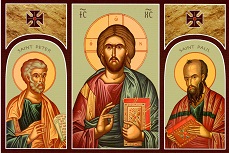
Sts. Peter and Paul: Equals in confessing Christ

right-click to save, or push Play

Sermon for the Feast of Sts. Peter and Paul

Jeremiah 26:12-16  +  Acts 12:1-11  +  Matthew 16:13-20

Dear saints of God, who have been sanctified, that is, made holy, by the blood of Jesus Christ and by the washing of water with the Word: Today we celebrate the feast of Saints Peter and Paul. Through the Word of God that they preached, you have become saints. And they, in their writings, referred to you baptized believers in Christ as saints. So we will not hesitate to give them the same distinction.

We celebrate their feast day because of their faithful witness of Christ: a testimony they left behind for us both in their preaching and in their blood, which was willingly shed for the sake of Christ and His Gospel, and also for our sake, so that you and I may know that what they preached was worth dying for. They serve as teachers; they serve as examples, specifically for those who hold the office of the ministry as they did, but also for all Christians in their vocations.

Peter and Paul were equals, but they weren’t the same in every way. Peter was a Jewish fisherman from Galilee, a married man; Paul was a Jewish tent-maker from Tarsus who was born a Roman citizen, a man who chose to remain unmarried. Peter was impetuous, quick to speak and act, down to earth and simple in his style of preaching and writing; Paul was a scholar, an intellectual, whose writings were more complex. Peter even referred to that in his second epistle: “Count the patience of our Lord as salvation, just as our beloved brother Paul also wrote to you according to the wisdom given him, as he does in all his letters when he speaks in them of these matters. There are some things in them that are hard to understand, which the ignorant and unstable twist to their own destruction, as they do the other Scriptures.”

Peter and Paul were different in many ways, but they were equals in the most important way: equals in confessing Christ. They shared a common Christian confession, a common Christian ministry, and a common Christian cross.

First, they shared a common Christian confession. You heard in the Gospel Peter’s clear confession: Jesus asked His twelve apostles, “Who do you say that I am?” Simon Peter answered and said, “You are the Christ, the Son of the living God.” Those few words are full of meaning. Peter was connecting all the Old Testament dots of Messianic prophecy to Jesus as the promised Savior, who was true God and true Man, who is the only hope, the only Redeemer of sinful men.

Paul, at first, denied that Jesus was the Christ and was a persecutor of Christians. But after Jesus converted him, Paul’s confession couldn’t be clearer: And I, brethren, when I came to you, did not come with excellence of speech or of wisdom declaring to you the testimony of God. For I determined not to know anything among you except Jesus Christ and Him crucified.

Peter and Paul confessed Jesus as the Christ by preaching against sin, by calling sinners to repentance, by teaching that sinners are justified before God by faith alone in Christ. Peter’s sermons recorded in the book of Acts are beautiful Gospel gems. Here is part of one of them: God anointed Jesus of Nazareth with the Holy Spirit and with power, who went about doing good and healing all who were oppressed by the devil, for God was with Him. And we are witnesses of all things which He did both in the land of the Jews and in Jerusalem, whom they killed by hanging on a tree. Him God raised up on the third day, and showed Him openly, not to all the people, but to witnesses chosen before by God, even to us who ate and drank with Him after He arose from the dead. And He commanded us to preach to the people, and to testify that it is He who was ordained by God to be Judge of the living and the dead. To Him all the prophets witness that, through His name, whoever believes in Him will receive remission of sins.

Paul’s words to the Romans are just another way of saying the same thing: But now the righteousness of God apart from the law is revealed, being witnessed by the Law and the Prophets, even the righteousness of God, through faith in Jesus Christ, to all and on all who believeTherefore we conclude that a man is justified by faith apart from the deeds of the law.

You may remember that St. Peter himself once stumbled on this point when he was in Antioch and, for fear of the circumcision group, stopped associating with the uncircumcised Gentiles. Paul had to confront Peter on that occasion to bring him back to the truth: I said to Peter before them all, “If you, being a Jew, live in the manner of Gentiles and not as the Jews, why do you compel Gentiles to live as Jews? We who are Jews by nature, and not sinners of the Gentiles, knowing that a man is not justified by the works of the law but by faith in Jesus Christ, even we have believed in Christ Jesus, that we might be justified by faith in Christ and not by the works of the law; for by the works of the law no flesh shall be justified.”

In all things, in all articles of doctrine, Peter and Paul confessed in perfect harmony with one another, as equals who didn’t come up with their own doctrine or borrow it from others, but were given their common doctrine directly by their common Lord Jesus.

In the same way, neither of them took it upon himself to be an apostle, but they were chosen equally by Jesus and called into a common Christian ministry.

We learn in Luke 6 that Jesus personally chose twelve of His disciples, including Peter, to be apostles. The book of Acts and Paul’s own epistles tell how he, too, was directly chosen by Jesus to be an apostle, and that he didn’t get his apostolic authority from Peter or from any man, but only from Christ. In this ministry, none is superior or inferior to the other. You heard in today’s Gospel of the ministry Jesus gave to Peter: I also say to you that you are Peter, and on this rock I will build My church, and the gates of Hades shall not prevail against it. And I will give you the keys of the kingdom of heaven, and whatever you bind on earth will be bound in heaven, and whatever you loose on earth will be loosed in heaven.

The rock on which Jesus will build His church is not Peter the man, but Peter the chosen minister who confesses Jesus as the Christ. In other words, this is the ministry of Christian confession on which Jesus would build the church, the preaching ministry by which the Holy Spirit would convict sinners of their sins, and bring sinners to faith and so justify and save them. And it’s not the ministry of one man, but of all the apostles in general, as St. Paul also writes to the Ephesians: Now, therefore, you are no longer strangers and foreigners, but fellow citizens with the saints and members of the household of God, having been built on the foundation of the apostles and prophets, Jesus Christ Himself being the chief cornerstone.

The tools of this ministry are also the same among all ministers—Peter and Paul and all ministers after them who are called by God, through the Church, into the office of the Holy Ministry. The tools are keys, the “keys of the kingdom of heaven.” It is the authority given by Christ to speak and to act in His name and in His place, to forgive sins to penitent sinners and to retain sins to the impenitent. It’s the ministry of Word and Sacrament that convicts sinners of their sins, calls them to repentance, and applies the righteousness of Christ to the penitent.

It was Peter who proclaimed on the Day of Pentecost, “Repent and be baptized in the name of Jesus Christ for the remission of your sins.” It was Peter who said, “Baptism saves us.” It was Paul who spoke of baptism as the “washing of water with the word,” and as “washing of regeneration and renewal of the Holy Spirit.” It was Paul especially who taught the Corinthians about the importance of Lord’s Supper as the communion with the body and blood of Christ, given and shed for the forgiveness of sins. And it was both of them who emphasized the power of the Word of God to give new birth and new life.

Finally, Peter and Paul were equals in confessing Christ in that they bore a common Christian cross, the cross of suffering for the name of Christ. They bore it faithfully, even to death. You heard in the reading today from Acts how Peter was imprisoned and shackled for his confession of Christ. It wouldn’t be the last time. Jesus had told Peter ahead of time that Peter would die a martyr’s death, and after He told him that, He said to him, “Follow Me.” And Peter did follow, rejoicing that he was counted worthy to suffer for the name of Christ. So when, in his epistles, he encourages Christians to endure suffering patiently and joyfully for the sake of Christ, he knew exactly what he was talking about.

Paul once “boasted” of his sufferings, not to make himself look good, but to show how weak he was and how powerful Christ was to sustain him: Five times I received at the hands of the Jews the forty lashes less one. Three times I was beaten with rods. Once I was stoned. Three times I was shipwrecked; a night and a day I was adrift at sea; on frequent journeys, in danger from rivers, danger from robbers, danger from my own people, danger from Gentiles, danger in the city, danger in the wilderness, danger at sea, danger from false brothers; in toil and hardship, through many a sleepless night, in hunger and thirst, often without food, in cold and exposure. And, apart from other things, there is the daily pressure on me of my anxiety for all the churches. Who is weak, and I am not weak? Who is made to fall, and I am not indignant? And Paul, writing to Timothy, shows us how a Christian prepares for death: I endure all things for the sake of the elect, that they also may obtain the salvation which is in Christ Jesus with eternal gloryFor I am already being poured out as a drink offering, and the time of my departure is at hand. I have fought the good fight, I have finished the race, I have kept the faith. Finally, there is laid up for me the crown of righteousness, which the Lord, the righteous Judge, will give to me on that Day, and not to me only but also to all who have loved His appearing.

Dear saints of God, there is so much for us to learn from St. Peter and St. Paul and from their confession of Christ. Let us honor them, not with a Sunday service, but with a lifetime of learning and studying the doctrine they have handed down to us, and by following the example they have left behind for us, their example of faith in Christ, of ongoing repentance and renewal and growth in holy living. Let us follow their example of bearing the Christian cross with patience and with joy. And let us be bold, as they were, to confess Jesus as the Christ, the Son of the living God, in life and in death, and in hope of the resurrection of the dead and in the blessed eternal life to come. Amen.

Posted in Sermons | Tagged , | Comments Off on Sts. Peter and Paul: Equals in confessing Christ

A loveless heart is a dead heart that needs to be replaced

right-click to save, or push Play

Sermon for Trinity 1

Jeremiah 9:23-24  +  1 John 4:16-21  +  Luke 16:19-31

Last week, on Trinity Sunday, we heard Jesus’ dialogue with the Pharisee, Nicodemus, and we learned of God’s gracious plan of salvation, which includes the lifting up of the Son of Man on the cross, and the new birth of faith, worked by the Holy Spirit through the Means of Grace—faith which looks up to Jesus and receives eternal life from Him. We heard Jesus say that, “Unless a man is born again, he cannot see the kingdom of God.” This week, we see a vivid example of that very truth.

This week, in Jesus’ parable of the rich man and poor Lazarus, we encounter a man—the rich man—who was not born again and didn’t enter the kingdom of God; instead, his soul went to hell when he died. But we also encounter another man, Lazarus, who was born again and did enter the kingdom of God.

The rich man is the main character in this parable, because Jesus was addressing this parable to rich men, to a group of Pharisees. The entire chapter of Luke 16 is Jesus’ condemnation of the Pharisees for all their hypocrisy, for their love of money, for their unscriptural divorces and remarriages and adulteries. Now, with this parable, Jesus reveals the source of their wickedness: a loveless, godless heart. And He will drive home to them the seriousness of their condition and the dire consequences of going through life with a loveless heart. A loveless heart is a dead heart that needs to be replaced, lest they, or we, end up like the rich man in hell.

As Jesus describes the rich man in the parable, we’re struck by how innocent the man appears. He is no murderer, no thief, no adulterer. He, like all citizens of Israel at that time, was a church member, a circumcised son of Abraham, a worshiper of the true God—or at least so he appeared to be. Jesus describes him as a rich man who “fared sumptuously every day.” He wore expensive clothes, he had more than enough to eat, and he had enough wealth that he wasn’t just living paycheck to paycheck. Nor is he described as an abuser or oppressor of the poor, as if he got rich at their expense. So far, nothing that sounds hell-worthy, is it?

So what is it that Jesus highlights as his hell-worthy flaw? He did…nothing. He did nothing, when he could have easily done something to help poor Lazarus—poor Lazarus who was not just some poor man out there in the world, but the poor man placed at the rich man’s gate every day.

And yet, even then, it wasn’t the doing nothing that condemned him. Because Lazarus also did nothing, didn’t he? Is Lazarus credited with a single good work in this parable? No. He sat at the rich man’s gate, with sores all over his body, begging. Begging is not a good work. Being sickly or poor does not make you closer to God or more pleasing to God. Lazarus did nothing, and yet he entered the kingdom of God, while the rich man did nothing, and went to hell. No, it wasn’t the doing nothing that condemned the rich man. It was the apathetic, loveless heart that prompted him to do nothing for his neighbor, for his brother, for his fellow church member in his desperate need.

Now, Jesus says that when Lazarus died, the angels “carried him to Abraham’s bosom” where he was “comforted.” Why speak of this place of comfort as “Abraham’s bosom”? Because Abraham was the father of the Jewish people. Abraham was the one whom the Pharisees claimed to be their father as they mocked and ridiculed Jesus for daring to claim that salvation was by faith alone in Him alone. The Pharisees fully expected to be dining with Abraham at the heavenly banquet because of their good works. Well, here Jesus describes Abraham as the comforter of the poor beggar who receives the poor beggar to his side even while the rich man is separated from Abraham by a great chasm and receives no comfort at all from Abraham.

What does that tell us? Who are the true “sons of Abraham”? The Apostle Paul tells us very plainly that the true sons of Abraham are those who walk in the footsteps, not of Abraham’s good works, but of Abraham’s faith; he is the father of those who believe in God and trust in His promises of eternal life through Christ.

As Jesus revealed in the Gospel last week, the only way to not perish but to have eternal life is to look to the Son of Man, to Jesus, in faith, to be born again. So, even though this parable doesn’t say anything about Lazarus’ heart, we let Scripture interpret Scripture, and therefore, we know that he ended up at Abraham’s side because he shared Abraham’s faith in Christ.

This parable presents a real problem for those false teachers who make the Christian life about personal fulfillment and prosperity and happiness and health. Look at Lazarus. He was a believer. He was loved by God and favored by God and granted a place of comfort in heaven, but his earthly life stank. And so it is in this life that believers in Christ are often not the prosperous ones, not the rich ones, not the healthy and happy ones, while the wicked often prosper and have a cushy life full of earthly pleasures. But we see how things end for the believing Lazarus and for the unbelieving rich man. If you could trade places with one of them, which would you choose? Only a fool would choose the rich man, who enjoyed earthly pleasures for a little while but will spend eternity in torment, in flames.

His own words to Abraham demonstrate his own regret, his own desire to go back and do things differently. And yet, his words also reveal, that his heart is the same old dead heart as before. Why? What is his first concern? Himself and his own suffering. Father Abraham, have mercy on me, and send Lazarus that he may dip the tip of his finger in water and cool my tongue; for I am tormented in this flame. When Abraham says that there’s nothing to be done to help him, then what? He does think of his brothers who are still alive. He doesn’t want them to come to this place of torment. Isn’t that a little bit of love? No. Not at all. Not to want other people to suffer is not the same thing as love.

As John said in the Epistle, “God is love.” Do we hear a word from the rich man about God? No. Does he trust in God? No. Does he fear God? No. Does he love God’s Word—the Law and the Prophets? No. On the contrary, he denies that God’s Word will have any power to convince his brothers of anything. Only something else will convince them. Only a man coming back from the dead! No, Abraham says. If they do not hear Moses and the prophets, neither will they be persuaded though one rise from the dead.

And right there is where Jesus is hammering the Pharisees. They had Moses and the prophets. In fact, they boasted about how well they knew and obeyed the Law of Moses and how much they honored the prophets. And yet what did Moses and the prophets require? Very simply, “You shall love the LORD your God with all your heart, soul, mind and strength.” And, “You shall love your neighbor as yourself.” But they didn’t. They had a bad heart. As Jesus says elsewhere, “From within, out of the heart of men, proceed evil thoughts, adulteries, fornications, murders, thefts, covetousness, wickedness, deceit, lewdness, an evil eye, blasphemy, pride, foolishness. All these evil things come from within and defile a man.”

A loveless heart may produce all of those evil things, or it may simply produce no good thing. Either way, a loveless heart is a dead heart. And the only thing to do with a dead heart, is to replace it with a new, living one. Only God’s Spirit can do that. He does it by revealing people’s dead hearts to them and by bringing them to be sorrowful and terrified over their lost condition, because it really will lead to hell and eternal torment. And then, to those who are terrified, He reveals Christ, the Lamb of God who takes away the sin of the world, whose death on the cross makes up for all the lovelessness of men.

Now, when God’s Spirit, working through God’s Word, brings sinners to faith in Christ, He gives us new birth. He creates a new heart in us and replaces the old, dead one. And that new heart is a living heart, a loving heart. Faith alone saves, but faith is never alone. It is always accompanied by love. John spoke in the Epistle today about the impossibility of loving God who is unseen, if someone has no love for his neighbor, whom he sees.

The Spirit’s work of renewal in the reborn, regenerated heart is an ongoing work, a work in which He battles against our sinful flesh that still doesn’t love and never will. But where the Spirit is working, where this struggle is happening, the Christian will love his neighbor. God said in Jeremiah 9, I am the LORD, exercising lovingkindness, justice, and righteousness in the earth. For in these I delight. Lovingkindness, justice and righteousness are also the delight of those who have faith in Christ, and the entire Christian life is a life of growing in these things as the Spirit of God molds us into the image of our brother Jesus, and of our Father in heaven.

Where there is no love for the neighbor, there is no faith, and where there is no faith, there is no life, only death. But where there is repentance and faith in Christ, there is pure forgiveness, life and salvation. And there is a person who loves and who will continue to grow in love, even as Christ has commanded us. God is love, and he who abides in love abides in God, and God in him. This is the new birth that God gives through water and the Spirit, not a faith of the lips only, but a faith of the heart that expresses itself in love. The rich man in Jesus’ parable ignored the warnings of Moses and the prophets and didn’t believe them.  May Jesus’ words today serve to renew your regenerated hearts, so that you may be zealous for every good work, and that genuine love may rule your words and your actions today and every day. Amen.

Posted in Sermons | Tagged , , | Comments Off on A loveless heart is a dead heart that needs to be replaced

The Holy Trinity – the only God, the saving God

right-click to save, or push Play

Sermon for the Festival of the Holy Trinity

Ezekiel 18:30-32  +  Romans 11:33-36  +  John 3:1-15

On this Trinity Sunday, as we “worship one God in Trinity and Trinity in Unity,” we are introduced to each Person of our triune God in the Gospel—the Father, the Son and the Holy Spirit. And as we hear the words of Jesus in His dialogue with Nicodemus, it’s anything but a dull, boring, philosophical explanation. It’s a life or death kind of conversation that Jesus had with Nicodemus, and it’s a life or death kind of teaching that the Holy Spirit brings us today in these words. There is only one God, and you must know Him and know Him rightly in order to be saved. In fact, Jesus says later in the Gospel of John as He prays to His Father, “This is eternal life, that they may know You, the only true God, and Jesus Christ whom You have sent.” Well, you only know the true God as He reveals Himself to you in His Word. So consider carefully the words of Jesus in John chapter 3 as He reveals the Holy Trinity to you—the only God, the saving God.

Nicodemus came to Jesus at night, so that he wouldn’t be seen. He was an important teacher and leader in Israel, and apparently a very sincere, a very respectful man. But for all his sincerity, for all the respect he showed Jesus, even though he was a teacher in Israel, he didn’t know the true God rightly—not yet. Anyone who doesn’t want to be seen with Jesus shows that he doesn’t know God rightly. But he did know one thing rightly: Rabbi, he said, we know that You are a teacher come from God; for no one can do these signs that You do unless God is with him.

Yes, Jesus had come from God. He says over and over, especially in the Gospel of John, that He had been sent to earth by God, His Father. But knowing that Jesus was a prophet sent by God is still not knowing God rightly; it’s still not enough—not enough to be saved. Not enough to enter the kingdom of heaven.

Jesus is quick to point that out to Nicodemus: Jesus answered and said to him, “Most assuredly, I say to you, unless one is born again, he cannot see the kingdom of God.” Now, Nicodemus was a Pharisee, some of the most religious, law-abiding, good-work-performing people in all the land, a descendant of Abraham and a circumcised citizen of Israel. And yet, with one sentence, Jesus discounts all of those things and declares that rebirth or regeneration is the only way into the kingdom of God—into God’s favor, into God’s family. Only by being born again can anyone see heaven.

Nicodemus at first interprets Jesus’ words in a physical way: How can a man be born when he is old? Can he enter a second time into his mother’s womb and be born?” So Jesus explains a little bit: Most assuredly, I say to you, unless one is born of water and the Spirit, he cannot enter the kingdom of God. That which is born of the flesh is flesh, and that which is born of the Spirit is spirit. In other words, Jesus explains that He isn’t talking about physical rebirth, but spiritual birth. Just being born into this world does not make someone a subject or an heir of God’s kingdom. Not at all.

Because “that which is born of the flesh is flesh.” That’s the flesh we inherited from our first father, Adam, who rebelled against God in the Garden of Eden. We all start out life—from the moment we’re born, from the moment we’re conceived—outside of the kingdom of God, dead in sins and trespasses. The way into God’s kingdom, the way out of death and into life, is already blocked off to us from birth. Only if the Spirit of God gives us a new birth can we live.

That new birth takes place as the Holy Spirit works faith in our hearts, faith in the true God, the only God, the saving God, the God who forgives sins, the God who takes ungodly, unrighteous people and justifies them, for free, for the sake of Christ Jesus, the Son of God. That message of rebirth by Spirit-worked faith in God and His Messiah filled the Old Testament. “The righteous shall live by his faith.”

And now, in the New Testament, starting with John the Baptist, God the Holy Spirit has specifically attached His promise of forgiveness and regeneration to water and calls it Holy Baptism. To be baptized is to be born of water and the Spirit. That’s the means the Holy Spirit uses to wash away sin, to justify sinners. That’s the New Testament way into God’s kingdom—through Holy Baptism and the faith connected to it—Baptism that is performed in the name of the triune God, in the name of the Father, and of the Son, and of the Holy Spirit.

Now, if Baptism is to be performed in the name of Father, Son, and Holy Spirit, then each Person must be God; it would be blasphemous to be baptized in the name of any creature. The One who has power over life and death, the One who creates faith where there was only unbelief, the One who gives a person birth into God’s kingdom—that One must be God; only God can do those things: forgive sins, give spiritual birth to a person, make a dead person alive, and open the kingdom of heaven. So the Holy Spirit is God, together with the Father and the Son. This is the only God, the saving God, who is Father, Son and Holy Spirit. No one can be saved except by faith in this God.

The Spirit’s work of regeneration is invisible; you can’t see Him doing it. Jesus compares it to the wind. Do not marvel that I said to you, ‘You must be born again.’ The wind blows where it wishes, and you hear the sound of it, but cannot tell where it comes from and where it goes. So is everyone who is born of the Spirit. You can’t see the Spirit working or explain the origin of faith. But you can see the effect of the Spirit’s work. A person who formerly didn’t trust in Jesus’ atoning death for sin now believes that the blood of Jesus purifies us from all sin. A person who formerly lived to please him or herself now lives to please God. A person who formerly didn’t care about hearing God’s Word now can’t get enough of it. A person who formerly was ashamed of Jesus is now ready to face death for His sake. That’s the night and day change that occurs when a person is born again. People don’t change themselves in matters of faith; it’s the Holy Spirit who changes them, through water and Word.

Nicodemus heard the words of Jesus, but it still didn’t make sense to him, because, as the Apostle Paul says, the natural man does not receive the things of the Spirit of God, for they are foolishness to him; nor can he know them, because they are spiritually discerned. What Jesus revealed next about “heavenly things” sounds even more foolish to the man without the Spirit: No one has ascended to heaven but He who came down from heaven, that is, the Son of Man who is in heaven.  What does that mean?

It means, no man can know God or understand His thoughts, because no man has ever ascended into heaven to see Him. But there is One who knows every thought of God, every action, every plan and purpose. That One is the Son of Man who came down from heaven—Jesus, who appeared to be just a man to Nicodemus, Jesus who was born in time according to the flesh, but who, according to His divine nature, was with God from the beginning, and was God. He came down from heaven, was incarnate as the Son of Man. And yet, because He never ceases to be God, Jesus could also say, as He was standing right there in front of Nicodemus, that the Son of Man “is in heaven.” Now, tell me, can any creature be in two places at once? Of course not! Therefore, Jesus is God. So. Since we can’t ascend into heaven to know God, God has come down to reveal Himself to us in the Person of Christ, and the Holy Spirit drives that knowledge home into our hearts. As Paul says to the Corinthians, For “who has known the mind of the LORD that he may instruct Him?” But we have the mind of Christ. To try to know God, or worship God, or enter into God’s kingdom in any other way but by hearing and believing the Word of Christ is useless.

And what is the mind of the Lord which we know through Christ? Jesus has been building up all along to that very climax: And as Moses lifted up the serpent in the wilderness, even so must the Son of Man be lifted up, that whoever believes in Him should not perish but have eternal life. This one picture from the Old Testament summarizes perfectly the work of the triune God on our behalf. The people of Israel sinned against God and against Moses by grumbling and complaining in the wilderness: Why have you brought us up out of Egypt to die in the wilderness? For there is no food and no water, and our soul loathes this worthless bread. So God sent venomous snakes into the camp to bite them, to kill them for their sin. Death has always been the punishment for sin, ever since God told Adam, “If you eat of this fruit, you will surely die.” But the people of Israel repented of their sin, and God, in His mercy, chose to heal them. He could have just miraculously zapped all the snakes and healed the snake-bitten people, but instead He had Moses make a statue of a serpent out of bronze, and lift the serpent up on a pole. And whoever looked up at the serpent on the pole was healed and didn’t die.

What a beautiful picture of the Trinity’s plan to save fallen mankind. God the Father sends God the Son into the flesh and has sinful men lift Him up on a pole—a cross—so that all who look at Him, that is, who believe in Him, should not perish but have eternal life. No one can believe in Him by his own strength or power, just as no one can give birth to himself. But God the Holy Spirit comes in Word and in water and turns the sinner’s eyes toward Jesus in faith, and so heals us from the snake-bite of sin so that we won’t die from it, but will live forever in God’s kingdom.

This is the life or death message of Scripture, because without faith in this triune God, and without the working of the Holy Spirit to create and sustain that faith, you will surely die under the wrath of the only true God. But His desire for you, His purpose for you is that you not die. His purpose for you is that you know the only God, the saving God, the Father, the Son, and the Holy Spirit. Through Holy Baptism He has brought you into His kingdom and made you sons of God. Through His Word and His Sacraments He sustains you in His kingdom and teaches you to live as sons of God. This is the God whom we worship, “one God in Trinity and Trinity in Unity.” He is the only God, the saving God. Blessed be His name forever and ever! Amen.

Posted in Sermons | Tagged , , | Comments Off on The Holy Trinity – the only God, the saving God

Luther Sermon for Trinity Sunday

SUNDAY AFTER PENTECOST, OR TRINITY SUNDAY

by Martin Luther

Text: John 3:1-15 (KJV)

I. THE HOLY TRINITY.

1. Today we celebrate the festival of the Holy Trinity, to which we must briefly allude, so that we may not celebrate it in vain. It is indeed true that the name “Trinity” is nowhere to be found in the Holy Scriptures, but has been conceived and invented by man. For this reason it sounds somewhat cold and we had better speak of “God” than of the “Trinity.”

2. This word signifies that God is threefold in Persons. It is a heavenly mystery which the world cannot understand. I have often told you that this, as well as every other article of faith, must not be based upon reason or comparisons, but must be understood and established by means of passages from the Scriptures, for God has the only perfect knowledge and knows how to speak concerning himself.

3. The great universities have invented manifold distinctions, dreams and fictions by means of which they would explain the Holy Trinity, and have made fools of themselves. We shall therefore quote only passages from the Scriptures in order to determine and establish the divinity of Christ. In the first place, we quote from the New Testament, where we find many proof texts; for instance, John 1:1-3: “In the beginning was the Word, and the Word was God. The same was in the beginning with God. All things were made through him; and without him was not anything made that hath been made.” Now if he is not made, but is himself the Maker, he must indeed be God. John also says afterwards: “And the Word became flesh.”

4. Again, we quote from the Old Testament, where David says, in Psalm 110:1: “Jehovah saith unto my lord, Sit thou at my right hand,” that is, sit upon the royal throne and be a lord and king over all creatures, all which must be subject to thee — “until I make thine enemies thy footstool.” In Psalm 8:4-8, we read: “What is man, that thou art mindful of him? and the son of man, that thou visitest him? For thou hast made him but little lower than God, and crownest him with glory and honor. Thou makest him to have dominion over the works of thy hands; thou hast put all things under his feet: all sheep and oxen, yea, and the beasts of the field, the birds of the heavens, and the fish of the sea, whatsoever passeth through the paths of the seas.” That means: Thou hast made him Lord of the whole world. Paul explains this passage, in Ephesians 1:20 and Colossians 2:9-10, in a masterly way. Now, if God has set him at his right hand and made him lord of all in heaven and on earth, he must indeed be God; for it would not be fitting that he should set him at his right hand and give him as much power over all creatures as he himself possesses, if he were not God. God will not give his glory to another, as he says in Isaiah 48:11. Thus, we have here two persons, the Father, and the Son to whom the Father has given all that is subject to him.

To “sit at the right hand of God” means to be over all God’s creatures; he must therefore be God to whom is given all this.

5. God has also commanded us not to worship strange gods. Now, we read in John that, according to the will of God, we should honor the Son even as we honor the Father. These are the words of John 5:19-23, where Christ says to the Jews: “Verily, Verily, I say unto you, The Son can do nothing of himself, but what he seeth the Father doing: for what things soever he doeth, these the Son also doeth in like manner. For the Father loveth the Son, and showeth him all things that himself doeth: and greater works than these will he show him, that ye may marvel. For as the Father raiseth the dead and giveth them life, even so the Son also giveth life to whom he will. For neither doth the Father judge any man, but he hath given all judgment unto the Son; that all may honor the Son, even as they honor the Father. He that honoreth not the Son honoreth not the Father that sent him.” These are, to my mind, truly clear and distinct words concerning the divinity of Christ. Now, as God commands that we should have only one God, and should not render to any other creature the glory which belongs to God and is due him, and yet he gives this glory to Christ, Christ must indeed be God.

6. Paul says in Romans 1:2-4: “The Gospel he promised afore through his prophets in the Holy Scriptures, concerning his Son, who was born of the seed of David according to the flesh, who was declared to be the Son of God with power, according to the spirit of holiness, by the resurrection from the dead; even Jesus Christ our Lord.” Therefore, according to the flesh he began to exist, but according to the spirit he existed from eternity, although it was not clearly understood before; as it was not necessary that we should make a God of him, but only that we should declare and understand that he is the Son of God. This is the work of the Holy Spirit, as Christ himself says in John 16:13: “Howbeit when he, the Spirit of truth, is come, he shall guide you into all the truth.” And elsewhere the Evangelist writes, John 17:1-5: “These things spoke Jesus; and lifting up his eyes to heaven, he said, Father, the hour is come; glorify thy Son, that the Son may glorify thee: even as thou gavest him authority over all flesh, that to all whom thou hast given him, he should give eternal life. And this is life eternal, that they should know thee the only true God, and him whom thou didst send, even Jesus Christ. I glorified thee on the earth, having accomplished the work which thou hast given me to do. And now, Father, glorify thou me with thine own self with the glory which I had with thee before the world was.”

7. We also read in Psalm 2:8: “Ask of me, and I will give thee the nations for thine inheritance, and the uttermost parts of the earth for thy possession.” He is truly enthroned king of all. He is God’s child, and the world it subject to no other prince or king. Likewise, in another psalm, David openly calls him God, when he says: “Thy throne, O God, is for ever and ever: a scepter of equity is the scepter of thy kingdom. Thou hast loved righteousness, and hated wickedness: therefore God, thy God, hath anointed thee with the oil of gladness above thy fellows.” Psalm 45:6-7.

God will make no one such a king who is not God, for he will not give the reins out of his hands; he alone will be the Lord over heaven and earth, death, hell, the devil and all creatures. If he, then, makes Christ Lord of all that is created, Christ must truly be God.

8. We can. therefore, have no surer foundation for our belief in the divinity of Christ than that we enwrap and enclose our hearts in the declarations of the Scriptures. The Scriptures gradually and beautifully ‘lead us to Christ; first revealing him to us as a man, then as the lord of all creatures. and finally as God. Thus we are successfully led to the true knowledge of God. But the philosophers and the wise men of this world would begin at the top and so they have become fools. We must begin at the bottom and gradually advance in knowledge, so that the words of Proverbs 25:27 may not apply to us: “It is not good to eat much honey; so for men to search out their own glory is grievous.”

9. Our faith in these two persons, the Father and the Son, is therefore sufficiently established and confirmed by passages from the Scriptures. But of the Holy Spirit, the third person, we read in Matthew 28:19 that Christ sent forth his disciples, saying to them: “Go ye therefore, and make disciples of all the nations, baptizing them into the name of the Father and of the Son and of the Holy Spirit.” Here divinity is also ascribed to the Holy Spirit, since I may trust or believe in no one but God. And I must trust only in one who has power over death, hell, the devil and all creatures, whose authority withholds them from harming me, and who can save me. None will suffice except one in whom I may trust absolutely.

Now, Christ in this passage commands that we should also believe and trust in the Holy Spirit; therefore he must be God. In the Gospel according to John, Christ speaks frequently to his disciples of the Holy Spirit, his power or existence.

10. In Genesis 1:2 we read: “And the Spirit of God moved upon the face of the waters.” But this passage is not as clear as the one last quoted; the Jews attack it and affirm that the word “spirit” in Hebrew signifies “wind.”

11. David says in Psalm 33:6: “By the word of Jehovah were the heavens made, and all the host of them by the Spirit of his mouth.” Here it is quite clear that the Holy Spirit is God, because the heavens and all their hosts were made by him. And, again, David says in Psalm 139:7-8: “Whither shall I go from thy Spirit? or whither shall I flee from thy presence? If I ascend up into heaven, thou art there: if I make my bed in Sheol, behold, thou art there.” Now, this cannot be said of any creatures — that it is everywhere and fills the whole world — but only of God, the Creator.

12. Therefore, we cling to the Scriptures, those passages which testify of the Trinity of God, and we say: I know very well that in God there are the Father, the Son and the Holy Spirit; but how they can be one I do not know, neither should I know it. This may suffice for the first part. Now we will come back to the Gospel and say something on that in the time that is left us.

II. EXPLANATION OF THIS GOSPEL;CHRIST’ S CONVERSATION WITH NICODEMUS.

I. THE CONVERSATION IN GENERAL.

1. In this Gospel you see clearly what reason and free-will can do. You may see it distinctly in Nicodemus, who was the best of the best, a prince and leader of the Pharisees, and the Pharisees held first place in their day.

They were, however, in the highest things — in spiritual life — altogether blind and dead before God, however holy, wise, good and mighty they may have been considered by men. The longer Nicodemus associates with Christ, the less he understands Christ, although he is expected to understand only earthly things and the manner of Christ’s death. Reason is so blind that it can neither perceive nor understand the things of God, nor all things which properly belong to its own sphere. This is a blow to nature and human reason, which have been rated so high by philosophy and the wise men of this world; the wise ones have said that reason always strives to attain the best.

2. God has here given us an example showing that even the best in nature must fail. In instances where human nature is at its best it is blind, not to speak of its envy and hatred. Christ has here demonstrated by examples, words and deeds that human reason is altogether blind and dead before God, Hence, it cannot appreciate divine things nor desire them.

3. Now, Nicodemus, who is a pious and well-meaning man, cannot grasp the work and Word of God; how then would Annas and Caiaphas? He comes to the Lord at night, which he did from fear, not desiring to be called a heretic by others. From this we may conclude that he was in nature an old Adam, cowardly seeking Christ by night, and that he did not yet possess the true light. If he had been a “new man,” he would have come in the bright light of day, fearing no one. Because of his hypocrisy, the Lord deals sharply with him, cutting off his salutation and all further speech, as we shall see. Nicodemus approaches the Lord with these words: “Rabbi, we know that thou art a teacher come from God; for no one can do these signs that thou doest, except God be with him.”

II. THE CONVERSATION IN DETAIL.

4. He thinks that he has uttered these words in all sincerity; but there is still the old life and nothing but hypocrisy. For this reason Christ will not accept his salutation, but will take from Nicodemus everything in which he feels secure and will make a “new” man of him, giving him a new heart and enabling him to walk by faith. He says to him: “Verily, verily, I say unto thee, Except one be born anew, he cannot see the kingdom of God.”

5. Christ’s words are as if to say: No, my dear Nicodemus, I am not moved by your beautiful words. You must give up your old life and become a new man. You have not the faith which you say you have; you are still afraid.

Although the natural man hears the Word of God, the Gospel, and delights in it, yet it does not enter the heart. Therefore, we must slay reason and experience the new birth. This is what Christ means when he says that we must be born anew. Reason cannot understand this, wherefore Nicodemus replies: “How can a man be born when he is old? can he enter a second time into his mother’s womb, and be born?”

6. Thus reason takes offense at the Spirit, imagines unreality’s and conceives of this new birth as a natural birth. Therefore Christ proceeds, explaining this birth to him to clear his misunderstanding, and says: “Verily, verily, I say unto thee, Except one be born of water and the Spirit, he cannot enter into the kingdom of God.”

7. In other words: The new birth of which I speak must be otherwise explained. I do not abolish the natural birth but I speak of a birth which is of water and the Spirit. Then he continues: “That which is born of the flesh is flesh; and that which is borne of the Spirit is spirit.”

8. These words cannot be grasped by reason, which seeks to explain the words “Spirit” and “water,” speculating how such birth may be. Here it sees nothing in the nature of a birth and therefore plays the part of a fool by saying: How can a man be born of water and the Spirit? Indeed, such a source would produce but water-bubbles.

9. Now, Christ speaks and destroys reason, saying: “Art thou the teacher of Israel, and understandest not these things?” You should teach others the spiritual birth, that they might become righteous, but you yourself do not understand it. He defeats reason and the whole law and says: My friend, do you not know how these things can be? It is plain to me, as it was also to the prophets, who corroborate my words. Renounce your reason and close your eyes; cling only to my Word and believe it. Again he says: “Marvel not that I said unto thee, Ye must be born anew. The wind bloweth where it will, and thou hearest the voice thereof, but knowest not whence it cometh, and whither it goeth: so is every one that is born of the Spirit.”

10. As if to say: You presume to judge spiritual things by your reason, and at the same time you cannot understand the simple things of nature. He calls Nicodemus’ attention to the wind. No philosopher or scientist has ever been able to comprehend and describe the nature of the wind — where it has its beginning or where it ends. We cannot see where the wind comes from, or how it blows past us, or how far it goes. Now, if we cannot by our reason fathom those things which we see daily in nature, much less will we be able to fathom with our reason the divine works which God accomplishes within us.

11. How a man is born anew may easily be told in words. When, however, it is a question of experience, as it was here with Nicodemus, then it is a hard matter to understand and it requires effort to attain the experience. It is easy to say: We must blind our reason, disregard our feelings, close our eyes and only cling to the Word — finally die and yet live. But to persevere in this, when it becomes a matter of experience and when we are really tested, requires pains and labor. It is a very bitter experience.

12. An example of this new birth we have in Abraham, whose son was to inherit the world and whose seed was to be like the stars in heaven, as was promised him in Genesis 15:5 Then God came and commanded him to slay his son. Now had Abraham acted as reason dictated, he would have concluded thus: Aye, God has given me this seed, by which he has promised to increase my family, and now he commands me to offer him up as a sacrifice. Surely, God cannot command this; it must be the devil. But Abraham slays reason and honors God, thinking: God is so powerful that he can raise my son from death and increase my family through him. or he can give me another son, or effect his purpose in some other way, which I do not know. So Abraham commends all to God. Here Abraham leaves his old life and surrenders himself to God, believes in him and becomes a new man. Then the angel comes and says to him: “Abraham, Abraham, lay not thy hand upon the lad, neither do thou anything unto him,: for now I know that thou fearest God, seeing thou hast not withheld thy son, thine only son, from me,” Genesis 22:11-12. Abraham could not have imagined that God would thus come to his rescue; nay, he had already in his heart slain his son.

13. Now, the beginning of this birth was in baptism. The water is baptism; the Spirit is that grace which is given to us in baptism. The result of this birth is clearly seen in the hour of death or in times of test by poverty and temptation. He who is born of the flesh fights to defend himself, looks hither and thither, employs his reason to make his living. But he who is born anew reasons thus: I am in God’s hands, who has preserved and nourished me before in a wonderful manner: he will also feed and preserve me in the future and save me from all sorrow and misfortune.

14. When we are about to die we feel that we must depart and we know not whither; the house of shelter is not ready and we know not whether it will be a white or a black house. For where there is flesh and blood, there is still the old Adam, who does not know where he shall go, whether below or above, to the left or to the right; on what he should rest his soul and depart. Then there is anxiety and misery in the nature of a real hell; for the torment of hell is nothing but fear, terror, dread and despair. But if I believe in God and am born anew, I close my eyes and do not grope about. I am willing that the condition of the soul be changed entirely, and I think: O God, my soul is in thy hands; thou hast preserved it during my life and I have never known where thou hast put it, neither do I wish to know, to which place thou wilt now assign it. I only know that it is in thy hands and thou wilt take care of it. Thus we must abandon the life of the flesh and enter into a new life, being dead to the old. This is a real dying and not merely a painful sensation, like the scratching off of a scab, as the philosophers have said; and they have compared the entering upon the new life with the rinsing of a pot by the cook. There must be a real change and an entire transformation of nature, for the natural state and natural feeling must be completely overthrown.

15. Now, the Lord says here: “That which is born of the flesh is flesh.” “Flesh” means the whole man, with body and soul, reason and will, who is not yet born of the Spirit. For the soul has entered so deeply into the flesh to guard and protect it from harm that the soul is more flesh than the flesh itself. We see it in death, when the flesh does not willingly give up life because the soul is still present; but as soon as the soul has departed, the body allows itself to be mutilated and permits everything that may be done with it. The Lord our God also alludes to this with these words in Genesis, spoken before the deluge: “My Spirit shall not strive with man for ever, for that he also is flesh.” Man does not desire the destruction of the flesh, or, in other words, to die; but this is the will of the Spirit, wherefore he desires that the flesh may soon be destroyed. Thus the nature of the soul must change and it must become an enemy of the body, desiring that the body may die, so that it (the soul) may enter into a new life. That this will be, we are to believe, but not to know how. It is the work of God, and he has not commanded us to fathom it.

16. Thus the Lord would point out with this simile of the wind that the spiritual man is neither here nor there and is not limited to any time or place. He does not put on a hood, neither does he do any of the things that are merely material, for he knows that they will not avail. In brief, no pilgrimage, no fasting, no money given for masses, no good work at all, is of any avail; there must be a new life, that is, all our works must perish and come to naught, as has been said. The new life, however, consists not in dependence upon works, but it abides and perseveres in the grace of God, which he gives us through Jesus Christ. If I would then hold my ground, my works and all I have devised must fall to pieces and come to naught.

Consequently, there is in the new man no definite beginning nor end. We indeed hear the blowing of the wind, but do not know whence it comes and whither it goes. Thus it is here: A man preaches and the Word is in his mouth, but no one knows whence it comes to him, what it will accomplish and where it will bring forth fruit.

17. Hence, we conclude from this passage that a Christian should not depend upon works, upon certain places or persons. Reason wonders at this and inquires: How can it be that everyone, who is born of the Spirit is to be compared with the wind and that all our works mean nothing? What results can possibly follow? If this were so, all priests, monks and nuns, with their beautiful and worthy lives, must be condemned. Christ answers Nicodemus’ question, “How can these things be?” as follows: “Art thou the teacher of Israel, and understandest not these things?”

18. In other words: You surely should know this, because you are one of those who teach the people, but I see that you know nothing of it. That which I have explained to you, namely, that we must be born anew, you should have taught the people. But you have taught them the contrary — have endeavored to know whence the wind comes and whither it goes, have concerned yourselves about its blowing and other useless things; but the things most necessary to you and the people, you have disregarded.

Hear then what I tell you: “Verily, verily, I say unto thee, We speak that which we know, and bear witness of that which we have seen; and ye receive not our witness.”

19. As if Christ said: Should I point out to you how these things can be? It cannot be done. You should believe me, since you say yourself that I am a teacher come from God. When I have said that a man must be born anew and that all your works are worthless, it cannot be demonstrated so that you may see it with your eyes; it can only be explained in words. If you believe it, you will understand it. But Nicodemus did not understand it.

Therefore, the Lord, disclosing more and more to him his folly, continues: “If I told you earthly things and ye believe not, how shall ye believe if I tell you heavenly things?”

20. I have only told you of earthly things — how we must all come to naught; that man is dust and must return to dust: how the wind blows — and yet you do not understand it. What would you know if I should tell you much about God? I have spoken to you about insignificant things, and you do not understand them. How would you understand if I told you that our immortal bodies, after death, will shine as bright and clear as the sun?

And what if I told you of what comes after death? You would understand this much less. He then explains to Nicodemus a few of these heavenly things and continues: “And no one hath ascended into heaven, but he that descended out of heaven even the Son of Man, who is in heaven.”

21. Reason does not understand what this means, for it is a sermon from heaven; as if Christ would say: The Son of Man came upon earth and yet remained in heaven. He again ascended into heaven; that is, he became Lord of heaven and earth and all creatures. Know then that I am he who has come down, who even descended into hell, and yet remained in heaven.

For when Christ was in death, he lived; when he was considered the most insignificant and despised of men, he was before God regarded as the most worthy of honor, and the greatest. He ascended again into heaven, after he rose from the dead, assumed again all power, and has become lord of all creatures on earth. No one has followed him in this.

22. We are truly also in death, but at the same time we are in heaven like Christ. Sin and death rule within us, but they have not been able to conquer Christ; nay, in his hand and in his power are life and death, as he says in John 10:17-18: “Therefore doth the Father love me, because I lay down my life, that I may take it again. No one taketh it away from me, but I lay it down of myself. I have power to lay it down, and I have power to take it again.” No one but Christ obtains such power that all things are subject to him. Although before the world he was dead, yet he lived before God, his Father; and although before the world he was in great disgrace and shame, he was yet greatly honored by God. But all this he did only for our sakes. For in the fall of our first father Adam, we are all fallen. Christ had to atone for this fall by his disgrace, shame, ignominy and death, so that we might again obtain honor and life.

23. Christ rebukes Nicodemus here again, as he had done before when he said: “That which is born of the flesh is flesh.” He says in effect: You presume to ascend into heaven and to escape from hell, but you will fail.

Flesh and blood cannot enter into heaven. Only he ascends into heaven, who has come down from heaven, so that the control of all may be in his hands. He can destroy all that lives, make alive all that is dead and make poor all that is rich. It is then here determined that nothing can enter into heaven that is born of the flesh. But Christ’s ascent into heaven, as well as his descent to us, was for our benefit, so that we, who are carnal, might also enter heaven. Yet it is only on the condition that first our mortal body must perish. In short, we cannot effect anything by our own works, for God will save us only through Christ, who alone is the ladder by means of which we ascend into heaven. How this ascent into heaven is granted to us, how it becomes our own, Christ explains when he says: “And as Moses lifted up the serpent in the wilderness, even so must the Son of man be lifted up; that whosoever believeth may in him have eternal life.”

24. What does Christ mean by this? He means that all who would enter heaven and follow him must become new creatures; he ascended into heaven that we might follow him. The narrative to which Christ refers is written in Numbers 21:6-9: “And Jehovah sent fiery serpents among the people, and they bit the people; and much people of Israel died. And the people came to Moses, and said, We have sinned, because we have spoken against Jehovah, and against thee; pray unto Jehovah, that he take away the serpents from us. And Moses prayed for the people. And Jehovah said unto Moses, Make thee a fiery serpent, and set it upon a standard: and it shall come to pass, that every one that is bitten, when he seeth it. shall live. And Moses made a serpent of brass, and set it upon the standard: and it came to pass, that if a serpent had bitten any man, when he looked unto the serpent of brass, he lived.”

25. Christ uses this Scripture to point to himself; his reference is as if to say: Just as the Jews in the desert, who were bitten by fiery serpents, were saved by looking upon the serpent of brass, which Moses set upon a standard, so it is also with regard to me. None who looks upon me will perish; that is, all those who have an evil conscience, are tormented by sin and death, should believe that I have come down for their sakes and have ascended again. Then neither sin nor death shall harm them; nay, they shall not perish in all eternity. Whoever would enter heaven and be saved, must be saved by this serpent, which is Christ; otherwise he will perish. Thus, this Gospel condemns freewill and everything of human accomplishment and points only to this serpent.

26. The spiritual significance of the narrative in Numbers is this: The serpent, which bit and poisoned the Jews is sin, death and an evil conscience. I know that I must die and that I am under the power of death; I cannot free myself and must remain in this state until a dead serpent is set up for me, one which, because it is not alive, can harm no one, but rather benefit, as did the serpent of Moses. Now, this is Christ. I see him hanging on the cross, not beautiful nor greatly honored. If his death upon the cross were in fashion to win for him the plaudits of men, the flesh might say that he deserved his honors and his exaltation by his works. But I see him hanging in disgrace on the cross, like a murderer and malefactor; thus, reason must say that he is cursed before God. The Jews believed that this was true and they could only consider him the most cursed of all men before God and the world, for they remembered this passage in the Law of Moses: “He that is hanged is accursed of God.” Deuteronomy 21:23.

27. Moses had to set up a serpent of brass, which looked like the fiery serpents, but did not bite or harm any one, nay, it rather saved the people.

Thus, Christ also has the form and the appearance of a sinner, but has become my salvation; his death is my life; he atones for my sin and takes away from me the wrath of the Father. The living, fiery serpent is within me, for I am a sinner, but in him is a dead serpent; he was indeed regarded a sinner, but he never committed any sin.

28. If, then, man believes that the death of Christ has taken away his sin, he becomes a new man. The carnal, natural man cannot believe that God will gratuitously take away and forgive us all our sins. Reason argues in this manner: You have sinned, you must also atone for your sin. Then it invents one good work after another and endeavors to take away sin by good works. But the Gospel of Christ is: If you have fallen in sin, another must atone for you, if a man believes this, he becomes one with Christ, and has everything that is Christ’s.

29. This Gospel, then, signifies that our works are nothing, and that all human power can do is useless, but faith in Christ does it all.

Posted in Sermons | Tagged , , , | Comments Off on Luther Sermon for Trinity Sunday