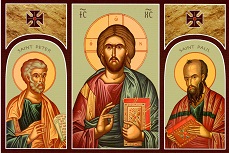
A THIRD SERMON FOR THE SECOND SUNDAY AFTER EASTER
by Martin Luther
Text: John 10:11-16 (KJV)
CHRIST’S PERSON, OFFICE AND GOVERNMENT.
1. Today’s Gospel has been appointed, I think, for this Sunday because Christ announces in it that he will lay down his life for his sheep, that is, suffer and die; and yet he also shows, at the same time, that he will rise again, in that he says: “Other sheep I have; them also I must bring” etc. For if he is to be and remain a shepherd of his sheep, he must not remain in death, as he himself afterward explains and interprets, in plain words: “I have power to lay my life down, and I have power to take it again.”
I. HOW AND WHY THE JEWS WERE OFFENDED AT THIS SERMON.
2. The Jews indeed heard this parable and sermon of Christ, but did not understand it at all, as the context declares. It sounded altogether too strange in their ears that he alone should be the true shepherd, and yet he was in the act of laying down his life for his sheep. What kind of a shepherd, think they, was this to be, who would die and give his life for the sheep? Can that be called guarding and keeping the sheep?
3. In like manner it was an intolerable doctrine to them that he said he had other sheep which were not of this fold, that is, did not belong to the nation which alone was called God’s people. These also he would bring, and of these, although they were not of this fold, there should be one flock, under one shepherd, regardless of what became of their fold and their shepherding. They understood very well what he meant by shepherd and sheep (for it was a form of speech familiar and current among them, especially from the Scriptures), namely, that he claimed to be a man who would teach and govern the people. But because, as they consider it, he puts forth his claim so unreasonably, wishing to be the shepherd alone and yet saying that he will lay down his life for the sheep and that he has still other sheep which he will gather and make one flock — notwithstanding that they, the Jews, refuse to be his sheep — they are offended in him and say that he is mad and that the devil speaks through him. They, nevertheless, understood this much, that his meaning was that their shepherding — that is, their entire government which they had from Moses, the Law, the priesthood, circumcision, the service of God, all appointed for them by God himself — should become void and henceforth count for nothing, and that he would institute something entirely new, in which he would be all in all and rule supreme and would gather a new flock of both Jews and gentiles, just as he should find those who would cling to him recognizing no one else, whether Judaism and its government, glory and existence should abide, stand or fall.
4. He makes matters still worse by saying, “I am the good shepherd,” whereby he draws the people entirely to himself. He means to say, Dismiss the teachers and rulers you have, and take me for your shepherd. The very best of them, those who teach and profess Moses and the Law, he calls hirelings, who are to be forsaken and not listened to; without considering that other multitude, the thieves and murderers, that is, those who teach against God’s Word and are public persecutors. Hereby he well deserves that they should execute him without sentence and grace, as a publicaccursed blasphemer against God, God’s Law and God’s people.
5. Without doubt, the great lords, high priests, Pharisees, scribes and all that belonged to their spiritual government, defiantly boasted and bragged against all this: We sit in the true office and priestly estate, ordained not by Moses, but by God himself through Moses. How dare you, rebellious scoundrel, open your mouth before all the people and boast against God’s ordinance and commandment, that you are the shepherd and you alone?
You are not even of priestly lineage, of those to whom God, through Moses, committed this charge and whom he commanded the people to hear. And when did God, publicly before all the people, speak to you as he spoke to Moses? Who are you, or where do you come from, that you dare, of your own authority, to utter such things and to apply to yourself alone all that has been said and commanded concerning the office of shepherd, thereby exalting yourself above and against Moses, the Law of God, the priesthood and all authority? Is not this both rebellious usurpation of the government and the crown by the whole people, and also blasphemy and sin against the divine Majesty?
6. To say, “I am the good shepherd,” what else is it but to say: To me alone they must hearken, the whole flock of sheep. That is, the entire nation belongs to me alone. I alone am its shepherd, and the only good shepherd, who saves the sheep. You, however, are but hirelings, that care not for the sheep, seeking only your own in them and letting them perish in time of danger. In one word, this is to make the people revolt from them and to tell the people that they have no good shepherd or preacher who is faithfully-minded towards them or is able to save them and to whom they ought to give ear. “For my sheep,” says he, “hear not the voice of a stranger.” But he tells them, if they cling to him, they shall be saved.
7. Moreover, he not only says that he alone is the shepherd of these sheep, but that he also has another flock and people, who are not under the government of Moses but are altogether outside of this fold. These, also, are to cling to him, and all shall be alike to him, gentiles as Jews, and Jews as gentiles. This is now the most offensive thing of all, that he makes nothing of God’s people and puts them, with their Law, priesthood and everything else, on a level with the gentiles, and the gentiles on a level with them, so that neither is better, of more importance or has more than the other. In short, it is equivalent to saying that all Moses instituted and ordained in the priesthood, temple and service of God is to come to an end and to pass away; that now there is a new priesthood and government, and a new shepherd has arisen, whose alone the flock is to be and who is to do all. This surely is knocking the bottom out of the barrel and taking the head off from all Judaism, depriving it of all its glory. Hereby he simply bids them to yield up their shepherdhood, to hear him alone and to suffer him to be all in all.
8. This was to them necessarily an odious, blasphemous injunction. For in their minds nothing was more certain than this: We have been appointed by God, through Moses, to the priesthood, to the office of teaching and ruling the whole nation. Now, whatever God has commanded and ordained must stand and not be changed by any creature. Therefore, our priesthood and Moses’ government must continue forever. And if the gentiles are to be added and to become God’s people, this must not and cannot take place through this carpenter of Nazareth (as they regarded and called Jesus), but through Moses, in that they suffer themselves to be circumcised and accept his Law, and visit the temple at Jerusalem. Even the apostles at that time still believed that this must remain, above all things, as the ordinance and commandment of God, given and instituted from heaven. In opposition to this, Jesus of Nazareth dares to arise and publicly declare the contrary. If you would come to God and be saved, you must, after all, surrender Moses, the Law, the temple and the priesthood. All these will in nowise help you. You must come hither to me, whether you be Jew, gentile, priest, layman or what you will, even if you should be Moses himself. So the Jews were offended at this discourse, and are offended at it to this day. This stumbling-block of opposition to Moses and their Law so lies in their way that they cannot get over it.
II. HOW THIS SERMON SERVES TO OVERTHROW THE FALSE TEACHINGS OF THE PAPISTS CONCERNING THE CHURCH.
9. In like manner it is also not less offensive to our opponents, the pope and his following, so to preach. For this Gospel makes it necessary to preach against their government, which has been called the only government of the Christian church in the world, and which, it is claimed, possesses constituted authority and all that belongs to the church, namely, baptism, the sacrament, the keys etc., by inheritance from the apostles and by the prescription of so many years. Wherefore, like the Jews, they claim to be the people of God and the church alone. It is intolerable to them, when, in spite of all their pretensions, it is urged against them that they are not the church and that God cares nothing about their boasting, their government and all that. And it is likewise intolerable to them when we separate ourselves from them and renounce obedience to them and also teach others so to do; because, in the name of the church, of Christ and of faith, they have quite obscured the shepherd Christ, and in the name of the church and Christian government have filled the church with their own idle talk, and are not as good as hirelings, but are wolves and murderers. They, themselves, now prove this by their public persecution and execution of Christians on account of this doctrine and confession concerning Christ, that he is the only shepherd, through whom we have forgiveness of sins and eternal life, who alone laid down his life for us.
10. And I declare that if the case of the pope were as good as that of the Jews, who without contradiction had the Scriptures and God’s Word in their favor, no man could get along with his adherents. For the Jews had the great advantage that their government was instituted by God’s command through Moses, and moreover was confirmed by miraculous signs and was so strict in its provisions that whoever would not hear Moses was to be stoned and excluded from God’s people. Such glorying and testimony, that their government of the church was commanded and confirmed by God, our opponents, God be praised, cannot produce.
Nevertheless, they do as the Jews did. Let any one preach concerning Christ and the Gospel whatever he will, they at once cry out against it: The church must be obeyed, the fathers be heard, the canons and decrees of the councils be kept. How else, say they, shall it be known what and where Christians or the church are? There must surely be some organization proceeding in proper order, such as the fathers and councils nicely arranged, and as has existed for so long a time, namely, that the church has a common head, the pope, and a regular government of bishops, and, under these, the ordinary priesthood, and, over all, a general council, whose decision, conclusion and judgment must be followed in all things. And if any one does not observe this order and institution, or opposes it and gives occasion to division, he must be of the devil, a perfidious, rebellious, accursed heretic.
11. In opposition to this, we must open our mouths and, in accord with this teaching of Christ, tell everybody, even as he commanded us to preach these things to all creatures: Dear friend, you may indeed observe, glorify and exalt such a human institution; but that does not make you a Christian.
This is not yet the true shepherd and master, whose name is Christ. You must be led another way to know and hear him aright, else all this will not help you in the least to your salvation. For being a Christian is something different from the pope’s government, and also something different from and higher than what the fathers have taught or the councils have decreed.
Even though they did well, as Moses also did well and truly somewhat better — for example, the Jews circumcised, they sacrificed, and they observed their divine service — and even though among us a fine order of offices and ranks be maintained, and external discipline and a beautiful service of God, together with fasting, praying, singing etc. — all this is not yet what is meant by Christ’s Word: “I am the good shepherd.”
12. For this shepherd and his office must be carefully distinguished (wherefore he also teaches this) from all other preachers, teachers and everything else that claims to have the rule over souls. Let all these do as well as they can, still none of them is a good shepherd. For Moses, forsooth, did not do badly; he instituted a fine order of a spiritual and temporal government, both in external discipline and in the service of God.
Nevertheless, his Jews are here compelled to hear that it can in no way help them before God, and that now, after it has endured and been maintained for so long a time, another is to come, who will glory exceedingly and boast: You have not yet the true shepherd that you ought to have. I alone am he, whose voice you must hear if you would be saved. And I have still other sheep, people who neither know nor observe anything at all of Moses and your entire government. Nevertheless, all shall be one flock. How so?
Both shall learn to know me as their true shepherd and shall hear my voice.
Therefore, I allow to preach whoever will preach, and let it pass; but the shepherd who can heal the injury, none will find until he comes hither and clings to me.
13. Therefore, we are also to conclude from this that there is nothing in the loud pretensions of those of the present day who would like to maintain the papacy with its counterfeit bishops, and who sputter much about the church government which they affect, where they sit together in established inherited power, as the heirs of the sees of the first bishops, ordained by the apostles etc.; by which the whole government of the church is to be bound to them, so that without them there can be no church. They alone are to have power to ordain, consecrate and confirm bishops. They would persuade us to hear them alone in whatever they jointly decide, and of necessity receive from them all that pertains to the church, its office and government, the sacraments, the office of preaching, priestly orders etc.
They would have us believe that they are no true bishops or priests, nor can they administer the sacraments, who have not received unction and chrism from them. Therefore, they also clamor and fume about us, saying that we are disobedient and rebellious and have set ourselves against the constituted power of the church and have seceded from them etc.
14. In opposition to this, Christ teaches us in this Gospel to look to him alone as the true shepherd, who only is the founder, lord and head of the church, and says his sheep hear his voice, and not a stranger’s. Hereby he indicates that these are the true church, without regard to their being under the pope and his bishops, or even under Moses. For he and his kingdom and church are bound neither to Moses’ Law nor to Judaism, although they were instituted by God, much less to the government of pope and bishops, established by themselves. Neither has he taken or received anything from them, but he is the Lord of Moses and of all creatures, to whom all men should be subject.
15. Therefore, when the Jews in the name of Moses, or our opponents in the name of the church and its power, undertake to draw people away from Christ, that is, from his Word and the pure teaching of the Gospel, he opposes them and says: “My sheep hear my voice; and a stranger will they not follow, for they know not the voice of strangers.” Here he gives us not only the right and power, but even a distinct command not to hear nor to be allied with them.
16. Since now we see and apprehend that the whole papal party not only keep, believe and teach nothing concerning Christ, but are public persecutors of the Gospel, that is, wolves and murderers of Christ’s sheep and church, and that they conduct and exercise a real anti-Christian government, we should and must, by Christ’s command, break away from their imagined power and possessions, from which they already are deposed by Christ himself. We are commanded to have nothing to do with them, but are to avoid and flee from them as the devil’s church, as St. Paul also utters this sentence ( Galatians 1:8): “Though we, or an angel from heaven, should preach any other gospel, let him be anathema.” This is certainly a strong enough deposition from all power in the church, a command to respect the deposition and condemnation of God.
III. WHAT IS THE SUMMARY OF THIS SERMON?
17. This then is the main thought and sum of this Gospel, that Christ alone is the good shepherd. It teaches us the power and fruit of the preaching of the Gospel and its ministry and distinguishes it from the office of Moses and the preaching of the Law. Christ names only two who keep and feed the sheep, the true shepherd and the hireling. For the wolf is but a murderer, who works only injury and havoc; to resist him shepherds are necessary. But if the shepherd and the hireling are compared, it becomes manifest that Christ alone is the shepherd, who lays down his life for the sheep. Neither Moses nor any other preacher of the Law does this.
18. For this reason, he justly calls himself alone the good, that is, the comforting and helpful, shepherd. For, although Moses, the prophets and all other preachers of the Law preach and teach, they are not able to lay down their lives for the sheep and to save them. They all had to die for themselves, and were not able thereby to save either themselves or others.
But Christ says: It is I alone who lay down my life for the sheep. Only death brings salvation to the sheep. And because I am such a one, I found this new doctrine and a new flock and people.
19. In this way he refers the true shepherd’s office, that is, the authority to help consciences and souls, to his own person alone, as the only one who has effected and completed the work of our redemption, given his body and life for his sheep, and instituted and perpetuated the office through which he gathers, governs and preserves them. This office, therefore, comprises the whole preaching of the Gospel, wherever, whenever and by whomsoever it is done. These preachers are also named, after Christ shepherds; not for themselves, for that honor belongs to Christ alone, but because they are in the office which is Christ’s and which he exercises through them.
IV. HOW CHRIST EXPLAINS IN THIS SERMON HIS PERSON AND OFFICE BY A REVERSE PICTURE.
20. This then is the first section, treating of Christ’s person and the office which he exercises in his church. Afterwards, when he speaks of his sheep, he elucidates it further. But first he pictures the hireling in contrast and says: “He that is a hireling, and not a shepherd, whose own the sheep are not, beholdeth the wolf coming, and leaveth the sheep, and fleeth, and the wolf snatcheth them, and scattereth them; he fleeth because he is a hireling, and careth not for the sheep.”
21. He names three kinds of persons or three offices which have to do with the sheep: The true shepherd, which, as has been said, he is himself; the hireling, including all besides him who preach the Law and teach how we ought to live and do good, but do not point to Christ, like the scribes and Pharisees among the Jews of old; and finally the wolf, who wishes to be among the sheep and to rule over them but only works injury and ruin. The wolf is the devil, who also has his messengers and preachers. However, they have not the Word of God, neither the ten commandments nor the Gospel, but they mislead souls by false doctrine and heresies, which St.
Paul, 1 Timothy 4:1-2, calls “doctrines of devils, speaking lies in hypocrisy.” Such are now the pope’s anti-christian doctrines, the Koran of the Turks, and doctrines of other sects. These three kinds of teachers have always been in the world from the beginning. We should keep the first, reform the second, and shun the third. None do this, however, except the true sheep, that is, the little flock which knows Christ.
22. He also manifests here the condition of the sheep, and why he alone must be known and believed as the true shepherd. The condition of the sheep is such that, if the shepherd is absent, they are in the certain danger and distress of being seized, torn and killed by the wolf, for by their own strength they can neither guard nor defend themselves against him. A sheep is naturally a poor, weak, defenseless animal above all others and is quite dependent upon the protection, care and help of someone. The true shepherd must devote himself to the sheep, ever be with them, watch over them, rescue and defend them, whenever it is necessary, so that they may not perish. A stranger or a paid hireling, whose own the sheep are not, says Christ, will not do that; although for a time he leads and feeds them, he will not hold out to the end. When the wolf comes, he flees in order to save himself, and meanwhile lets the poor sheep face the danger and perish.
23. So, also, it is with consciences in a spiritual way. If Christ himself, by his shepherd’s office, does not guard, lead and guide, all other preaching is vain, even if in other respects it is good and right. It cannot serve in distress, when the devil opens the jaws of hell by the terrors of sin and everlasting death. When this comes to pass, the poor sheep stands there alone and forsaken, dependent upon itself and its own efforts, according to the doctrine of the Law and of works, with nobody to help or assist, from whom to obtain comfort or find salvation.
24. No better example of this can be adduced than what we, ourselves, experienced under the papacy in times past. The sweetest preaching possible was given, which, among others, I gave diligence to teach both myself and the people. We were told: You ought to keep the ten commandments, love God with your whole heart and your neighbor as yourself. This teaching was not wrong, for the Law should be taught. But in order to impress this on the people, they added: Man can well do this, for he has the natural light of reason, given by God, by which he understands what he ought to do and what leave undone. Moreover, he has a will, by which he can resolve and begin to do this. And if with all diligence he exercises himself in such works and does what is in his power, God will regard and accept this, and undoubtedly bestow grace upon him.
25. To this comforting assurance they added many good counsels. For they, themselves, felt that what they taught concerning the decalogue was not sufficient. The purpose of their counsels was to escape from death and to obtain salvation. They prescribed extraordinary, severe orders and modes of life, mortification of the body, fasting, watching, pilgrimages etc.
All this they considered good and valuable, and performed it with the good intention that it was to be acceptable to God and to be received as a fulfillment of his commandments. But when all this had been tried, and when finally the devil came, in the hour of death or in other grievous trials, then all such teaching and works were found wanting, and poor consciences were miserably led into the devil’s sweat-box, in which they worried and tormented themselves with thoughts of despair, with words and groanings, crying: O Lord God, if I could live longer, I would do penance for all my sins! etc.
26. Such was the use and fruit of the hireling-doctrine, which referred poor souls to their own doing and suffering, while nothing was said of Christ and of faith. This kind of teaching can only comfort and sustain so long as the devil is not present; for he is not concerned about our works, satisfactions and life. Where he does not find Christ, he has won the game.
He advances, tears and devours souls without restraint or hindrance, according to his pleasure. Indeed, these teachers and masters are powerless to help themselves. They are frightened and scattered as well as the sheep, so that they know not where to abide and finally, unless they learn of other help, they become the prey of the enemy. An example of this is the case of a hermit who once came to a sick man on his deathbed and endeavored to comfort him so that he might die peaceably. He exhorted him, as is the custom of such comforters, work-saints and monks, to die willingly, and to suffer patiently; this would secure for him forgiveness of all sins, with God.
He was willing to pledge his soul for it. Gracious God! Here lies a poor sheep in its dying moments; it accepts what it cannot avoid, and on the strength of such comfort dies. But what happens? Soon after the death of this poor wretch the old hermit’s last hour comes and fills him with such anxiety and terror that he becomes despondent of the very comfort which he gave to others. No attempt at consolation will avail him, and he finally sinks into despair.
27. This is what must come to pass when only our own words are preached, or even only the ten commandments are taught, notwithstanding the preaching of these things is necessary, especially for the rude multitude.
But where there is no Christ, it only serves to confuse and scatter the poor sheep and to drive them into terror and despair, so that they must perish, unless they are restored again by the true shepherd.
28. When human nature and reason hear the preaching of the Law, even in the case of those who teach the Law in the very best manner without however knowing Christ, they foolishly err and imagine, when they have heard this doctrine, that they can easily fulfil it. For they say they have both the understanding and the will to do it. They think no further than that it is accomplished with their self-devised thoughts and outward works.
Accordingly they proceed, and imagine that they must do whatever is told and held up to them in the way of good works, as commanded by God.
They seek thereby to atone for sin and to blot it out, whereas God by no means demands that we do good works to this end, or that sin can be blotted out by works. Hence, they go on in this erroneous delusion and gather and accumulate all the works they can think or hear of, which God certainly has not commanded. They are simply caught by this conclusion:
Good works are to be done; this is a good work, therefore I am under obligation to do it. In this manner they proceed and are ever doing, but never arrive at fulfillment. Hence, they are not able to resist the wolf. The more they do, the less they are satisfied and the more they find to do. And as soon as the devil comes and pretends: Behold, this is a good work, which you have done — they cannot get around it and must allow themselves to be carried away.
29. Yea, though they had done all that man can do, nevertheless, if the wolf appears before their eyes with his gaping jaws of hell, they realize that it will not stand before God’s wrath and judgment. With a single breath the devil blows it all away and says: You have done much, it is true; but when have you fulfilled God’s commandment, to love him with the whole heart above all things, to have no evil thought, desire or lust in the heart, to speak no idle, vain words? Then both the doctrine which the hireling gave you, and all your works and deeds which cost you so much labor and toil, drop and fall. You have no comfort or refuge against the devil, for he always has the advantage of driving you back on your own conscience and the testimony of your own efforts, as the hireling instructed you, who taught you only what to do, but imparted no strength to do it, and so left you in the lurch. In short, you are overcome by yourself and are convicted by the sentence: The good must be done.
30. In this way the devil introduced the mire and filth of all human doctrines into the church through the pope, and there was no one to resist him, for all proceeded on the principle that what is good must be done.
Therefore, whatever they called good and a service of God, had to be done. And even now they have not ceased to spew venom upon us, contending that our doctrine of faith and love is a bad doctrine; that we know nothing better to preach than the childish lesson of the ten commandments; that we must rise much higher and do much more, and teach not only what is contained in the Scriptures, but also hear what the church and the councils say etc.
31. Hence, everything that any shabby, impudent mendicant monk dared to hold forth was violently confirmed and swept in like a deluge. Indeed, we simpletons, doctors of the Holy Scriptures as we were, could not prevent the pernicious barefoot (Carmelite) sect from persuading the people that if a dead man was buried in their monk’s cowl, he would be saved and the devil could not get him, or else he would have taken him before. For we were all dazzled and taken captive by the sentence: We must do good works, and whoever does them is saved.
32. Verily, even to this day we could not stand before the papacy or overthrow its least error if we had not more than this doctrine of our works and deeds. Even as the pious martyr, John Hus, was cried down and condemned by the devil in the diabolical council at Constance, when he rebuked the pope and his followers on account of the wicked, shameless life by which they often violated their own canonical laws. For this was their defense against him, that although the life was not right, the doctrine, that these things were to be kept and done, was right. Hence, the papacy has hitherto resisted overthrow so long as its doctrine has been considered true and remained unchallenged.
33. Therefore, these two, the hireling and the wolf, are always together.
The devil likes such teachers, for, in the absence of the true shepherd, they serve him in enabling him to rend and kill the sheep without trouble, when and as he wills. And there is no defense save Christ and his doctrine and protection. As the only true shepherd, he does not allow the sheep to struggle with the wolf (for if it once comes to that, they are already in his jaws), but flings himself against the latter and gathers us around himself, and so protects us that the devil is compelled to flee. This takes place when from the Scriptures it is taught that no human work or endeavor, however good it may appear, even if done in accordance with the ten commandments, and no possible teaching, will avail to free from sin or stand before the wrath of God and the terrors of death and hell etc. This alone avails, that Christ laid down his life for you and took it again, and thereby overcame the devil and death and made them subject to himself, in order that by his power and strength you might be saved.
34. But where the voice of this shepherd remains, the sheep can guard themselves against both hireling and wolf, and say: You, indeed, say truly that I ought to keep the ten commandments; but you do not tell me where I am to take refuge, seeing I have not fulfilled them. Here I will rather hear my dear shepherd, who died for me, and died not without reason nor in vain, but for this very purpose that I, who was such a poor lost sheep without a shepherd and in the power of the wolf, might be rescued. So, also, when the devil shows his teeth in your heart and threatens to kill and devour you, and tells you that you ought to have done or left undone this or that which you have not done or left undone, and that therefore you belong to him, you can take refuge with Christ as a sheep that knows its shepherd; and you can tell the devil to attack him who died and rose for you, and to try what he can win from him.
35. Still more can you repulse others who are not as good as hirelings, but are the wolf’s servants. They come and preach, as geese gabble, about our own fancied works. Say to them: I will hear and know nothing of these, for I have a much greater thing to do in learning the ten commandments. I am not able to keep them. Why should I worry myself with such useless works, which only harm and hinder me from properly considering the ten commandments? It indeed happened that the world was so filled with commandments and doctrines of men that no bishop and no doctor knew or taught the ten commandments properly.
36. For this reason we have reproved and attacked the papacy, not on the ground of their wicked and shameful life, which they themselves also acknowledge, but we say to them that, even if they led holy angelic lives, which they never have done and never will do, and if they kept not only their own law, but also the law of Moses, both of which are impossible, we nevertheless should regard them not only as hirelings, but also as wolves, because they teach only what destroys the souls. For nothing can feed or give life to the soul, which is not the doctrine of Christ. Although the hireling does not himself slay and destroy, he does not restrain the wolf.
Therefore, because you neither point out nor teach this shepherd, you shall not and ought not to be heard, but you shall be shunned as a wolf.
37. With this argument the papacy and all that leads away from this doctrine are overthrown. Otherwise it is impossible, as has been said, to correct the least error which is given out under the pretence of a holy life.
And no doctrine is so foolish or disgraceful but that it finds hearers and disciples, as is proven by the experience of the church with so many heresies and divisions. The heathen were reasonable and highly intelligent people, yet we read of them that they worshiped not only cats and storks, but also cabbages and onions, and even a member of the human body. All this comes from the name and delusion that such things are good works and render a service to God. The preacher of such works comes with the reputation and pretence of a shepherd who desires to counsel and direct souls on the way to God.
38. Alas! we have hitherto not been able to correct or prevent the shameful lies and fables of the monks concerning the rosary of Mary. This consisted of fifty Ave Marias and five Pater-Nosters addressed to Mary the Virgin.
The popes granted many indulgences to it, and the preaching friars (Dominicans) scribbled great books full of fanciful and disgusting lies concerning the power and wonderful efficacy of this prayer, which they themselves invented. Besides there was the frippery of innumerable similar lies invented by others, like the barefooted friars’ (Carmelite) crown and Psalter of Mary, concerning which they themselves are now silent and ashamed. Indeed, at the present day nobody in the papacy could refute or resist the faith of the Turks or of the Jews, for they of the papacy have not the true master nor the true solid doctrine of this shepherd. Therefore, the devil has power and authority over them, even by the decalogue. He always has the advantage of convicting you by your own conscience of not having kept the commandments; so much the more if you have spent your life in works based on human teaching.
39. If, however, you know this shepherd, you can defend yourself against devil and death, and say: Alas! I have not kept God’s commandments, but I creep under the wings of this good hen, my Lord Jesus Christ, and believe that he is my shepherd, bishop and mediator with God, who covers me with his innocence and bestows his righteousness upon me. What I have not kept he has kept, and the sin I have done, he has atoned for with his blood etc; for he died and rose, not for himself but for me. Even as he says here, that he lays down his life, not for himself, but for his sheep; that is, as St. Peter says ( 1 Peter 3:18): “Christ also suffered for sins once, the righteous for the unrighteous.” Thus you are secure and the devil and hell must leave you in peace. The devil certainly will not be able to do harm to Christ, who has overcome him, and who, if you only believe in him as his sheep, will, as a faithful shepherd, not forsake you, but will stand by you, protect and preserve you.
40. If now under this shepherd you are secure against the wolf, it is right that the hireling should also come as a good teacher, showing how you ought to live according to God’s commandments and to do good works, and go before you where now you can walk yourself (as far as lies outside of the conflict of the conscience with sin and death), provided, however, that you are first in the protection and pasture of this shepherd and do not stray away from him.
41. Behold, these are the three forms of preaching which always exist in the world: First, that of the great multitude, who set forth not God’s Word, but human doctrine. These are the wolves, such as the pope with his decretals, the Turk with his Koran, the Jews with their Talmud, and other sects against the pure teaching of the Scriptures. Second, the hirelings, who preach only the decalogue. They are few, and without the Gospel cannot long remain pure. Third, those who sincerely and truly point and lead to Christ. These are the fewest of all, but they will necessarily be found somewhere until the last day, as we say in the creed: “I believe in the holy Christian church etc.”
42. These are, and are called, true shepherds, because they preach not themselves, but Christ, and hence are the mouth of Christ, as he himself says in Matthew 10:20: “It is not ye that speak, but the spirit of your Father that speaketh in you;” and again in Luke 21:15: “I will give you a mouth and wisdom, which all your adversaries shall not be able to withstand or gainsay,” that is, it shall not be your mouth, but I will prepare your mouth that it shall be full of wisdom given by me, and shall speak by me. For this is the clap of thunder by which everything that is not of this doctrine and quality is laid low so that it serves and avails nothing for the life to come. It may in other respects be good to keep people under restraint or to bring them to a knowledge of their faults. For what is it that a man, pope or Turk can do in the face of eternal death and hell!
43. Hereby the pope’s government and all doctrines of men are stormed and overthrown. However, we do not antagonize them because they do not keep their own commandments and doctrine; for against this they always have the defense that, although their life is censurable, their doctrine is good and right. Hence they maintain their government by force, arguing from the words of Christ in Matthew 23:2-3: “The scribes and Pharisees sit on Moses’ seat: all things therefore whatsoever they bid you, these do and observe: but do not ye after their works; for they say, and do not” etc.
Therefore, before we had the Gospel, we were able to accomplish nothing against them. But now that we know Christ, we are able to condemn their doctrine together with all their works.
44. Here now you have the distinction which Christ draws between his preaching and government and that of all others who desire to rule consciences and hearts without or independent of him. With so many words about the hireling he pictures the danger, nay more. the injury and destruction, which must follow if he is not heard and known as the only shepherd, namely, that the wolf cannot be warded off, however numerous the hirelings. For with their doctrine they cannot help or give counsel how to escape from sin and death, nor can they resist the devil: and the poor sheep must soon be eternally lost and destroyed, unless it comes to this shepherd. Therefore, he again repeats what he said at the beginning, in order to impress it upon us, that we must hold fast to his protection and pasture, that is, to his Word and ministry, and says: “I am the good shepherd; and I know mine own, and mine own know me, even as the Father knoweth me, and I know the Father; and I lay down my life for the sheep.”
V. HOW CHRIST SETS FORTH HIS OFFICE AND GOVERNMENT IN THE MOST CHARMING MANNER.
45. Many, alas! too many, are called shepherds and undertake this government, which consists in feeding and leading souls; but I alone, says he again, am called and truly am the good shepherd. This means in plain words: All others besides me are not good, but are unmerciful, cruel shepherds, because they leave the sheep in the jaws of the wolf. But me you must learn to know as your dear, faithful, good, kind, sweet and comforting shepherd, towards whom your heart must be filled with laughter in the assurance that by him you are redeemed from every burden, fear, trouble and danger, and that he will not and cannot let you perish. I prove this, says he, by laying down my life for the sheep. Therefore, joyfully abide with me and let none other rule in your consciences. Listen only to me, who speak and by deeds prove this comforting word, that I will not drive, trouble or burden you like Moses and others, but will most lovingly lead and guide, protect and help you.
46. In this manner he ever insists on this one doctrine as the chief point of our salvation, that there is no deliverance or help apart from this shepherd, Christ, apprehended in the faith that he alone rescues us by his death from the power of death and the devil. Therefore, this is the most necessary doctrine to be taught in the ‘church. The devil is hostile to it and cannot endure that we remain with this good shepherd and in the pure sense and significance of his teaching. Therefore, he is always raging against it through his agents, with cunning and deceit, with persecution and blasphemy, with a view of tearing people away from it, just as he also opposed this teaching through the Jews. But we on the other hand, as his pious sheep, must listen to the shepherd’s voice and know that, when all things fail and the counsel and help of all men come to naught, we are safe and are preserved by faith in this shepherd, who laid down his life for us.
He also concludes concerning his sheep, that is, the whole church, that he knows them and they know him: “I know mine own, and mine own know me.”
47. This is, indeed, strange language, and naturally was singular and ridiculous to the Jews, just as when he had said that he alone was the shepherd. Without doubt they scornfully curled their lips at it and said:
You talk much about your shepherd’s office and your sheep. Man, where have you your sheep and where are they to be found? We have a nation and a flock, who adhere to the temple and the service instituted by God, and keep the Law of Moses. By this they are organized into a fold; so that they can be known and named. But where are yours? How are they known? What are they like? Give them a name and sign. No, says he, you shall not know them in the way that you conceive. Your sheep have their marks, by which they are known and distinguished: they are circumcised, they come to the temple at Jerusalem etc. But my sheep have another mark, not made or painted with colors and red ochre, so as to be visible on the forehead or on the wool. The pope, also, imitating the Jews, makes and marks such a church and Christians that everybody may know them by their outward conduct and life. No, it will not do, he means to say, to indicate them with the mark and seal which you put upon them or Moses puts upon them; but they are so marked and distinguished that nobody knows them except me alone.
48. Although Christians also have external marks, given by Christ, to-wit, baptism, the sacrament and the preaching of the Gospel, these may fail when we have to judge any individual minutely. For many a one has been baptized, hears the Gospel, and goes to the sacrament with others, and yet is a rogue and no Christian. But the distinguishing mark is this alone, that the faith that looks upon Christ as the shepherd dwells within the heart.
But who knows this? You cannot see it in me, nor I in you; for nobody can look into the heart of another. So, then, it remains true that nobody knows or is able to describe these sheep and this flock, except this shepherd, Christ, alone. Again, my sheep alone know me, says he, and so know me that they do not allow themselves to be turned or torn from me, but abide in the faith, confession and doctrine that I am the shepherd and give my life for them against the devil, the world, death and hell.
49. Now, here again he overturns Judaism with its law and priesthood, and still more our papacy with all that belongs to it, and deprives them of the power of ruling and of judging his flock. He simply will not have himself and his church ruled by them, and therefore rejects and condemns all such judgment as they, according to Moses or any other external order and government, wish to pronounce in regard to who are Christians or not Christians and God’s people. On the contrary, he tells them that they neither shall nor can know his sheep, yet he will have and preserve his church, although they know and receive neither shepherd nor sheep, but reject and condemn both, as cut off from the people of God.
50. Moreover, he gives us the criterion by which we are to distinguish the true church or people of God from that which has the name and reputation but in truth is not the church. He teaches us that the church neither is nor ought to be a society which must be organized with an external government and order, like the Jewish people under the Law of Moses.
Nor does it exist, nor is it governed and preserved, by outward human power; much less is it bound to a regular succession or government of bishops or their successors, as the papacy claims. It is a spiritual assembly, which hears this shepherd and believes in him, and is governed by him through the Holy Spirit. It is outwardly recognized by this alone, that it has his Word, that is, the preaching of the Gospel, and his sacraments.
Inwardly it is known to him alone, as in turn it also knows him by faith and clings to him when it hears his Word, regardless of the fact that it may neither maintain nor even know anything of that outward Jewish or papistical government and order, and may be scattered here and there in the world without any organized external government; as in fact it was in the time of Christ and the apostles, who, apart from and in opposition to the regular power of the whole priesthood, believed in Christ and confessed him.
51. Therefore, if you wish really to know what a Christian is or why a man is called a Christian, and to give a true definition of the same you must not look to the Law of Moses the government of the pope, nor the life and sanctity of any man, however holy. But you must look alone to this Word of Christ, where he says: “My sheep know me, and my sheep hear my voice.” Then you will say: A Christian is not one who leads a strict, severe, earnest Carthusian or hermit life; for Jews and Turks can also do that, some of whom do live even more strictly. In short, nothing that is in us or can be done by us, makes a Christian. What then? This alone, that one knows this man, and regards him and trusts him as he wishes to be considered, namely, as the good shepherd, who lays down his life for the sheep and knows them.
52. This knowledge is nothing else than faith, which arises from the ministry of the Word. The Word consists not of our own thoughts nor does it come from men; but it was brought from heaven and was revealed by Christ himself, as he said to Peter in Matthew 16:17: “Flesh and blood hath not revealed it unto thee” etc. These two must always come together and agree: his Word and our faith. For if he were not to reveal himself by his Word nor let his voice be heard, we would know nothing of the shepherd. I say, in this way and in no other does a man become a Christian, when he hears this voice alone, and knows no other shepherd and allows no other to be fashioned for him, whatever his fame and luster, but grasps this image alone in his heart. And all the sheep of Christ without distinction have this one color and form, whereby they are to be identified, and are like each other in this, that they believe on this shepherd and confess his Word, although externally they differ in many respects, and are scattered here and there in the world without order and are spread abroad among different peoples.
53. Hence we derive this comfort, that if anyone knows Christ in this way, he is certainly one of his sheep, and is already known by him and elected to be a sheep. He ought and needs not to seek and to look further how he may become a sheep, nor to worry and torment himself with the vain thought of whether or no he is elected and how he may become certain of salvation. But he ought joyfully to comfort himself and be secure in this, that if he hears the voice of Christ, he has in him a dear shepherd who knows him, that is, cares for him as his sheep, provides for him, protects and saves him, so that he need have no fear of the devil, hell and death.
This knowledge of his sheep and its power he further explains with comforting words and says: “My sheep hear my voice, and I know them, and they follow me: and I give unto them eternal life; and they shall never perish, and no one shall snatch them out of my hand.”
54. And for still greater comfort he adds: “Even as the Father knoweth me, and I know the Father.” It is a glorious, comforting knowledge with which the Father knows his dear Son in inexpressible, unfathomable, eternal love, as he publicly testified by the voice from heaven and said: “This is my beloved Son,” Matthew 3:17. So that for his sake he took pity and had mercy on the human race, when it had fallen into eternal wrath and condemnation and was in danger of being eternally lost; as St. Paul says in Ephesians 1:6: “Which (grace) he freely bestowed on us in the Beloved” etc. In the same manner Christ also knows us with a like inexpressible love, as from the beginning he loved the human race, and therefore most deeply humbled himself beneath all men and even beneath sin and death, and endured the wrath of God for us, that God might not permit the devil to keep us in his bonds and in everlasting condemnation.
55. Since now, the Father knows Christ in this way, and Christ in the same manner also knows us, his sheep, the knowledge which comes to us from the Father through Christ and that whereby we should know the Father’s heart toward us through Christ, become one and the same. That is to say, as he loves Christ his Son, so he cherishes toward us, who know Christ as sheep know their shepherd, true paternal love, in order that we may know that it is not his will that we should be lost or condemned if only we believe in his Son whom he has given for us. For he cannot hate his Son; and he sent him from heaven that through his blood and death he might deliver us from sin.
56. This is truly a high and glorious consolation. But it is also a very spiritual, that is, hidden and secret, knowledge in our eyes and thoughts, to believe that both Christ and the Father know us in this way. For to all human eyes it is deeply buried under manifold scorn, weakness and hostile opinions of the world and of our flesh and blood. In the world they take offense at this kingdom of Christ and his church, because it does not accord with their wisdom and is not organized and regulated as in their opinion it should be regulated if it is to be God’s government and work.
Indeed, because its course is contrary to reason, sense and thought, the world regards the doctrine as pure folly and delusion, and condemns and persecutes all who adhere to it and are unwilling to follow the world’s own opinion. Not only is Christ hidden from the world, but a still harder thing is it that in such trials Christ conceals himself even from his church, and acts as if he had forgotten, aye, had entirely forsaken and rejected it, since he permits it to be oppressed under the cross and subjected to all the cruelty of the world, while its enemies boast, glory and rejoice over it, as we shall hear in the next Gospel. Moreover, Christians must suffer themselves to be especially tormented by the devil inwardly, in their hearts, with the terrors of their sin and God’s wrath, and so must endure every misfortune and the tortures of hell; not to mention what they are otherwise compelled to feel and see in themselves and among their own brethren in the way of weaknesses and faults in both faith and life, and whatever scandal the devil can cause.
57. Under these circumstances, who knows the sheep, or regards them as such, seeing they are so deeply buried and overwhelmed with suffering, shame, disgrace, death, scandal etc., that they are concealed even from each other? Certainly nobody but Christ alone. He tells them, and comforts them by it, that notwithstanding all that excites the displeasure of the world and our own flesh and blood, he nevertheless knows his sheep, and neither forgets nor forsakes them, although so it seems.
58. And in order to impress this more deeply upon us, he adds a comparison and says: “Even as the Father knoweth me.” This is truly also a deep, hidden knowledge, that God the Father knew his only begotten and beloved Son, when like the child of the poorest beggar he had to lie in the manger, not only unknown by his entire people, but cast out and rejected; or when he hung in the air most disgracefully and ignominiously, naked and bare, between two murderers, as the most wicked blasphemer of God, and a rebel, cursed by God and all the world, so that he was compelled to cry out to him in great agony: “My God, my God, why hast thou forsaken me?” Matthew 27:46. Nevertheless, he says here: My Father knoweth me, precisely in this suffering, disgrace and offensive form, as his only Son, sent by him to be the sacrifice and to offer up my soul for the salvation and redemption of the sheep. Likewise I know him, and am aware that he has not forgotten and forsaken me, but that he will lead me through and out of disgrace, the cross and death to eternal honor, life and glory. In the same way my sheep shall also learn to know me in their misery, shame, suffering and death, as their dear, faithful Savior, who has suffered in like manner and given his life for them. They shall trust me with assurance that in their distresses they are not forsaken or forgotten by me, as reason and the world imagine; but that in all this I will wonderfully preserve them and thereby bring them to eternal victory and glory.
59. Behold, this is the true knowledge of Christ, with which he knows us and we are known by him. High and glorious wisdom! But for the reason and thought of the world it is far too deeply buried and hidden. It is comprehended by faith alone, which must here undergo a great conflict in order to keep this knowledge and to increase in it, lest by the great occasion for stumbling which appears here it be drawn away from Christ; as he himself admonishes in Matthew 11:6: “Blessed is he, whosoever shall find no occasion of stumbling in me.”
60. Here we are also to learn, as I have often said, that we must not judge of the kingdom of Christ and his church by the outward appearance and with the judgment of reason and human wisdom. For here you are told that this knowledge of the sheep belongs to Christ alone, and that it is as much hidden to reason under the greatest offense as he himself was when hanging on the cross.
61. Therefore, the presumption of the mad, proud, sanctimonious and unreasonable wiseacres is to be rebuked, who with their arrogant judgment are already to secure and condemn Christians who possess the teaching of the Gospel and faith in purity, when they detect in these any weakness or fault. In their minds they picture a church which has only perfect, heavenly saints, without any fault, defect or offense — a manifestly impossible thing in this life. For even if the devil be not always busy sowing his seed in the true church through his sects and false saints, there are many Christians who are still weak in faith and show many infirmities in life; yea, even the greatest saints, who are pure in faith and irreproachable in life, find and feel in themselves many a weakness and remaining sinful inclination, and find cause enough for grief and conflict in overcoming this offense in themselves.
62. Particularly they who fill the office of the church as preachers and pastors, are to learn here how they ought to conduct themselves toward the weak and erring, so that they may learn to know them as Christ knows us. That is to say, they ought not to be harsh and rude towards them, forcing and scolding them, or condemning them if everything is not always just right; but they ought to deal gently and tenderly with them and bear their weaknesses until they grow stronger. Wherefore, the prophet Ezekiel also rebukes the priests and those to whom God committed the office of shepherd, because they ruled over the sheep harshly and rigorously, and did not nurture the weak, nor heal the sick, nor bind up the wounded: nor restore the erring, nor seek the lost, and says ( Ezekiel 34:15-16): “I myself will be the shepherd of my sheep. I will seek that which was lost, and will bring back that which was driven away, and will bind up that which was broken, and will strengthen that which was sick” etc. Hereby he shows that God also has in his flock the weak, the wounded, the erring, aye, even the lost. Still he recognizes these as his sheep, and will not have them rejected, but nurtured, bound up, healed and restored. And because they, wishing to rule strictly and rigorously, according to the government of Moses and by enforcement of the Law, failed to do this, he gives the promise of the kingdom of Christ, in which he will himself rule and feed his sheep, by the Gospel, through the true shepherd, Christ: “And other sheep I have, which are not of this fold: them also I must bring, and they shall hear my voice; and they shall become one flock, one shepherd.”
63. Concerning these words we said in the beginning that with them Christ bids farewell to the Jews with their synagogue, the people and priesthood, who adhere to Moses, and declares that, although they do not receive him and regard him as their shepherd, which he was ordained of God to be, even by the testimony of Moses, he would still find sheep, both among them and, because they are not willing, among others who are not called God’s people nor know ought of Moses, that is, the gentiles. As he had also announced before through the prophets ( Hosea 2:23): “I will say to them that were not my people, Thou art my people.” And “I will move them to jealousy with those that are not a people.” Deuteronomy 32:21.
These, says he, will I bring, not to hear Moses and you, but to hear my voice and so through my Word to become my sheep, even though they do not come hither nor receive circumcision and the government of Moses, nor even have me visibly and bodily present with them. In this way all shall be, in one word, faith and Spirit, one flock under Christ, the only shepherd, and shall be subject to nobody else. This work began at his ascension, and will be in course of fulfillment daily until the end of time.