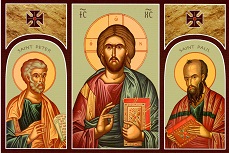
When the Son of Man comes in His glory

right-click to save, or push Play

Sermon for Trinity 26

Isaiah 40:9-11  +  2 Thessalonians 1:3-10  +  Matthew 25:31-46

Today the Holy Spirit confronts us with an image of the future of our planet and our human race. It’s the image of Christ returning in glory to make a final and eternal separation between the saved and the damned, believers and unbelievers.  It’s a fixed image of what’s coming for every human being who has ever lived and who ever will live before that Day. No one can escape it, and nothing can change it.

Jesus tells us what’s coming, especially to comfort His believers, but also to warn us, to spur us on to works of love, and to leave unbelievers without excuse when the Son of Man comes in His glory.

When the Son of Man comes in His glory… That’s the first comfort for believers in Christ. Jesus, the Son of Man, will, indeed come in glory. The picture He gives of Himself, coming down on the clouds and great glory, surrounded by the great company of holy angels, sitting on His glorious throne—He gave this picture to His disciples during Holy Week.  In just two days they would see Him standing before human judges, Jewish and Roman, wicked judges who would sit on their thrones and pervert justice and condemn the innocent Son of God to death on a cross. Similar things would happen to Jesus’ disciples. But Jesus assures them, it won’t always be that way.

We, too, do not see Christ in glory now. His disciples beheld Him risen from the dead, but we haven’t. To us it looks as if He has no glory, and neither shall we.  But it will not always be this way. Even now, Christ reigns from the right hand of God and His will is done, but His reign is secret and hidden and must be believed, not seen. One day it will be seen. As Isaiah cried out for joy in the Lesson today, Say to the cities of Judah, “Behold your God!” Behold, the Lord God shall come with a strong hand, And His arm shall rule for Him; Behold, His reward is with Him, And His work before Him.  That prophecy of Isaiah already began to be fulfilled when Christ came the first time. Its culmination waits for the time when the Son of Man comes in His glory.

The second comfort for believers is that it is the very same Son of Man, Christ crucified for us, who will be sitting on the throne of Judgment, no other.  No other god, no other prophet, no sinful human judge who might make a mistake or judge with partiality.  It is the very same kind and merciful Jesus whom we have come to know in the Gospels, in whom we believe, who will be judging the earth. The very One who gave His life for us, and has called us into Himself through Holy Baptism, and who feeds us even now with His body and blood for the forgiveness of sins; the very One who right now, in the words of Absolution, speaks the sentence of forgiveness upon you—He will be our Judge.  And will He who does not change change His mind when He comes?  Far be it! The judgment you hear now in the Word is the only judgment there is.  He who believes in Him is not condemned; but he who does not believe is condemned already, because he has not believed in the name of the only begotten Son of God.

The third comfort for believers is that the King will separate the sheep from the goats.  He will need no help. He will make no inquiries, nor will He be interrogating anyone on that day. The judgment is determined during this life.  Those who persevere till the end in faith are the sheep.  Those who are found unbelieving at the end are the goats. And when I say, “believing” and “unbelieving,” I don’t just mean those who “believe” that Jesus is the Son of God.  The demons believe that, and shudder.  To believe in Christ is to cling to Him alone for forgiveness and salvation.  To believe in Christ is to rely on Him and His cross to make things right with God.  To believe in Christ is to use Him as the Mediator between God and man, and to plead His merits in God’s court of Law.  There are many who speak highly of Jesus and call themselves Christians, but secretly despise His Word and cling to their sins or to their works rather than to Him. The herd of goats on the Last Day will include everyone who was not baptized into Christ.  It will also include many who were baptized into Christ, but who fell away from the faith of their Baptism.

The fourth comfort for believers is that, as the King turns to His right on that Day, He will have no stinging accusations or shameful observations, only words of praise and commendation for His sheep.  It’s not that the sheep committed no sins in this life.  On the contrary, believers, too, are by nature sinful and unclean.  They are miserable sinners—every one of them.  But the sheep are sinners who have been called to repentance in this life by the Word of God, who no longer sin willfully and stubbornly against God’s commandments, but now hate the sins in which they used to live and that still cling to their flesh. All the sins of those who believe in Christ have been swallowed up in the blood of Christ and buried in the tomb of Christ. Their sins have been intentionally forgotten, even by the Judge Himself.  They will never be remembered again.

What will be remembered by the King are the works of love done by believers in Christ for the brothers and sisters of Christ. The Lord is serious about the necessity of works of love on the part of His people.  That’s also how St. Paul spoke to the Thessalonians in today’s Epistle: We are bound to thank God always for you, brethren, as it is fitting, because your faith grows exceedingly, and the love of every one of you all abounds toward each other.  The fact that the King will mention these works of love, the fact that the King will be so pleased by these works of love on the Last Day should spur us on to even greater devotion to one another.

At the same time, it should serve as a warning to the false Christians who imagine that they don’t need to worry about serving their neighbor or helping their neighbor in need.  God expects that His love will be reflected in the lives of His children. Knowing this, hearing these words from Jesus about what works He will praise on the Last Day, no Christian, no believer would dare to say, “I’m not concerned about how my Lord wants me to live or how He wants me to treat my neighbor.” Only the reprobate—only the unbelievers would say such things.

Now, of the works of love that Jesus says will be remembered on the Last Day, He only speaks here about works of love prescribed the Fifth Commandment—helping and being a friend to our neighbor in every bodily need.  He certainly could mention the works of love prescribed by the other commandments as well.  It’s not as if God doesn’t care about the other commandments, like the honoring of His name, His Word, His Sacraments, parents, marriage, our neighbor’s good reputation, etc. He most certainly does care about those things and will certainly reward the works of love done by His people according to those commandments as well.

But as Luther points out, these Fifth Commandment works of showing love to the needy are the ones that even the pagans do for one another.  The heathen do similar and better works of charity and bodily help for their own.  It’s not the works that save.  It’s faith in Christ that saves. The unbelievers don’t do their works for love of Christ, or for His Christians who bear His name.  To serve a Christian, no matter how small, no matter how insignificant, is to serve Christ. That’s another comfort for the Christian. Our works of love done to the smallest, least important believer are done to Christ. He receives it as a service to Him when you serve a fellow Christian, when you support your pastor and his family, when you take care of the needs of little children, when you spend hours in the hospital with the elderly. There is no insignificant act of love in the Kingdom of Christ. It’s all service done to Christ, and He remembers it.

The sixth comfort for Christians in this Gospel is, at the same time, a stern warning for the unbelievers.  All the sins and crimes of the unbelievers will be remembered, and justice will be done for all the harm that has been done against God’s children in this world.  Jesus doesn’t even bother mentioning the unbelievers who have persecuted His sheep or committed vile, immoral acts. Those are obvious things for which they will be condemned.  But even this will be held against them: that they failed to help the least of these brothers of Jesus in need.  And they’ll think, wait! I did plenty of good!  How can you say I didn’t do these things? And Jesus will say, “You didn’t do them for Me.”  Their condemnation is just and right, as Paul said to the Thessalonians: It is a righteous thing with God to repay with tribulation those who trouble you, and to give you who are troubled rest with us when the Lord Jesus is revealed from heaven with His mighty angels,  in flaming fire taking vengeance on those who do not know God, and on those who do not obey the gospel of our Lord Jesus Christ. These shall be punished with everlasting destruction from the presence of the Lord and from the glory of His power, when He comes, in that Day.

Now we call out to all men with this warning, so that they may escape their destruction by repenting and turning to Christ for forgiveness before it’s too late. But on that day, no more warnings will be issued, and time for forgiveness will be past.

The seventh comfort for believers is that, as Paul said to the Thessalonians, in that day Jesus will be glorified in His saints and admired among all those who believe, because our testimony among you was believed. For all the glory that Jesus already possesses, Paul says that He will be glorified also in His saints—in us who believe in Him and have been counted as holy through faith in the Holy One.  We will get to glorify Him in person, and give thanks to Him for loving us and giving Himself for us so that we might live with Him in eternal righteousness, innocence and blessedness.

The eighth comfort for believers is that blessed invitation from the King: Come, you blessed of My Father, inherit the kingdom prepared for you from the foundation of the world. And the righteous will go away into eternal life.

All this will come to pass when the Son of Man comes in His glory. Jesus doesn’t tell us this just so that we know how it will be, but to spur us on before that day to repentance and faith and to works of love. What could be more urgent for us than walking in daily repentance and faith that clings to Christ alone?   What could be more beneficial than spending our time diligently seeing to the needs of our neighbor and especially our brothers and sisters in Christ?  When the Son of Man comes in His glory, then we, too, shall appear with Him in glory. Set your mind on such things!  Amen.

Posted in Sermons | Tagged , , , , | Comments Off on When the Son of Man comes in His glory

Luther Sermon for Trinity 27

LutherCranach

The following sermon by Martin Luther was translated in 2013 by the Rev. Paul A. Rydecki from Luthers werke für das christliche haus: Predigten und erbauliche schriften. Martin Luther, Georg Buchwald – January 1, 1891.

A Sermon on the Gospel for the Twenty-Seventh Sunday after Trinity

Text: Matthew 25:1-15 (KJV)

On Faith and Good Works

Preached in Erfurt at St. Michaeliskirche on the Day of the 11,000 Virgins (October 21st), 1522

Dear friends, I did not come here to preach.  I also hope there is no need of my preaching, since you already have enough good preachers here, by God’s grace.  Nor did I choose to preach on this Gospel in order to validate the story of the 11,000 virgins, which—although I do not reject it—seems awfully similar to a lie, as if it were fabricated by an artist. Now, be that as it may, I will leave it up to each one to think what he will. We wish to take up the best part of this feast: the holy Gospel, which cannot lie to us.

You heard how the ten virgins with their vessels or lamps went out to meet the bridegroom. Five of them were wise, but the others were foolish.  Two types of Christians are depicted for us in this parable, namely, true Christians and phony Christians who only give the appearance of being Christians.

But here we do not wish to speak about those who reject and persecute the Gospel, or even to have them included in these two categories. For, to be sure, such people are not even worthy to be called the foolish virgins, as I hear that a good number of them are so regarded here. Indeed, if it were not the Gospel, then of course, it would not be persecuted. For Christ says: “If the strong, armed man guards his house, then all the things he owns are at peace. But if someone comes along who is stronger than he and overpowers him, then he takes all the weapons in which the other hopes and divides the spoils” (Luke 11:21ff.). When Christ, the Strong Man, came along at His First Coming—for before that the devil held sway over the whole world—then he, as a false prince, was weakened. So it is also now before the Second Coming. The devil long ruled in the academies, and everything was at peace. But now that, by God’s grace, the holy Gospel has come along and grabbed our doctors by the wool and knocked them over, they fume and rant and rave, and there is no more peace. “Yes,” they say, “we have doctorates and masters’ degrees!”  Fine, if it were just a matter of their exercises, copulatives, summaries and similar labyrinths!  Fine, if they could extinguish the fires of hell with their questions and open up heaven with their distinctions!  Then their degrees might mean something. But if we’re just talking about titles, then I, too, earned a bachelor’s degree here, and a master’s degree, and another bachelor’s. I also went to school with them, and I know very well and am quite certain that even they do not understand their own books. Aristotle, Plato and Averroes are worth nothing here, and these knights of straw are right behind them!

Dear people, pay no attention to such things! We have something else to discuss, namely, the holy Gospel, which does not teach how you may obtain honor, favor, gold, silver, joy and happiness in this world.  No, it is such a great, valuable, powerful thing that it instructs you and shows you how you may overcome sin, death, the devil, and hell. No amount of ranting will avail when doing battle against these enemies. It takes a very brilliant, sharp, mighty sword to fight against such power. Therefore, we do not contend with these weak, poor Sophists, nor do we contend against flesh and blood (Eph. 6:12), but rather against the principalities, against the powers, against the lords of the world and the rulers of the darkness of this world.  This is why there is still no end to the offense it must suffer. But whoever grasps this Gospel rightly does not allow himself to be disturbed by such stormy winds and watery geysers, but remains steadfast. Even if today one person stands here and preaches in this way, and tomorrow another comes along and preaches something different, nevertheless an evangelical man does not stumble about, but remains firm till the end, and therefore is truly saved (Matt. 10:22).  It’s like a battle in which two armies move out against one another.  Each side ventures everything. Each stands the test as bravely as possible and strives to win, without shrinking back from the enemy horde that it considers to be unjust and hostile. So also a godly Christian must indeed stand the test with the Gospel against the Roman—how shall I say?—Babylonian whore. You must preach this clearly and purely, and faithfully pray God that He let us proceed according to His nature and manner, in truth. Then it will not return without fruit and profit to Him who sent it.

For this reason, we must take care, for if we would attempt to preserve the Gospel, not by means of its own power, but with our own strength, then it will be entirely lost. Therefore, if one tries with all his might to defend it, he will fail.  Let us stop worrying about preserving the Gospel. The Gospel has no need of our help; it is sufficiently powerful on its own. God alone is in charge of it.  It belongs to Him. This is also what I do. Although there are many and great obstacles standing in the way, none of this bothers me in the least; I do not worry about how I will defend it. I and all of us are too weak for it, too weak to champion such a Word. I have entrusted it to our dear God.  Yes, it is His Word. He is man enough to be its Champion and Guardian.  Thus it is a small, trivial matter that this poor horde of Sophists should set themselves up against it. What do these bats hope to accomplish with their flapping wings?  Let them go, these people who are ignorant of God’s grace!  Things must grow still worse, until the whole world opposes, rejects and condemns this Word. But the gates and all the power of hell will not prevail. In all of this, there is no better counsel going forward than to preach the Gospel simply and purely, and to pray God that He lead and guide us. I know of no other way to proceed.  This is what I do, and I do so joyfully in the name of God.

This is why I say that these adversaries of the Gospel are not worthy to be numbered among the foolish virgins. The Lord is speaking now about Christendom and compares it to ten virgins.  Five are wise, five foolish. Here He calls all Christians “virgins.” The foolish virgins are those Christians who give the appearance and impression of being godly.  They want to be good evangelicals and are able to say much about these things.  They praise the Word and say: “Yes, it is a splendid thing.  This is what it means.  It cannot possibly be otherwise according to the Scripture, etc.” Paul speaks of these people in 1 Cor. 4:20: “The kingdom of God is not in speech, but in power.” It consists not in speech, but in life; not in words, but in works. Although they are able to say much about many things, they are in reality unwise virgins who only have the lamps or the vessel, that is, the external equipment, and they behave according to their nature, as Matthew writes (7:22), saying: “Lord, Lord!”  The mouth is there, but the heart is far away (Matt. 15:8). The oil is not in the lamp, that is, faith is not in the heart. They give it no thought. Indeed, they know it not and imagine that their lamps are ready. Their nature is that they gladly hear the preaching about faith, and if they have heard the Word, they invent and fabricate for themselves a thought, a delusion in the heart which they consider to be oil, and yet they remain the same as before in their behavior. Following their old ways, they are just as wrathful as before, just as covetous, just as unmerciful toward the poor, just as discourteous, etc. This faith is a manmade thing. Therefore, it is just like foam on the water, or like the head on a bad beer.

The other virgins (the wise ones) carry in their hands not only the lamps, but oil with the lamp, that is, the true faith that God has created and made in their hearts. These virgins have something with which to defend themselves, for they have God’s work with them and not an imaginary, invented delusion that is unable to protect them when death looms before their eyes. They are fixed on the divine promise, and the Spirit of God works great things through them, even to the point that they would rather die than live.

Now pay attention: this parable speaks of the time right before the Last Judgment of God, and thus it applies to all Christians. For many of them—the majority—will turn, some to the imaginary faith, and the others to the true faith. This leads us to conclude that the Last Day is not far off, now that the Word of God has thus made a beginning and is bringing about disparate results. But be that as it may, I will not speculate about how far or how near it may be.

To expand further on the Gospel, notice that the lamps are intended to depict for us an outward thing and a bodily practice. But the lamps together with the oil are the inner treasures with the true faith. For this is the nature of faith: God creates and awakens it in the heart so that a person trusts in Christ.  Indeed, it is so powerfully founded upon Christ that it defies sin, death, hell, the devil, and all the adversaries of God.

This is the nature of true faith, which is very different from the faith of the Sophists, Jews, and Turks.  That kind of faith merely stumbles upon something with the heart, considers it, believes that it is true in this way or that, but God has nothing to do with such a delusion. It is a manmade work; such a delusion comes from nature, from the free will of man. Accordingly they say: “I believe that there is a God, that Christ died for me, etc.” Yet even though one has such a faith about God, it is still nothing, because there is no oil in it since God does not pour in the true oil by giving His Son Jesus Christ and all that He has to the heart as its very own.

But then there comes about a wondrous change, that Christ gives Himself and His benefits to the heart, and takes the heart to Himself with all that it has in it, and makes it His own. But what is in Christ? Innocence, godliness, righteousness, blessedness and every good thing. Furthermore, Christ has conquered sin, death, hell, and the devil. So all of that comes to pass in him who grasps it, who firmly believes and trusts that he becomes, in Christ Jesus, a conqueror of sin, death, hell, and the devil. Likewise the innocence of Christ becomes his innocence. So also the godliness, holiness, and blessedness of Christ and whatever there is in Christ—all of it resides in a believing heart together with Christ.  As a result, then, our lamps are not extinguished. For if we wish to approach God with our own works, no matter how brilliantly they may glisten, no matter how fine they may appear, all is in vain and condemnation. For if the wise virgins had only had their lamps, it would have been no use to them at all, just as it was with their counterparts. For eternal life cannot be gained through our works, no matter how good they may be, but only through faith, so that you say: “O Lord, although I am unworthy to see heaven even for a moment, nor am I able to redeem myself from hell with my works, nevertheless You have given me Your Son Christ, who is more valuable and precious than heaven. He is also much stronger than sin, death, and hell.”

But it is God who awakens such faith in us. From it, the works also follow with which we serve our neighbor and come to his aid. But if a person were to place his hope and confidence in such works, he would be damned, for he would not be giving the honor to God and to the faith that He awakens and creates. This is why I am concerned, for there are very many of these work-saints in our time, who lead both themselves and other people astray with their good works (as they call them).  Indeed, they claim on the one hand: “Our works are nothing.” And yet, on the other hand, they ascribe everything to free will.  But when it comes to grace and faith, they are more ignorant than a goose before the Psalter. Therefore, beware of this invented and imaginary faith. For true faith is not a work of man, which is why an invented faith cannot afford any protection in the face of death; it will be overcome and utterly destroyed by sin, by the devil and the pangs of hell. True faith is the complete trust in Christ that resides in the heart. Only Christ awakens such faith.  Whoever has it is saved. Whoever has it not is condemned.

Nor does such faith come from one’s own preparations, but if the Word of God is preached openly and clearly, then such faith and hope arise; such a strong confidence in Christ is raised up.

But in the cloisters and universities, we have been forced to hear and learn until now how Christ is a harsh, strict Judge, who is merely one of the mediators between God and man, and thus they have set up Mary and many other saints as mediators.  For this reason, there have come along any number of endowments, pilgrimages, and journeys back and forth. See, here in the Gospel Christ calls all Christians at once a spouse or a bride, and He is the Bridegroom. Here there should be no mediator. What kind of marriage would it be if a middleman had to be placed between the spouses to woo and win the bride at her Bridegroom’s side! A pitiful love, a dilapidated marriage it would be if the Bridegroom didn’t give to His bride the keys and the power over wine, bread, and whatever is in the house. Thus we should know here that Christ is our dear, friendly Spouse, and we are the bride. No mediator is needed here, but we ourselves should approach Him with the same complete confidence with which any beloved bride has ever approached her sweet, friendly, wedded husband. For the Christian faith brings it about that Christ is the Bridegroom, and I am the spouse. Everything is His—the wealth, the godliness, the righteousness, the purity, the wisdom, the humility, the patience, and all such virtues and gracious gifts of God. Now, if these things belong to my Bridegroom, then surely they also belong to me, as Paul also says in Rom. 8:32: “If God gave us His Son, how then has He not also given us all these things together with Him?” Therefore faith must indeed be a great and powerful thing, that such goods should belong to me and that His righteousness should be my own. For though my sins rise up to overwhelm me on my deathbed, I have something to use against them: the godliness and righteousness of my Bridegroom, who stands by my side against the devil, who surely will not fail me in that hour. Against hell, I have heaven, and in Christ and through Christ I become a conqueror of sin, hell, and the devil, and my natural death is conquered, for now I depart from this mortal life into eternal rest.

Therefore, beware that you do not invent any other way to heaven nor attempt to break in by any other path. There is surely no other way but this way of faith, which is shown by the pure Word of God, as Paul says in Rom. 10:17: “Faith comes from hearing.” For this reason, free will and all human wisdom evaporate and disappear, just as the foam on the water and the head on a bad beer. But the faith that is poured in by God—that is the true oil.

Furthermore, it follows from this that we are able to know here what the Christian Church is. It’s true, the sword has been taken out of our hand. And whatever the pope and the bishops have concluded and determined in their councils, all of that has got to be the Gospel. Theirs are all the books full of decrees, decretals, Extravaganten, etc. Oh, it cost the devil a good amount of trouble to set up this spiritual estate and to dedicate these two swords to them alone.  We must not only point out such error, but we must also trample it with our feet and utterly condemn it. Yes indeed, it was an impoverished Church that stood upon these pointy little hats and shiny chanterelles, on these oil-idols that can do nothing but smear the people, wash the walls and baptize clocks. Here Christ says in the Gospel that He is the Bridegroom, and that the Christ-believing man is the bride. This must be the true meaning and no other. If, then, this man is truly a husband of Christ, then he is also a ruler over the pope, the devil and all these powers—indeed, a judge of this spirit, as Paul says (1 Cor. 2:15).

You are baptized and endowed with true faith. Therefore, you are also spiritual and should judge all things by means of this Word of the Gospel, and you should be judged by no one. So, then, the pope comes with his sword and says: “I want you to put your faith in me. I and my brothers, yes, the council, too, have established it.” But now my faith is founded only on Christ and His Word, not on the pope nor on the council. Therefore, I should also firmly hold onto the Gospel, without regard for the command of any man. For my faith is here a judge, so that I should say: “This doctrine is good and true, but that one is wicked and false.” Indeed, even the pope and all his followers are subject to this judgment—yes, all men on earth. Therefore, they are all liars who say that the interpretation of Scripture lies with the Holy Father, the pope. Bless you, Sir Pope!  This is what I say to that: He who has faith is a spiritual man and judges all things, and is judged by no one. Even if it were only a simple mill-maid or a nine-year-old child who had faith and judged according to the Gospel, the pope owes them obedience and must lie under their feet, or else he is something other than a true Christian. All the academies and scholars and Sophists are likewise subject to such a one.

“Yes,” they say, “even if you are holy, you still do not understand the Scriptures.”  How is that different than saying, “Yes, you have no faith”? This is what the desperate Sophists say, for which they will sit in the deepest hell with the devil. They are trying to be knights here, as if they alone knew the interpretation that goes with the text. Indeed, they have amassed great beer bellies over it!

But someone might say: “What if the pope were also a Christian?” Someone stands up against him and says: “I am a Christian. Therefore, dear brother, you should hear me.” Then the pope says words similar to these: “Hear me! I am a Christian!” Who will judge this dispute for us? The holy Scriptures.

The holy Scriptures! That’s precisely where you must turn. That’s how you stop up the mouth of the Sophists who rant: “Pope, Pope! Council, Council! Fathers, Fathers! The academies, the academies, the academies!” What do they matter to us? One Word of God is worth more than that bunch with all their power. But at this point there arises a great quarrel and discord within Christianity, just as it was within the womb of Rebecca (Gen. 25). Esau rises up against Jacob.  They say, “You must listen to your teachers and to the conclusions of the pope and the councils.” But they lie like knaves and scoundrels.  It is the devil who says such things.

God says in Matt. 3:17: “This is My beloved Son. Him! Him you shall hear!” And He says also in John 10: “My sheep—they hear My voice.” Therefore we must daily exercise ourselves in the Holy Scriptures, so that we may overcome such human laws and crush the devil’s head with the Gospel, with this Seed.  Thus the pope’s crown falls to the ground. Now, even if the pope and the bishops come and hold before me the Word of God, I am a little lamb of Christ, so I will say immediately: “Welcome!  Blessed is he who comes in the name of the Lord!” But if they bring with them their bulls, their drivel and their human twaddle, then I will say: “Get behind me, Satan! It is written: ‘You shall worship only God your Lord. Only, only Him you shall serve.’” He has given me His Son. I need nothing else. I am most certainly His spouse, and He is my Bridegroom. The Christian Church is founded on the Gospel, and not even the gates of hell will prevail against it. I have my Christ just as truly present with me as they do who are in Eisenach, Rome and Jerusalem. I may have a little faith; someone else may have a great faith.  Nevertheless, there is one faith through which I hold onto Christ. Just as one man pours wine from a costly vessel into a glass, and another pours it into a large silver goblet, the wine is the same, even if one man has more than the other. See, then, how we all are the same through this one faith, which gives us Christ completely, as a Bridegroom, and we all are one bride in this faith, one Christian Church of this Spouse, Jesus Christ.

Where, then, do our holy fathers and worthy lords come from, who have the spiritual sword in their power and the secular one as well, who want to be our princes and lords? It is clear that they do not possess the spiritual sword, and God has never given them the secular one, either. So, then, it serves them right that, even as they have highly exalted their regime, so it is being humbled, and they are left sitting right between two thrones below.

So they come forth with their rusty spears. “Come now,” they say, “we are the old grey heads. Our university in Cologne, etc., has been around for such a long time.  Are we really supposed to have erred for so long?” Well then, if they wish to dispute on the basis of age, then our Christ and His Gospel are older than the university in Paris. Let them go on about such things. Christ has all angels and believers in His grace. He is also the Wisdom against which all their counsel and attacks must break. Do not let such things cause you to go astray, my dear people. If God is for us (as I am certain that He is), who will do us harm? Faith is stronger than every foe.  No one can extinguish our lamps.

Therefore, let each one see to it that he has these two together: the oil, which is true faith and trust in Christ; and the lamps, the vessel, which is the outward service toward your neighbor. The whole Christian life consists in these two things: Believe God. Help your neighbor. The whole Gospel teaches this. Parents should tell it to their children at home and everywhere. Children, too, should constantly foster this Word among themselves.

I should really say something about the sleep of the virgins and about the setting out of the Bridegroom for the wedding. But the hour is late. Another time. May God be gracious to us! Amen.

Posted in Sermons | Tagged , , , , , | Comments Off on Luther Sermon for Trinity 27

In this world there will be tribulation

right-click to save, or push Play

Sermon for Trinity 25

Isaiah 49:12-17  +  1 Thessalonians 4:13-18  +  Matthew 24:15-28

Our thoughts turn today toward the end of the Church Year, and also toward the end of the world. What should Christians expect in this world in the days leading up to Christ’s coming?  Jesus tells us today.  He tells us beforehand so that we’re not surprised, so that we’re not afraid, and so that we can be properly prepared.  In this world, there will be tribulation.

Tribulation, affliction, distress—that’s what Jesus foretells for this world. But not necessarily the kind most people think of.  Here’s what Jesus says:

Therefore when you see the ‘abomination of desolation,’ spoken of by Daniel the prophet, standing in the holy place, then let those who are in Judea flee to the mountains. What is this “abomination of desolation”? An abomination is a hateful thing, a detestable thing.  The prophet Ezekiel describes the abominations that filled the temple in Jerusalem even back in his day, which was about the same time as the prophet Daniel.  The abominations were idols and idolatrous practices, set up right there in God’s house. False worship and unbelief, turning away from God’s Word. It caused desolation in the land of Israel even then.

But Daniel saw beyond those abominations to a future time. One of those times was 40 years after Jesus’ death and resurrection.  The Jews by that time had firmly rejected Jesus as the Messiah sent from God to save them.  Jerusalem had been given 40 years to repent of their sins, even their crime of crucifying the Son of God.  But they wouldn’t. They trusted in their own works, not His. They trusted in their own religion, not in the Gospel of Christ. They trusted in their own sacrifices made in the temple to make atonement for their sins, not in Jesus’ sacrifice on the cross for their sins.  And so what they were left with, by following a Jewish religion no longer pointing to Jesus Christ, was a false religion—the same false religion that is Judaism today, a false worship and idolatry right there in their own temple.  Their idolatry was an abomination before God. And it eventually brought about the desolation of the temple at the hand of the Roman armies in 70 AD.

But the Jewish Christians, the believers in Jerusalem, escaped the destruction, because they took Jesus’ words seriously and fled before it came.

Still, Jesus wasn’t only talking about the abomination of desolation leading up to Jerusalem’s destruction. He was also talking about the state of the Church in the world as the Last Day approaches. He spoke of an abomination—a great idolatry—right in the midst of the holy place, which is the Church on earth. You see it in the development of the Roman papacy into the Antichrist it became—as the Gospel of salvation and forgiveness by faith alone in the blood of Christ was replaced with the “gospel” of earning God’s favor with your works, or buying it with the merits of the saints.  You see it in the Roman papacy as the Word of God was placed beneath the word of men, and manmade worship turned people away from Christ to gods of their own making.

Flee to the mountains, Jesus says, and that’s what believers have been doing ever since the time of the Reformation. They have fled the false Church—whatever its name may be.  We’re not talking about a single denomination here, but wherever the teachings of man have become more important than God’s Word.  Believers have fled from the doctrines of men and the worship of men in order to escape the desolation that is coming on those who have believed a lie, on those who have not loved the truth.  Here we are, hiding in the mountains, as it were. We have fled from Rome, fled from all false doctrine, as all true Christians must, because the Word of Christ is too precious for us to remain where it is not given its full honor.

So the Holy Christian Church on earth is a fleeing Church, a remnant of true believers in the huge mass that is called Christianity, a remnant fleeing from all the idolatry that is performed in the name of Christianity. That’s why outward prosperity and numbers and glory can never be marks of a church’s orthodoxy. Those who are faithful to the Word of Christ are in flight. When you’re in flight—when you’re fleeing from doom and destruction, you’re not worried about how you look. You’re worried about getting to safety.  Christ and His Word—that’s where safety is, that’s what counts, that’s what matters. Where the Word of God is preached in its truth and purity and where the Sacraments are rightly administered—that’s where the true Church is, no matter how small it may appear to be.  Faithful churches in these last days will not look prosperous and glorious.  Faithful churches will struggle to survive. We’re fleeing, after all.

Some—some are unwilling to flee from the idolatry of manmade doctrines; they don’t listen to the urgency in Jesus’ words when He says, “Let him who is on the housetop not go down to take anything out of his house. And let him who is in the field not go back to get his clothes.” But others—others are hindered from fleeing. But woe to those who are pregnant and to those who are nursing babies in those days! And pray that your flight may not be in winter or on the Sabbath.  You can understand how those situations made it hard for some people to flee from Jerusalem before its destruction. What hinders people—what makes it hard for people to flee from the idolatry that has set itself up in the false Church today? Family ties, perhaps. Financial impediments. Geographic obstacles.  In some parts of the world, there is no orthodox presence within traveling distance. The true Christians who remain there are stuck.

And why is it so important to have the pure doctrine of God’s Word in these latter days? For then there will be great tribulation, such as has not been since the beginning of the world until this time, no, nor ever shall be. Jesus describes this “great tribulation.”  But it’s not the great tribulation of a shaky economy or high unemployment rates or even war.  It’s the great tribulation—the great distress under which believers in Christ are made to live in this world.  It’s the tribulation of a surrounding culture that wars against the teachings of Holy Scripture and attacks the Word of God at every turn.  It’s the tribulation of a Christianity that is so full of false beliefs and false teachings that it’s hard to know where to turn or where to go or whom to believe. It’s the distress of the devil as he seeks to drag you away from Christ through false belief, despair, and other great shame and vice. 

Jesus says that it will get so bad for believers that no one—not even the elect would be saved, if God didn’t shorten those days.  Even the elect will start to lose hope, will begin to despair, and will be tempted to throw up their hands and give up.  But, Jesus promises, but for the elect’s sake those days will be shortened.  God will not allow the devil, the world, or our flesh to defeat us, if we “adhere to God’s Word, pray diligently, abide in God’s grace, and faithfully use the gifts received.” (FC:SD:XI)

The gifts we have received from God to sustain us through the great tribulation are the Means of Grace, the ministry of the Word—the preaching of the Gospel and the administration of the Sacraments.  That’s where Christ gives Himself to us to forgive us our sins and to strengthen us.  In the Means of Grace—and nowhere else.  So Jesus warns, Then if anyone says to you, ‘Look, here is the Christ!’ or ‘There!’ do not believe it. For false christs and false prophets will rise and show great signs and wonders to deceive, if possible, even the elect.  You want signs and wonders? You want programs and numbers? You want a tent revival with the healing power of the Spirit? False christs and false prophets will be offering such things, says Jesus. Every peddler of religion will be glad to help you find Christ somewhere—within yourself, in self-affirmation and self-help, in your works, in your righteousness, in your feelings.  And many are deceived.  But don’t you be deceived.  If you’re looking for Christ, for His mercy and forgiveness, find Him in His Word and in the ministry of His Word.  That’s the only place you’ll find Him, until He returns in glory.  At that time, no one will be able to miss Him, because as the lightning comes from the east and flashes to the west, so also will the coming of the Son of Man be.  Until then, do not seek Christ or forgiveness or salvation in the desert or within yourself or anywhere else.  Seek Him in His Word, and you will find Him.

Because, as God promised His Church in the Old Testament lesson today, He will never forget His people.  During the great tribulation, Zion, the Church, believers may well say,  “The LORD has forsaken me, And my Lord has forgotten me.”  But God says, “Can a woman forget her nursing child,  And not have compassion on the son of her womb? Surely they may forget, Yet I will not forget you.  See, I have inscribed you on the palms of My hands; Your walls are continually beforeMe.

God will not forget or forsake His children—those whom He has called to faith in His Son and adopted as His own.  On the contrary, just when everything looks hopeless, then the prophecy of the Apostle Paul from today’s Epistle will be fulfilled. the Lord Himself will descend from heaven with a shout, with the voice of an archangel, and with the trumpet of God. And the dead in Christ will rise first. Then we who are alive and remain shall be caught up together with them in the clouds to meet the Lord in the air. And thus we shall always be with the Lord.

But before that day, in this world there will be tribulation.  Let the words of Christ be your comfort throughout this great tribulation in which we live: “In the world you will have tribulation; but be of good cheer, I have overcome the world.” And you have overcome the world, too, not by your strength or power or goodness, but by faith in Christ Jesus, who overcame the world for you by His death and resurrection to prepare a kingdom for you and an eternal home.  As John says in his First Epistle, For whatever is born of God overcomes the world. And this is the victory that has overcome the world—our faith.  Amen.

Posted in Sermons | Tagged , , | Comments Off on In this world there will be tribulation

See how good! See how powerful is the Lord Christ!

right-click to save, or push Play

Sermon for Trinity 24

Isaiah 51:9-16  +  Colossians 1:9-14  +  Matthew 9:18-26

Isaiah cried out in the Old Testament Lesson, “Awake, awake, put on strength, O arm of the LORD!,” and he recounts how the Lord God redeemed Israel from slavery in Egypt with His strong arm, and how He would redeem Israel from bondage in Babylonia with His strong arm, and how He would rebuild the people of Israel with His strong arm and say to Zion, “You are My people!”  In the Gospel, the arm of the Lord is revealed as Jesus Christ Himself. He is the Redeemer of Israel. He is the Helper to whom all nations are invited and the Savior of everyone who goes to Him for help.

In fact, there we have the definition of a true Israelite, a true citizen of Zion, a true member of the Holy Christian Church: the one who goes to Jesus for help, the one who looks to Him for mercy in time of need, no matter how great the need, or how small.  You see, the definition of a Christian isn’t someone who lives a moral life.  The definition of a Christian is someone who clings to Christ, which is another way of saying, someone who has faith in Christ.  Doing good and being good are necessary things that flow from faith.  But they don’t make you a Christian.  Clinging to Christ for help—that’s what makes a person a Christian, and to them, no matter who they are or what they’ve done, Jesus says, “You are My people!”

Today’s Gospel is just dripping with the goodness and kindness of Jesus, not to mention His almighty power to save both body and soul from sickness and death.  And it’s just this picture of Jesus that convinces timid hearts to seek help from Him. See how good!  See how powerful is the Lord Jesus Christ!

All three Evangelists, Matthew, Mark and Luke, record the two miracles mentioned in our Gospel, the healing of these two daughters of Israel.

One daughter of Israel had grown up with her family for 12 short years, still just a child when she became very sick, near the point of death. So her father, Jairus, a ruler of the synagogue, went, not to doctors, not to idols, but to Jesus for help.  Luke’s Gospel tells us that he went to Jesus before his daughter died and pleaded with Him to come and lay His hand on his daughter to heal her.  He went to Christ because the good Word he had heard about Christ had convinced Him that Christ would help. And Jesus, who never turns anyone away, went with Him.

As they traveled, large crowds flocked around them on the road, a sort of traffic jam of pedestrians.  The father must have wished the people would just move out of the way so that Jesus could get to his daughter quicker.

But instead of moving quicker, Jesus stops.  “Who touched Me?”  His disciples look around at the multitudes crowding around them on every side and ask, “What do You mean who touched You?”  But Jesus knows what has just happened, and He wants everyone else to know, too.  Another daughter of Israel needed His help.  For 12 longs years she had been suffering from a never-ending flow of blood.  She had been to see doctor after doctor, as St. Luke (the doctor) tells us—spent all her money on the doctors, but they had only made it worse.  But like Jairus, she had heard about Jesus, about His goodness and power, that He never turned anyone away who came to Him. So highly she thought of Jesus that she was convinced that if she just touched the border of His garment, she would be healed.  So she did.  And she was.

Jesus restores her to health instantly and makes sure to single her out from the crowd, to teach her something, to teach the crowds something, to teach Jairus something, to teach us something.  This woman gave nothing to Jesus. She had nothing to offer Jesus.  She came with her sickness, with her uncleanness, with her pain and suffering.  Even if she had had any good works to offer, even if she had had any money left after wasting it on the doctors, none of it would have helped.  Jesus teaches her and us and everyone else: Faith in Christ is what heals.  Faith in Christ is what saves.  Because faith in Christ means going to Him for salvation, and He’s always ready and willing to save.  That’s why He came into our race and shed His blood on the cross—to make atonement for our sins, so that He might bring salvation to Israel, that is, to all who look to Him for help.  Take heart, daughter; your faith has made you well.  See how good He is!  See how powerful!

And just at that moment, Luke tells us, just at that moment, while Jesus was still telling the crowds how salutary it was to have faith in Him—Jairus’ servants met them and told Jairus that his daughter had died, that it was pointless to bother Jesus anymore.  If left to his own powers, Jairus would have abandoned faith and hope at that point.  He would have let go of Jesus, just like you or I would, but Jesus held onto him. Do not be afraid; only believe, and she will be made well.

“Only believe.”  You hear that phrase far too often in our pseudoreligious culture.  “Only believe,” they say, and you’ll have whatever you believe in.  “Only believe,” and things will work out.  “Only believe,” and what you want to happen will happen.  What a wretched lie from the devil!  “Only believe,” as if your faith had some kind of power, as if you were God!  “Only believe” is only the right advice when you’re telling someone to only believe in a promise made by God in His Holy Word.  “Only believe” only makes sense when Christ is the object of your faith.  He is the arm of the Lord who saves.  His goodness, His power to save, His promise to save is what you are to “only believe” in.  “Only believe” is worthless when you’re the one making up what to believe in.  “Only believe” is a gracious and comforting word when your faith rests on Christ.

They arrived at Jairus’ house, and it was already filled with mourners, weeping and wailing for the dead girl.  Jesus silenced them.   Make room, He said, The child is not dead, but sleeping. With these words, Jesus effectively redefined death for the Christian.  Something that used to be permanent has now been made temporary by Jesus. Jesus went to death for us and conquered death for us.  He died and was raised as the firstborn from among the dead.  He was the first to awaken, never to die again.  And ever since then, the Apostles and the Holy Church, while not afraid to speak of “death,” have preferred to speak of believers who die in faith as “those who have fallen asleep,” because Jesus has promised to wake us up at the Last Day to serve Him in everlasting righteousness, innocence and blessedness.

Of course, when Jesus said this, most of the people in the room laughed, and most people still do.  That’s how it always goes with the words of Jesus.  They cause unbelievers to mock and ridicule, while causing believing hearts to believe even more and rejoice.  Most of the mourners ridiculed Him, but Jesus took the child’s mother and father, and His disciples Peter, James, and John, and went in where the dead girl was.  St. Mark tells us He took her by the hand and said to her, Little girl, get up! And she got up immediately and Jesus gave her back to her parents.  See how good He is!  See how powerful!

And see how good and right it is to put your faith in Him. All help comes from Christ and through Christ, and Christians know that and come to Him.  That’s what makes you Christians. And those who were not previously Christians hear about the goodness of Jesus, and the Holy Spirit convinces them, too, that Jesus is trustworthy. And in this way, new sons of Israel are born every day—born again by the washing with water through the Word, Holy Baptism.

This is the part that so many people get wrong.  Where does one find Jesus and how does one come to Him for help? Those who have heard the Word that Jesus is a good and merciful Savior are invited to find Him here in His Church.  Here in His Church Christ has given Holy Baptism, where He first washes sins away and brings people into Himself and makes them members in His Holy Church. Here in His Church, in the assembly of those who have been called by the Gospel, is where you find Christ and all His blessings handed out through the Holy Ministry—forgiveness of sins, life and salvation.  Here in His preaching, here in His body and blood you come into contact with the One who is good and powerful, who gave His life for you, and now gives His life to you so that you will never die.

And so, if you’re wondering how to bring others into our church, how to fill up these chairs, not just with bodies, but with Christians, there is no other answer, there is no other way besides this: You come, and cling to Christ in repentance and faith.  And then as the Lord gives you opportunities in your daily life, tell the people around you how good and how powerful is the Lord Jesus Christ, the only Savior there is, who never turns anyone away who comes to Him for help, who has power over life and death. And then tell them where to find Him.  Amen.

Posted in Sermons | Tagged , , | Comments Off on See how good! See how powerful is the Lord Christ!

Lectionary 2013-2014

Date Day First Lesson Epistle Gospel
Dec-1-13 Ad te levavi Jer. 33:14-18 Rom. 13:11-14 Matt. 21:1-9
Dec-8-13 Populus Zion Micah 4:1-7 Rom. 15:4-13 Luke 21:25-36
Dec-15-13 Gaudete Mal. 3:1-6 1 Cor. 4:1-5 Matt. 11:2-10
Dec. 21 St. Thomas Judges 6:36-40 Eph. 1:3-6 John 20:24-31
Dec-22-13 Rorate coeli Is. 40:1-8 Phil. 4:4-7 John 1:19-28
Dec. 24 Christmas Eve Is. 9:2-7 Titus 2:11-14 Luke 2:1-14
Dec. 25 Christmas Day Is. 7:10-14 Heb. 1:1-12 John 1:1-14
Dec. 26 St. Stephen 2 Chronicles 24:17-22 Acts 6:8-7:2a, 51-60 Matt. 23:34-39
Dec. 27 St. John Hosea 14:1-9 1 John 1:1-10 John 21:19-24
Dec. 28 Holy Innocents Jer. 31:15-17 Rev. 14:1-5 Matt. 2:13-18
Dec-29-13 Sunday after Christmas Is. 11:1-5 Gal. 4:1-7 Luke 2:33-40
Jan. 1 Circumcision of Our Lord Is. 55:1-13 Gal. 3:23-29 Luke 2:21
Jan-5-14 Sunday after New Year Is. 42:1-9 1 Peter 4:12-19 Matt. 2:13-23
Jan. 6 Epiphany Is. 49:1-7 Is. 60:1-6 Matt. 2:1-12
Jan-12-14 Epiphany 1 Is. 61:1-3 Rom. 12:1-5 Luke 2:41-52
Jan. 13 Octave of Epiphany – Baptism of Christ Is. 42:1-7 1 Cor. 1:26-31 Matt. 3:13-17
Jan-19-14 Epiphany 2 Deut. 18:15-19 Rom. 12:6-16 John 2:1-11
Jan. 25 Conversion of Paul Jer. 1:4-10 Acts 9:1-22 Matt. 19:27-30
Jan-26-14 Epiphany 3 Jer. 33:6-9 Rom. 12:16-21 Matt. 8:1-13
Feb-2-14 Presentation Haggai 2:6-9 Mal. 3:1-4 Luke 2:22-32
Feb-9-14 Transfiguration Is. 61:10-11 2 Peter 1:16-21 Matt. 17:1-9
Feb-16-14 Septuagesima Jer. 1:4-10 1 Cor. 9:24–10:5 Matt. 20:1-16
Feb-23-14 Sexagesima Is. 55:10-13 2 Cor. 11:19–12:9 Luke 8:4-15
Feb. 24 St. Matthias Is. 66:1-2 Acts 1:15-26 Matt. 11:25-30
Mar-2-14 Quinquagesima Is. 35:3-7 1 Cor. 13 Luke 18:31-43
Mar-5-14 Ash Wednesday Jonah 3:1-10 Joel 2:12-19 Matt. 6:16-21
Mar-9-14 Invocavit Gen. 3:1-24 2 Cor. 6:1-10 Matt. 4:1-11
Mar-16-14 Reminiscere Is. 45:20-25 1 Thess. 4:1-7 Matt. 15:21-28
Mar-23-14 Oculi 2 Sam. 22:1-7 Eph. 5:1-9 Luke 11:14-28
Mar. 25 Annunciation Micah 5:2-4 Is. 7:10-16 Luke 1:26-38
Mar-30-14 Laetare Is. 49:8-13 Gal. 4:21-31 John 6:1-15
Apr-6-14 Judica Gen. 12:1-3 Heb 9:11-15 John 8:46-59
Apr-13-14 Palmarum Zech.  9:9-10 Phil. 2:5-11 Matt. 21:1-9 (John 12:12-19)
Apr-14-14 Monday of Holy Week Is. 50:5-10 John 12:1-23
Apr-15-14 Tuesday of Holy Week Jer. 11:18-20 John 12:24-43
Apr-16-14 Wednesday of Holy Week Is. 62:11-63:7 Luke 22:1-23:43
Apr-17-14 Maundy Thursday Ex. 12:1-14 1 Cor. 11:23-32 John 13:1-15
Apr-18-14 Good Friday Is. 50:6-9 Is 52:13–53:12 John 18:1–19:42
Apr-20-14 Easter Day Is. 52:13-15 1 Cor. 5:6-8 Mark 16:1-8
Apr-21-14 Easter Monday Hosea 13:14 Acts 10:34-41 Luke 24:13-35
Apr-22-14 Easter Tuesday Acts 13:26-33 Luke 24:36-48
Apr. 25 St. Mark Is. 55:1-5 Eph. 4:7-16 Luke 10:1-9
Apr-27-14 Quasimodo Geniti Job 19:25-27 1 John 5:4-12 John 20:19-31
May 1 St. Philip / St. James Mal. 3:16-18 Eph. 2:19-22 John 14:1-14
May-4-14 Misericordias Domini Ezek. 34:11-16 1 Peter 2:21-25 John 10:11-16
May-11-14 Jubilate Lam. 3:18-26 1 Peter 2:11-20 John 16:16-22
May-18-14 Cantate Is. 12:1-6 James 1:16-21 John 16:5-15
May-25-14 Rogate Jer. 29:11-14 James 1:22-27 John 16:23-30
May-29-14 Ascension Is. 57:15 Acts 1:1-11 Mark 16:14-20
Jun-1-14 Exaudi Ezek. 36:25-27 1 Peter 4:7-11 John 15:26–16:4
Jun-8-14 Pentecost Joel 2:28-32 Acts 2:1-21 John 14:23-31
Jun-15-14 Holy Trinity Ezek. 18:30-32 Rom. 11:33-36 John 3:1-15
Jun-22-14 Trinity 1 Jer. 9:23-24 1 John 4:16-21 Luke 16:19-31
Jun. 24 Nativity of John the Baptist Mal. 4:4-6 Is. 40:1-5 Luke 1:57-80
Jun-29-14 St. Peter and Paul Jer. 26:12-16 Acts 12:1-11 Matt. 16:13-20
Jul. 2 Visitation Judges 13:2-7 Is. 11:1-5 Luke 1:39-56
Jul-6-14 Trinity 3 Micah 7:18-20 1 Peter 5:6-11 Luke 15:1-10
Jul-13-14 Trinity 4 Is. 58:6-12 Rom. 8:18-23 Luke 6:36-42
Jul-20-14 Trinity 5 Jer. 16:14-21 1 Peter 3:8-15 Luke 5:1-11
Jul. 22 Mary Magdalene Song of Solomon 3:2-5; 8:6-7 Prov. 31:10-31 Luke 7:36-50
Jul. 25 St. James the Elder 1 Kings 19:9-18 Rom. 8:28-39 Matt. 20:20-28
Jul-27-14 Trinity 6 Ex. 20:1-17 Rom. 6:3-11 Matt. 5:20-26
Aug-3-14 Trinity 7 Jer. 31:23-25 Rom. 6:19-23 Mark 8:1-9
Aug-10-14 Trinity 8 Jer. 15:19-21 Rom. 8:12-17 Matt. 7:15-23
Aug-17-14 Trinity 9 1 Ch. 29:10-13 1 Cor. 10:6-13 Luke 16:1-9
Aug-24-14 St. Bartholomew Prov. 3:1-7 2 Cor. 4:7-10 Luke 22:24-30
Aug. 29 Martyrdom of John Rev. 6:9-11 Jer. 1:17-19 Mark 6:17-29
Aug-31-14 Trinity 11 2 Sam. 22:21-29 1 Cor. 15:1-10 Luke 18:9-14
Sep-7-14 Trinity 12 Is. 29:18-19 2 Cor. 3:4-11 Mark 7:31-37
Sep-14-14 Trinity 13 Lev. 18:1-5 Gal. 3:15-22 Luke 10:23-37
Sep-21-14 St. Matthew Ezek. 1:4-14 Eph. 4:7-14 Matt. 9:9-13
Sep-28-14 Trinity 15 Deut. 6:4-7 Gal. 5:25–6:10 Matt. 6:24-34
Sep. 29 St. Michael and All Angels Gen. 28:10-22 Rev. 12:7-12 Matt. 18:1-11
Oct-5-14 Trinity 20 Is. 65:1-2 Eph. 5:15-21 Matt. 22:1-14
Oct-12-14 Trinity 21 Hos. 13:14 Eph. 6:10-17 John 4:46-54
Oct. 18 St. Luke Is. 35:5-8 2 Tim. 4:5-15 Luke 10:1-9
Oct-19-14 Trinity 22 Deut. 7:9-11 Phil. 1:3-11 Matt. 18:21-35
Oct. 23 St. James of Jerusalem Acts 15:12-22 James 1:1-12 Matt. 13:54-58
Oct-26-14 Reformation 2 Ch. 29:12-19 Rev. 14:6-7 Matt. 11:12-15
Oct. 28 St. Simon & Jude Jer. 26:16-19 1 Pet. 1:3-9 John 15:17-21
Nov. 1 All Saints Rev. 7:9-17 1 John 3:1-3 Matt. 5:1-12
Nov-2-14 Trinity 24 Is. 51:9-16 Col 1:9-14 Matt. 9:18-26
Nov-9-14 Trinity 25 Is. 49:12-17 1 Thess. 4:13-18 Matt. 24:15-28
Nov-16-14 Trinity 26 Is. 40:9-11 2 Pet. 3:3-14 / 2 Thess. 1:3-10 Matt. 25:31-46
Nov-23-14 Trinity 27 Is 65:17-19 1 Thess. 5:1-11 Matt. 25:1-13
Nov. 30 St. Andrew Ezek. 3:16-21 Rom. 10:8-18 Matt. 4:18-22
Posted in Uncategorized, Worship | Tagged , , | Comments Off on Lectionary 2013-2014