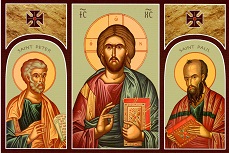
Propers for Trinity 4

INTROIT: Ps. 27:1-2; Ps. 27:3a

(Antiphon) The LORD is my light and my salvation; Whom shall I fear? The LORD is the strength of my life; Of whom shall I be afraid? When the wicked came against me To eat up my flesh, My enemies and foes, They stumbled and fell.

Though an army may encamp against me,
My heart shall not fear.

Glory be to the Father, and to the Son, and to the Holy Spirit;
as it was in the beginning, is now, and ever shall be, world without end. Amen.

COLLECT

Grant, O Lord, we beseech You, that the course of this world may be so peaceably ordered by Your governance, that Your Church may joyfully serve You in all godly quietness; through Jesus Christ, Your Son, our Lord, who lives and reigns with You and the Holy Spirit, one God, now and forever.

OLD TESTAMENT READING: Isaiah 58:6-12

6 “Is this not the fast that I have chosen: To loose the bonds of wickedness, to undo the heavy burdens, to let the oppressed go free, and that you break every yoke? 7 Is it not to share your bread with the hungry, and that you bring to your house the poor who are cast out; When you see the naked, that you cover him, and not hide yourself from your own flesh? 8 Then your light shall break forth like the morning, your healing shall spring forth speedily, and your righteousness shall go before you; The glory of the LORD shall be your rear guard. 9 Then you shall call, and the LORD will answer; you shall cry, and He will say, ‘Here I am.’ If you take away the yoke from your midst, the pointing of the finger, and speaking wickedness, 10 if you extend your soul to the hungry and satisfy the afflicted soul, then your light shall dawn in the darkness, and your darkness shall be as the noonday. 11 The LORD will guide you continually, and satisfy your soul in drought, and strengthen your bones; You shall be like a watered garden, and like a spring of water, whose waters do not fail. 12 Those from among you shall build the old waste places; You shall raise up the foundations of many generations; And you shall be called the Repairer of the Breach, The Restorer of Streets to Dwell In.” (NKJV)

GRADUAL: Ps. 79:9-10a

Help us, O God of our salvation, For the glory of Your name;
And deliver us, and provide atonement for our sins, For Your name’s sake!
Why should the nations say, “Where is their God?”

EPISTLE READING: Romans 8:18-23

18 For I consider that the sufferings of this present time are not worthy to be compared with the glory which shall be revealed in us. 19 For the earnest expectation of the creation eagerly waits for the revealing of the sons of God. 20 For the creation was subjected to futility, not willingly, but because of Him who subjected it in hope; 21 because the creation itself also will be delivered from the bondage of corruption into the glorious liberty of the children of God. 22 For we know that the whole creation groans and labors with birth pangs together until now. 23 Not only that, but we also who have the firstfruits of the Spirit, even we ourselves groan within ourselves, eagerly waiting for the adoption, the redemption of our body.  (NKJV)

VERSE: Ps. 9:4b,9

Alleluia. Alleluia. You sat on the throne judging in righteousness.
The LORD also will be a refuge for the oppressed, A refuge in times of trouble. Alleluia.

HOLY GOSPEL:  Luke 6:36-42

36 “Therefore be merciful, just as your Father also is merciful.

37 “Judge not, and you shall not be judged. Condemn not, and you shall not be condemned. Forgive, and you will be forgiven. 38 Give, and it will be given to you: good measure, pressed down, shaken together, and running over will be put into your bosom. For with the same measure that you use, it will be measured back to you.”

39 And He spoke a parable to them: “Can the blind lead the blind? Will they not both fall into the ditch? 40 A disciple is not above his teacher, but everyone who is perfectly trained will be like his teacher. 41 And why do you look at the speck in your brother’s eye, but do not perceive the plank in your own eye? 42 Or how can you say to your brother, ‘Brother, let me remove the speck that is in your eye,’ when you yourself do not see the plank that is in your own eye? Hypocrite! First remove the plank from your own eye, and then you will see clearly to remove the speck that is in your brother’s eye.”  (NKJV)

Posted in Worship | Tagged , | Comments Off on Propers for Trinity 4

Luther Second Sermon for Trinity 4

Sermon for the Fourth Sunday after Trinity (2nd sermon). This sermon appeared in 1535 under the title: “A Beautiful Christian consolation in all kinds of suffering and trial from the 8th chapter of Romans, with the explanation of the Gospel for the Fourth Sunday after Trinity. Preached by Dr. Martin Luther.”

Text: Luke 6:36-42 (KJV)

THE RIGHT CONDUCT TO ONE’S ENEMIES.

1. Beloved Friends! Upon this Gospel a great deal might be said, but at present we will not consider it all, lest we overload ourselves and retain nothing. You have heard in the text how our dear Lord and Saviour, Jesus Christ, holds up to us the works of mercy, how we should be merciful; not to judge nor to condemn but gladly forgive everyone and in like manner willingly give and help all, as there is need. If we do this, he says, there shall be given to us again good measure, pressed down, shaken together and running over. But if we will not do this, with the same measure we mete to others it shall be measured to us again. By this he would earnestly forbid his Christians to condemn anyone, to judge or avenge themselves, or to take from anyone, but rather to give and forgive.

For a better understanding of this Gospel, we must in the first place reply to our adversaries, who hold up this text against us as a strong, firm ground of their doctrine, that a man can by works obtain forgiveness of sins and eternal life, and boast of it as though they already had surely gained the victory. They say: Here indeed it stands clearly written: “Forgive, and ye shall be forgiven; give, and it shall be given to you again.” What can a man bring up against such clear passages? Therefore, it certainly follows from this, that a man can obtain forgiveness of sins by good works. Thus, by these and similar passages concerning works, they wish to prove that we are justified and saved by our own merit; and denounce and condemn us as heretics, because we teach that we are saved only through faith in Jesus Christ, who has been crucified and died for us, who gave his body and shed his blood for us for the forgiveness of sins. Thus they make Christ entirely unprofitable for us, and call the doctrine of faith simply an error and falsehood. Here we see how the blind lead the blind.

2. Well, we allow them to proceed, because they want to be blind and hardened. But if they were in earnest to know the truth, they could plainly see from this Gospel to what such passages, to which they so firmly hold, properly refer, and how they should be interpreted. For this Gospel evidently and plainly says, that Christ does not speak to those who shall first obtain grace, but to his disciples, who already are children of grace and justified, and are also sent out by him, that they should preach to others such grace and salvation; from which it clearly follows that they already have forgiveness of sins, and are pious and justified, and are not first to obtain salvation through works. I say, he speaks to those, and instructs them how they shall conduct themselves toward their enemies, namely, when they are persecuted by them, that they should not persecute them in return, but should patiently suffer all these things, and do them good for evil.

3. Hence it is not meant, that by such works as are here enumerated they should first obtain forgiveness of sins and the righteousness that avails before God; but Christ speaks plainly and simply to his disciples whom he had chosen and called Apostles, as St. Luke shows preceding this Gospel. Christ teaches them how they shall conduct themselves when they preach, as though he would say: You dear disciples, I send you as sheep among wolves, and commend this office unto you to preach, and others shall hear your preaching, accept and believe it. And you will be so received that the world will be offended at you and regard you as enemies, and you will find just as much friendship and love in it, as sheep among wolves. For it will become wholly mad and foolish at your preaching, and will by no means tolerate it.

Therefore see to it that you lead a better life and conversation than your enemies, who will practice upon you all kinds of unmerciful deeds by judging and condemning you. Moreover they will not only not forgive you any sin, but will proclaim your best works and deeds of mercy as the greatest sins. Again, they will not only not give you anything, but they will also hunt down that which is your own, and will take and keep it by violence. Thus they will treat you. But beware, that you be not like them; on the other hand where they judge, judge not; where they condemn, bless; where they take revenge, forgive; when they take, give. For immediately before, the Lord teaches the very same when he says: Love your enemies, do good to them that hate you, bless them that curse you, pray for them that despitefully use you.

4. In this manner St. Paul also admonishes the Christians at Rome (Romans 12:18-19): “If it be possible, as much as in you lieth, be at peace with all men. Avenge not yourselves, beloved, but give place unto the wrath of God.” Christ here teaches the very same when he says: Be merciful, judge not, condemn not, avenge not yourselves, give unto and assist everyone, in order that you may not become equally as bad as your enemies; but rather that they may be prevailed upon by your kind and friendly conversation, to give you a good testimony, and finally be compelled to say conscientiously: Behold, we judge and condemn these people, and carry out all our maliciousness against them; against this they neither defend or avenge themselves, but suffer it all patiently, and besides, they overcome evil with good. Surely, they cannot be bad people, because they have so much patience, and reward evil with good; I myself, will also hold to them, because they do no one any harm, although they have good reasons for so doing.

5. From this one can easily see that Christ does not here teach us to become pious and just through our works, but admonishes those who were already pious and just, that they be merciful like their Father in heaven, so that the heathen may thereby become better, and that thus unbelievers may be kindly enticed to become converted and edified, not only by preaching, but also by the merciful and blameless lives and good conduct of the good and just.

6. In the same sense St. Paul also teaches in 1 Cor. 7:13: And the woman that bath an unbelieving husband, and he is content to dwell with her, let her not leave her husband, as long as he will permit her to remain a Christian. Because it can so happen that the man may be influenced by the virtue of his Christian wife to become converted and say: I see by my wife, that Christians are good people; therefore I also want to be a Christian. Thus we also read of St. Monica, the mother of St. Augustine, who had a strange and wonderful husband, who besides was also a heathen. But what did she do? She so conducted herself toward him that he did her no wrong. Other Christian wives were very much astonished at this, and went to her and complained about their husbands, that they could not do anything to please them, although they were Christians, and yet they were scolded and beaten by them; therefore they questioned her how she treated her husband, who, as every one knew, was not only a wonderful man, but a heathen also, and yet he never beat her. Such favor they could not expect from their husbands, although they were not heathen, but Christians.

7. Kindhearted Monica answered them and said: I fear you give your husbands cause for doing this. If you were subject to them and would not clamor back, or especially when they begin to be strangely cruel, if you would not answer back, but be patient, submit and obey them, and with friendly words appease them, you would, of course, not be beaten. For thus I am accustomed to treat my husband; when my lord scolds, I pray; is he angry, I avoid him, or return kind words; in this way I have not only put down his anger, but I have also brought him so far, that he is converted and has become a Christian. Behold, the beautiful fruit that followed this conduct, because kind Monica was merciful toward her husband, and did not condemn and judge him. Thus it can often take place, as St. Paul says, that an unbelieving husband or wife, may become converted through the one who believes.

8. Thus, says Christ here, should you Christians also do, because you are children of grace and peace, not of anger and discord, and are also called to inherit the blessing. Therefore you should also bring the blessing among the people, first by your preaching and public confession, and after that also by your good outward conduct, so that when the unbelievers judge and condemn you, treat you unmercifully and rob you, you will be merciful to them, and not avenge yourselves, but give and forgive, and besides help, love and bless them, and speak the best things of them before God and the world; that they may also observe by your good conduct that you are pious and blameless people, who do not only suffer evil, but also return good for evil. By this you will obtain a good name among the heathen, and be estimable and honorable in my sight, who art your Lord and God.

9. Thus you see that this text does not at all permit us to conclude from it that forgiveness of sins is obtained by works; for Christ here speaks to those who are already children of grace, and does not instruct them how to obtain by works, as the Papists dream; the forgiveness of sins, which they already had by grace; however, he here teaches them how they are to conduct themselves, when they go forth and preach, toward the people who persecute, judge, condemn them, and afflict them with all kinds of torment and misfortune; that they immediately do the contrary, not judge, nor condemn, but forgive and give; and then they shall also be neither judged nor condemned before God or the world. And even though the world judge them, still God will not condemn them, as it is said in Ps. 37:13-40. So it shall also be forgiven and given them again.

10. Thus Christ admonishes his disciples with these words, that they diligently perform the duties of their office and preach with courage, let it offend whom it may, and that nothing whatever may lead them astray, even though all the world revile and curse; let them only freely continue and they shall be richly rewarded; for it is already determined in heaven that there shall be given unto them full measure, pressed down, shaken together and running over.

11. From all this it is certainly clear, that Christ does not here speak of that righteousness, of how a man becomes just before God, which takes place alone through faith in Jesus Christ, but teaches his disciples how to lead a good life here on earth among unbelievers, by which they may be of great benefit to those who judge and condemn them. When they do such things, it shall be rewarded unto them again both here and hereafter; not that they thereby merit the forgiveness of sins; for no work, be it ever so good, is able to accomplish this; but when they on this account suffer or lose anything, it shall be returned to them even here in this life an hundred fold, as is written in Mark 10:30, and in the life to come they will be more gloriously arrayed and adorned than other saints. Why? Because they have suffered and done more for Christ’s sake than others. For Daniel the prophet says, 12:3, that the teachers shall shine as the brightness of the firmament after the resurrection of the dead, and they that turn many to righteousness as the stars forever and ever. And St. Paul in 1 Cor. 15:41 says: “For one star differeth from another star in glory. So also is the resurrection of the dead.”

12. The Lord further says: When you fail to do thus, but return evil for evil, it shall be measured to you again, “for with what measure you mete, it shall be measured to you again.” For by thus judging and condemning those who judge and condemn you, you sufficiently show that you are not my true disciples, and have not yet the forgiveness of sins, or else you would do what I have commanded you. From which it follows further that your faith is not right. So with you it will be changed, and you will hear from me that you have no faith and are false Christians.

13. This is sufficiently proved, because you still judge one another, and one does not assist the other. This my Christians will not do. Therefore your sins will remain upon you, and will only become greater, as is shown in the parable of the wicked servant who owed his Lord ten thousand talents and could not pay it; the Lord forgave him the debt out of pure grace. But as he would not forgive his fellow servant the very little debt, he again fell into his own former debt, which was forgiven him and brought down upon himself the great wrath of his Lord, who delivered him over to the tormentors. Mat. 18:34.

14. Thus our dear Lord would here kindly and lovingly invite us to do good works and lead a Christian life also among our enemies. But when we fail to do this he threatens us, that he would not regard us as Christians. For such works are as a sign or confession that we are true Christians. In addition to this, other people will be made better by such works, and so will we ourselves who do them, as St. Peter says, we make our calling and election sure thereby, and become richer in faith.

15. To this friendly admonition of Christ our Lord we Christians and especially we ministers should diligently give due heed, for we also have at the present day adversaries of our faith and doctrine, who are great and powerful, kings, princes, lords, Pope and bishops. To these our enemies according to this doctrine of Christ we show all mercy, and are not willing that a hair of their heads should be injured, or that they should be robbed of a cent. But this we wish them from our heart, that they may learn to know their errors and sins, and commit themselves to the grace of God and believe the Gospel. On this account they judge, condemn and persecute us, rob us of honor, goods, body and life, as though we were the worst rogues that tread the earth. Such things we do not to them in return, God be praised! but show them all love and kindness, and would willingly help them, if they would only permit it.

16. Yes, they say, you revile us nevertheless, both in writing and preaching, and condemn us as heretics, and will not permit us to be the Christian Church. Is such reproof and condemnation mercy? We answer: This is quite a different matter. Christ in this Gospel speaks of those who shall suffer injustice. And it would not be right to apply this to those who by virtue of their office are required to reprove what is wrong. For those who have the office to judge and condemn, do no wrong thereby, in so doing. For as little as it agrees or is valid for a child to say to its father when he would punish it; father, be merciful, and God will then also be merciful to thee; so little is it valid against those who have the office of reproof. For it would be very inappropriate for a thief or evil doer to say to the officer of the law: Dear sir, forgive and do not judge me, and then our Lord God will again forgive thee. No, my dear fellow, the officer of the law by virtue of his office will thus answer and say: It is not necessary that I should forgive you. I do what is right, and doing right needs no forgiveness, but is praiseworthy. Thus also when father and mother punish their children, they do right, for this is called true punishment, when the office requires it. But beware, that you do not revenge yourself against him who must punish you, even if at times he treats you unjustly.

17. Wherefore it is not appropriate to twist this text, as though the Lord speaks of those who have the authority to punish the wrong, as ministers and all persons in authority, fathers, mothers, princes, lords, and finally also the executioner, who should not say to the evil doer, to whom he must administer justice, as however they are accustomed to do: “Dear Sir, forgive me, what I do to you today,” for why should he say this? As he does right, he needs no forgiveness, which pertains alone to sin and wrong; for his office is to punish wrong. Just as it would be wrong if a father would say to his son when he would punish him: Dear son, forgive me, that I punish you. No, he does right, therefore the son should bear it, for thus God will have it.

18. Thus St. Paul says, 2 Cor. 5:13: “For whether we are beside ourselves, it is unto God; or whether we are of sober mind, it is unto you.” In his first Epistle, Paul severely rebuked the Corinthians, which some thought was too severe; but he does not excuse himself in the least nor asks for grace, he simply says: If we rebuke too severely, it is unto God and we serve him; but if we are sober and deal gently, we do so for your good. He will not admit that he has done any sin at all, because he so severely rebukes them, but says he serves God by it, and if he has been too indulgent, he did it for their benefit. This is quite a poor answer to such a complaint as: Dear Paul, why do you strike us so hard? But as he fills the office of an Apostle, he gives no other answer but this: I rebuke and punish sin as I wish, I do right and serve God thereby; not on account of my person, but because God has so commanded and ordered it.

19. Thus also a judge can say, when by virtue of his office he sentences the evil doer unto death, that he serves God thereby. So also father and mother, when they punish their child as it has deserved, thus serve God; but if they punish it somewhat milder than it deserves, it is for the good of the child.

20. We must make a distinction however, for it is vastly different when a person punishes who has the office to punish, and when one punishes who has not this office. An office, call it what you may, is ordained to punish sin; not to tolerate wrong, but protect the right. Therefore, because I and other ministers have this office, we do right, a work of mercy for the people, when we rebuke them, let whoever will do us good or evil for it.

21. Just as it is a great mercy not to allow young people to have their will and way, whether it be accomplished by threats or by the rod; it will still cost trouble and labor enough to oppose and prevent evil, even though we punish severely. If punishment were altogether omitted and mercy took the place of office, the country would be full of rogues, and the world become a mere den of murderers. Then one would say to another: If you steal from me, I will rob you; if you go with my wife, I will go with yours.

No, this would never do; therefore the executioner is a very beneficial and even a merciful man, for he prevents the rogue from repeating his crime, and restrains others from committing crimes. He executes the one and thus threatens others that would do the like, that they may fear the sword and keep the peace. This is a magnificent grace and pure mercy.

22. Again, it is a great sin against mercy, yes a horrible murder, when a father allows his child to go unpunished; for this is just the same as though he killed it with his own hands; hence Solomon says, Prov. 23:13, 14: “Withhold not correction from the child; for if thou beat him with the rod, he will not die. Thou shalt beat him with the rod, and shalt deliver his soul from hell.” That is, he will not die of your beating, but with the rod you cause him to live, and deliver his soul from death; for if you do not punish him, the executioner will, even unto death, by taking away his life. As Solomon would say: If you do not beat your son with the rod of life, in order that he may live, then you are a murderer; because you assist your child to become a rogue, so that the executioner must strike him with the rod of death. Therefore take in your hand the rod of life, and freely punish when necessary, that he may escape the rod of death. Then you will perform a noble work of mercy to him, whereas if you let him have his own will, you become his murderer.

23. Therefore it is senseless for the Papists to cry: We of course teach others not to judge, nor condemn, but we ourselves do the contrary, punish, judge and condemn everyone. For as I said, what we do in this, we do by virtue of our office. Therefore our judging and punishing is of such a nature, that it only makes one better and harms no one. And we are obliged to do it on account of the command of Christ our Lord, Luke 24:47, that repentance and forgiveness of sins be preached in his name among all nations on earth; and John 16:8: “The Holy Spirit will reprove the world of sin.”

24. According to this command all the Apostles have first judged and reproved the world, and proclaimed God’s wrath against it; afterwards they preached forgiveness of sins in Christ’s name, as St. Paul does, Rom. 1:3, and St. Peter, Acts 2:3-10, and Christ himself when he says, John 9:39: `”For judgment came I into this world.” Those who have accepted this preaching and permit themselves to be judged and reproved by it, have received the comfort of the Gospel, that without merit, by God’s grace through the redemption that is in Christ Jesus they are justified and saved, Rom. 3:24.

This judgment and reproof of Christ and the Apostles is not harmful, but beneficial, comfortable and wholesome. Moreover, those who have not allowed themselves to be reproved by these have remained in their sins, and have died and perished forever; and also, in time, have their cities, lands and kingdoms in which they have lived, been most woefully devastated and destroyed.

25. As therefore the Apostles have preached according to the command of Christ, so too must we do, and say that all men are conceived and born in sin and are by nature children of wrath, and on this account condemned, and can neither by their own or any other creature’s help, advice, work or merit, receive forgiveness of sins and be saved. This is to reprove, judge and condemn everybody, and yet we do this, not out of our own wantonness, or that we take pleasure in crying down men as sinners and godless; but out of Christ’s order and command. With this however we do not cease, but we again encourage and comfort those whom we have rebuked, and say that Jesus Christ has come into the world to save sinners, so that all who believe in him, should not perish, but receive everlasting life.

26. Therefore God-fearing people accuse us of no fault in this; for they observe that we do not preach human nonsense like monks in their hoods, but proclaim the Gospel of Christ; they are glad therefore, and heartily thank God that they have lived to see the time when they can know the precious truth, and thereby obtain comfort for their consciences, and accept this our reproof and judgment as a great mercy. Again, the great and godless crowd scold and condemn us on account of this our reproof, as heretics and traitors, who disturb both the old faith and worship and also the worldly government and peace. We must bear this; yet our conscience gives us the testimony that they wrongfully accuse us, and besides we are comforted to know that we are not the first ones who have been thus slandered. St. Paul also had to hear from Jews and Gentiles, that he was a blasphemer and traitor. Yea, Christ himself was accused before Pilate for misleading the people and making them disobedient to the emperor, for which also he was crucified. With them we are glad to be cried down as heretics and traitors, until the time when our innocence shall come to light.

27. If now the wretched, hardened Papists were not such bitter enemies of the truth, and of us on account of the truth, they could observe by our life that we hold firmly to this admonition of Christ, be merciful; for God be praised, we have not thus far avenged ourselves against any man who has done us injury, we have not driven anyone from house and home, wife and child, we have cast no one into prison on account of his faith, much less have we beheaded, burnt at the stake or hung anyone for their faith, as the Papists have done, the tender saints, who have for the last few years shed much innocent blood, and still do not cease. But we have complied with this doctrine and admonition of Christ, and have honored their order and government and confirmed it with our doctrine as far as they are right, we have prayed and pleaded for them, privately and publicly, and have faithfully also admonished them in writings by virtue of our office which God has committed to our charge.

And for this our mercy we have received from them the reward, that they have put us under the ban, cursed and persecuted us, and driven many of our brethren from their possessions and murdered them. What more shall we do? Yet we must bear the name of being impatient, angry, spiteful, and revengeful people, who judge and condemn all the world. Well, we must bear this disgrace before the world, until our dear Lord Jesus Christ, the just Judge, shall examine us and decide the matter; in the meantime we permit them evermore to lie, slander and persecute us; but they shall learn by experience when God’s time comes, whom they have slandered and persecuted in us.

28. This much is said of the chief meaning of this Gospel, how we are to be merciful also toward our enemies. Now we should also apply it to our own lives, we who want to be Christians and brethren should practice this among ourselves; for it is very necessary also that this admonition be preached to us. Although we are all called Evangelical, I fear that the most of us are heathen under the Christian name. Well, what shall we do about it? We must allow the name to all, although few there be who bear it in truth. For St. Paul in 2 Thess. 3:2 says: “For all have not faith”; and Christ himself complains, Mat. 22:14, that many are called but few are chosen. Now, those who are true Christians should with all diligence take this admonition of Christ to heart, that they may not only be friendly toward enemies, but also much more toward those called Christians.

29. Therefore let everyone who goes to the sacrament and pretends to be a Christian take heed to himself that he deceive not himself. For one can now well see what a scraping, grabbing and scratching there is even among those who want to be Christians, from the lowest to the highest stage of society. It is a sin and a shame to hear it. Nearly everyone falls into this shameful greed, and such a state may well be called a swine’s life, for as the swine in the trough, whichever one is the strongest pushes the rest away, as though she wanted to devour all herself, just so it goes in the world today, and everyone goes securely forth, gives nothing whatever and takes all he can get, whether he gets it rightfully or wrongfully, so that the word give, which stands here in the Gospel, has almost disappeared, and instead robbery and theft in homes and in the market have everywhere come to take its place. What unfaithfulness prevails even among day laborers and house servants, how shamefully they earn their bread with malicious unfaithfulness, cheating and overcharging. They do not look upon it as stealing, and yet it is just as much stealing when they labor unfaithfully, as when they steal it out of our purse. This is the way servants and laborers do, and it matters not by what they are called.

30. But how will such people stand in that day when Christ shall ask them, whether they have done according to his admonition? For if Christians are to be merciful to their enemies as Christ here teaches, much more will it become them to show all love and friendship toward their brethren and Christian people; and as they are not to curse their enemies, much less should they curse their friends. Again, if they are not to avenge themselves on unbelievers, but give to them and do them good, much more should they show this kindness to the household of faith. Yes, turn the thing around to rob, to covet, and to take advantage of another wherever one can; this goes on yet in the world with violence. But the holy Gospel says: Give, and it shall be given unto you; if we do not hold ourselves to this rule, we shall hear the opposite: Steal and rob, and you shall be robbed and stolen from again.

31. But our Lord God is so full of resources that he can send misfortune upon a city or a country so that even after they have gathered and hoarded for a long time, some tramp brother or fellow pilgrim comes along, to whom one must give or he will take it himself by force. For it must surely come to this that if we willfully forget that word “give,” our Lord God will make out of it “take.” After such misfortune we strive with all diligence, for wherever the Lord says “give” there we only wish to make out of it “take.” Well then take, steal and rob as long as you will, what will it avail you; things will take a turn some day so that it will be taken from you again.

32. All history teaches us, that when a kingdom, a principality, or a city, has been exalted to the highest pitch and becomes rich, then comes a war, or some other misfortune, so that it again becomes poor. Thus it happens also to individual families and persons; when they rise suddenly and become powerful, they also immediately fall again. I have already observed several who sat amid great possessions, and yet in a short time were thoroughly ruined. Why is this? Because they did not want to give as Christ here admonishes, but much rather took from others, for this reason a change took place with them, that it was again taken from them; as also teaches experience, and the common proverb runs: Goods unjustly won, will not last to the third son, that he may enjoy it. Such things we see daily in all ranks of life; and if it does endure for a time and descends from father to son, yet it sinks with the third heir, for it is a cursed wealth, which has either been obtained by theft or greed.

33. By such daily experience the children of the world ought to become wise and think: Why scratch and scrape so long, you cannot rightfully possess goods obtained by stinginess after all, nor will it prosper in your hands, as you have time and again experienced from one or another.

34. But we Christians should be more influenced by what the Holy Scriptures teach about it. Thus David says, Ps. 37:16–18: “Better is a little that the righteous hath, than the abundance of many wicked,” and the reason immediately follows: “For the arm of the wicked shall be broken, and the Lord upholdeth the righteous. The Lord knoweth the days of the perfect; and their inheritance shall be forever.” As though he would say: Although a good man may have but little, if he only has it with God and honor, it will be dearer to him than all the treasures of the ungodly. For our Lord God will shower his blessings upon that little, so that it will last to children’s children to the thousandth generation. This is also apparent; for at the present time we find many old and honorable families in the cities, whose possessions have reached to several hundred generations, whereas with others it has disappeared with the third.

We should learn from this and similar passages, and hold to it because it is the truth, that it is better to have thirty dollars with God and honor, than three thousand won without God and with dishonor. For God blesses the little which the righteous have (says Ps. 37:16), so that he may not only possess it with a good conscience, but will also be to his benefit and he will use it so that God may be pleased with it. But the wealth that has been unjustly obtained, may be enjoyed for a time; yet because God’s blessing does not rest upon it, it wears away and loses it-self, so that we cannot tell what has become of it; for it has been won by greed and wrong, and as they did not regard it as stealing. For one to scrape all together and give nothing away, the rust is entered into it and eats it up, so that it cannot be seen that there ever was a penny there. As also the heathen have learned from experience and said: “By evil acquired, by evil it goes,” “As it is won, so it is gone.”

35. But why say more? One will not grow wise except by his own losses; we let our Lord God promise and threat in vain, but who asks about it? Though we preach ever so much, Prov. 11:4: “Riches profit not in the day of wrath; but righteousness delivereth from death,” and v. 28: “He that trusteth in his riches shall fall; but the righteous shall flourish as the green leaf;” everyone thinks the while: “Dear Sir, say what you will, if I had money and goods, I would be free from all distress;” they simply make our Lord God a liar. But they will experience sooner than they wish, that they are deceived.

Therefore, my dear friends, let us fear and trust in God, and hereafter be merciful and kind, not only toward enemies as this Gospel teaches, but still more toward our friends and brethren; especially because we hear that our Lord is such an enemy to shameful covetousness, that he will blow upon such ill-gotten gain, so that it will vanish and fly away as the dust before the wind. The prophet Haggai 1:6, says of the miser, that he gathers into a bag with holes; as though he would say: Well, they may gather, but it will do them no good, because they want to get rich by greed even to the injury of others. And Solomon says: The godless man, when he has for a long time gathered wealth in heaps, has such a curse in his house, that he not only does not become better by his wealth, but it also disappears under his hands, as though the rust had devoured it.

36. Now dear friends, do not despise such a warning, but take it to yourselves, and if you have already been ensnared by this covetousness, turn again and reform. Formerly when one served the devil in popedom, everyone was merciful and kind, then they gave with both hands joyfully and with great devotion, to support the false worship of God. Now, when one should justly be kind and give, and show his thankfulness to God for the holy Gospel, everyone is about to perish with hunger, no one will give anything, but will only receive. Formerly every city according to its size, liberally supported several cloisters, not to mention mass-priests and rich monasteries. Now, when only two or three persons, who preach God’s Word, administer the sacraments, visit and comfort the sick in an honest and Christian manner and instruct the youth, are to be supported in one city, and that too not from their own but from property that came to us from the papacy, it is hard for everybody to give.

37. But thus it must be, that Jesus with Mary and Joseph should have no room in the inn at Bethlehem, but after all he finds a crib, and Mary and Joseph a stall, in which they miserably help themselves as best they may. And as they are not at home in Nazareth but in a strange place at an inconvenient time, in the midst of winter, and altogether forgotten in the stall by the people of Bethlehem, yet after all they do not perish with hunger. But before they should suffer hunger among their blood relations who care nothing for them, even the heathen must come from rich Arabia and present the little child Jesus gold, frankincense and myrrh. Christians understand well enough what is meant.

38. Therefore let everyone be diligent to comply with this admonition, that he willingly give, if he desires that it shall be given unto him again. If he will not do this, Christ will most certainly keep his Word, that it shall not be given unto him again. And though he already has something, there shall not be given him grace enough to enjoy it, as has already been shown from Scripture passages. Now God does not only show us by his Word that our covetousness is displeasing to him, and that usurers shall not enjoy their goods, but proves it also by daily examples. I will relate one as a warning which has recently occurred, although some may be offended at it: It is not far from here to Wittenberg, as has been reported to me and have also myself made proper inquiries, there was a farmer, who all his life cheated and took advantage of the people in the market, as at present nearly all are accustomed to do, he went into his barn to look after his grain; then the devil set such a ghost before his eyes, that he found his barn empty, and could see no corn there. What happened? The miserable, stingy man becomes frightened, and thinks the corn was secretly stolen from his barn. He goes down to his wife and servants with great cries and lamentations and says all his grain has been stolen out of his barn. As the wife and servants go in to look after it, in the meantime the wretched man hangs himself for grief, and dies in the rope before they return again to him. And yet it was but the deception of the devil. For all the corn was still lying untouched on the floor. The devil by the decree of God had thus infatuated him, that he could not see even a single grain.

39. This I say, has taken place before our very doors, to frighten and warn us. What benefit did the poor man reap from it? What help are now his goods to him, which he had scraped together so long with care and labor? The devil wanted to kill him, therefore he so blindfolded him that he could not see his own corn, and thus he gave him a cause, to hang himself for grief. This is I think a curse, which came upon ill-gotten goods, that he should not only not enjoy it, but even not behold it, and thereby lose both body and soul. More similar histories have appeared, as you at other times have heard from me; and it is good not to forget them, there may yet be some who will be re-formed by them. The wretched man who so miserably hung himself will find his sentence. But we tell it you as a warning. If you will not receive it, but despise it, you do not despise me who told it you, but the Lord Christ, who tells it to you through me. But if you receive it and do better, I will give you no reward, for I cannot reward the works of a Christian. But he who here says: Give and it shall be given to you, will richly reward it. Whoever will, let him accept, and whoever will not, can let it alone. This text will not become false on that account. For although not all are punished like this man, yet everyone who despises this admonition of Christ, will find his condemnation on the last day. And it is indeed to be wondered at, that we willingly and with great care, weariness and labor, for the stingy man’s stinginess becomes very hard, 1 Tim. 6:10, should bring into our own house first our own injury and curse, whereas with lighter labor and a more joyful courage, if we according to the doctrine of Christ would give and help our neighbor, could well be rich. For he who said, Give, and it will be given you, will certainly keep his Word, and give again to those who obey his admonition, and that abundantly; for he says: A full, pressed down, shaken together, and overrunning measure shall be given to you again.

40. Were it not better, you had but little with God and honor, and give and help the needy according to your ability, and have thereby a good conscience and the glorious comfort that God will bless and increase your humble store, than that you should, with care and restlessness and with an evil conscience, have great possessions, which you not only cannot enjoy, but cannot even be master of, for a miser is mammon’s servant and a captive. And yet, you do not only know from God’s Word, although you will not believe it, but also from daily experience, that it will do your children or heirs no good, but by the very consumption of it they shall become poor.

41. What have you of it at last, 0 wretched man, when you have so long scraped and scratched together, except that you have made your life very toilsome in sins, and the devil, when your last hour comes, will drag you into the abyss of hell, and so you will not only shamefully lose your money and goods, which in this life you never could enjoy, but besides you also wretchedly lose both body and soul, and upon all this with your condemned treasures you bring down God’s displeasure and curse upon your children and heirs, who have become no better than yourself, but fall into poverty and into all distress and misfortune. Very well, he that will hear, let him hear. For everyone must bear his own burden, as St. Paul says, Gal. 6:5: I believe it also. Therefore you who will not hear, answer for yourselves. This is enough of this Gospel for a small admonition. God grant, that in some of you it may bring forth fruit! Amen.

Posted in Sermons | Tagged , , , | Comments Off on Luther Second Sermon for Trinity 4

Luther First Sermon for Trinity 4

A Sermon by Martin Luther; taken from his Church Postil. This sermon appeared in separate pamphlet form in 1523 under the title: “A sermon preached by Martin Luther on the Gospel, Luke VI. Be ye merciful as your Father is merciful. Wittenberg.”

Sermon for the Fourth Sunday after Trinity

Text: Luke 6:36-42 (KJV)

BE MERCIFUL AS YOUR HEAVENLY FATHER IS MERCIFUL

1. This Gospel describes the works of love to our neighbor in temporal things. The Lord here describes these in few words, for he had just said, we should love our enemies, do good to them that hate us, bless them that curse us, pray for them that despitefully use us; if they smite us on one cheek, we should offer also the other; and from him that taketh away thy cloak withhold not thy coat also. All this he here condemns in a short conclusion, and in summing up all, says: “Be ye merciful, even as your Father is merciful.” Here you see described as in a nutshell all the good works we are to do to one another, as our heavenly Father has done to us and still does without ceasing.

2. You have often heard that we need not do good works to God, but to our neighbor. We cannot make God stronger nor richer by our works, but we can make our neighbor stronger and richer with them; he is in need of them, and hence they should be directed to him and not to God. This you have often heard and you have it now in your ears; I would to God, that it might come also into your hands and feet.

3. Therefore observe here what a perversion it is for man to exercise himself in doing works to God, which should be done to his neighbor; and then centers his faith in men and saints, which he should center alone in God. Turn this around, and then it is right, thus: faith must belong alone to God, whoever receives the divine works, God alone does them, and the same works of God we receive alone through faith. Then we should apply ourselves to our neighbor and arrange all our affairs to the end that they serve our neighbor. Before God all should be done in pure faith alone. The reason of this is because no one can help us but God, and what we have in body and soul we have alone from God, and in him alone should we anchor our heart.

4. Now, they turn it around thus, so that they center faith, which is due to God, upon themselves and other people and they fall down before their own devised idols, and what the great masters have invented, and place their confidence in them. Is not that very Satan and death? as God in Jer. 2:13f. says: “My people have committed two evils: they have forsaken me, the fountain of living waters, and hewed them out cisterns, broken cisterns, that can hold no water.” Again he says in verse 35 to the people: Thou sayest, I shall turn my anger from thee, thou hast not sinned. “Behold, I will enter into judgment with thee, because thou sayest, I have not sinned.”

5. First he says, that the bride has become a harlot and has turned from God; the living fountain from which flow life, salvation and all good, they have forsaken. Secondly, they turn to their own invention, and make their own fountain, in which there is no water. Thus also the Papists build upon their own inventions, saying mass, fasting, praying and the like; they indeed appear very much as though they were a fountain, as though they would draw from it life and salvation, yet it cannot hold any water; and they forsake God, the living fountain.

6. In this manner God says: They boldly rise up against me; I shall not be angry with them, they insist their ways and doings are right and enter into judgment with me. Behold, this is their other sin, that they are determined to defend their own doings. Therefore God says: I will enter into judgment with you and show you, how base you have become, in that you have continually gone your own way.

7. See, thus faith belongs to God alone and it should acquire for us from God alone what we need in temporal and spiritual matters; and it should acquire all in a way that it does not think it has merited it. This same faith should later again flow forth from our heart’s depths to our neighbor freely and unhindered in good works; not that we wish to rest our salvation in them; for God will not have that, but wishes the conscience to rest in himself alone. Just like a bride must cleave to the bridegroom alone, and to no one else, so does God require also from us that we confide only in him.

8. This Luke explains when he says: “Be ye merciful, even as your Father is merciful.” Here my conscience must be disposed toward God as a gracious, merciful father, and in harmony with this, go out to my neighbor and be also merciful to him. I must bring faith into my heart and up to God; and works out of my heart down to my neighbor. Thus Abraham did, when he went up on Mount Moriah to God, he left his servants and ass down at the foot of the mountain and took Isaac alone with him, Gen. 22:5. So should we also do: when we wish to ascend to God, we should come with Isaac alone, that is, with Christ through faith; the servants and ass, that is, our works, we should leave below.

9. Now this has been said of faith and works as an introduction to our Gospel lesson, namely, that the motion of faith is inward and upward, of works outward and downward. For thus are we righteous before God and men, in that we honor God and look direct to him and believe according to his Word, and in love do sufficient for our neighbor. Let us now consider the words of today’s Gospel in their order.

“‘Be ye merciful, even as your Father is merciful.”

Now how is God our heavenly Father merciful? Thus, in that he gives us all things, natural and spiritual, temporal and eternal, gratuitously and out of pure goodness. For should he give unto us out of and according to our merits, he would have to give us only hell-fire and eternal condemnation. Therefore what he gives us in our possessions and honor, is given out of pure mercy. He sees that we are captives of death; but he is merciful and gives us life. He sees that we are the children of hell; but he is merciful and gives us heaven. He sees that we are poor, naked and exposed, hungry and thirsty; but he is merciful, and clothes, feeds and gives us to drink, and satisfies us with all good things. Thus, whatever we have for the body or spirit, he gives us out of mercy, and pours his blessings over us and into us. Therefore Christ says here: Imitate your Father and be also merciful, as be is merciful.

11. Now this is not a common mercy, nor one that reason teaches. For that is selfish: it gives to the great and learned and those who merit it; loves those, who are beautiful; gives to those from whom it has some benefit or advantage. That is a political, beggarly, shaggy, piece-meal mercy. For if I give to him, who merited it, or if I regard beauty and friendship, then it is duty and debt and not mercy. This is also what the Lord meant, when he just before this Gospel in Luke 6:32-34 says: “And if ye love them that love you, what thank have ye? for even sinners love those that love them. And if ye do good to them that do good to you, what thank have ye? for even sinners do the same. And if ye lend to them of whom ye hope to receive, what thank have ye? even sinners lend to sinners, to receive again as much.” However, Christian mercy should not seek its own; but it should be thus: it must be round, and open its eyes and look at all alike, friend and foe, as our heavenly Father does.

12. And where this mercy is not, there is also no faith. For if your heart is in the state of faith that you know your God has revealed himself to you to be so good and merciful, without thy merit, and purely gratuitously, while you were still his enemy and a child of eternal wrath; if you believe this, you cannot refrain from showing yourself so to your neighbor; and do all out of love to God and for the welfare of your neighbor. Therefore, see to it that you make no distinction between friend and foe, the worthy and the unworthy; for you see that all who were here mentioned, have merited from us something different than that we should love and do them good. And the Lord also teaches this, when in Luke 6:35 he says: “But love your enemies, and do good unto them, and lend, never despairing; and your reward shall be great, and ye shall be sons of the Most High: for he is kind toward the unthankful and evil.” Thus we have considered the first part of this Gospel.

13. Further one may say here: Have you not now taught that our works avail nothing before God in paying him for anything: how is it then that here the very contrary stands written, as Christ says: “Be ye merciful, even as your Father is merciful. And judge not, and ye shall not be judged: and condemn not, and ye shall not be condemned: forgive, and ye shall be forgiven.” All these sayings sound as though we should appear before God with our works and merit by virtue of them God’s mercy and forgiveness; although you have nevertheless heard that faith does all.

14. Now note well, St. Paul and the holy Scriptures here and there teach this; for they emphasize that man must believe and appear before God with pure faith alone. Therefore the sayings, as they are here, are to be understood that works are only the test and confirmation of faith, so that if I believe, I must be merciful, not judge, not condemn, give and forgive my neighbor. Gen. 22:5f. is an example of this. What did Abraham, when he was called to offer his son? He was obedient to the commandment, and was about to sacrifice his son, and drew the sword to do it. What happened? The angel of Jehovah restrained him and said unto him: “Lay not thy hand upon the lad, neither do thou anything unto him; for now I know that thou fearest God, seeing thou hast not withheld thy son, thine only son, from me.”

15. Thus here also; we must first receive before we give; before we can do acts of mercy, we must receive from God mercy. We do not lay the first stone; the sheep does not seek the shepherd, but the shepherd the sheep; therefore it is also with our works, that we obtain nothing by them from God, but that we acquire all that we do acquire without any merit on our part. Thus in the prophet Isaiah 65:1, God says: “I am inquired of by them that asked not for me; I am found of them that sought me not.” And at the end of the same chapter he says: “And it shall come to pass that, before they call, I will answer, and while they are yet speaking, I will hear.” For before we seek him, he finds us; before we ask for him, he has us. The same Paul says to the Romans, 3:22-26: “There is no distinction; for all have sinned, and fall short of the glory of God; being justified freely by his grace through the redemption that is in Christ Jesus: whom God set forth to be a propitiation, through faith, in his blood, to show his righteousness because of the passing over of the sins done aforetime, in the forbearance of God; for the showing, I say, of his righteousness at this present season: that he might himself be just, and the justifier of him that hath faith in Jesus.” And in the following chapter, Rom. 4:4-5, he says:

“Now to him that worketh, the reward is not reckoned as of grace, but as of debt. But to him that worketh not, but believeth on him that justifieth the ungodly, his faith is reckoned for righteousness,” “For if it be by grace it is no more of works: otherwise grace is no more grace,” as Paul writes later in Rom. 11:6.

16. In the second place the works are a sure sign and like a seal stamped on a letter, by which I am assured that my faith is right. The reason is: Do I feel in my heart, that my works flow forth out of love, then I am assured that my faith is genuine. If I forgive, then my forgiving assures me that my faith is genuine, and it seals and proves my faith, that God also has forgiven me and daily forgives me; but if I do not forgive, then may I at once conclude that I am lacking in faith. So it was also with Abraham, his works made known to him his faith. God well knew that Abraham believed; but he had to know and prove it.

17. Therefore the works are only continual spontaneous fruits and proofs of such faith. For of what use were it to me, if I had already strong faith and did not know it? As, if I had a chest full of gold and knew it not, it would be of no use to me; but when someone makes it known to me, he then does me as great a service as if he donated it to me. Just so, if I have faith, and know it not, it is of no use to me. Therefore faith must blossom forth and become known to me through the works following faith and these are then signs and seals that faith is present in my heart.

St. Peter also teaches the same when in 2 Pet. 1:10-11 he conclusively says of the works of love and the virtues of faith: “Wherefore, brethren, give the more diligence to make your calling and election sure: for if ye do these things, ye shall never stumble: for thus shall be richly supplied unto you the entrance into the eternal kingdom of our Lord and Saviour Jesus Christ.” He does not say, do good works that you may be called; but that you may make your calling and election sure, to your own satisfaction.

18. Therefore the Scriptures guard you well from blundering into them and fortifying your works by such passages. For works are rejected in Scripture, that we should not think of becoming righteous through them; but they are honored and praised in Scripture in that they are needed by our neighbor and are signs and fruits of our faith.

19. See, I had to make this explanation in order that I might not strengthen the interpretations of the Papists, all of whom err in their understanding of this Gospel. Now, therefore God often places such passages against one another, as we and reason are apt to imagine, in order to exercise us in reading the Scriptures, and that we may not think we know the whole Scriptures, when we hardly know a passage. Some passages convey the spirit and teaching, how we are to appear in God’s presence, with nothing but our faith; as the passage: “Being justified freely (undeservedly, without merit, gratuitously, Ed.) by his grace.” Then later in order that the body outwardly might not lie around lazy and become sluggish, we have also passages, which direct and exercise the body; as those above. “Forgive, and ye shall be forgiven; give, and it shall be given unto you;” and the passages in Mat. 25:42f., where our Lord Christ says, he will require works of us on the day of judgment, when he will say to the condemned: “I was hungry, and ye did not give me to eat; I was thirsty, and ye gave me no drink; I was a stranger, and ye took me not in; naked, and ye clothed me not,” and so on. These passages the ignorant and fickle spirits wish to cram together and murder, and construe everything to refer to works; and that is wrong. But those who are spiritual refer them only to their body and stand before God also only in spirit: that is right and also necessary; for man is made up of two parts, spirit and flesh. Therefore some passages refer to naked faith in the spirit, others to naked works done to the body; for a passage of Scripture cannot refer at the same time to the spirit and also to the body.

20. Here we should also speak on the attitude we are to take to our neighbor with respect to our temporal possessions. With regard to his possessions one should act thus: he should part with some to others, should loan and give to his neighbor, where and when he will. And for doing this we have rigid commandments and not only words of advice, as they explain them who teach, that whoever wishes to be perfect should do them. Consequently those wishing to live thus, have retired into monasteries and have desired to become perfect. Hence all monasteries are founded upon the filth of the devil. For there are no people more avaricious and less benevolent than just those in the monasteries. Now, if one wishes to be a Christian, he should loan to others, to the extent of his ability, freely without any writing. Again, if we see one has nothing with which to pay us back, we should freely donate it to him and cancel the debt, as Nehemiah did, as is recorded in the fifth chapter of II Esdras (Neh. 5). For God has given this to you, he can indeed give you more, if you believe differently. Further, if one takes anything from us, we are not to demand it to be returned; but our neighbor is to intercede for us and help to restrain injustice and to enter a complaint against the authorities, in order that we may not suffer too much.

21. Now observe the monks and priests have entirely and completely twisted these works, that they should be only advisable. And in this way they have drawn all other persons from them, who then, having done no Christian work during their whole lives, provide for the saying of masses or leave other legacies when they are about to die, by which all is fulfilled and accomplished. But you hear now: If we wish to be Christians, we must loan, give and part with our possessions, or we will be deficient in our faith.

22. Therefore thoroughly ponder and grasp this Gospel, in order that you may not deal with God in any other way than through naked faith and let good works gush from such faith that they may serve only your neighbor. This has been said of the first part of our Gospel text. Now. let us see what follows further, since the Lord himself explains what kind of mercy he means. He says:

“Judge not, and ye shall not be judged: and condemn not, and ye shall not be condemned: forgive, and ye shall be forgiven: give, and it shall be given unto you.”

23. Here the Lord divides mercy into thee parts, that we may know what mercy is which we are to exercise toward our neighbor. First, we are not to judge or condemn; second, we are to forgive our neighbor, if he has offended us; third, you are to come to the help of the needy: this is what the word “mercy” means, when used in the Scriptures.

24. And all this must flow out of an upright faith so that it be done without hypocrisy and without guile, and that we may have no respect of persons. For if you would wish them well, who wish you well; or benefit those, who benefit you; or harm those, who harm you, that would be a great error. But you should do to him as Christ here just preceding our Gospel text says: You should imitate your heavenly Father and love your enemies, do good to those who do harm to you, forgive him who offends you, loan to him who is in need, and so on, as you have heard.

25. Now, to speak of the first part, how we should not judge nor condemn, we remark that God has appointed the sword of the state to punish public crime, only that care must be taken that it be not used contrary to God’s precept and command, for example, that we do not murder one when he is innocent. For when the judge does injustice, he is at the same time as much a murderer as others. Of this judgment the Lord here does not speak; he has in mind Luke 12:14, where he said to him who wished he should say to his brother that he should divide the inheritance with him: “Who made me a judge or a divider over you.” For Christ’s kingdom is not concerned about outward matters.

26. But the Lord speaks here of another judgment, namely, that one esteems another good or bad because of that which one does not see on the outside, which judgment belongs to God alone. For it can happen that you see your neighbor sin today whom God receives tomorrow. You can indeed also be pious in your own eyes and not think of your own sins. Such judging Christ has forbidden, for no love or unity can be where people thus judge and condemn. To judge or condemn one another is nothing but to have a beam in your own eye; as all hypocrites have in their eyes. For those who regard themselves righteous, take offense at their brethren; whatever they do displeases them, and they will not behold their own sins.

But it so happens that you will not discover the beam in your own eye, if you behold continually the sins of others, and thus fall under the judgment of God. From this it follows then, that you, who judge another, art a greater sinner before God, than the lowest villain or the worst harlot, for God alone knows who shall be saved or condemned; all sin is nothing compared to your judging.

27. The same hypocrites are adept in rejoicing over and taking pleasure in having an opportunity to gossip about the fall and crime of a neighbor, and to stir up his filth. And what other persons do, they always construe in the worst light, and no one can do, anything to please them; and although they themselves cannot at once do this, they nevertheless gladly hear others speak of it. if you were a godly person you should cover up and help to quiet such things, as much as it may be possible for you. And it generally happens that the worst harlots, even according to the flesh, also judge and pass sentence; yea, they judge not only human beings, but also God himself.

28. Therefore, is thy brother a sinner, then cover his sin and pray for him. Dost thou publish his sins, then truly thou art not a child of your merciful Father; for otherwise thou wouldst be also as he, merciful. It is certainly true that we cannot show as great mercy to our neighbor, as God has to us; but it is the true work of the devil that we do the very opposite of mercy, which is a sure sign that there is not a grain of mercy in us. All this is the meaning of the text of this Gospel, when it says:

“Can the blind guide the blind? shall they not both fall into a pit? The disciple is not above his teacher: but every one when he is perfected shall be as his teacher. And why beholdest thou the mote that is in thy brother’s eye., but considerest not the.beam that is in thine own eye? Or how canst thou say to thy brother, Brother, let me cast out the mote that is in thy eye, when thou thyself beholdest not the beam that is in thine own eye? Thou hypocrite, cast out first the beam out of thine own eye, and then shalt thou see clearly to cast out the mote that is in thy brother’s eye.”

29. As if the Lord would say: You think thy Brother is blind and will punish him, that is, you wish to guide others and you are blind yourself. You hold him as a sinner and think you are righteous. What difference is that than that your heart is so disposed as to think you are better than he? This means nothing more nor less than that you wish to guide others, and yet you are blind yourself; and whoever follows you will fall into the ditch with you. Concerning characters who imagine they are better than others and would that the people followed them more than the Word of God, Paul says to the Romans, 2:17:23: “But if thou bearest the name of a Jew, and restest upon the law, and gloriest in God, and knowest his will, and approvest the things that are excellent, being instructed out of the law, and art confident that thou thyself art a guide of the blind, a light of them that are in darkness, a corrector of the foolish, a teacher of babes, having in the law the form of knowledge and of the truth; thou therefore that teachest another, teachest thou not thyself? thou that preachest a man should not steal, dost thou steal? thou that sayest a man should not commit adultery, dost thou commit adultery? thou that abhorrest idols, dost thou rob temples? thou who gloriest in the law, through thy transgression of the law dishonorest thou God?” Therefore he says also at the beginning of the same chapter to the hypocrites: “Wherefore thou art without excuse, 0 man, whosoever thou art that judgest: for wherein thou judgest another, thou condemnest thyself; for thou that judgest dost practice the same things. And we know that the judgment of God is according to truth against them that practice such things. And reckonest thou this, 0 man, who judgest them that practice such things, and doest the same, that thou shalt escape the judgment of God?”

30. I call that telling the truth to the hypocrites who understand to show others the way, which they themselves do not know, and guide others along with themselves into the ditch. Therefore the Lord says: “The disciple is not above his teacher, but everyone when he is perfected shall be as his teacher.” It is a common proverb to say: I cannot learn more from my teacher, than he knows. Why did the Lord utter this saying? Because of two kinds of teachers: the first is blind; if I follow him, then I also will be blind; if he falls into the ditch, so will I. The other teacher is the merciful Father, from whom we should learn mercy; follow we him, then we also will be merciful, even as he is merciful; and if we were merciful all the time, then we would be perfect, even as he is perfect; but that does not fully take place while we are here in this life.

31. The second part of mercy is that we are to forgive those who offend us. A Christian can never be so greatly offended, that he should not forgive, not only seven times, but seventy times seven, as the Lord spake to Peter in Mat. 18:22. Therefore God also forgives a Christian his sins or infirmities, so that he may forgive others their infirmities. This Christ pictured just before in a beautiful parable, which he closed with the words: “So shall also my heavenly Father do unto you, if ye forgive not everyone his brother from your hearts.”

32. And we pray for this also daily in the Lord’s Prayer, when we pray the petition and say: Forgive us our debts, as we forgive our debtors. Is not that something great, when I a poor sinner forgive my neighbor his sins or failings, that God will forgive me also my sins and infirmities? Had one murdered my father, what would that be compared to my sin, with which I have offended and provoke God to anger.

33. The third element that belongs to mercy is, that we should give to the poor and needy and come to their help. Concerning this John in his first Epistle, 3:17, says: “But whoso hath the world’s goods, and beholdeth his brother in need, and shutteth up his compassion from him, doth the love of God abide in him?” For where the love of God is, it must manifest itself. To this the saying of Christ in Mat. 5:7 refers: “Blessed are the merciful: for they shall obtain mercy.” Therefore the Lord adds here in our Gospel a promise, and says: “Give, and it shall be given unto you; good measure, pressed down, shaken together, running over, shall they give into your bosom.” And he further says: “For with what measure ye mete it shall be measured to you again.”

34. This is sufficient for the present on the three parts of the mercy we are to show to our neighbor. To this end should the saying of Christ in Mat. 7:12 especially stir us. After he spoke so much about Christian love and how we should show our brother such love, he concludes and says: “All things therefore whatsoever ye would that men should do unto you, even so do ye also unto them: for this is the law and the prophets.” Now everyone is always so disposed, if he be sick, that he wishes the whole world would come to his help. Am I a poor sinner, steeped in shame, have I a heavy afflicted conscience: then I ought to wish for the whole world to comfort and help me, and cover my sins and my shame. Just such should my attitude be to my neighbor, not to judge and condemn, forgive his failings, help him, counsel, loan and give to him as I would that others should do to me, if I were overwhelmed with anxiety and want, with misery and poverty.

35. And just in this way does the world take knowledge of Christians, how they live among themselves and show one another such acts of mercy. This the Lord Christ also taught his disciples in the Lord’s Supper when in John 13:34-35 he said: “A new commandment I give unto you, that ye love one another; even as I have loved you, that ye also love one another. By this shall all men know that ye are my disciples, if ye have love one to another.” Such is the explanation of this Gospel; let us pray to God for his grace.

Posted in Sermons | Tagged , , , | Comments Off on Luther First Sermon for Trinity 4

Luther Second Sermon for Trinity 3

A Sermon by Martin Luther; taken from his Church Postil. This sermon appeared first in pamphlet form entitled: “A sermon on the Lost Sheep, by Dr. M. Luther, delivered at Wittenberg in the presence of of the Elector of Saxony, Duke John Fredrick, etc., 1533.”

Sermon for the Third Sunday after Trinity (2nd sermon)

Text: Luke 15:1-10 (KJV) 

1. This Gospel contains the teaching we hold and boast of as our chief doctrine, which is called the true Christian teaching, namely, the doctrine of grace and forgiveness of sins, and Christian liberty from the law. It is a very loving and friendly admonition to repentance and the knowledge of Christ. And it is ever a pity, that a godless, impudent person should be permitted to hear such an excellent, comforting and joyful sermon. And yet it is more sad, that every one graduates so soon in it and masters it so that he thinks he knows it so well that he can learn nothing more from it. Yet God, our Lord, does not permit himself to become vexed or weary in repeating it yearly, yea, every day, and enforces it as though he knew nothing else to preach, and as though he had no other skill or art. While we poor, wretched people immediately become so overlearned, so satisfied, tired of it and disgusted besides, that we have no longer a desire or love for it.

2. But before we take up the subject taught in this Gospel, let us first examine what St. Luke gives as an introduction to show what prompted Christ to preach the following sermon, when he says: “Now all the publicans and sinners were drawing near unto him to hear him,” because they wanted to be near him to hear his word, and he expresses freely and plainly what kind of people he had about him, namely, those who openly lived as they should not live, and were called downright sinners and wicked people. Thus it would appear that the Pharisees had sufficient reason to blame him, because he, who pretended to be a pious and holy man kept company with such low characters.

3. For at that time the men scattered hither and thither through the land were called publicans, to whom the Romans gave charge of a city, or of the revenue, or other duties or offices, and required of them a certain amount of revenue; just as the Turks or Venetians now assign a city or office to a certain person from which he must give many thousands of dollars a year, and whatever he extorts over and above that amount is his own. In this manner they proceeded. Those who collected such revenue and tax proceeded so that they had a profit from it. And as this sum thus appointed was large for each city or office, the officers extorted without let or hindrance, so that they might enjoy more as their own; for their masters were so close with them that they could not gain much for themselves, if they desired to act justly end take advantage of no one. Hence they were reported in all lands as being great extortioners in whom little good or honesty could be found.

4. Thus the other great crowds in general were called “sinners,” who otherwise were worse people and publicly lived in a shameful and wild way, in covetousness, adultery and the like. Such drew near to Christ in order to hear him, since they had heard, that in the light of his doctrine and his many miracles he was an excellent man.

5. Now, after all, there was a spark or two of virtue and honesty in them, that they had a desire for Christ and gladly heard his doctrine, and see what he did. Inasmuch as they well knew that he was a good man, and heard nothing but good of him, both in words and deeds, so that their doings did neither agree nor harmonize with his life; and yet they feel no enmity against him, nor flee from him, but go to him, not to seek anything evil in him, but to see and hear something good, and to hope that they might become better.

6. The Pharisees and the scribes, on the contrary, who were held and esteemed as the most pious and holy, were such poisonous reptiles, that they were not only enemies of Christ, and could not bear to see or hear him, nor suffer poor sinners to come to him and hear him that they might be made better, yet they even murmured and blamed him for harboring and receiving them, and said: Behold, is this that excellent and holy man? Who will now say that he is of God, as he associates with such rogues and wicked people? Yes, he is a “wine-bibber and a glutton,” and they say in another place, “a friend of publicans and sinners.”

7. Such names he must bear from these holy people, not because he was riotous or given to gluttony and drunkenness, but only because he permitted them to come to him, and did not thrust them from him nor despise them. For they thought he should have done so, and should have gone forth in a gray frock with a sour countenance and remained secluded from common people, and when he saw such publicans and sinners, he should have held his nose and looked the other way, so that he would not become polluted by them, as they themselves like holy people were accustomed to do. As Isaiah, 65:5, writes of them: that they kept themselves so pure that they would not dare to touch a sinner; as may also be seen in the example of Luke 7:39, where the Pharisees so bitterly opposed Christ, because he allowed himself to be touched by a woman who was a sinner. Now, these were they who at all times desired to be his master, and to prescribe to him and give him rules how he should conduct himself and live holy. Hence they murmur here, because he does not hold to them and avoid such public, sinners as they do.

8. Now Christ is also a little self-willed and shows here that he is simply not to be dictated to by any one, and that he will be free in all things, as we see also everywhere in the Gospel, that a peculiar firmness or self-will is found in this man, who is nevertheless at other times so mild a man, willing and ready to help, the like of whom was never found on earth. But when they came to him with laws and wanted to be his teachers, then all friendship was at an end, he starts and bounds back, as when you strike on an anvil, and he speaks and does just the contrary they demand of him, although they even say rightly and well, and have God’s word for it, as they do here where they come and say: You should do thus, you should hold to the society of good people and not to sinners. This is a precious doctrine taken out of the Scriptures; for Moses himself writes that they should avoid the wicked, and put away evil from among them. They have the text on their side, and come trolling with their Moses, and want to bind him and rule him by their laws.

9. But, whether it be God’s law or the law of man, he will in short be unbound, like the unicorn, of which it is said, that it cannot be taken alive, it matters not how you attempt it. It will suffer itself to be pierced, shot and killed, but it will never submit to be taken. Thus Christ also acts, although you approach him with laws to throw them over him, he will not endure it, but he bursts through them as through a spider’s web, and gives to them besides a good lecture. As in Mat. 12:3, where they blamed his disciples because they plucked the ears of corn on the Sabbath day, citing the divine command to keep the Sabbath day holy; he turns it around altogether and bursts through the commandment and proves besides, both by Scriptures and examples, just the contrary. Again, in Mat. 16:22-23, where he tells his Apostles how he shall suffer and be crucified, and when Peter with good intentions comes forth with the law of love and sets before him God’s commandment and says: “Be it far from thee, Lord; this shall never be unto thee.” In this connection he also gives him a good strong reply, and handles him roughly and unfriendly, and says: “Get thee behind me, Satan; for thou mindest not the things of God, but the things of men.

10. In short, wherever they begin to deal with him only according to laws, he resents it and will be free from all laws, and be the Lord of them all, by which he thrusts them from him, and will observe no law at all, as though he were bound to keep it. And yet, on the contrary, when it springs from himself no law is so trifling, but that he will gladly keep it, yea, even much more than the law could demand, so that a more willing servant could not be found, when he is left free without a master. Yea, he even humbles himself as lowly as to wash and kiss the feet of Judas, his betrayer, and even protects his disciples at night, as history relates of him, and we may well believe, as he says himself, Mat. 20:28: “Even as the Son of man came not to be ministered unto, but to minister.” There, of course, belong the works of the law, but not as springing out of the law nor compelled by the law. As also may be seen by his life in that he always goes about hither and thither in the land, sleeps at night on the bare earth, fasts forty days without rest, and performs so many labors that they feared he might lose his mind, Mark 3:21, or harm his body. He does whatever he should and can, but he will be free and unbound, and will have no laws prescribed to him, and wherever one attempts it, there he halts and defends himself most determinedly. Thus he is both the most obstinate and the most kind of all men, and at the same time he is neither stubborn nor slavish, who will do nothing to which he is driven by the law, and yet he does all things in abundance like a flood of good works, when he is only permitted to work of his own free will, without being mastered and taught.

11. This has been written for us as an example, that we may learn what a true Christian man he is according to the Spirit, and that we should not judge him according to the law, nor master him according to our own shrewdness; for this reason also Christ is our Lord, that he may make out of us such people as he is himself. And as he will not suffer himself to be bound by any laws, but is Lord over the law and all things, thus also the faith of a Christian church should not suffer it. For through Christ and his baptism we are to be so highly exalted and liberated that our conscience according to faith may know no law, but simply remain unmastered and unjudged by the same, that nothing else may be so cheerful to us according to the internal experience of conscience, than as though no law had ever appeared on earth, neither ten nor one commandment, either of God, or the Pope, or the emperor; but at all times stand in liberty, that we can say: I know no law, and do not desire to know any.

12. For in this state and nature by virtue of which we became Christians, all human works cease, and hence all law. For where there is no work, there can be no law to demand work and to say: do this, leave that; but we are through baptism and through the blood of Christ simply free from all works, and justified by mere grace and mercy, and even live before God alone by them. This is, I say, our treasure, according to which we are Christians and live and stand before God. For how we should live according to the outward life in our flesh and blood before the world, has nothing whatever to do here.

13. Therefore a Christian must so learn to rule his conscience before God as not to permit himself to be ensnared by any law, but whenever his faith is attacked by the law, let him defend himself against it, and act as Christ does here and in other places, where he shows himself so firm, exceptional and odd, that neither Moses nor any legal exacter can do anything with him, although he is otherwise the most humble, the most gentle and friendly of men.

14. However, this is an excellent and sublime art, which no one knows but he alone who was the master of it, who was able to defy all laws and teachers of law. But we cannot attain to this high degree, for the devil sports with our flesh and blood, when he attacks a man in his conscience and makes him tell what he has done and not done, and disputes with him both concerning his sins and piety. Here a man is drawn into a pit of clay and deep mire, so that he cannot extricate himself, but only sinks deeper and deeper. For it rests upon him as a heavy load and presses him down, so that he is not able to rise above it, under which he goes on and consumes himself with it, and can not obtain peace. As I also feel in my own experience, when with my labor I can not extricate myself, although I labor incessantly, and though I strangle myself to get out of the pit, that I might rise above the law, and accomplish enough to compel it to be quiet and say: Well, you have done sufficient, now I am satisfied with thee! But it amounts to nothing, for it is such a deep pit and mire, out of which no one can emerge, even if he take the whole world to his assistance, as all can bear me witness who have tried it, and still daily experience.

15. Now the cause of this is that our entire nature is so that it is in short inclined to be occupied with works and laws and hear what they dictate and follow those who say: Why does he eat with publicans and sinners? If he would eat and drink with us, then he would do right. Again: Why do your disciples pluck the ears of corn and do what one ought not to do on the Sabbath day? And they always act and dispute with the law until it says: Now you are good. For it can not rise higher nor understand anything better than that the doctrine of the law is the highest doctrine, and its righteousness is the best life before God. Thus human nature remains in the law, forever captive and bound. And as it lays hold and makes the attempt, it can never quiet the law, so that it has nothing to demand or to punish, but is compelled to remain captive under the law as in a perpetual prison. And the longer human nature struggles and afflicts itself with the law, the worse it becomes until entirely overcome.

16. What then am I to do when the law attacks me and oppresses my conscience, because I am conscious of not having done what it requires? I answer: Behold what Christ does here, he sets his head against it, and grows firm, and allows no law to be forced upon him, even though it be taken from the law of God. Thus you must learn to do, and flatly say to it: My dear law, let your contention cease, and go your own way, for I have nothing to do with thee; yes, just because you come to dispute with me and inquire how good I am, I will not hear thee; for nothing avails before this judge, with whom we now dispute, nothing what I am and shall do or not do; but only what Christ is, gives and does. For we are now in the bridal chamber, where the bride and the bridegroom should be alone, you have no right to enter there, or speak on this subject.

17. However in this very way the law still continues to knock and say: Yes, nevertheless you must do good works, keep God’s commandment, if you want to be saved. Here answer again: Do you not clearly hear, that it avails nothing now to consider this. For I have already my righteousness and the sum of all salvation in Christ my Lord without any works, and I was already saved long before thou camest, so that I have no need whatever of thee. For as I said, where works are of no avail, the law also amounts to nothing, and where no law is there is also no sin. Therefore nothing shall rule here except the bride alone in the bridal chamber with Christ, in whom she possesses all things together, and lacks nothing that is necessary unto salvation, and the law must remain excluded with drums and trumpets, and courageously despised and banished when it would attack the conscience. For it does not belong here, it comes out of season, and wants to make a great ado where it should not intrude, for here we are in the sphere of the article of faith; I believe in Jesus Christ, my Lord, who suffered for me, died and was buried, rose again from the dead, etc. Before him must give place the law of Moses, of the emperor and of God, and I am to repel everything that would dispute with me about sin, right or wrong, and everything I may do.

18. Behold, Christ would here present to us such liberty, so that we as Christians according to our faith may tolerate no other master, but only hold that we are baptized and called unto Christ, and through him have become justified and sanctified, and say: This is my righteousness, my treasure, my work and everything against sin and wrong, which the law can do and bring against me. If you want another righteousness, work, law, sin, then take them where you may, you will not find them in me. In this way a man may defend himself and withstand the suggestions and temptations of the devil, either referring to past or present sins; so that these two may be kept wide apart, Moses and Christ, works and faith, conscience and the outward life; so that when the law attacks me and would terrify my heart, then it is time to give the good law a furlough, and if it will not go, bravely drive it away, and say: Gladly would I do and promote good works where I can at the proper time, when among the people; but here where my conscience must stand before God, I will know nothing of them, in this only let me alone, and do not speak to me of what I do or fail to do. Here I will not listen either to Moses or the Pharisees, but my baptism and Christ only shall reign here in full sway, and I will like Mary sit at his feet and hear his Word. But Martha must stay out and go about in the kitchen and do her housework, and in short, leave the conscience alone.

19. But how is it, if I still continually have sin in me, that is certainly not right? I answer: It is true, I am a sinner and do wrong; but I am not going to despair on that account nor run straight to hell, or flee from the law; for I have still a righteousness and work far above Moses, by which I apprehend him who has apprehended me, and I cleave to him who has embraced me in baptism and laid me in his bosom, and by his Gospel has promoted me to the fellowship of all his benefits, and commands me to believe in him. Where he is, there I command the Pharisees, and Moses with his tables, all lawyers with their books, all men with their works, immediately to be silent and depart. For here no law has any right to accuse or demand, although I have not done it nor can I do it, for in Christ I have all things in abundance, whatever I need or lack.

20. Such, I say, is the Christian’s doctrine and skill, and it belongs only where Christ reigns, and the conscience acts as in God’s presence. But this is not preached to rough, impudent and light-minded people, who understand nothing of it, and who as St. Peter says in his second Epistle, 3:6, only confuse and pervert such doctrine to their own condemnation, from which they take license to live as they please, and say: Ho! why shall I do good works? What harm is it if I am a sinner? Has not Christ abolished the law? Now, this too will not avail, for here you must view Christ from another point, and observe what he further does. For here he himself says that he is the man who seeks the poor lost sheep, and besides proves it by his present deed, in that he receives publicans and sinners, and preaches to them. Here you will see that he does a great deal more than what the law has commanded, and by his example also teaches thee to do likewise. He is so proud that he will not be under the law; and again he is so willing that he desires to do much more than the law can require.

Do thou also likewise, and wait not first until you are driven and tormented with the law, but do what you should of your own accord without the law, as St Peter admonishes, 1 Pet. 2:16 “As free, and not using your freedom for a cloak of wickedness, but as bond servants of God;” and in Rom. 6:18 says: “And being made free from sin, ye became servants of righteousness.” These are they who do all things with a free conscience without the coercing of the law.

21. For where the Gospel is truly in the heart, it creates a new man who does not wait until the law comes, but, being so full of joy in Christ, and of desire and love for that which is good, he gladly helps and does good to every one wherever he can, from a free heart, before he ever once thinks of the law. He wholly risks his body and life, without asking what he must suffer on account of it, and thus abounds in good works which flow forth of themselves. Just like Christ will not be compelled to pick up a straw, but without compulsion he permits himself to be nailed to the cross for me and the whole world, and dies for the lost sheep. This may indeed be called work above work.

22. Therefore learn now carefully to discriminate, both rightly to place and to divide these things, when it comes to the test, and when the law and sin would dispute with the conscience, that you courageously take the word out of the mouth of Moses and tell him to be still, and order him out to your old man, whom you are to lead into the school of Moses, that he may dispute with him and say: Listen, you are both lazy and slow to do good, and to serve your neighbor. When you should praise Christ, you rather drink a bottle of beer. And before you expose yourself to danger for Christ’s sake, you prefer to rob and cheat your neighbor wherever you can. For the same lazy scoundrel who will not move, whose hands will not work, whose feet will not go where they should, whose eyes are not chaste, here you may take stones and smite the old Adam until he does move.

23. Therefore, when Moses attacks me where it is right, I am to say to him, I will gladly hear and follow thee, namely with my hands and life, aside from the faith and righteousness of my conscience before God, there thou mayest reign like a schoolmaster amid the servants of the family, and order me to be obedient, chaste and patient, to do good to my neighbor, to help the poor, to praise and honor God, besides allow myself to be disgraced and slandered for the sake of his Word, and suffer the world to bring upon me all its torments. In all this I am well pleased, and am willing to do even more than I am able as to the outward man. For Christ says the spirit is willing, and more than willing, but the flesh is weak. For thus he permits himself to be circumcised, to offer in the temple, to be scourged and crucified, none of which was necessary for him, nor could the law demand them from him.

But should Moses go further, where he has no right, that is, into my heart and conscience, there I will neither hear nor see him. For there I have another great and unspeakable treasure, called Christ, with his baptism and Gospel. In a word, what concerns the outer man, there Moses cannot burden nor urge too much, but he dare not in the least burden the conscience. For where the Spirit is who brings us Christ, he is above all law, as St. Paul says, 1 Tim. 1:9: “That law is not made for a righteous man,” and yet he at the same time does more than he is able to accomplish according to the flesh. For after the flesh we are nothing but sinners, and as to our person we would of course have to remain condemned under the law; but by virtue of Christ and baptism we rise high above all law.

24. Thus let Moses carry on his rough work, aside from Christ to urge those who are not Christians, or ever spur the old Adam. For Christians he cannot thereby make either pious or righteous; but of course he does this, namely, he shows them their duty, which according to the Spirit they gladly do, and much more besides, except that the flesh does not willingly follow nor obey the Spirit, so that on this account they still need not be admonished and urged. But at the same time the conscience must remain free, for the law has no right here before God to accuse and condemn. Wherefore in Christianity such doctrine and admonition must be upheld, as even the Apostles did, whereby every one is admonished and reminded of the duty of his calling.

25. But Moses must be allowed to have absolute rule over those who are not Christians, and burden them both outwardly and inwardly, so that he may force and torment them to do what is right and omit what is wrong, although they do it not gladly, like the licentious multitude and stiffnecked people, who neither esteem nor understand the liberty of Christ, although they can prate and boast of the Gospel, and yet they only misuse it for their licentiousness. They should remember that they belong under Moses.

For they are not people who can grasp our doctrine. They go along so securely and think they have no need of the Gospel, or that they know it well enough; but it is only for those who thus dispute with the law because of their sins and the wrath of God, and are frightened by it and feel their hearts say to them: Woe is me! how have I lived? How shall I stand before God? And thus they go about too timid and bashful, whereas others are too hard and presumptious, so that they neither feel nor care for any law nor for their sins and distress. Hence to both it is unequally distributed, so that those who ought to have nothing to do with the law are the only ones to feel it and they have too much of it; but the others, who only ought to feel it, do not concern themselves about it at all; yes, the more you try to terrify them with the law and the wrath of God, the harder they become. Therefore they need another master, namely, the hangman and the sheriff to teach them; if they will not do good in God’s name, that they may be obliged to do it in the name of some one else, and have no thanks for it, but receive hell-fire and all torments as their reward.

26. On the contrary, Christ, here and everywhere, as I have said, teaches us, who feel our sins and the burden of the law, and would gladly be Christians, both by his example and his sermons, to accustom ourselves to contend against it, and directs us from ourselves to himself, and not to give place to the devil, who by the law would invade the bride chamber of Christ, and sit in his place, that is, rob the conscience of its joy and comfort, in order that he may force man into despair, so as not to be able to lift up his head or heart to God. For this is called the Christian’s art, who should learn and know more than the vulgar, profane crowd can know and understand, namely, that they are able to contend against and withstand the devil, when he attacks us and desires to dispute with us with the aid of Moses; so that we simply allow him no argument or conversation, but direct him from Moses to Christ and stay with the latter; for he only goes about cunningly to bring us from Christ under Moses; for he knows when he accomplishes this, he has the victory.

27. Wherefore be on your guard that you be not led from the way or be tempted out of your sphere; but, although he already sets forth many things from the law, which is also God’s Word, which you are in duty bound to obey, you can answer him and say: Dost thou indeed not understand that I will now neither know nor hear of any law? For we are now within a sphere and on ground, where there is no question as to what I shall do or leave undone. I already know well enough, that I have not done, nor do I do, what the law requires; but here is the question, how may I acquire a gracious God and the forgiveness of sins, and how shall I learn the article of faith concerning Christ? Here I will abide in the arms of Christ and hang about his neck, and creep into his baptism, God grant it, and let the law say and my heart feel what they may. If we can only keep this chief part pure, and this bulwark firm and well secured, then I will gladly do and suffer externally as much as is laid upon me.

28. Behold, whoever learns this art well is a truly perfect man, as Christ was, so far above all law that he might also call St. Peter a devil, the Pharisees fools and blind leaders, and stop the mouth of Moses and order him to keep quiet, and thus live entirely without any law, and yet fulfill all laws and be proud and firm against everything that would bind and lead him captive, and yet also of his own free self be serviceable and subject unto all men.

29. But here we are always deficient, that we can never properly learn this, for the devil lies in our path and leads us so far that we pervert it and are only too willing and modest to hear everything the law says and become frightened at it, when we should raise our head and neither hear nor follow it. Again, in external matters, we are only too liable to fall into license, when we should courageously keep down the body and exercise it with the law, that it may be compelled to suffer everything that causes it pain, because it still continually commits sin; yet, so that sin here remain without, where it should remain, and have its Moses to lay upon its back and oppress it. But internally no sin or law ought to reign, but Christ alone with pure grace, joy and consolation. Then all things would go right, and man would be prepared for every good work, both to do and suffer all things with joy, with a glad and willing heart, out of good, honest faith in the grace of God through Christ, [so that the conscience remain a master over all laws, and the flesh be subject to all laws.]

30. Now, whoever can do such things, let him thank God, and see to it, that he be able to do it only not too well or loudly boast that he has great skill. For I, and those like me, can not yet accomplish it as we should, although we have indeed tried it most and practiced it the longest; for it is, as I have said, a skill that no one possesses but Christians, all of whom must remain scholars and learn it all their lives; except only those other secure spirits, who pretend that they alone know everything, and yet with such pretended skill they know nothing at all, and thereby have departed farthest from it. There is not a more vexatious thing, nor a greater affliction or harm that can happen to Christendom than that everything becomes full of factions and sects through such sophists; while they are only people who serve neither God nor the world, and hear rightly neither the law nor the Gospel, but securely despise the former and become disgusted with the latter, and are always seeking some other doctrine. But we do not preach in their behalf, for they are unworthy of it, and are punished by God so that they can never learn it or derive any benefit from it, although they hear it; also, that we nevertheless only retain it and that they take nothing of it from us, except that they hear only an empty sound and noise of it.

This is the first part which Christ here teaches by his own example; [how we should keep our conscience free from all disputations of the law and from all the terrors of the wrath of God and of sin]. Now let us examine this beautiful sermon of the Lord, where he begins and says:

PART II.

“What man of you, having a hundred sheep, and having lost one of them, doth not leave the ninety and nine in the wilderness, and go after that which is lost, until he find it?”

31. Christ the Lord is not only firm, in that he refuses to obey their doctrine and despotism, but also shows good reasons for doing so, and with great and fine skill overthrows their objections and stops their mouths, so that they have nothing to say against it, yes, he circumvents them by their own actions and example, and forces them in their very hearts to be ashamed of themselves, that they demanded such things of him and blame him in such weighty matters, which they themselves do in much more trifling things, and wish to do them even with honor.

32. For how could he answer them better than to say: You great masters and dear sophists, would you order and teach me that I should thrust from me poor sinners who desire me and come unto me to hear my words? While even you yourselves for the sake of one lost sheep do much more, when among a hundred you miss a single one, you leave the ninety and nine in the wilderness, that is, in the field with the shepherds, standing all alone, and run after the one of the hundred and have no rest until you find it, and this you call a good and praiseworthy deed, and if any one would reprove you for it, you would consider him mad and foolish. And should not I, the Saviour of souls, do the same for men as you do for a sheep, although there is no comparison whatever between a soul and everything else that lives and moves of all the creatures on the earth. Then should you not in your hearts be ashamed of yourselves, to boss and reprove me in a work which is infinitely better than the work you yourselves praise and are compelled to praise? So, if you reprove me, you must first condemn yourselves.

33. This is called giving a good answer, and in all honor putting them to silence, while he gives sufficient reasons why he does not at all need their great authority, yea, he will not, neither should he, endure it. And so they run on as is their nature, for they obtain thus nothing but their own sins and shame. For it is truly a shame to all masters, and an insufferable outrage, for them to attempt to dictate to him, who is appointed of God Lord over all. But it ought to be as I said, whoever desires to direct and judge a Christian, and lead him away from his baptism and the article of faith in Christ, and to govern him by his wisdom and laws, does not only make a fool of himself, but also causes abomination and murder; for he defiles God’s temple and sanctuary, and with a devilish outrage invades his kingdom, where he alone should reign through his Holy Spirit. Wherefore he fairly and justly deserves that God should also put him to sin and shame before all the world, because he wants to be a master in the devil’s name, whereas Christ alone is master, and with his head he runs against him who is too high and wise for him.

34. Therefore it is not a good thing to trifle with Christians, for they are living saints, who are undisturbed before all the world only because of their man whose name is Christ; for men gain nothing in him at any rate, as he will not suffer others to teach and rule him. So also a Christian can and should not suffer it, for if he suffers it and gives place and yields to suggestions of this kind, where one would blame and master Christ in him, or attack his faith with the law and doctrine of works, then he is lost and fallen from Christ. Therefore let us only hold firmly to him, and care not if the whole world outwits and masters us. For when we abide in him and hold fast to the true sense of this article of faith, we will easily overcome all such fanatics and put them to shame. For this Christ shall and will remain uncorrected and without a master, but he alone will rule and reform the whole world, so that they shall either by grace acknowledge him as their Lord and Master, and themselves as fools, or without grace be exposed to shame and utterly perish.

35. But, as I have said, this sermon is much too good, sweet and comforting for the coarse, rough crowd, and the mad, knotty mob, and so we do not preach it to them that they may know it; but only to those who are in the terrors and anxiety of conscience, or in the danger and toils of death, and when the devil disputes with them about their sins, to drive them into melancholy and despair. To those this lovely picture must be presented, that they may become comforted and joyful. But the rest, who already live in drunkenness and know but very little of melancholy and spiritual sorrow, are to be diverted to Moses and mister hangman and his servants, and afterwards to the devil. For it is painted so very friendly and much better than any man can paint it, and no one is so eloquent as to outline it or equal it with words, but as much as possible it must be grasped by faith in the heart. However, we must notice a little of it, so as to give an occasion to meditate upon it.

36. Christ says I have a hundred sheep, that is, the little flock of entire Christendom, from which number one is lost and fallen from the communion of Christians. If you would know how it is with my heart, only truly describe such a shepherd and his lost sheep!

37. For while the shepherd is merely a man and tends the dumb animals, created to be slaughtered and killed, yet he has such a sympathetic heart for his lost sheep, that he is in as great anxiety to find the sheep as it is to find its shepherd. For as soon as the sheep knows, as it does by instinct, that he is its shepherd, it is not at all afraid, but runs up to him with all confidence, and walks along before him in perfect trust. Yes, as soon as it only hears his voice, it bleats and runs after him, and has no rest until it comes to him. And thus there is of course the purest friendship and love between them both, and they have toward each other only one heart and one mind; so that if the lamb could speak and pour out its heart, it would desire nothing but its shepherd. Again, the shepherd has no other cares and anxieties than how he may again find his precious pet, that has gone from him and strayed away. He makes haste, and sends out servants wherever he thinks it may be found, and never ceases until he has found it and brought it home. For he knows well enough what a poor animal it is, as it can live only by the help and under the protection of its shepherd, and can not at all care for itself, but is wholly lost and must perish, if deprived of its shepherd, and besides it is naturally fearful and inclined to stray; and as soon as it leaves the way and loses the shepherd, it is at once discomfited and can not rest, although it comes among other shepherds and sheep, and the stranger calls it, yet it runs in its fright through briers and water and everything before it until it falls a prey to the wolf or otherwise perishes.

38. But still it has in it the virtue and good nature, that it holds with all diligence to its shepherd and knows his voice so well, and when it hears it, it runs immediately to him, and will not permit itself to be taken from him, though all the world may call and coax. And though it be already lost or gone astray, still it has the hope as much as instinct gives it, if it can only once again hear its shepherd, it would be cheerful and void of all care. Thus the shepherd is not for the purpose, when he finds it again, to be angry at it and thrust it away, or to cast it into the jaws of the wolf; but all his cares and thoughts are, only to allure it in the most friendly manner and treat it in the tenderest way, he takes it upon his shoulders, holds and carries it, until he again brings it home.

39. The picture painted before us by this creature of God is, how Christ shows his disposition toward us, what he will do for us and what we may expect from him. For, as all this is true in nature, much more is it true in the kingdom of Christ, which is a kingdom of grace, pure love and consolation. Wherefore keep in mind this sheep that belongs to the shepherd, then you will also find, with how much more and greater affection he takes it to himself and how friendly and perfectly and heartily he cares for it, to bring it back. By this he would set forth and indeed poor out his inexhaustible love and ardent desire toward poor, sinful, frightened and weak consciences, which are his true sheep.

40. For when a man has lost this shepherd and does not hear his voice, it is with him exactly as with the lost sheep, which always wanders ever farther and farther from him. And though be even be allured and called by strange doctrines to run over to them and think it is coming to its shepherd, yet it does not find him, but always runs from one corner to another, and the longer it runs the farther it goes astray, and it has no comfort nor help, until it again hears the voice of its true Shepherd ringing in its ears. As also experience plainly shows us, and every one can experience it in his own heart. For if the second article of the creed concerning Christ be taken away or not taught, then here comes a factious spirit, there a fanatic, where one perverts the sacrament of the altar, the other baptism, and one preaches this, the other that, concerning strange holiness of life, and each one entices the poor sheep to himself, and pretends to be the Shepherd, by which the sheep strays more and more, until it loses the way altogether.

41. Moreover, the devil also joins in with his own thoughts, which he shoots into the heart: Ah, if you had done this and that, or not done it! by which the heart becomes only more fickle and erring, that it does not know whither to go. This certainly takes place when Christ is removed out of sight, and the article of faith concerning him is not taught. It matters not how they teach, advise and admonish, it will only be worse and approach nearer destruction, unless the true Shepherd with his own voice comes again to him.

42. Therefore we should now learn rightly to know and recognize Christ our Lord, that we may not regard him as a tyrant or an angry judge, as hitherto he has been preached to us, and as the devil always presents him to the heart, as one standing behind us with a sword. But as the little lamb naturally beholds its shepherd, not at all as one who would frighten, hunt and strike it down, but as soon as it first sees him, it becomes happy and obtains a hope as though it received help already, and needs no more to fear or care, and runs straight up to him with all confidence.

43. Thus too, if our confidence is to begin, and we become strengthened and comforted, we must well learn the voice of our Shepherd, and let all other voices go, who only lead us astray, and chase and drive us hither and thither. We must hear and grasp only that article which presents Christ to us in the most friendly and comforting manner possible. So that we can say with all confidence: My Lord Jesus Christ is truly the only Shepherd, and I, alas, the lost sheep, which has strayed into the wilderness, and I am anxious and fearful, and would gladly be good, and have a gracious God and peace of conscience, but here I am told that He is as anxious for me as I am for him. I am anxious and in pain about how I shall come to him to secure help, But he is in anxiety and worry and desires nothing else than to bring me again to himself.

44. Behold, if we could thus portray his heart, and press it into our own heart, that he has such a gushing desire, anxiety and longing for us, then we could not dread or fear him, but would joyfully run up to him and abide with him alone, and hear no other doctrine or teacher. For wherever a different doctrine comes, be it of Moses or others, it will certainly accomplish nothing, except only to hunt us down and torment us, so that we can find neither rest nor peace. Wherefore Christ also says, Mat. 11:28-29: “Come unto me, all ye that labor and are heavy laden, and I will give you rest. Take my yoke upon you, and learn of me; for I am meek and lowly in heart; and ye shall find rest for your souls.” As though he would say: Run about and seek wherever you will, hear and learn everything that man can preach, yet you will find no rest nor peace of heart except in me alone.

45. We will gladly permit the preaching of good works, the ten commandments and all other moral teaching; but to preach to the conscience bound in torment and terror on account of its sins, there shall positively be no other word preached except the Word of Christ. For this is that poor lost sheep, which neither shall nor can have and suffer any master, except this its only Shepherd, who does not deal with it by compulsions and the requirements of the law, but in the sweetest and tenderest manner, and takes upon himself the dear sheep with all its distress, sins and anxiety, and himself does what the sheep should do, as we shall hear further.

46. But, as I have sufficiently said before, we must well distinguish here between two kinds of preaching, or the voice of Moses and the voice of Christ, that by no means you may permit any Moses to come to the lost sheep, though his preaching be ever so excellent. For if these things be confused and we attempt to comfort the troubled conscience with the law thus: Be of good cheer, you have not committed murder nor adultery and done any other outrage, or you have indeed meant it all good! This also is comfort, but it will not last long nor hold out against the cuffs of the devil. For this is nothing more nor less than a consolation with yourself, by which the poor sheep is not benefited, for it remains astray and lost in spite of this, and it can not help itself or come to its Shepherd.

47. However, if he is to be helped, he must be shown the true Shepherd, who comes and seeks him to bring him home, and let his voice be heard, then he can receive true comfort, so that he dare answer Moses and say: I now no longer care either for thy comfort or terror, and you may make me just as bad as you can, you may make me a murderer time and again, and say I have hanged my father and mother; but now, because I am in anxiety and terror before the wrath of God and eternal condemnation, I will neither hear nor obey thee. For I myself feel and confess, that I am, alas, a poor lost sheep; but this is my salvation and comfort in which I triumph, that I have the Shepherd who himself seeks me, his lost sheep, and carries me on his shoulders. Let us now discuss this, and not how good or bad I am, but, how I am to come to Christ.

48. Therefore, all preaching must be adapted to the capacity of the hearers. For I have said that this doctrine is not suited to a carnal and hardened man, even as it does not profit to give a hardy thresher sugar and costly delicacies, which are intended for the sick, but give him a good piece of hard bread and cheese and a drink of water. But other soft and delicate food reserve for the sick and young children, who cannot digest anything hard. Thus you must also observe here how rightly to divide and give each one his proper portion, like a prudent householder. Likewise, that you hold fast to the preaching of Moses and the law, until you find hard and vicious people, who live secure and without fear. These you must permit to eat only the coarse food of common laborers, that is, to hear the angry Moses, who thunders and flashes from Mount Sinai, who destroys the children of Israel and slays them in the desert, and drowns King Pharaoh in the Red Sea.

49. But wherever there are troubled, weak hearts and consciences, which have now become lost sheep, there keep silent about Moses and all the works of God, done under the law, and speak only of the works done by Christ in the time of grace, and well impress the poor conscience how he shows himself toward the lost Sheep; namely, that he is the dear, good Shepherd, who is so anxious and concerned about the sheep that he drops everything and leaves all lay, only that he may find it again, and never ceases until he brings it home. For it grieves him that a man should remain in sin, fear and tremble; and he cannot endure it, that he remains there and perishes. But he calls to thee with his Gospel in the most friendly manner, that you should only come to him, and be taken up and carried on his shoulders, and remain his dear sheep.

50. But that multitude must not be called the lost sheep, which lives securely and riotously and do not concern themselves whether God above is angry or laughs, for it is a wild goat that will not be either led or protected. But those are called the stray, lost sheep, whose sins oppress them and who struggle in the conflict of faith, where there is no danger of losing Moses but Christ and his chief article of faith, that is, where the conscience is in anxiety and worry as to whether God is merciful to him? This is the true sheep which sighs and cries for its Shepherd, and would be glad for help, as David says, Ps. 119:176: “I am gone astray like a lost sheep, seek thy servant,” etc. To those the sugar and this friendly sweet refreshment tastes good, by which the heart is revived that it may not despair, but that it may raise itself up again by such consolation, not through Moses but in Christ; not in order to make Moses his friend or be able to quiet his voice, but because he has a gracious God in his Lord and Christ. God grant it. Let Moses abide with his comfort where he can.

51. Although it is also a fine thing and should be so, that a man should not live contrary to the law, rob, steal, murder, or do his neighbor wrong and cause him pain; yet such a life does not give the heart true comfort, but only tickles the skin, which does not enter the heart nor lasts. For when the devil comes and seizes the heart, he takes away all such comfort, and although you have even done right, yet he of course prefers tenfold against it, where you did the contrary. Yea, in the very best works he can easily find much uncleanness, and turn everything to sin.

Therefore nothing can be built on such comfort, but only courageously cast it away, and say: God grant, whether I be good or not, this I will reserve for its proper place, when we come to teach and treat of works; but in this circle in which I now stand, it avails nothing to treat of my works and goodness, but of Christ and his works which he has done for me as his lost sheep. If now you ask whether I am good, I will simply answer: No, and I do not want to be in this circle of good people.

52. But if you ask whether Christ is good, then without hesitation I can say yes, and present him as my righteousness, and defiantly appeal to him. For in him I have been baptized, and I have the seal and document here in the Gospel, that I am his dear sheep, and he is my good and pious Shepherd who seeks his lost sheep, and deals with it entirely without the law, demands nothing of me, neither drives, threats nor frightens, but shows me pure sweet grace, and humbles himself beneath me and takes me upon himself, that I may only lie on his back and be carried. Why should I then fear the terrors and thunderings of Moses, or the devil besides, because I am in the protection of that man who gives me his holiness and everything he has, to possess it as my own, and who carries and holds me so that I cannot be lost, because I remain a sheep and do not deny the Shepherd or maliciously fall from him.

53. Thus you have this picture presented in the most lovely manner it is possible to present it. But all this is done only on account of faith. For the picture is indeed fine and full of comfort, and is the truth itself. But it is wanting in this, that it is not felt in experience as it should be. For while the sheep runs astray, that is, when man feels his sins and they oppress him, and he does not know where to stand, and the devil terrifies him; then only the contrary takes place, and he cannot grasp that it is true, for all that he has here heard entirely departs through his present feelings and experience. For the devil has so perverted his vision that he sees nothing but God’s wrath and indignation, by which his heart is so burdened that he cannot raise himself above it or turn his eyes from it, for he has so deeply sunk into it that he sees nothing else even in Christ than an angry Judge, as he has been hitherto described and forced into all hearts by the scandalous Papists as sitting alone on the rainbow with a sword in his mouth.

54. For the real art and roguery of the devil, which he practices on the poor wandering sheep, are that he perverts this picture and makes a continual bawling in his presence, that he can no more recognize his Shepherd, so that in Christ’s name he might lead the man subject to Moses, as he disputes about Christ just as he did before about Moses, so that he indeed needs a strong faith that it is true, and a man first of all must contend against himself on this account. For his own feeling is powerful in itself, and the devil magnifies sin and terror so greatly, that nerve and bone, and the heart in the body, could fail.

55. Therefore it is not so easily learned as some imagine. When all is peace it is easily believed that Christ is sweet and amiable, but when anxiety and terror break forth and overwhelm the heart, then man is blind and wandering, and will judge only according to his heart and feelings, to which he clings and confirms himself in his error, for he is held captive in it, and cannot think otherwise but that it is as he feels it, and yet it is not true.

56. Now this would be an art, were he able to say to his heart: If You acknowledge yourself to be a lost sheep, you speak the truth; but that you would on this account flee from Christ, and imagine him to be a man who would hunt you down and frighten you, this is the work of the sorry devil himself. For if you rightly behold and confess him as your true Shepherd, you would neither be afraid nor frightened at him, but you would run up to him with joy and confidence. For he is not present here to condemn thee, but he comes to seek thee, to carry you on his back, to help and deliver you from sin, error, the power of the devil and every misfortune.

If you now feel that you are a sinner and have deserved the wrath of God, then you should just on this account the more earnestly cry and run to your dear Shepherd, that he might deliver you, and you should not imagine him to be anything else than the sheep does its shepherd, which cannot fear him, but is glad and happy as soon as it sees and hears him, although it has strayed away from him, and deserved on this account to fear him. But it knows full well that he bears no anger or indignation against such a sheep, and can expect nothing of him but love and every good thing.

57. Hence everything here depends only upon this, that you rightly learn to look upon Christ according to the Word, and not according to your own thoughts and feelings, for human thoughts are frauds and lies, but his Word is true and cannot lie. For he has even proved it by living deeds and examples, and daily proves it still throughout the whole of Christendom. Wherefore we must only press the Word close to our hearts, and knit ourselves into it and learn the art to reprove our own heart with its lies, and set this article of faith against it. For this alone must remain true, and everything opposed to it, must be false and a pack of lies. But this is an art which I cannot master, and much less can other vain spirits, who boast so much of it, as though they knew it all, if they have only heard it but once, and yet they never taste or experience anything of it. For it is an easy matter to speak and preach about it; but how difficult it is to prove it in reality, which those thoroughly experience, who are earnestly concerned about it.

58. Now this is the first description of the lovely Christ, set forth by himself in this Gospel, that he pours out all his heart and is so anxious for the sheep, that he goes after it alone, leaving the ninety and nine; not to frighten or strike it, but to help it and bring it home again, and to rejoice the wretched and sorrowful heart and conscience by his sweet and friendly voice, so that on both sides there is nothing but hearty love and joy for each other, that you can see what great love and pleasure you thereby afford him, when you cleave to him with the whole heart and look to him for every good thing.

59. You see in the second place how he pours out his joy and unspeakable goodness by external signs and gestures of every kind, and how, when he has found the sheep, he shows himself so friendly, for he does not deal with it at all according to his own law or force, to which indeed he has a right, to drive it before him like the other sheep, and leave it go alone. On the contrary he lays hold and puts it on his shoulders and carries it himself the whole way through the wilderness, takes all the labor and trouble upon himself only in order that the sheep may have rest and a home, and he does it gladly and heartily for he is full of pure joy, only because he once more has it in his care. And observe also how well it is with the sheep, how it lies in all peace and safety upon the shoulders of its Shepherd, and how well pleased it is that it lies so softly and does not need to travel, is safe and without care, both from dogs and wolves, that is, from all error and lies, danger and destruction. This is indeed a friendly painting, excellent, lovely and refreshing to behold.

60. For just so Christ our Lord does when he delivers us, which he once did bodily by his sufferings and death, but now he continually does in power and spirit by his Word. In this way he lays us on his shoulders, carries and defends us, that we may be safe from all danger of sin, of death and the devil; although they even terrify us, and act as if they would tear us away and devour us. For being thus carried is our salvation, and we remain safe from every peril and need fear nothing; just like the precious lamb that lays on the shoulders of the Shepherd will not let itself be disturbed, although the dogs already like fiends bark, and the wolf lurks about, while it hangs its head without any care and sweetly sleeps.

So we do also, if we stand and abide in this article of faith: I believe in Jesus Christ, our Lord, who suffered, died and rose again for us, etc., then we need not worry about being lost, or that the devil can devour us, though he even opens his jaws ever so wide. For we are not then on our own way, nor do we walk with our own feet, but hang about the neck of our dear Shepherd and lay upon his back, where we are entirely safe. For although sin, death and hell appear ever so wicked and terrible, they cannot devour him; otherwise we poor sheep would too soon be lost and destroyed.

61. For even as the sheep cannot protect or provide for itself that it go not astray, unless the shepherd continually directs and leads it in the way; and when it has strayed and is lost, it cannot of itself find the right way or come to its shepherd, but the shepherd himself must go after it, and seek it until he find it, and when he has found it, he holds and bears it upon his back, that it may no more be frightened away from him, hunted or seized by the wolf. So we too cannot either help or advise ourselves, that we may obtain rest and peace of conscience, and escape the devil, death and hell, unless Christ himself brings us again and calls us to himself by his Word. And when we come to him and are in a state of faith, even then we are not able to keep ourselves in faith or be steadfast, unless he himself by his Word and power holds and carries us, because the devil every way and without ceasing watches for us, end lurks, round about us like a roaring lion, as St. Peter In 1 Pet. 5:8 says, to devour us. So that here it avails nothing whatever to boast of our free will and strength, either to begin or continue our return to the Shepherd, and to abide with him, but Christ alone, our Shepherd, must do everything.

62. But now we are certain of this, that as long as we lie around the neck of Christ, we shall be safe from all terror and misfortune. For he will certainly not permit us to be torn from his neck, norr will he cast us off, because he is so happy and of good cheer that he once again has his sheep, and can bring it back to the rest of the flock. In short, there is nothing here of terror, driving and commanding, but a simple friendly carrying and a mere life of grace, by which he cares for his sheep in the tenderest manner. On the contrary, Moses, not like a shepherd of poor, weak sheep, but of rough, strong cattle, with his staff and rod drives his herd before him a three days journey into the wilderness, Ex. 3:1, until they become weary; for such treatment is proper for hardened and proud people.

63. Even we also, when we come under Moses, namely, according to the flesh and the external life, must then go ourselves and do what the law demands. But according to our faith we must not suffer any work to be forced upon us or required of us, but only permit ourselves to be carried and raised up most tenderly, not on horse and chariot, but on his own back and shoulders. Which, as I said, is done, when he permits his Word to be preached unto us, that he died for us, and bore our sins in his own body on the cross, and put the devil with death and sin under his feet, and has led us unto eternal life, and always carries us as long as we live, so that we need not look to our life, how good and strong we are, but only lie upon his shoulders. For in this circle or article of faith we need not be troubled about any sin, death or life, but we have all things in Christ who carries and defends us.

64. Now he is not satisfied with the two parts, that he so lovingly seeks the lost sheep, and carries it so gently and with joy; but also when he brings it home he appoints a special feast and season of joy, and calls together his friends and neighbors that they may rejoice with him. Yea, he makes such a great jubilee, that God in heaven together with all the heavenly hosts and all creatures rejoice over one sinner that repenteth. By this he shows and explains who it is that is called a lost sheep, namely, the sinner who repents, that is, who feels his sins and is heartily sorry on account of them, and would gladly be free from them and come to Christ and amend his life, which is called having a miserable, sorrowful heart and an afflicted conscience, which the devil attacks, that it might perish with sorrow and sadness. For Christ is such a man who seeks and carries no sheep except that which is lost and knows no refuge or help of its own.

65. And now consider, how could he preach still more friendly and comfortingly, or what more should he do to make the heart joyful, and awaken a strong confidence in him? Since we see such a Shepherd, we miserable sinners are painted forth by him, who so unwillingly loses his sheep and so anxiously seeks it, and when he has found it carries it with all joy, and spreads forth such joy that all the angels and saints in heaven, yea, and all creatures rejoice and smile over us so friendly, that even the sun must shine much more lovely. For as it is natural that when a man is sorrowful, the sun and everything looks dark to him, and again when the heart is happy, then man appears twice as joyful, and everything looks to him lighter and brighter.

66. Now he who can firmly believe this, shall also receive true consolation and joy in and through Christ the Lord, because he has here the certain promise, that if he cleave thus unto Christ, and permit himself to be carried on his shoulders, that he is a dear guest in the kingdom of heaven, and will be received with great joy.

67. But we have altogether a different feeling in the sorrow and melancholy of the conscience, when the heart cannot think otherwise than that every angel stands behind us with a drawn sword, so that we can have no good cheer either from God or angels, that even some cannot behold any creature with joy, and fear the friendly sun itself, yea, every leaf that stirs. All which arises from tormenting and consuming themselves with their own thoughts, from which they would gladly disentangle themselves, and labor so much and feel so good that they need not fear; but by this they only make the evil worse.

68. But if you desire to possess true comfort and joy in your soul, then only learn to impress this lovely picture and word of this Gospel in your heart, that you may seek it where it is to be found, namely, in Christ, and nowhere else. For in this man you will find all things, if you only remain under his protection and lie still upon his shoulders. But whatever joy may be sought outside of him, never enters the heart, even if you took to your aid all creatures, and had in one place the joy and pleasure of the whole world.

Posted in Sermons | Tagged , , , | Comments Off on Luther Second Sermon for Trinity 3

Luther First Sermon for Trinity 3

A Sermon by Martin Luther; taken from his Church Postil.

Sermon for the Third Sunday after Trinity

Text: Luke 15:1-10 (KJV)

PARABLE OF THE LOST SHEEP

1. The words of the Gospel are living and quickening, if we only comprehend them aright. But, in order that we may learn to understand this Gospel better, we will now place before us two classes of men, namely, public sinners and Pharisees, and will make Christ their judge. You have often heard that it is our duty, for love’s sake, to serve our neighbor in all things. If he is poor, we are to serve him with our goods; if he is in disgrace, we are to cover him with the mantle of our honor; if he is a sinner, we are to adorn him with our righteousness and piety. That is what Christ did for us. Phil. 2. He who was so exceedingly rich did, for our sake, empty himself and become poor. He served us with his goods, that we in our poverty might become rich. He was made to be sin on our behalf, that we might become the righteousness of God in him.

2. Now, the outward works of love are very great, as when we place our goods in the service of another. But the greatest is this, that I surrender my own righteousness and make it serve for the sins of my neighbor. For, outwardly to render service and help by means of one’s goods is love only in its outward aspect; but to render help and service through one’s righteousness, that is something great and pertains to the inward man. This means that I must love the sinner and be his friend, must be hostile to his vices and earnestly rebuke them, yet that I must love him with all my heart so as to cover his sins with my righteousness. I am commanded to rebuke; but Christ tells me, in Mat. 18:15-18, how I am to do this: “If thy brother sin against thee, go, show him his fault between thee and him alone; if he hear thee, then hast thou gained thy brother. But if he hear thee not, take with thee one or two more, that at the mouth of two witnesses or three every word may be established. And if he refuse to hear them, tell it unto the church; and if he refuse to hear the church also, let him be unto thee as the Gentile and the publican. Verily I say unto you, what things soever ye shall bind on earth shall be bound in heaven; and what things soever ye shall loose on earth shall be loosed in heaven.”

3. In short, such an enemy of my neighbor am I to be that I cannot let him suffer. So dearly must I love him that I shall even run after him, and shall become like the shepherd that seeks the lost sheep, like the woman that seeks the lost piece of silver. On this occasion, therefore, we shall speak concerning such great work of love as is shown when a pious man invests the sinner with his own righteousness, when a pious woman invests the most wanton harlot with her own honor.

4. This is something that neither the world nor reason will do. A work like this cannot be done by honorable and pious men who are actuated only by reason, by men who would prove their piety by turning up their nose at those who are sinners, as here the Pharisees do who murmur and grumble at public sinners.

5. This is what our monks do. They have gone about making faces at all who lie in their sins, and have thought: “Oh, but this is a worldly fellow! He does not concern us. If, now, he really would be pious, let him put on the monk’s cowl.” Hence it is that reason and such hypocrites cannot refrain from despising those who are not like them. They are puffed up over their own life and conduct, and cannot advance far enough to be merciful to sinners. This much they do not know, that they are to be servants, and that their piety is to be of service to others. Moreover, they become so proud and harsh that they are unable to manifest any love. They think: “This peasant is not worthy to unloose the latchet of my shoes; therefore do not say that I am to show him any affection.” But at this point God intervenes, permitting the proud one to receive a severe fall and shock that he often becomes guilty of such sins as adultery, and at times does things even worse, and must afterwards smite himself, saying: “Keep still, brother, and restrain yourself, you are of precisely the same stuff as yonder peasant.” He thereby acknowledges that we are all chips of the same block. “No ass need deride another as a beast of burden; for we are all of one flesh.

6. This we clearly see in the two sorts of people here presented to us as examples. In the first place, we have the Pharisees and hypocrites who are exceedingly pious people, and were over head and ears in holiness. In the second place, we have the open sinners and publicans, who were over head and ears in sins. These, therefore, were despised by those shining saints, and were not considered worthy of their society. Here, however, Christ intervenes with his judgment and says that those saints are to stoop down and take the sinners upon their shoulders, and are to bear in mind that, with their righteousness and piety, they are help to others out of their sins. But, no! That they will not do. And this is indeed the way it goes.

7. A truly Christian work is it that we descend and get so mixed up in the mire of the sinner as deeply as he sticks there himself, taking his sin upon ourselves and floundering out of it with him, not acting otherwise than as if his sin were our own. We should rebuke and deal with him in earnest; yet we are not to despise but sincerely to love him. If you are proud toward the sinner and despise him, you are utterly damned.

8. These, then, are great and good works in which we should exercise ourselves. But no man pays attention to them. Such works have entirely faded away and become extinct. In the meantime, one resorts, in the name of the devil, to Saint James, another proceeds to build a church, a third provides for the saying of masses,–this one does this, the other does that, and no one thinks of praying for the sinner. It is therefore to be feared that the holiest are in the deepest hell, and that the sinners are mostly in heaven.

But it would be a truly Christian work, if you received sinners, if you entered into your closet and there said, in earnest prayer to the Lord: “Oh, my God! of such a person I hear so and so, he lieth in his sins, he hath fallen. Oh, Lord, help him to rise again,” etc. This is just the way in which to receive and serve the sinner.

9. Moses acted thus when the Israelites worshipped the moulten calf. He mingled freely with the people in their sins. Yet he punished them severely, and caused three thousand men to be slain from gate to gate. Ex. 32. After that he went up and bowed down before God, and prayed that he would forgive the people their sin, or blot him out of the Book of Life. Behold, here we have a man who knew that God loved him and had written his name in the book of the blessed; and yet he says: “Lord, I would rather that thou shouldest damn me and save the people.”

10. Paul, too, acted thus. At times he rebuked the Jews severely, calling them dogs and other names. Yet he knelt down and said: “I could wish that I myself were anathema from Christ for my brethren’s sake.” Rom. 9:3. It is as if he had said: “I would willingly be anathema, if only the mass of the people might be helped.” Such a course as this is much too lofty for reason, and passes beyond its conception. It is thus that we, too, must act, and thus that we must serve our neighbor.

11. Again, we have an incident in the first Book of Samuel. When the people demanded a king, and would not be ruled by God’s Word alone, but lost faith in the Lord, and said that they wanted a temporal king to go out before them and fight their battles, like all the nations, 1 Sam. 8:20. Then God came and punished them for the sin of having despised him, and spake thus to the prophet Samuel: “They have not rejected thee, but they have rejected me.” After that the people came to Samuel and besought him to pray for them, saying: “Pray for thy servants unto Jehovah thy God, that we die not; for we have added unto all our sins this evil, to ask a king.” Then Samuel, among other things, said unto them: “Far be it from me that I should sin against Jehovah in ceasing to pray for you; but I will instruct you in the good and right way. Only fear Jehovah, and serve him in truth with all your heart, for consider how great things he hath done for you.” 1 Sam. 12:19-24.

12. David also acted thus. When the Lord inflicted the plagues upon Israel he spake unto the Lord and said: “Lo, I have sinned, and I have done perversely; but these sheep, what have they done? Let thy hand, I pray thee, be against me, and against my father’s house.”

13. Such should be your bearing toward sinners; inwardly the heart in service, outwardly the tongue in earnest. God requires this of us; and this is what Christ, our Captain, has manifested in himself, as Paul says to the Philippians, 2:4-9: “Not looking each of you to his own things, but each of you also to the things of others. Have this mind in you, which was also in Christ Jesus; who, existing in the form of God, counted not the being on an equality with God a thing to be grasped, but emptied himself, taking the form of a servant, being made in likeness of men; and being found in fashion as a man, he humbled himself, becoming obedient unto death, yea, the death of the cross.”

14. Christ was filled with all righteousness, and might justly have condemned us all as sinners. But he did not do so. What did he do, then? He gave himself to be our Servant. His righteousness has served for our sins, his fulness for our feebleness, his life for our death. This we find illustrated, for our example, in the Gospel before us, where he bears himself with such friendliness toward sinners that the Pharisees murmur. The Lord therefore sets before them the following parables in order to teach how they are to receive sinners and be of service to them, saying:

“What man of you, having a hundred sheep, and having lost one of them, doth not leave the ninety and nine in the wilderness, and go after that which is lost, until he find it, etc. Or what woman having ten pieces of silver, if she lose one piece, doth not light a lamp, and sweep the house, and seek diligently until she find it?”

15. Christ is both the shepherd and the woman; for he has lighted the lamp, that is, the Gospel, and he goes about in the desert, that is, the world. He sweeps the house, and seeks the lost sheep and lost piece of silver, when he comes with his Word and proclaims to us, first our sins, and then his grace and mercy. Christ’s declaration, that he is the shepherd and has laid our sins upon his back or shoulders, makes us trust in him fully, and makes publicans and other sinners run after him. These would not have come unto him thus, had they regarded him as a hard and wrathful judge; for they had previously acknowledged themselves to be sinners and in need of his grace. And so they were drawn to him when they heard his loving doctrine. Here comes the sheep out of the wilderness, and here the lost piece of silver is found.

16. Learn from this, then, that our neighbor is to be sought as a lost sheep, that his shame is to be covered with our honor, that our piety is to be a cover for his sins. But nowadays, when men come together they backbite one another; and thus they would show how zealous they are against sin. Therefore, ye men, whenever ye come together, do not backbite your neighbors. Make not one face at one person and another at some one else. Do not cut off one man’s foot and another man’s hand; make no such traffic of living flesh. Likewise, ye women, when you come together, conceal the shame of others, and do not cause wounds which you cannot heal. Should you meet with anything like this in some one’s house, then throw your mantle over shame and wounds, and close the door. A very good reason for doing this is, that you would have others do, the same to you. Then, if you have kept the matter secret, bring the parties before you afterwards, and read them a good lecture; and let it remain with you as a secret.

17. Christ, too, acts thus. He keeps silent and covers our sins. He could, indeed, expose us to shame, and could tread us under foot, as our text shows that the Pharisees did. But he does not do so. All will be brought to light, however, at the final judgment. Then everything hidden must be revealed. Then the virgin must place her crown upon the harlot, the pious woman must throw her veil over the adulteress, and everything we have must serve as a garment to cover the sins of others. For every man shall have his sheep, and every woman shall have her piece of silver. All our gifts must be the gifts of others.

18. Hence there is, in God’s judgment, no greater sin on earth than that pious men and women and virgins commit when they despise those who lie in their sin and would appropriate to themselves their natural gifts, puffing themselves up and despising their neighbor.

19. Hence this Gospel is very comforting to sinners. But whilst it is friendly to sinners, it is a source of great fear to Pharisees. Had this Gospel been nothing more than a good counsel, it would not have been so comforting; but now that it has been commanded I can recognize the mind of God in Christ, since he will have it so, and enjoins that we are to cover the sins of others. Yea, what is still more, Christ himself does this, and to this end was he sent; for no man fulfills the law of God as perfectly as he. We are scarcely a spark amid the divine fire and light. He is the fire of which heaven and earth are full.

20. The Gospel is spoken to those only who acknowledge their sins, and their sins they acknowledge when they repent of them. But this Gospel is of no use to the Pharisees, for they do not acknowledge their sins. To those, however, who do acknowledge them, and are about to despair, the Gospel must be brought. But at this point the devil sets tip a game, and suggests to the consciences of those who acknowledge their sins and long to be freed from them, that this one should resort to Saint James, that one to Rome, this one should take refuge in prayers, the other in confession. And then they are told: “Give six pounds of wax, have so many masses said, do this, do that, and thus you will be freed from your sins.” Thereby they are led farther and farther from the Gospel, and are brought to the standpoint of works. In this way they must certainly despair at last.

21.Therefore, when you feel your sins gnawing at you, and feel your heart trembling and agitated, place yourself beside the publicans where they are standing. These are the very ones who shall receive the Gospel. Do so joyously, and say: “Oh, God! it is thy word that says there shall be joy in heaven over one sinner that repenteth, more than over ninety and nine righteous persons, who need no repentance, and that all the righteous and angels are to interpose and cover up sins. Now, Oh, God! I have come to this that I feel my sins. I am already judged. I need but the one Shepherd who seeketh me; and I will therefore freely venture on thy Gospel.”

22. It is thus that you come to God. You are already the sheep placed upon his Shoulders. You have found the Shepherd. You are the piece of silver in the hand. You are the one over whom is joy in heaven in the presence of all the angels. We are not to worry, if we do not experience or feel this at once. Sin will daily decrease, and its sting will drive you to seek God. You must struggle against this feeling by faith, and say: “Oh, God! I know thou hast said this, and I lean upon thy Word. I am the sheep and the piece of silver; thou the shepherd and the woman.”

23. You might say: Yes, this I will gladly do; but I cannot atone for my sins. I can render no satisfaction for them. Consider then the publicans and sinners. What good have they done? None. They came to God, heard his Word and believed it. Do the same. His are living words. The Gospel is too deep to be fathomed by human words. Conscientious men who tried it readily understand this.

24. The learned and idle may determine the meaning of the ninety-nine in the desert. It is enough for us to learn the main thought of this Gospel.

Posted in Sermons | Tagged , , , | Comments Off on Luther First Sermon for Trinity 3