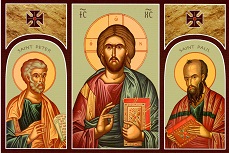
What a blessed calling, to belong to the one Church of God!

right-click to save, or push Play

Sermon for Trinity 17

Ephesians 4:1-6  +  Luke 14:1-11  +  Proverbs 25:6-14

It’s always a joyful occasion when we can celebrate a baptism here in our congregation – even more joyful when there are two baptisms.  Not only do we get to welcome the newly baptized into our church, but all of us who are baptized into Christ get a chance to recall the blessings that are ours as baptized Christians.   Today’s Epistle from Paul’s letter to the Ephesians, chapter 4, teaches us about the blessed calling we have received as members of his Holy Christian and apostolic Church – a membership that became ours through Holy Baptism.  Jaimie and Jeremy have now been brought into this blessed fellowship, and so it’s good and right for all of us, as members of God’s Church, to consider today what it means to be a part of this Church, to marvel, together with the Apostle Paul, at the calling we have received:  What a blessed calling!  to belong to the one Church of God.

Paul begins, I therefore, a prisoner for the Lord, urge you to walk in a manner worthy of the calling to which you have been called.  Now, what is that calling to which you have been called, and how were you called to it?  He’s talking about how God has called out to you through the preaching of his Gospel and called you into his kingdom by faith, just as Jesus called out in his preaching, “Repent and believe the good news!”

First, it’s that call to repent, to acknowledge your sin – both the sin that infects your very nature since the moment you were conceived, as well as all the sins of thought, word and deed that flow out of your sinful heart.  Pride was the sin Jesus specifically called on people to repent of in the Gospel today.

The people at the banquet where he was were filled with sinful pride, first toward God.  They thought the Sabbath day was all about their service to God by keeping his Sabbath commandment, while all the while they refused to admit that they were the ones who needed to be served by God, by Jesus, to be healed by Jesus on that Sabbath day, to admit that they were the ones who had fallen into a pit of condemnation and needed Jesus to reach down and pull them out.

Then he called them to repent of their pride toward their fellow man, as each one of them at that banquet rushed to take the most important seat for himself, looking out for himself, seeking his own benefit, because each one thought, “I deserve it!  I deserve to be honored more than all these people around me.  I’m better than them.  I’m more important than them.” And so Jesus called on them and today calls on you to repent, not of this one thing or that one thing, but of everything, to fall on your knees before God and admit your complete inability to please God or to come up with the selflessness and with the righteousness that God demands of you in his holy Law.  You can’t save yourself.  You need him to do it for you.

And he does!  The calling to which you have been called – you who hunger and thirst for righteousness, you who are weary and burdened – is the call to believe the good news, the Gospel, the call to believe in Jesus, the Christ, the Son of God for the forgiveness of sins.  He is the one who took on our flesh and humbled himself to the lowest place, even death on a cross, so that we might be lifted up with him to the highest place, even heaven.  He accomplished the righteousness that we lack, the only righteousness that counts before God.  He offered the sacrifice on the cross that covers all your sins, that reconciles you to God, that makes you his child and heir, that gives you a gracious Father in heaven.

The calling to which you have been called is nothing less than to trust in God’s promise that all who believe in Jesus are judged by God to be saints, not because of your own holiness, but because of the holiness of Jesus, whose name you bear as Christians, with whom God clothed you when you were baptized.  What a blessed calling!

Paul urges you, then, to walk in a manner worthy of that calling to which you have been called.  By faith in Christ, you are Christians.  So live like Christians.  By faith in Christ you are saints.  So live accordingly – not to become children of God, but because, as baptized believers in Christ, you are children of God.

How do saints – how do Christians behave?  What kind of attitude do they have?  What does it mean to walk in a manner worthy of you calling?

Paul gives a few specific examples.  He says, “with all humility and gentleness.”  Humility is to have a lowly opinion of yourself, to think of others more highly than yourself – not just some others, like the people you really respect and admire, but all people.  To walk in humility means not to look down on anyone, as if they don’t live up to your standards, as if your needs mattered more than theirs, as if they were here on this earth or in this church to serve you.  No, we can’t behave that way.  Humility is the way of Christ, and it must be the way of the Christian if we would walk in a manner worthy of our calling.

And to walk with gentleness – that’s the opposite of meanness, nastiness, harshness.  There are many of you who walk in humility and gentleness.  It’s evident in how you treat your fellow members with respect and concern.  But if you ignore your fellow members, or give them a dirty look or snap at them or complain about them – that’s not gentleness.  If you present yourself to the world as a mean and nasty person, as a churchly snob or a disinterested Christian, then you dishonor the name of Christ. Repent.  Go back to Christ for mercy and grace and forgiveness, and you will find it, because he is humble and gentle.  He had such a lowly opinion of himself that he thought even you were more important than he, and that your well-being was worth more than his.  And he doesn’t snap at you or complain about you.  He is gentle toward you. In his gentleness is your salvation.

Paul gives another example of walking in a manner worthy of your calling.  He says, “with patience, bearing with one another in love.”  Patience – literally, “a long-suffering attitude,” an eager willingness to put up other people, with all their sins and weaknesses and flaws, not because you’re forced to, but “in love.”  Many of you do bear with your fellow members in patience when they ignore you or speak unkindly to you or about you.  When you bear with them in love, you’re walking in the steps of Jesus.  But understand this, people of God, fellow Christians: your calling from God does not allow you to get disgruntled or angry or to walk away from your Christian family when your family doesn’t do what you want them to do or treat you how you want to be treated, when someone says or does something you don’t like, or if your pastor isn’t the pastor you want him to be.  That is walking unworthily of the calling to which you were called.  We are all sinners here.  If you thought otherwise, you were wrong.  We are sinners who are called to live each day in repentance and faith, sinners with whom the sinless God has been very patient, bearing with us in love, for Jesus’ sake whose name we bear. What better reason could there be to be patient and bear with one another – fellow sinners! – in love?

Finally, Paul tells us how we are to walk in a manner worthy of our calling:. “being eager to maintain the unity of the Spirit in the bond of peace.”  Being eager, literally, hastening, hurrying up to hold onto the unity of the Spirit.  The unity of the Spirit is not a feeling of camaraderie.  It is not an atmosphere of friendliness.  The unity of the Spirit is a unity around the doctrine – the teaching of Christ, just as it was the Spirit who came upon the apostles and taught them the heavenly doctrine and inspired them to write it down for us, the same Spirit who has brought us to faith through the preaching of this doctrine.  The unity of the Spirit is a unity of faith and confession.  That’s why we’re confessional Lutherans and not Roman Catholics or Methodists or anything else – because we are convinced that we have in our Lutheran Confessions the one, true, apostolic doctrine of Christ, the unadulterated Christian faith that has been undeservedly passed down to us over these two thousand years.  We are confessional Lutherans because we are hurrying up to maintain that unity, and yes, running away from those who would disturb it through false doctrine.

So let us hurry up to preserve this unity.  Let us be quick to hold up every teaching of every teacher in the Church to the Scriptures and the Lutheran Confessions to make sure they agree.  And if someone among us has doubts or questions about the doctrine of Christ, let us hurry up to search the Scriptures together.  And if someone doesn’t care to grow in knowledge of the doctrine of Christ, then let us hurry up to warn them about such spiritual apathy.  And if someone is causing discord or dissension or strife in our midst, then let us hurry up to address it, in love. Don’t let it fester and grow, so that it may not threaten the unity of the Spirit, the unity to which we have been called.

And what a blessed calling it is!  As Paul says, “There is one body and one Spirit—just as you were called to the one hope that belongs to your call— one Lord, one faith, one baptism, one God and Father of us all, who is over us all and through us all and in us all.”  Many entire sermons could be preached on just those words, but for today, it’s the one baptism that’s on our minds.  It’s not a WELS baptism or a Lutheran baptism.  It’s a Christian baptism, and it unites us not with the Wisconsin Synod, not with any denomination, but rather it unites us to the one Christian Church that exists in every nation, in every language under heaven, that confesses Jesus Christ as Lord; the one Christian Church made up of saints on earth and saints who have already fallen asleep and wait in heaven for the glorious coming of our Lord Jesus Christ.  This one Church is called the body of Christ for good reason, because all who have been baptized are united by faith to the Person of Christ so closely that we died with him and were raised with him, so closely that when God the Father looks at you, he sees Jesus and is as pleased with you as he is with his Son.

This is what it means to belong to the one Church of God – to be called out of the unbelieving world, to be called out of the family of the devil that is perishing, to be called into the family of the Triune God:  Father, Son and Holy Spirit.  In his name we are baptized.  In his name we have been called to inherit eternal life.  By his name alone we are saved.  What a blessed calling, to belong to the one Church of God! Amen.

Posted in Sermons | Tagged , | Comments Off on What a blessed calling, to belong to the one Church of God!

Jesus Is Our Life in the midst of Death

right-click to save, or push Play

Sermon for Trinity 16

Luke 7:11-17  +  1 Kings 17:17-24  +  Ephesians 3:13-21

A week and a half ago there was a tragic death here in Las Cruces.  A one-year old boy was found dead, lying on a couch.  His parents thought he was sleeping.  Apparently he put a penny in his mouth and it got stuck in his throat so that he couldn’t breathe.  What a tragedy!

Lorraine Schnitz died two months ago on her 88th birthday.  She lived out her years, and her death put an end to her painful battle against cancer.  Maybe you wouldn’t call her death a tragedy.  But I would.  Her husband, Gary – her husband of 66 years – was left all alone by her death. He was moved to a nursing home shortly thereafter, devastated by her loss.  There he sits alone.  He’s old.  He’s weak.  He probably doesn’t have too long to live, but how long is too long when you’re living all alone in a nursing home after your spouse dies?  It’s tragic.

Death always is.  We’re foolish to deny the tragedy, the devastation of death.  We’re confronted with it today in our Gospel of the widow of Nain whose only son had died, a young man at that.  Her son died young. She was left all alone, and without family, a widow in Israel had no real possibility of taking care of herself financially.  Unless she was wealthy, which she probably was not, she would become a beggar, or at best, she would have to depend on the kindness of others for the rest of her life.  Talk about tragedy!

But here’s the truth that the world refuses to face:  Tragedy is the result of sin. Suffering and death are the result of sin.  The boy from Nain died because he was a sinner. Not that his death was probably caused by anything specific he did wrong.  It’s that he was wrong. He was a sinner.  His mother was widowed and bereft of her son and headed for the poor house because she was a sinner.  Not that she had probably committed some great sin or done anything more wrong than anyone else.  But suffering and death are not punishments reserved for the worst of sinners.  They come upon all sinners, and if someone suffers, if someone dies, you can know beyond a shadow of a doubt that he or she was a sinner.

Death is our own fault.  We’ve brought it on ourselves.  With every selfish thought or deed, with the very flesh that clings to us, we have earned the wages of sin, which is death.

But you already confessed that this morning.  “I, a poor miserable sinner confess all my sins and iniquities with which I have ever offended You and justly deserved Your temporal and eternal punishment.”  The problem is that Satan has an ally in your flesh, so that even though you confess that you deserve suffering and death, Satan and your flesh disagree with your confession.  “You can’t really believe that you justly deserve God’s temporal and eternal punishment, can you?  I mean, maybe some people deserve that, but not you.  Not that little boy.  Not Lorraine.  Not the young man from Nain or his widow mother.  How evil God is!  How rotten is his running of the universe, that he lets these horrible things happen to good people!” The devil is so wicked he would even turn the miracle in today’s Gospel into blasphemy against the Son of God – “what about all the other sons and daughters in Israel that he didn’t bring back to life.  What about all the young people who die today.  What about your loved ones?  Why doesn’t Jesus come and touch their coffins and give them back to you?  What a sadistic God!”

But to hell with Satan!  Death isn’t God’s fault.  It’s our fault.  God is under no obligation to us, to give us life, to give us healing.  You and I are not entitled to God’s help – not in the least.  It is only our dead sinful nature that thinks so.

So when Jesus approached the city gate of Nain, he didn’t show up then and there, just at that moment, because he had to, but because he chose to.  And when he saw the woman there, crying in that tragic funeral procession, he didn’t have to have compassion on her.  But he did. His heart went out to her, and the heart of Jesus is the heart of God.  God sees our suffering, our sin and our death.  He sees our mourning, our crying, our pain and there’s no reason in the universe for him to care.  But he does.  Not with a superficial sadness that lasts only a few moments, but with a deep, eternal compassion that’s felt from the belly of the Son of God.  He knows. He cares.  It’s why he came.

Don’t cry,” he said to the grieving mother.  Then he touched the boy’s coffin and told him to get up.  And just that easily, the boy sat up and began to talk.  Death had to pay back its wages.  Death was conquered by the voice of the Son of God who gives life to the dead and calls into existence the things that don’t exist.  Jesus raised the boy from the dead and, it says, “gave him back to his mother.”

But for as effortless as Jesus’ miracle appears, it wasn’t that simple.  Death will not be cheated.  Death has a right to the lives it takes.  It had a right to take the widow’s son, just as it has a right to take all of us sinners.  In order for Jesus to conquer death, he had to trick death into doing something that it didn’t have the right to do: shed innocent blood, take the life of the sinless Son of God.

You and I don’t choose the life we have.  You and I don’t choose suffering and death.  But Jesus chose his life and his suffering and his death, so that he could create a true remedy for our sadness.  He looked at our sorrow and pain and suffering and death, and even though it’s all our own fault, he had compassion for us.  He came to suffer.  He came to die, because he came to take all our faults on himself, to suffer what we have deserved. The only way for a sinner to stand before an angry, righteous God is to have his sins forgiven, and the only way for God to forgive our sins was for the sinless Son of God to redeem us with his holy precious blood and with his innocent suffering and death.  By raising the widow’s sin, Jesus demonstrated what he himself would soon do.  He would touch the place of our death, and then rise from the dead.

This raising from the dead that Jesus does actually takes place even before a person dies physically.  We were all dead in sin at one time, just as all people are born dead in sin.  But Jesus says in John 5, “I tell you the truth, whoever hears my word and believes him who sent me has eternal life and will not be condemned; he has crossed over from death to life. I tell you the truth, a time is coming and has now come when the dead will hear the voice of the Son of God and those who hear will live.” He’s not talking about the Last Day.  He’s talking about raising dead souls to life here and now through his powerful Word.  He calls out to sinners in the Gospel and says, “Repent and believe in me for the forgiveness of sins!”  And by the power of his Gospel, you believe!  You have crossed over from death to life.  By faith in Jesus, you live in the shelter of Christ’s forgiveness.  You live with a righteous status before God.

But that life is hidden for now – hidden in Christ.  To the rest of the world you look just as mortal as anyone else.  And your body will die, just like the body of everyone else.  But Jesus has a secret that he only reveals to God’s children, “I am the resurrection and the life.  He who believes in me will live, even though he dies.  And whoever lives and believes in me will never die!”  That was Lorraine’s hope as she closed her eyes in death.  That’s Gary’s hope as he waits for death in the nursing home.  That’s the hope of every child of God, a sure hope that will never disappoint us.

Here, in the midst of our death, Jesus steps in with his life.  Jesus steps in as our Life.  Here we are on Sunday morning, the Lord’s Day, celebrating the Lord’s Day once again, a little Easter festival week.  Today is Sunday, resurrection day, a memorial to Life in the midst of our death, a reminder each week that though we are surrounded by death in this world, Christ our Life has conquered it by rising from the dead, continues to conquer it by raising the dead by the Word of his Gospel, and will conquer death completely at the Last Day.  Here we are on Sunday, confessing not only the death of Jesus, but the resurrection and the life of Jesus, who comes to us now with his living body and blood in the Sacrament that the Church Fathers called, “a medicine of immortality, an antidote, that we may not die but live in God through Jesus Christ, a cleansing remedy for warding off and driving out evils.”

Death is still a tragedy and life on earth will be filled with toil and pain and sadness right up until the Day when Jesus returns.  (Come quickly, Lord Jesus!)  But here and now, in the midst of our death, Jesus our Life gives us victory in the midst of tragedy, and a reason for gladness that outweighs all our sadness.  Truly God has come to help his people.  Amen!

Posted in Sermons | Tagged , , | Comments Off on Jesus Is Our Life in the midst of Death

The Father’s Care Frees Us to Care about the Things That Matter Most

Sermon for Trinity 15

Matthew 6:24-34  +  1 Kings 17:8-16  +  Galatians 5:25 – 6:10 

 What do you care about?  What kinds of things do you worry about?  If you were to make a list of the things that occupy your thoughts and your plans and the things you spend your energy on from day to day, how many of those things would have to do with money, or the things money can buy for your life on earth?  House issues, job-related issues, school issues, income issues, retirement savings, insurance policies, how to provide for yourself and for your future – do you spend time worrying about those things?  If any of those things is threatened – say, by a bad economy, a volatile stock-market, a job loss that has either happened or is looming on the horizon – are you troubled? Are you scared?  Are you worried?

If so, you’re not alone.  Few if any of us do not spend time being concerned about money matters; few if any of us are not scared when our livelihood is threatened.  But just because it’s common among doesn’t mean it’s acceptable for us, or that it makes any sense.  In today’s Gospel, Jesus wishes to crush us and crucify us sinners with the sickening reality of our double-minded service and our faithless worrying – not to harm us, but to save us and to free us from it, so that instead of spending our time worrying about how to provide for ourselves, we can know the peace of having a Provider in heaven who really is worthy of the name “Father.”  Then we can spend our time worrying about bigger and better things, like, how to serve our Father.  In our Gospel, Jesus shows us how The Father’s Care Frees Us to Care about the Things That Matter Most.

The first thing to notice in the text is that it falls within Jesus’ Sermon on the Mount.  That’s when he took his own disciples aside and taught them many things about the kingdom of God.  He was talking to his disciples, not to the heathen, not to the unbelieving world.  He’s talking to his disciples who know God as a gracious Father through faith in his beloved Son, Jesus Christ.  So everything Jesus says in this Gospel, he is saying to those who are Christians.

And to those Christians, he says, “No one can serve two masters. Either he will hate the one and love the other, or he will be devoted to the one and despise the other. You cannot serve both God and Money.”

Notice, Jesus doesn’t say you can’t possess money and God at the same time.  It’s not sinful to have possessions, even many possessions.  Many Christians in the past have been wealthy.  But what Jesus says is that it is impossible to serve both God and money – although many Christians foolishly try.

You serve money by hoarding up a pile of money – as much as you can, and then living your life to serve that pile of money.  You make your plans around feeding that pile. You look to that pile to provide you with food and shelter and safety and security.  You look to your pile to be there for you when you get sick.  You look to your pile to give you a future.  You turn to your pile to satisfy your earthly needs and your earthly wants.  And you get nervous and scared and defensive when your pile is threatened.

But see!  Your pile of money is a dead god.  It’s corruptible.  It’s perishable.  It doesn’t care about you at all.  It’s fickle, and even if you spend your whole life working hard to serve it, it can flee from you in an instant and leave you with nothing but misery and emptiness.  It takes from you much more than it gives, and it refuses to accompany you to the grave.  Your pile of money is a worthless god, and we are fools to serve it, to rely on it, to count on it, to base our hope and our future on it. 

The Gentiles – the pagans seek after these things, Jesus says.  Oh, how Jesus puts us to shame and shows us how we mimic the ignorant, unbelieving world, putting so much stock in stocks, so much trust in wealth and income and bank accounts and insurance companies and governments to bail us out.    It’s at least understandable that the pagans would run after such things – they have no one else to turn to.  But for Christians to worry about “things,” as if we had no Father who really cared for us, or who was so impotent that he can’t help us in our need or so unfriendly and unfatherly that he won’t help his children when they need the most essential things of life – food and clothes and shelter – that’s unconscionable.  No wonder Jesus says, “O you of little faith.”

Maybe you’ve noticed that telling someone to stop worrying doesn’t usually work.  If someone is in crisis mode, they won’t just stop worrying because you told them to.  The lifeline God lets down to the person who is trapped in a pit of worry and anxiety is the simple message of law and gospel.  “What are you doing down there in your pit?” he says.  “Well, I’m worried.”  “Why are you worried?” he asks.  And you confront the reality, “I’m worried because I don’t really believe that you will love me like a Father and take care of me.”  There it is!  There’s the problem!  It’s called “sin.”  But now that we’ve identified it, we can address it.

Our Father doesn’t walk away angry.  He says, “You’re wrong not to trust me.  You’re wrong to believe that money will be your Savior.  I brought you into my house when you were baptized.  Do you really think I will abandon you now?   Repent of your life lived in service to your pile of money; repent of your unbelief; repent of your doubt and your worry and your lack of faith in me.   Because I alone am God.  I alone am your Savior – I and no other.  And I will be true to my baptismal promise to treat you as a son, as my child.  For the sake of my Son, Jesus Christ, for the sake of his holy, innocent, bitter sufferings and death – I forgive you.  And I will provide for you.  I know your weaknesses and your little faith.  But a little faith is still saving faith if you rely on the atonement my Son has made on the cross to save you.  I will strengthen you and help you.  You have my Word!  And you have my Son!  And you have my Sacraments to bring him to you, with all his strength and with all his comfort.”

And if you’ve never believed in Christ before as your righteousness before God, if you haven’t been baptized into his name, or if you have, but have since walked away from your baptismal faith, then come and see what a good and gracious Father God wants to be to you in Christ Jesus and only in him.

You want proof of the Father’s goodness?  Jesus points you to the birds that God feeds without their worrying.  Now, the point isn’t that God will do the same for you as he does for the birds, but far more!  Because not only are human beings worth far more than birds, having been made in the image of God, but you – you are God’s baptized children, branded with the image of Christ that is being renewed day by day!  You have infinite worth before God. You are as valuable to him as the Son of God whose name you bear. So you’d better believe he will give you everything you need to sustain your earthly life, whether by the natural means of work and income or by supernatural means, as he fed Elijah the prophet and the widow and her son who served him.

Then there are the lilies of the field that wear some of the finest clothes in all creation, given to them by God the Father.  But still, the point isn’t that God will do the same for you as he does for the flowers, but far more! Because the flowers last a few days before they wither and die and are cut down forever.  But you who trust in Christ Jesus, when your days are done on this earth and your body withers and dies – you are not gone forever! You have been given eternal life as a gift!   If God cares enough to clothe the flowers that live for a day and die forever, then he surely cares more than enough to make sure that his children will have all they need for their body before it rests in the grave for a little while, until the resurrection from the dead when he will clothe them with the splendor of immortality.

The Father’s care frees us to stop serving our bellies and our bodies, because he’s promised to take care of those things without our worry and without our help. Instead, Jesus says, “Seek first the kingdom of God and his righteousness, and all these things will be given to you as well.”

Seek first his kingdom and his righteousness. That means, first and foremost, the kingdom and the righteousness of Jesus Christ, that by faith in him you may have his righteousness as your own.  There is no righteousness before God apart from faith in Christ. So seek the things that create and sustain faith – the preaching of the Gospel, the Word, the Sacrament.  Seek them and believe in the forgiveness they pronounce.

Seek first his kingdom. That means seek his Word, to hear it and to learn it, but also to do it and to live it.  God doesn’t want you to live a “carefree” life.  He wants you to care very much about serving him and serving your neighbor. 

Seek first his kingdom. That doesn’t mean quit your job or stop looking for employment.  It means, don’t seek a job in order to pay the bills or to find fulfillment in your life.  Instead, reverse it.  Seek a job in order to serve God, in order to further his kingdom.  God doesn’t want a certain percentage of your money.  God demands all of your money, even as he demands all of your heart.  But that doesn’t mean drop your whole paycheck in the offering plate.  It means use your money to serve your neighbor.  That includes your church.  It also includes your family.  It also includes the government.  It also includes the poor and needy.

The temptation will come to compromise on the things of God if they jeopardize your income or your reputation or your church’s membership numbers.  The temptation will come to be silent when you know you should speak, to speak something less than the truth because you know the truth itself will go over like a ton of bricks.  That’s seeking first the god of money, the god of popularity, the god of self.  But instead, reverse it.  Be willing to compromise on anything and everything except the things of God and his kingdom.  Serve him and know that the other things will be provided in his way, in his time, sometimes more richly than you could have ever imagined.

It’s not that all trouble will be taken away.  No, tomorrow will have plenty of trouble, Jesus says.  That is our life and our lot on earth.  And your flesh will always war against your spirit, so that care and worry and fear will always be there bubbling up under the surface.  That doesn’t mean you’re not a Christian.  Our Gospel today is meant for Christians.  But in his love, Jesus calls us today to walk in daily repentance and faith.  It won’t do you any good to worry about things.  But by faith in Jesus, we have a gracious Father who lives in the today and the tomorrow, and who has taken it upon himself to worry about taking care of you.  Trust in your Father to provide your daily bread, both today and tomorrow.  The cross of Christ is the proof that he cares for you – more than you can possibly imagine.  Amen.

Posted in Sermons | Tagged , | Comments Off on The Father’s Care Frees Us to Care about the Things That Matter Most

Saving Faith Lives in the One Who Returns to Give Thanks

right-click to save, or push Play

Sermon for Trinity 14

Luke 17:11-19  +  Proverbs 4:10-23  +  Galatians 5:16-24

The Gospel of the Healing of the Ten Lepers is an easy story to understand.  Ten men were afflicted with the chronic skin disease called leprosy.  Ten men approached Jesus, begging him for mercy.  Jesus had mercy on them and sent them on their way to the priest, who was charged by God with the task of examining lepers and pronouncing them either clean or unclean.  Ten men were healed of their leprosy.  But only one returned to where Jesus was to give him thanks.  Let’s take a few moments this morning and consider what the Holy Spirit is teaching us in this Gospel.

You may remember that people who were afflicted with leprosy not only had their skin disease to deal with.  They had to deal with the reality of being excluded from society, excluded by God’s own Law.  They were considered contaminated and contagious.  They had to keep their distance and live at a distance from all the “clean” people in Israel.  People with leprosy not only lost their health.  They lost their family and friends, and even their ability to go to the Temple, where God had placed his name forever.

But along came Jesus, who went out of his way to travel between Galilee and Samaria on his journey to Jerusalem to give his life on the cross.  Along came Jesus, whose reputation of goodness and kindness and healing power had reached the lepers’ ears.  The kindness of Jesus is what drew the lepers to him.  They had nothing to offer him, nothing to give, just their leprosy and uncleanness.

They prayed that simple prayer, “Jesus, Master, have mercy!”  “Eleison!”  There’s that word, that phrase, that prayer that we sing and say over and over again in every Divine Service.  It’s the prayer of the pathetic, the prayer of the weak and frail and helpless who seek help from a Jesus who is kind and merciful and able to help.  “Lord, Jesus, have mercy!”

And Jesus did have mercy in our Gospel.  He sent the Ten Lepers to the priest, but he delayed their healing until they had gone on the way for a little while.  You can imagine them walking along the road, checking their hands and arms every few minutes to see if they were healed yet.  And when they realized that they had been healed, you can imagine their joy and the brief dialogue that probably took place among them.

“Look! I’m healed!  Are you healed? We’re all healed!  Praise God!  Now, let’s hurry and get to the priest so that we can get back to our lives!”  They’re all Jews, apparently, except for one who is, for sure, a Samaritan.  We heard about them last week, didn’t we?  The Samaritan says to the other nine, “Hey! Let’s go back and give thanks to Jesus for healing us!”  But the others barely hear him, too distracted by the prospects of returning to a normal life again.  He urges them again, “Come on! Let’s go back!” And they say something like, “You go ahead.   We’ve got a life to return to – finally.  We’ve got friends and family to see again.  We’ll just say a prayer of thanks to God in our hearts.  We don’t need to actually go to where Jesus is.  And if we get a chance, we’ll try to bump into him someday.  After all, there will always be time to give thanks.”

So while the nine race to the nearest priest, the Samaritan turns around and races in the opposite direction, back to Jesus, praising God with a loud voice and falling on his face at Jesus’ feet in humble praise and thanksgiving.

Then Jesus asks that burning question, “Were not all ten cleansed? Where are the other nine? Was no one found to return and give praise to God except this foreigner?”  Of course, he knows the answers to his questions. Yes, all ten were cleansed.  The other nine are busy racing back to their earthly cares and concerns.  And no, no one else was found to return and give praise to God except for this foreigner.

It doesn’t say that Jesus was sad or mad or angry about that, but he did notice and he wanted all those around him to notice as well. As for the one who returned – the Samaritan, Jesus simply accepts his humble thanks, “Rise and go; your faith has made you well.”  And here’s where I wish the English translation would just say what the Greek word says, “Your faith has saved you.”  Not, “your merit and worthiness,” not “your good character” not “your works of love,” not “your returning to give thanks – has saved you.” “Your faith has saved you.”

Over and over again in the Scriptures, we see this simple truth.  It is faith that saves the sinner.  Not because faith is some great work on our part, but because faith lays hold of Christ, the Savior of sinners.  Leprosy, in the Scriptures, is a symbol of the disease of sin that infects us all, that makes us unclean and unhealthy and ugly and that alienates us from God and from one another.  God’s law shows us our leprosy, the works of the flesh, that whole laundry list you heard in today’s Epistle from Galatians 5.  But the Gospel shows us Christ, who died on the cross to pay for that whole laundry list of sin, who invites sinners to trust in him for the forgiveness of sins.  And that Gospel, filled with the power of the Holy Spirit, creates faith, where and when it pleases God.  And that faith approaches Christ for mercy and receives mercy and forgiveness and help from him.

But see what often happens!  In nine of the ten lepers who sought and received healing from Jesus, faith was quickly replaced by unbelief.  Faith died as their sinful natures took over and they turned away from Jesus to gratify the desires of their sinful nature.  It’s not that they turned into murderers and thieves.  It’s that they stopped seeking Christ and replaced him in their hearts with earthly cares and with earthly pleasures.  The Spirit of God was urging them back to Jesus to worship him and give thanks to him.  But they chose to be led, instead, by other concerns that took them in the opposite direction of where Jesus was.

Heed the Spirit’s warning in this Gospel.  Many Christians start out recognizing their sinfulness and seeking mercy from Jesus.  But after receiving a little bit of his mercy – a little taste of forgiveness and earthly blessing, they go on their way and Jesus becomes an afterthought.  “We’re healed now,” they figure.  “Time to get on with the rest of our life.  We can give thanks to God anytime.  We don’t need to be in church. We don’t need to receive the Sacrament.”  And the struggle within the believer that Paul described in Galatians between the Spirit and the flesh begins to fade, until there really isn’t a struggle anymore.  The flesh has won.  Faith has died.

This is not a rare occurrence.  It happened to nine out of ten cleansed lepers.  How many Christians will let this happen?

But then there’s that one leper, the most unlikely of all, the Samaritan.  He shows us what saving faith looks like.  The one with saving faith clings to Christ.  He looks to Christ for mercy, not once, but always.  He knows that he has no life to get on with apart from Christ.  He knows that, although God is everywhere, Jesus wants to be worshiped in a place.  Not just one place, not in a Temple in Jerusalem, not necessarily in a church building, but where the Church gathers – that’s where Jesus says that he will be found.  That’s where Jesus says he will accept our worship and continue to hand out to us the forgiveness of sins, life and salvation.  “Where two or three are gathered together in my name, there am I in their midst.”

Here is Jesus, in our midst, according to his own word, to receive our humble thanks and praise.  We gather here as the Church, not to purchase Jesus’ help with our words of thanks, but to worship him for the help he has already given us: for becoming man to be our divine Brother and take our place under the Law; for struggling against sin and temptation and overcoming the devil for us; for bearing our sins and our diseases and for making atonement for our sins; for rising from the dead and bringing his eternal life to us in the Gospel; for sending his Spirit in the Gospel to warn us, to comfort us, to encourage us and empower us in our daily struggle against our sinful nature.  There will never come a time in this life when we cease to need Jesus’ help.  There will never come a time when Jesus will turn away those who seek him in faith.  There will never come a time when we have more important things to do than give him thanks for saving us from sin, death and the power of the devil.

We’re about to give him thanks once again this morning.  You know, don’t you?, what the Church’s ancient name for Holy Communion is:  “The Eucharist.” It’s OK to call it that.  Eucharist means “Thanksgiving.”  The Eucharist is not our sad, weekly, funeral remembrance of Jesus.  The Eucharist is the Church’s great Thanksgiving to the Son of God who gave his life for us and took it up again.  If you have been losing the struggle against your sinful flesh, if you have sins that need forgiving, if you believe Jesus’ words that his body and blood are here for you to give you forgiveness and life, then come to where Jesus is.  Come and worship him by receiving what he wants to give – his life to you, his salvation to you, his righteousness to you.  Here he is to receive your humble thanksgiving, and to give and to give and to give.

Many will receive Jesus’ healing for awhile and then go their own way.  It will always be that way, as our Gospel teaches us today.  But it will also always be true that some return again and again to Christ to praise and thank him, to receive mercy and help from him.  Take this warning and this comfort and this sincere encouragement with you today from the Gospel, that you may the one out of ten who returns to give thanks to Jesus for healing you of your leprosy, for saving you through faith in him alone.  Amen.

Posted in Sermons | Tagged , , | Comments Off on Saving Faith Lives in the One Who Returns to Give Thanks

The Law is good, but I am not. Thank God for the Good Samaritan!

right-click to save, or push Play

Sermon for Trinity 13

Luke 10:23-37  +  2 Chronicles 28:8-15  +  Galatians 3:15-22

If you’re at all familiar with the Bible, and certainly if you’re familiar with the Lutheran Church, then you know that there are two main teachings that run throughout the Scriptures:  The Law and the Gospel.  You hear them both throughout the divine service and throughout the sermon.  The Law reveals God’s will for mankind’s behavior; the Gospel reveals God’s plan for mankind’s salvation.  The Law preaches works; the Gospel preaches faith in Christ. The Law says, “Do this!”  The Gospel says, “Believe that Christ has done it for you!”  The Law accuses all people of sin; the Gospel promises forgiveness of sins for all who believe in Christ.  The Law says, “The sinner must die;” the Gospel says, “Believe in Christ who died in the sinner’s place!”  As we heard last week in the Epistle, the Law – the letter – kills, but the Gospel – the Spirit gives life.

Maybe at one time you learned this mnemonic device:  The Law was and is still necessary to “S.O.S.” – “Show Our Sin.”  The Gospel was and will always be necessary to “S.O.S.” – “Show Our Savior.”  Today in our Gospel, Jesus’ parable of the Good Samaritan, Law and Gospel are woven together so intricately by Jesus, the Master Teacher, that one and the same parable preaches both the sternest Law and, to those whom the Son of God chooses to enlighten by his Holy Spirit, it preaches also the sweetest Gospel.  Learn this lesson today: The Law is good, but I am not.  Thank God for the Good Samaritan! As Law, the Good Samaritan shows us our sin.  As Gospel, the Good Samaritan shows us our Savior.

An expert in the Law approached Jesus to test him. He knew the Law backwards and forwards.  He loved the Law.  And he thought he had eternal life through the Law.  “Teacher, what must I do to inherit eternal life?”  Here he sees Jesus, this Rabbi who is gaining in popularity, who has attracted big crowds around him.  But what’s so special about Jesus’ message?  What new teaching could he be adding to the Law of Moses?  Is he saying the Law of Moses is defective?  Is it not good?

Oh, no.  Jesus agrees that the Law is good.  He turns that expert in the Law back to the Law and questions him on it: “What is written in the Law? How do you read it?”  Ah! The Law says, Love the Lord your God with all your heart and with all your soul and with all your strength and with all your mind’; and, ‘Love your neighbor as yourself.’

You have answered correctly, Jesus told the expert in the Law.  Do this, and you will live.

Simple, right?  Or, if not simple, at least achievable, right?  At least within the realm of possibility if you work hard enough, right?  Not if you take the words of the Law seriously, no.

Jesus’ simple statement, “Do this and you will live,” caught the expert in the Law off guard.  Not, “You’ve done enough!” Not, “You’re doing this! Keep it up!” Not, “Try your hardest to do this.”  Just, “Do this and you will live.” If perfect love for God and my neighbor is required of me, thought the lawyer, then I am doomed.  But maybe I can find a loophole in the Law!  Who is my neighbor, Jesus?

And so Jesus tells the parable of the Good Samaritan to illustrate to the one who relied on the Law what it looks like to keep the law of love toward one’s neighbor.  It looks like a man who has been robbed and beaten half to death and is lying on the road helpless and dying.  And two very religious men, two men from among the leaders of the people of Israel, who consider themselves law-keepers, see the wounded man – their own countryman lying there, and they pass by on the other side.  That’s not what it looks like to love your neighbor as yourself.  That’s not what it looks like to keep the law.

But then a Samaritan comes by – one of those half-Jews who were hated and mistreated by the Jews.  And when he sees the wounded Jew lying on the road, he takes pity on the man.  See, no guilt or sense of obligation motivates him.  Just mercy and compassion.  He goes to the wounded man, pours oil and wine on his wounds – the best medicine available under the circumstances. He bandages up his wounds, places the man on his own donkey, sacrificing his own ride and being content to walk, until they arrive at the nearest inn where the Samaritan further tends to the man’s wounds and pays the innkeeper to keep looking after him until the Samaritan returns from his journey, at which time the Samaritan would be sure to check in on the wounded man and pay any additional expenses to the innkeeper – all out of the goodness of his heart.

That’s love.  That’s mercy.  The expert in the law agrees with Jesus.  It was the Samaritan who kept the law of love.  And so Jesus reveals that loving your neighbor means not looking for a single thing from anyone else, not worrying in the least how someone else treats you.  Loving your neighbor means seeing a person, even a total stranger, in need of your help, and then out of pure love, giving him all the help that you can give, without giving even a moment’s thought to how much you might lose in the process.

“Go and do likewise,” Jesus told the expert in the law.  That’s what God’s Law requires of you.  Do this and you will live.

Now, you have to agree, as the expert in the Law agreed:  the Law is good.  What God requires of man is perfect.  What the Good Samaritan did in the parable, that’s exactly what it means to love your neighbor. That’s exactly what we should all do for each other all the time.   The Law is good!

But I am not.  You will not find that kind of selfless devotion in your heart.  The Good Samaritan stands on a pedestal that you and I will simply never reach in this life.  How easily are you angered at your neighbor?  How easily offended?  How quick are you to forgive them when they come to you in sorrow for how they’ve mistreated you?  How much time or energy have you been willing to devote even to saying “good morning” with a smile to a fellow believer much less running over to offer your care and even your wealth to help someone in need, to help someone perhaps who has mistreated you?

The Good Samaritan shows us our sin.  The Good Samaritan convinces us that the Law is good.  What God requires of us is good and right.  But I am not good, because even in my best moments, I am not the picture of love that the Good Samaritan is.  I do not love anyone like that, much less do I love everyone like that, not my friends, much less my enemies.  And then the words of the Apostle John really hit home, anyone who does not love his brother, whom he has seen, cannot love God, whom he has not seen. Do this and you will live? Then I cannot live.

So thank God for the Good Samaritan.  He serves to snap you out of your dream world in which you thought you were a pretty decent person.  Jesus’ words, “Go and do likewise” are like a policeman’s order to a drunk driver to “Walk a straight line.” To those who rely on the Law, the love of the Good Samaritan will always be an unattainable goal.

But to those who have been killed and crushed by this Law, to those who despair of themselves and their works, the Good Samaritan is something more – much more!  Thank God for the Good Samaritan.  He shows you your Savior.

Rewind the story of the Good Samaritan in your mind.  Who is the one who is assaulted, robbed of his possessions, bleeding and dying, helpless on the side of the road?  Isn’t it you?  Isn’t it you who haven’t kept the law, who have no spiritual possessions left, no strength, no help, assaulted by the devil and rightly accused by him?  And your countrymen are no help.  They have seen you in your distress and have passed you by on the other side of the road, unable and unwilling to save you.

Then along comes a man, riding on a donkey, a Samaritan – a foreigner, the Son of God who came from heaven, yet now related to you by human blood.  The Samaritan is Jesus.  He is the loving neighbor to the injured.  He sees you sick and dying and hopeless and takes pity on you. In pure love and tender mercy, he goes to you and tends to your wounds – your sins – like a great physician, allowing himself to be wounded on the cross for your healing.  “By his wounds we are healed.”  Then he takes you to an inn – we call them “churches,” to be cared for by an innkeeper, by a caretaker of souls.  We call them pastors.  He gives the innkeeper plenty of money to take care of you until he returns.  That’s the Gospel in Word and Sacrament.  A church is nothing but a hospital where the wounded are cared for, where the medicine of the Gospel is administered to the sick until Jesus, the Good Samaritan returns.

And he will return, as he has promised.  The parable of the Good Samaritan ends there, but the Gospel fills in the rest of the story. When the Samaritan returns to the inn, he finds the man who once was injured and takes him home with him to eternal life in heaven.

This is the revelation of the Gospel that was hidden until Christ came.  The Law was never meant to save anyone.  The Law reveals how far short mankind falls of true goodness.  The Gospel reveals that salvation is by faith alone in Christ.  This is exactly what you heard in the Epistle today: But the Scripture declares that the whole world is a prisoner of sin, so that what was promised, being given through faith in Jesus Christ, might be given to those who believe.

The Law is still good.  It still shows you what goodness looks like.  If you’re wondering how to treat your neighbor today and tomorrow and the day after that, then remember the love shown by the Good Samaritan.  Go and do likewise! Yes! But don’t imagine that you earn eternal life in that way, because if your eternal life depends on your love, you are doomed.

What must I do to inherit eternal life?  The Law answers, “You must do this: love the Lord your God will all your heart and love your neighbor as yourself.”  And you should!  But you don’t!  .  The Gospel says, “All who rely on the Law are under a curse.  Repent and believe in Jesus, the Samaritan who loved you as himself and gives you forgiveness of sins and eternal life as a gift.”  Thank God for the Law that shows you what is good.  But more than that, thank God for the Gospel, through which all of God’s goodness comes to the aid of those who are not good!  Thank God for the love of the Good Samaritan, your Savior Jesus Christ.  Amen.

Posted in Sermons | Tagged , , , | Comments Off on The Law is good, but I am not. Thank God for the Good Samaritan!