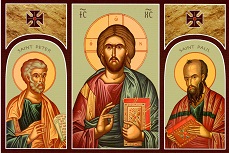
Worship the God-Man who brings men to God

Sermon
Download Sermon

Service
[vimeo https://vimeo.com/897965100 w=540&h=360]
Download Service Download Bulletin Download Service Folder

Sermon for Christmas Day

Hebrews 1:1-12  +  John 1:1-14

A baby can soften the heart of just about anyone. Anyone can accept that a baby was born in the small Judean town of Bethlehem, a baby named Jesus, to a mother named Mary. It’s rather harmless. It’s unintimidating, by God’s own design. It’s why, sometimes, even unbelievers are willing to hear the Christmas Eve Gospel from Luke 2, because the story of God’s salvation begins, in a sense, with this baby, who doesn’t threaten anyone. The unbeliever can even tolerate, for a night, at least, the notion of angels. Because it’s all good tidings of great joy for all the people (even if they overlook the part about Him being a Savior, who is Christ the Lord). It’s peace on earth, goodwill to men!

But we’re careful to explain, even on Christmas Eve, that the good tidings of the birth of an unintimidating baby can only be understood properly through the lens of the sin and darkness into which that baby was born—sin and darkness that permeated even Israel, not to mention the even greater darkness that covered the non-Jewish world, that this Jesus was born because of mankind’s idolatry, because of mankind’s rebellion against God’s Word, because of mankind’s disobedience toward God’s commandments, that He was born to suffer and die for the sins of the world, and that His peace on earth has nothing to do with the absence of war or the end of violence. That’s a lot harder for the unbeliever to hear, and yet it’s the only way an unbeliever will ever become a believer, by hearing the whole truth about Christmas and about Christ.

Then we come to the Christmas Day Gospel, and suddenly the unbeliever is confronted with the truth head on, with things that human reason can’t even begin to grasp, with things that sound like foolishness to the modern “scientific” ear. That there was a time when time didn’t exist. That there was a time when there was no matter, no energy, just God who brought all things into being, not with a big bang, but by His almighty Word. And most incomprehensible of all, is that that Word was with God, and that the Word was God, and that this Word that was with God and that was God eventually became flesh, became a Man. That this Word who existed already in the beginning, outside of time and space and matter and energy, is the very Person through whom all things were brought into existence, including the flesh that He one day took on.

But again, if anyone is going to believe in Jesus Christ, the Word made flesh, it will only be through hearing this truth proclaimed. You can’t argue anyone into the faith. It’s all about the simple proclamation of the Word, the promise of forgiveness through Christ, and the invitation to believe.

Already in v. 5 of our Gospel, St. John the Evangelist is referring to the Word coming into the world as a man, as “light.” As Jesus Himself once declared, I am the light of the world. He who follows Me shall not walk in darkness, but have the light of life…As long as I am in the world, I am the light of the world. The very One who is true God also became true Man, the light which gives light to every man, just as the sun gives light to every man, except that He was already there before the sun was, and the sun was created through Him. St. Paul once wrote that God alone has immortality, dwelling in unapproachable light, whom no man has seen or can see. So the only way we poor, sinful mortals could truly see the light of God, is if it’s veiled in flesh, if God makes Himself approachable to us. And that’s exactly what He did in the Person of the Word made flesh.

John the Baptist bore witness to Him. This is the light who gives light to every man! Not that every man sees by this light. But He is the only light by which any man may see, and He offers His light to all. What is His light? It is the knowledge of who God is and of how God gave His eternal Son to be born as a man, not to show us how to work our way up to heaven, but to earn heaven for all men, to suffer hell for all men, and to show us that it is by believing in Him who did all this for us that all men might have everlasting life.

That brings us to the tragedy of Christmas. The tragedy of Christmas is not that Jesus had to lie in a manger for a little while. The tragedy of Christmas is that He came to save all men from their sins, to give life to all men, and yet most men, even His own people of Israel, didn’t and don’t want Him for a Savior, and so most men remain dead in their trespasses and sins. He was in the world, and the world was made through Him, and the world did not know Him. He came to His own, and His own did not receive Him.

But, John writes, as many as received Him, to them He gave the right to become children of God, to those who believe in His name: who were born, not of blood, nor of the will of the flesh, nor of the will of man, but of God. This is the glorious victory of Christmas, not that God’s Son was born as a human child, but that the eternal Child of God was born as a human child in order to give us sinful human beings the right to become holy children of God like Him.

Because we weren’t. By nature, no one is. Creatures of God? Yes. But children of God? No. As sinners, we had no right to call Him Father, and no expectation of living in His house or of inheriting anything from Him. But now we do. Because we have a Brother who is God’s Child. Because we have a Savior who paid for our sins and offers us a place in God’s family through Holy Baptism and through faith in Him. Because He sends His own Holy Spirit to give us that new birth of faith, since we couldn’t come to faith by our own power or will.

Yes, the Word became flesh and made His dwelling among us. He became Emmanuel, God with us, so that we might follow Him in faith, be safe on the Day of Judgment, and live with Him forever.

The angels worshiped the Person of the Word since the moment they were created. But now God has taken on human flesh, and all God’s angels continue to worship Him also as a Man, even as they did on the night of His birth. If the angels worship Him for taking on human flesh to save sinful human beings, can we fail to worship Him? May it never be. On this Christmas Day, may the truth of the God-Man in the manger fill your hearts with wonder and with joy. And let your worship of Him today change the way you live your life tomorrow, so that you who have received Him and have been given the right to become children of God may live as children of God in the world, that your life may be a song of joy and thanksgiving. Amen.

Posted in Sermons | Tagged , | Comments Off on Worship the God-Man who brings men to God

What will you do with this Child?

Sermon
Download Sermon

Service
[vimeo https://vimeo.com/897777102 w=540&h=360]
Download Service Download Bulletin

Sermon for Christmas Eve

Isaiah 9:2-7

We asked and answered a very important question in that last hymn, one of the most important questions in all of history. What Child is this who, laid to rest, on Mary’s lap is sleeping? It’s the first of only two questions that really matter at Christmas time. Since we’re being led by the prophet Isaiah during our midweek services this year, it’s fitting that we should also be guided by Isaiah in our Christmas celebration, to hear his answer to that first question: What Child is this?

The people walking in darkness have seen a great light. Those dwelling in the land of the shadow of death, a light has shone upon them. The people walking in darkness were the people of Israel. At the time of Isaiah, they had largely rejected their God and turned in their hearts either to false gods or to foreign nations. But false gods can’t save, and neither can foreign nations. Only the true God can save. And so the Lord God subjected them to oppression by foreign nations, on and off, for the next seven centuries.

But the real enemy the people needed saving from wasn’t foreign oppression or earthly trouble. It was the enemy of sin, death, and the devil. And since only the true God can save from those enemies, mankind remains trapped under the power of those great enemies as long as mankind remains an enemy of the true God. And Israel was! Even though God had called them out of darkness and revealed the light of His truth to them. They had rejected that truth. They had made themselves God’s enemies by their idolatry and unbelief. Some still believed, of course, but most didn’t. Even 700 years in the future, from Isaiah’s standpoint, Jesus looked out at the people of Israel and lamented that the people were like sheep without a shepherd, with no leaders left in the Church who were teaching them the truth—so far had the outward, visible Church of Israel deteriorated.

But God had a solution for Israel—a solution that was meant to extend far beyond the borders of Israel, to all the nations of the earth. He foretells a time of great joy and deliverance. You have multiplied the nation; you have increased their joy. They rejoice before you as with the joy of harvest, as men rejoice when they divide the spoils. And what was the cause of the deliverance, and of the joy? For to us a Child is born, to us a Son is given. Isn’t that exactly what we heard the angel proclaim to the shepherds? I bring you good news of great joy which will be for all the people. For to you is born this day, in the city of David, a Savior, who is Christ, the Lord. The entire Old Testament had been pointing to the birth of this Child, the great Deliverer, the Seed of the woman, the Seed of Abraham, Isaac, and Jacob, the Son of David, now finally born as the Son of Mary, along with Joseph, who was descended for everyone on that list. What Child is this? It’s the Child whose birth announcement God had been sending out for 4,000 years. Finally, He was born.

Now, the fact that God sent His Son into human flesh isn’t necessarily good news all by itself. But it is when you add that other phrase: To us, Isaiah said. To you, the angel said. A Child, a Son, has been born to us, to you, for our good, for our deliverance, for our salvation from sin, death, and the devil, and, eventually, from every evil.

But each deliverance at the proper time. The light that shone on the people who sat in darkness wasn’t primarily the light from the angel choir or from the star. It was the light of truth that would later be spoken by that Child. It was the light of the revelation of God to mankind as the God who loved the world and gave His only-begotten Son, so that whoever believes in Him should not perish, but have everlasting life.

Isaiah goes on to tell us more about that Child who was born. The government will be upon his shoulder. Not the earthly government of the nation of Israel, but the government over all things, not immediately when He was born, but after His death, resurrection, and ascension, as He sits even now at the right hand of God the Father.

And his name will be called Wonderful, Counselor, Mighty God, Eternal Father, Prince of Peace. How can the infinite God wrap himself up into a package so small he fits in Mary’s womb, and then in Mary’s arms, and then in a manger? How can God choose to dwell among his enemies and love them? How can the Creator humble himself to the level of his creation, and then get down on his knees and serve his creation? How can God substitute this one child for the whole human race and lay all of his wrath and all of our punishment on him? Truly He is wonderful. And the perfect Counselor, because He knows God perfectly and He knows man perfectly, the one Mediator between God and Man. He is the Mighty God, whose goings forth are from of old, from eternity, as Micah also said. He is the Eternal Father, not the same as God the Father, but eternal with the Father and, since all things were made through Him, He is still the Father of all creation, even as He has become our Brother within the creation. Prince of Peace, because He came to make peace between God and sinful man, and invites all men to repent and to come to Him, find peace with God through Him, and escape from everlasting condemnation.

That’s Isaiah’s answer to the first most important question in the world, What Child is this? God has answered that question for you. The second most important question is yours to answer: What will you do with this Child? Will you reject Him as true God and true Man, as the Savior who was born for you, to bring you to God? Or, just as bad, will you ignore Him, or fail to listen to Him? May it never be! No, God has given His Son to you, so that all men, including each of you in this room, should receive Him in faith and wonder and joy, worship Him, believe in Him, and listen to Him. Picture the Son of God as a humble child, lying in a manger, and then as a humble Man, hanging on a cross, and lying in a tomb. He is no longer a child. He’s no longer lying in a tomb. But God still offers His Son to you in His humility, so that you may know how much your God loves you, what He was willing to live through and to sacrifice for you, to give you this time to come to know Him and believe in Him during this time of grace. So haste, haste to bring Him laud! Hail, hail the Word made flesh! Joy, Joy, for Christ is born, the Babe, the Son of Mary! Amen.

Posted in Sermons | Tagged , | Comments Off on What will you do with this Child?

Still making straight the Lord’s way

Sermon
Download Sermon

Service
[vimeo https://vimeo.com/897633559 w=540&h=360]
Download Service Download Bulletin

Sermon for Advent 4 – Rorate Coeli

Philippians 4:4-7  +  John 1:19-28

The King is coming! Jesus, the King, is coming! And He’s almost here. In just a few days, we’ll celebrate His first coming. But we always, always need to be preparing for His second coming. And so we turn to the preacher of preachers, John the Baptist, for help, because just as God used him to prepare the people of Israel for Christ’s first coming, so He uses the preachers who follow in John’s footsteps to prepare the Church for Christ’s second coming.

Last week we met John, at the end of his ministry, in prison, sending his disciples to Jesus to ask Him if He was, in fact, the One who was to come. Today we go back in time a couple of years, to when John first began to preach and to baptize, before Jesus began His own ministry being baptized by John. Who was this strange preacher, living out in the desert, wearing camel-skin clothing, eating a diet of locusts and wild honey, who came “neither eating nor drinking” at banquets or feasts, but led a solitary, ascetic life?

John tells us the most important thing about himself in today’s Gospel. Who was he? He was the preacher, the voice, who made straight the Lord’s way, and in that way, he was the model for all preachers who would come after him.

If you recall, John had been making straight the way of the Lord since before he was born. When the newly pregnant virgin Mary greeted her relative Elizabeth, the baby John leaped for joy in Elizabeth’s womb, announcing to his mother that they were even then in the presence of the Lord.

Some thirty years later, John would leave his home and go out into the wilderness to continue preparing the Lord’s way. His strange lifestyle and his bold preaching began to draw people out to him from all over Israel, until large crowds were gathering around him on a regular basis to hear him. Many were also baptized by him. That got the attention of the religious leaders in Jerusalem. They were supposed to be in charge of the Church of Israel, but they had never sent John out to preach, and certainly not to baptize. So they sent a delegation out to him, to question him.

Who are you? they asked. And he confessed, and did not deny, but confessed, “I am not the Christ.” The Apostle John is careful to note John’s testimony, emphasizing his strong confession that he was not the Christ. He was not the one Israel was supposed to be waiting for or hoping in or trusting in.

Not the Christ…Then, are you Elijah? No. Not Elijah. The prophet Malachi had prophesied that Elijah would come ahead of the Lord, and according to Jesus, John was that figurative Elijah. But he wasn’t the literal, famous, miracle-working prophet who was taken to heaven with a fiery chariot some 800 years earlier. That would have made John something supernatural and impressive. But he didn’t want or claim that kind of fame.

Are you the prophet? they asked, apparently referring to the prophet about whom Moses had prophesied: The LORD your God will raise up for you a Prophet like me from your midst, from your brethren. Him you shall hear. That was a reference to the Christ Himself, which they didn’t seem to understand. No, John said. I’m not the Prophet. In every way possible, John pointed away from himself, not seeking popularity, not seeking fame, not wanting at all to be the center of attention, except for the briefest moment, as people focus briefly on a road sign telling them which way to go, and then the sign has served its purpose and is quickly and appropriately left behind in the background.

John’s only desire was to be a sign like that. He told them, I am the voice of one crying out in the wilderness, ‘Make straight the way of the Lord,’ as the prophet Isaiah said.

There were three ways in which John did that “making straight the way.”

First, he preached repentance. He preached to the Jews, but we’re told that Roman soldiers also came to hear him. He told them what God’s holy Law demanded of them: obedience to the Ten Commandments, and he wasn’t afraid to point out that they had all gone astray, and where. He preached especially against adultery and sexual sins, against mistreating others, against stealing from others, against deceitful business practices. He exposed the people’s sin of putting their own interests first and taking advantage of one another. And he exposed the many ways they committed idolatry, not with idols of wood and stone anymore, but with idols of money, idols of family, idols of tradition, idols of pride in themselves. He warned them to repent, to recognize and to turn from their sins, before God came against them in judgment. And so John made straight the Lord’s way, so that He might come with healing and forgiveness for the penitent.

Second, John baptized the penitent. Mark and Luke both describe John’s baptism as a baptism of repentance for the forgiveness of sins. Those who confessed their sins, those who wanted God’s forgiveness and who wanted to amend their sinful lives, were invited to be baptized by John, to be baptized with water as a means by which God would wash away their sins and make them ready for Christ, who would actually take their sins on Himself and pay for them, eventually, on the cross.

Third, John pointed the people of Israel toward the Christ, who was already on the earth at that time and was just about to reveal Himself. He said, There stands among you one whom you do not know. It is he who comes after me, who has been ahead of me, whose sandal straps I am not worthy to untie. Don’t look at me, John said. I’m only here for a moment to point you to Him. He is the great One. He is the Savior. He is the Lord, true God and the Son of God. He is the One who remains forever and whose word does not pass away. He’s the One we’ve all been waiting for. Hope in Him. Trust in Him, and you will not be disappointed.

And so John has become a model for all the true Christians preachers who have come after him, so that he, through us, continues to make straight the Lord’s way in the hearts and lives of all who hear, so that, when Christ comes again, He may come in deliverance for us instead of judgment against us.

First, like John, true Christian preachers preach repentance. They point out sin—the sin that dwells in your flesh and influences your every thought, word, and deed. They preach against obvious sins, and they preach against secret sins, including self-righteousness and hypocrisy. They warn you of God’s coming wrath against sinners. They urge you to “change your mind” about sin (that’s what the Greek word “repentance” actually means), to view it, no longer as something desirable or innocent, but as something ugly, harmful, and detestable.

Second, like John, true Christian preachers preach and administer Baptism, God’s indescribable gift to mankind, where He invites penitent sinners to wash and to actually be made clean, to be forgiven for the sake of Christ, by being united with Christ in His death and in His resurrection. And now we also have that other great Sacrament, the Sacrament of the Altar, where Christ gives His body and blood with the bread and wine for the forgiveness of sins.

Finally, like John, true Christian preachers point away from themselves. They may make much of their ministry, as St. Paul also did, but they don’t make much of themselves. They don’t make much of their opinions, or their personal stories, or their degrees, or their charisma. They don’t seek the spotlight for themselves. Don’t look at me! Instead, look at Jesus Christ, the One who came, true God and true Man, who suffered for you and died for you that you might live forever with Him. They point to Jesus Christ, the One who is now to be sought, not standing among you, not whispering in your ear, but speaking to you through the Word and ministering to you through the Office of the Holy Ministry. They point to Jesus Christ, the One who is coming again soon, the One whose Advent you should be expecting and longing for, far more earnestly than any earthly success or joy or relief.

So make straight the Lord’s way! Make sure you’re not living in any form of impenitence or idolatry, but, in daily contrition and repentance, drown the Old Man and let him die. And rise again as the Christians God has made you to be, to live according to the New Man, who follows in the earthly footsteps of Jesus, determined to live for God, to suffer for God, to live as a holy person in the world. Then you will be ready to follow in the heavenly footsteps of Christ, the King, when He comes. Hope in Him! Trust in Him! Rejoice in Him! The King is coming soon! Amen.

Posted in Sermons | Tagged , | Comments Off on Still making straight the Lord’s way

Don’t lose hope between Advents!

Sermon
Download Sermon

Service
[vimeo https://vimeo.com/895630511 w=540&h=360]
Download Service Download Bulletin

Sermon for Advent 3 – Gaudete

1 Corinthians 4:1-5  +  Matthew 11:2-10

The King is coming! That’s what all the Old Testament prophets foretold! The King—the Christ—is coming! John the Baptist himself foretold it. In fact, as Jesus tells the crowds in today’s Gospel, John himself was prophesied in the Old Testament by the prophet Malachi. He was the promised messenger who was sent to prepare the way before the Lord. He was the most blessed among all the prophets, because he didn’t point to a Christ who was to come. He alone, among all the prophets, was able to point to the Christ who had come.

But where is John in today’s Gospel? He’s in prison. He’s in prison, waiting to be executed by King Herod. He’s in prison for faithfully carrying out his ministry, for preaching God’s Word to the King—warning him to repent for taking his brother’s wife to be his own wife, contrary to God’s Law. How can God’s prophet remain in prison, when it was foretold that the Christ would “proclaim liberty to the captives, to proclaim the acceptable year of the LORD, and the day of vengeance of our God; to comfort all who mourn, to console those who mourn in Zion, to give them beauty for ashes, the oil of joy for mourning, the garment of praise for the spirit of heaviness”? Where was all that?

What’s more, John had preached about Jesus that He will baptize you with the Holy Spirit and fire. His winnowing fan is in His hand, and He will thoroughly clean out His threshing floor, and gather His wheat into the barn; but He will burn up the chaff with unquenchable fire. Where was the winnowing fan? Where was the fire? God’s prophet sat in prison, while wicked King Herod continued to prosper. Zion (the people of Israel) still sat under Roman oppression. If Jesus was the Christ who was to come, why wasn’t he making everything right? It didn’t make sense. And, often, it still doesn’t make sense to God’s people, even to ministers of the Gospel, like John was. But Jesus’ message to John in today’s Gospel was all he needed, and it’s all we need, too. And that message is, essentially, Don’t lose hope during this time in between!

John wisely, properly, sent his disciples to Jesus to ask Him about this apparent contradiction. If He was the one who was to come, if He was the promised Christ, why wasn’t He doing many of things that were prophesied about Him? Are you the one who is to come, or should we expect another? Jesus answered and said to them, “Go and tell John what you hear and see. The blind receive their sight, and the lame walk; the lepers are cleansed, and the deaf hear; the dead are raised, and the poor have the gospel preached to them.

In order to answer John’s question, “Start,” Jesus tells John’s disciples, “with what you can see and hear.” Jesus is healing blindness, deafness, lameness, leprosy, and even death—just as the Old Testament prophecies said about the coming Christ. You can see that He’s doing these things. Furthermore, you can hear that He is preaching the gospel, preaching good news to the poor, just as Isaiah had prophesied about the coming Christ. But what good news is He preaching? And who are the poor? The answer to those questions will help us understand the rest.

While Jesus certainly preached against the rich people who were trusting in their riches or being stingy with their wealth, He never once preached to the poor people in Israel that they would become rich—not financially, at least. He never once told them that anyone was going to raise them out of earthly poverty. Think of the parable of the rich man and poor Lazarus, who remained poor and outwardly wretched right up until the day he died. Never did Jesus change the economic status of anyone. So, what good news, what gospel did He preach to the poor?

Come to Me, all you who are weary and burdened, and I will give you rest! Take heart, son, daughter, your sins are forgiven you. Your faith has saved you. God so loved the world that He gave His only-begotten Son, that whoever believes in Him should not perish but have everlasting life. God did not send His Son into the world to condemn the world, but that the world through Him might be saved. That message wasn’t directed exclusively to the financially poor. It was addressed exclusively to the spiritually poor, to the poor sinners who knew they were bankrupt before God, with nothing to offer Him that could ever make up for their sins. So Jesus stepped forward and offered them Himself as the true Lamb of God who would atone for or make up for their sins by giving His life on the cross for them.

Now, if the “good news to the poor” was to be understood in a spiritual way, then maybe so was the “liberty to the captives.” Maybe Jesus hadn’t come to jailbreak everyone who was innocently imprisoned, or to overthrow oppressive regimes. Maybe it was a spiritual freedom He was offering to spiritual captives, to those held captive by sin, death, and the devil. Yes, that’s often how Old Testament prophecies are to be taken, as depicting a spiritual salvation that the Christ would bring, as well as a spiritual winnowing fan and a spiritual fire that will rebuke and condemn the wicked with words, without wiping them off the face of the earth with the sword.

But there is also, clearly, a physical, outward salvation that’s included in those prophecies about the Christ. Jesus was, even then, literally healing some blind eyes and some deaf ears and raising some of the dead, while, at the same time, giving spiritual healing and spiritual life to many. So which things were to be understood literally and which things figuratively? In the end, it’s mainly the timing of the prophecies that was hard for anyone, especially at that time, to understand. As we’ve been saying throughout this Advent season, the prophets looked forward to the coming Christ and threw all the prophecies about Him together in a future heap, without distinguishing between a first coming and a second coming, between literal and figurative fulfillment. That was by God’s design. Certain things about the Christ were intended to be crystal clear, while other things were intended to be studied and contemplated and spiritually discerned.

So if a person, even a prophet like John, didn’t fully comprehend every aspect of every prophecy about the Christ, did that make him worthless or unreliable as a prophet? Hardly! Remember, the prophecies were never invented or thought up by the prophets. They were given to the prophets by God. God was the source of the prophecies, even as He is the source and the teacher of the interpretation. To emphasize that, Jesus reminds the people why they followed John the Baptist in the first place:

Jesus began to say to the crowds concerning John, “What did you go out into the wilderness to see? A reed shaken by the wind? No, what did you go out to see? A man dressed in soft clothing? Behold, those who wear soft clothes are in kings’ palaces. Back when John started preaching, out in the wilderness, in his camel’s hair scratchy clothing, he never pretended to be something he wasn’t. He never pretended to be scholarly or sophisticated or important. They didn’t go out to hear a so-called “scholar.” At the same time, he was never wishy-washy. His message was firm and solid and sure. They didn’t go out to hear what they wanted to hear, but to hear the truth from God. They went out to hear a prophet. And the truth that he spoke was always sure and certain. His entire message pointed people to repent and to receive the coming Christ, and, specifically, to receive Jesus as the promised Christ. There was no misunderstanding in that preaching, no leading anyone astray. And Jesus confirms that John was indeed a prophet sent by God for that purpose: No, what did you go out to see? A prophet? Yes, I tell you, and more than a prophet. For this is he of whom it is written, ‘Behold, I am sending my messenger before your face, who will prepare your way before you.’”

In other words, John was sent to prepare the way for Jesus, as true God, as the Christ, as Savior from sin, as a King who is coming again, and as the One who would teach us to understand Him rightly, who would teach us what we need to understand from the prophecies of Scripture, and who would teach us to be content with the understanding He gives.

Today’s Gospel is a beautiful encouragement to trust in Jesus as the Christ, even when you don’t understand everything He says and does. Blessed is he who does not stumble over me, Jesus says. He has done enough, hasn’t He, to demonstrate that He is who He says He is—true God, true Man, the One who came the first time to fulfill some of the prophecies about Him, including the prophecy that He would suffer and die for the sins of the world, and the One who is coming again to fulfill all the rest of the prophecies made about Him, including the prophecies that He will come with complete deliverance for those who are found trusting in Him when He comes. So don’t lose hope during this often-confusing time in between His advents. Let the Scriptures be your guide. Let the pastors whom God sends to you help to guide you, as a shepherd guides the sheep to green pastures. God hasn’t told us how everything will turn out in the immediate future. But He’s told us enough about the Christ to sustain our faith and to give us hope. And, as Paul writes to the Romans, hope will not disappoint, because the love of God has been poured out in our hearts by the Holy Spirit who was given to us. Amen.

Posted in Sermons | Tagged , | Comments Off on Don’t lose hope between Advents!

No one can keep God from delivering His people

Sermon
Download Sermon

Service
[vimeo https://vimeo.com/894363211 w=540&h=360]
Download Service Download Bulletin

Sermon for Midweek of Advent 2

Isaiah 40:15-31

It’s as if the prophet Isaiah were standing in Babylon, in the midst of Israel’s captivity there, preaching to the Jews who were sitting in exile in that foreign land after Jerusalem and her temple had been destroyed. Many of the captives are still impenitent idolaters. Others are penitent believers, but believers who are weak, who are tempted, who are barely hanging onto faith. God knows exactly the message that they will need to hear at that time. He knows exactly what they’ll be thinking, where they’ll need correcting, where they’ll need comforting. And so He gives Isaiah the words to write.

Isaiah makes four main points in his address to the captive Israelites in the verses you heard this evening, four truths about Yahweh—the LORD—that they needed to remember and take to heart.

The first point is God’s supremacy over all the nations of the earth.

Behold, the nations are as a drop in a bucket, And are counted as the small dust on the scales; Look, He lifts up the isles as a very little thing. And Lebanon is not sufficient to burn, Nor its beasts sufficient for a burnt offering. All nations before Him are as nothing, And they are counted by Him less than nothing and worthless. To whom then will you liken God?

The nations of the world that appear so powerful to us are not powerful at all before God. The wisdom of the wise is not wise before Him. The strength of the strong is too weak for God to even notice. There is no competition between man and God, no comparison at all. So, why worry about Babylon, or Persia, or any other nation or what any man can do? As you sit there in exile, worrying about how Babylon will treat you or what will happen next, think about how foolish that worry and fear is. God has promised deliverance. Which world power can stand in His way?

Isaiah’s second point is God’s supremacy over everything that is called god in the world.

First, His supremacy over idols: Or what likeness will you compare to God? The workman molds an image, The goldsmith overspreads it with gold, And the silversmith casts silver chains. Whoever is too impoverished for such a contribution Chooses a tree that will not rot; He seeks for himself a skillful workman To prepare a carved image that will not totter. Have you not known? Have you not heard? Has it not been told you from the beginning? Have you not understood from the foundations of the earth? It is God who sits above the circle of the earth, And its inhabitants are like grasshoppers, Who stretches out the heavens like a curtain, And spreads them out like a tent to dwell in.

See how God mocks the practice of idolatry. This isn’t the last time we’ll encounter such mockery in the Book of Isaiah. The Babylonians were famous for their idol statues and idol worship. You recall the great statue that King Nebuchadnezzar had set up in Babylon, which all people were supposed to worship when the music started playing. And everyone did bow down and worship, except for faithful Jews like Shadrach, Meshach, and Abednego. The statues and idols had to be crafted and cared for by men. Meanwhile, God sits above the circle of the earth as the Creator and Sustainer of all. So why worship manmade idols? And, even more applicable in this case, why be afraid of them? The believers in Israel were being tempted to think that the idols had some kind of power, had some ability to stand against God’s plans to deliver them from captivity. I mean, the Babylonians who worshiped those idols were prospering, were successful, while God’s people sat there as captives. But their captivity was not the idols’ victory. It was God’s design, for His purposes. And when He was ready to end their captivity, no idol would be able to stop Him.

Then Isaiah asserts God’s supremacy over princes and rulers: He brings the princes to nothing; He makes the judges of the earth useless. Scarcely shall they be planted, Scarcely shall they be sown, Scarcely shall their stock take root in the earth, When He will also blow on them, And they will wither, And the whirlwind will take them away like stubble. “To whom then will you liken Me, Or to whom shall I be equal?” says the Holy One.

The princes of the earth, and that includes presidents and senators and congressmen and judges and mayors and councilmen, are nothing before God, and He brings them to nothing, no matter how powerful they may seem, no matter how unjustly they rule. They aren’t competition for God in any way. So why be afraid of them? And why trust in them? Captive Israel was afraid of the princes of the earth. They thought their future depended on the decisions or the actions of the kings around them, when, in reality, the decisions and actions of the kings depended on God’s purpose and design.

Those are the first three main points Isaiah makes in these verses: God is supreme over the nations, God is supreme over the idols, and God is supreme over the princes of this world. He then makes a fourth main point.

Lift up your eyes on high, And see who has created these things, Who brings out their host by number; He calls them all by name, By the greatness of His might And the strength of His power; Not one is missing.

It’s nighttime for the captive Israelites, and God calls upon them to look up. There are no electric lights to brighten the sky. Just light of thousands of stars. Think about where they came from—they were all created by God! And now consider this, that God still preserves them. He knows each star individually. He calls each one by name, and He makes them all appear in the sky. They don’t obey “laws of nature.” They obey Him, because God has supremacy over the entire universe. Based on that fact, on all four truths Isaiah has spoken, what conclusion should the Israelites draw?

Why do you say, O Jacob, And speak, O Israel: “My way is hidden from the LORD, And my just claim is passed over by my God”? Have you not known? Have you not heard? The everlasting God, the LORD, The Creator of the ends of the earth, Neither faints nor is weary. His understanding is unsearchable. He gives power to the weak, And to those who have no might He increases strength. Even the youths shall faint and be weary, And the young men shall utterly fall, But those who wait on the LORD Shall renew their strength; They shall mount up with wings like eagles, They shall run and not be weary, They shall walk and not faint.

These words were exactly what the people of Israel in captivity needed to hear. They’re also exactly what New Testament Israel needs to hear, what we Christians need to hear in our time. We live in trying times in general. And each one personally may be going through a difficult time—not all with the same troubles, not all to the same degree, but each one being attacked by the same enemies—the devil, the world, and our sinful flesh,—and each one tempted to think, “My way is hidden from the LORD. Things in my life aren’t fair, and God doesn’t care.” Now, things may not be fair, may not be just. But to conclude that God doesn’t know about it, or that He doesn’t care, to conclude that God won’t eventually come to your aid and give you justice—that’s just plain wrong. If the stars of the universe are each known and controlled individually by God, if He has supremacy over all rulers and all gods and all nations, then you have no reason to think that you’re an exception to all that. You have no reason to think He doesn’t see, or that He won’t provide the help He has promised.

God came to Israel’s aid in Babylon. He came to the aid of all of us in Christ’s first coming to atone for our sins. He came to our aid in bringing us to Baptism and faith. He will come to our aid soon, to put an end to this “exile” away from our heavenly home. And, until then, He will come to our aid at the present time, too, in every trial, in every struggle, to give us new strength, if we look to Him for it, if we ask Him for it. No one can keep God from delivering His people. So look to Him and ask for a renewed faith and for daily strength until He comes! And trust in the help He will undoubtedly give! Amen.

Posted in Sermons | Tagged | Comments Off on No one can keep God from delivering His people