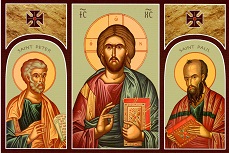
From persecutor to confessor

Sermon (audio)
Download Sermon

Service(video)
[vimeo https://vimeo.com/792854458 w=540&h=360]
Download Service Download Bulletin Download Insert

Sermon for the Conversion of St. Paul

Acts 9:1-22  +  Matthew 19:27-30

Imagine witnessing an execution. A public execution. The execution of a man who has not been accused of any form of violence whatsoever. The only charge against him is speaking against the religious teachings of the priests who are currently in power, telling people about the love of God in sending His Son to save those very people from their sins, and about God’s judgment against those who reject Him. He’s being put to death by having people throw rocks at him until they cause enough bruises and break enough bones to kill the peaceful man, who is praying for his executioners even as the stones are flying. And you’re not witnessing it from afar, with horror or with sadness. You’re standing right there in the midst of the angry stone-throwers, approving of their actions. And not only approving of their actions, but already planning how you will find other people, fellow Jews, both men and women, who are just like this peaceful man, so that you can arrest them, tie their filthy hands together, and have them tried and executed in a similar way. Imagine being that angry at these Christians, that vengeful, that violently determined to snuff out their lives. Why? Because they have dared to confess out loud the name of Jesus of Nazareth as the Son of David, as the crucified and risen Christ. And why are you so determined? Because you are absolutely convinced that they have insulted your God and are illicitly subverting His teaching and leading His people astray.

That was Saul. Saul the Pharisee. Saul the Hebrew of Hebrews. Saul, the Roman citizen, or Paul according to his Roman name, born in Tarsus, but brought up in Jerusalem at the feet of Gamaliel, taught according to the strictness of Jewish law, and as zealous toward God as anyone has ever been. Zealous, but not according to knowledge. Zealous for the truth while being ignorant of the truth. In other words, he thought he knew God rightly. He thought that the God of Abraham, Isaac, and Jacob supported his endeavors to snuff out these Christians. But, of course, he was wrong.

Now, God could have justly struck Saul dead for his crimes against His beloved Christians, which, as Jesus Himself says in our text, were actually crimes against Him. Why do you persecute Me? I strongly suspect that many of those early Jewish Christians were praying imprecatory Psalms against Saul, that is, those Psalms where the believers plead with God to rain judgment down on their enemies and His. But it’s as Jesus said in the second lesson you heard tonight: Many who are first will be last, and many who are last will be first. Judas Iscariot, one of the first and most prominent of Jesus’ followers, ended up last—cast into outer darkness—for his betrayal and unbelief. While Saul, who began, not as a follower but as a persecutor of Jesus, Saul, who had done things that were especially offensive to God, who once described himself as the least of the apostles, who am not worthy to be called an apostle, because I persecuted the church of God—Saul became among the first in God’s kingdom, perhaps the most famous of the apostles and by far the most prolific writer of the New Testament Scriptures. Saul the last, Saul the least, Saul the persecutor became Paul the first, Paul the believer, Paul the bold confessor of Christ, and as a result, also Paul the persecuted, suffering the same kind of persecution for Christ that he had once carried out against Christ.

What a story! A story, first and foremost, of grace, of God’s free favor toward a man who by no means deserved it, of grace that burned through Saul’s unbelief and stubborn resistance as he went from “kicking against the goads,” that is, resisting the Holy Spirit who had been urging him, “goading” him, through the Word of Christ that was being preached, to the message of the cross, to the true faith, to no longer resist, but to give in to grace, to repent and believe that Jesus was the Christ, that even his sins had been atoned for by Jesus, that the Gospel promise was meant even for him, that God would forgive even a persecutor of Christ. The word of Christ, spoken directly by Christ, and the word of Christ, spoken by Ananias, brought about the miracle we call conversion.

And someone will ask, why did God give Saul a special vision of Jesus to bring about his conversion? Should we all expect such a vision in connection with our conversion? Should anyone? Absolutely not! Unless that person is called to be a founding apostle of the Christian Church. The truth is, Saul had to see the risen Lord Jesus, not for his conversion, not to become a believer, but for the witness he would have to give to the world. Paul would go on to be an apostle in the truest sense, an eyewitness of Jesus’ resurrection, called and later taught directly by Jesus just as the Eleven had been. Paul would be one of the chosen apostles who, together with the Old Testament prophets, would form the very foundation on which the Church of Christ was to be built.

Now, Saul didn’t cooperate with God the Holy Spirit in His conversion; he didn’t use any natural power that he had to choose Jesus. But after he was converted, after the Old Man was drowned in the waters of Baptism and a New Man was created there, Saul the believer did work together with the Holy Spirit. He immediately stopped persecuting the Christians and instead began to preach the crucified and risen Christ in the synagogues, knowing that most of the Jews would turn against him, knowing that many of the Christians would struggle to accept him, knowing that some of the very Gentiles to whom he was being sent would imprison him, torture him, and eventually kill him. As the Lord told Ananias, I will show him how much he must suffer for my name’s sake. But it didn’t matter. From that moment on, Saul’s life had a new purpose, a new direction, and for the next 25 years or so, for the rest of his earthly life, he would willingly and gladly work harder than the other apostles and suffer more. He would rely, not on himself and his strength, but on God and His strength, whose grace was sufficient for Him, so that, spurred on by God’s grace, Paul would pour out his life as a drink offering, until there was nothing left. Because, while he was still God’s enemy, Christ died for him. And then He took him and goaded him until he gave in. He forgave and justified him by faith alone and took him into His kingdom and even made him into a minister of the New Testament.

Now, what would the Lord teach you through the example of His dealings with St. Paul? You (probably) can’t exactly relate to him as a murderer and violent persecutor of the Church. You can’t relate to him as one who was enabled to see the Lord Jesus with his eyes and receive His teaching directly from heaven. But some of you may be able to relate to him as someone who was once zealous for God but not according to knowledge. A few of us can relate to him as a called preacher of the Gospel, and all of us can relate to him as a wretched sinner upon whom God had mercy and who then devoted the rest of his life to serving the Lord Jesus.

Your conversion was no less of a miracle than the conversion of St. Paul. You were God’s enemy, too, when you were born, and part of you, the Old Man that clings to you throughout this earthly life, is still God’s enemy, not zealous for God, not trusting in God, but eager to go his own way, believe his own beliefs, and live for himself and for a good life here in this dying world. But God had mercy on you. Long before you were born, He gave His Son into death on the cross. He made the plans for your conversion before the foundations of the world were laid, how He would find you with the Gospel, how He would goad you to faith by His Word, and how He would preserve you in the faith by Word and Sacrament, through all the troubles and trials of this life, how He would change you from a self-serving creature into a person who is driven by His love to love both Him and your neighbor and to extend God’s kingdom. Just like He did with the Apostle Paul.

This applies to all of us, to pastors and to non-pastors. But pastors have even more to learn from the conversion of St. Paul. God’s choice of Saul was no accident. The Lord had been preparing Saul both for his conversion and for his particular ministry since the day he was born in Tarsus to a Jewish family that had the advantage of Roman citizenship. He saw to Saul’s extensive training in both Jewish law and Gentile culture, and we can see from the book of Acts and from Paul’s own epistles how he applied his training and experience in the course of his ministry. The Lord even used Saul’s misguided zeal and violent past to fire him into the exceedingly humble, zealous, and devoted minister he became. In some ways, Saul is very similar to the sinful woman who washed Jesus’ feet with her tears, who loved Jesus so much because He had forgiven her of so much. So it was with Paul.

And so it is with every minister whom the Lord calls. He has wonderfully prepared each of us for the particular ministry and timing and location into which He has called us. He formed you in the womb and then formed you further with all your life experiences. He knew your strengths. He knew your weaknesses. He knew your character and personality. He knew your sins, and He still wanted you to be called His child and to be given the humbling task of ministering to His children. Take comfort in that! And let the mercy God has shown us with regard to our own sins inspire us and spur us on to serve Him gladly, eagerly, and tirelessly, being willing, as Paul was, to become the objects of scorn and shame and even worse forms of persecution, rejoicing with Paul that I have been crucified with Christ; it is no longer I who live, but Christ lives in me; and the life which I now live in the flesh I live by faith in the Son of God, who loved me and gave Himself for me. Amen.


Posted in Sermons | Tagged , , | Comments Off on From persecutor to confessor

Matins for St. Timothy’s Day

Sermon (audio)
Download Sermon

Service(video)
[vimeo https://vimeo.com/792348568 w=540&h=360]
Download Service Download Bulletin

Sermon and Service for the opening service of the meeting of the Confessional Lutheran Ministerium, on January 24, 2023.

1 Timothy 6:11-16  +  Matthew 24:42-47

(Sermon by Pastor Joshua Sullivan of Kerrville, Texas)

In the epistle lesson appointed for the Festival of St. Timothy, the apostle Paul gives his son in the faith more than enough to keep himself busy and productive in the Lord. He gives several exhortations that are for Timothy the minister and Timothy the Christian, so that they apply to those of who are are pastors and those of who aren’t.

First he writes, “Flee these things.” “These things” being the love of money and the love of glory that leads to useless wranglings over words that are contrary to the the words of the Lord Jesus.  He writes in verse 9, “Those who desire to be rich—and we can add those who desire their own glory—fall into temptation and a snare, and into many foolish and harmful lusts which drown men in destruction and perdition.” Flee these things. But its not enough to flee  the temptations of the world. You have to have a place to run, a direction to go, a goal to pursue. So “pursue righteousness, godliness, faith, love, patience, gentleness.” Righteousness because God has declared you righteous because you believe in His Son; godliness because you are a son of God through faith in Christ Jesus; faith in God’s promises because faith is your victory over the world; love, gentleness, and patience toward others because that is how Christ Jesus lives toward you each day.

And lest Timothy fall the flesh’s allurement that all this should be easy, the apostle adds another verb: Fight. “Fight the good fight of faith.” It isn’t a fight against flesh and blood people—not matter how much it may seem like it at times, or how much other people want to make it so. The fight is against principalities, against powers, against the rulers of the darkness of this age, against spiritual hosts of wickedness in the heavenly places” (Eph 6:12). Timothy is to fight these powers, rulers, and spiritual hosts. He is to take up the shield of faith to extinguish the flaming darts of temptation and enticement the devil shoots at your heart and mind. He is to take up the sword of the spirit, the Word of God, and use it correctly to slay those temptations, enticements, and falsehoods as Samuel “hacked Agag in pieces before the LORD in Gilgal” (1 Sam 15:33). It is, after all, a fight, a warfare, and all these things wage war against his soul and his ministry. To this Paul adds perseverance. “Lay hold on eternal life, to which you were also called and have confessed the good confession in the presence of many witnesses.” As you confessed at your ordination, continue in the good confession of the gospel, to keep this commandment without spot, blameless until the appearing of the Lord Jesus Christ in glory.

I’m sure there were days in which Timothy asked the question Paul asked in 2 Corinthians 2:16, and a question which we have asked ourselves at times, “Who is sufficient for these things?” Certainly not Timothy in himself. Not you. Not me. But Paul gives us the answer. “Our sufficiency is from God” (2 Cor 3:5). This is why Paul urges Timothy in the sight of God who gives life to all things, and before Christ Jesus who witnessed the good confession before Pontius Pilate.” We are insufficient of ourselves to flee sin, to pursue righteousness, to fight the fight of faith, to lay hold of eternal life, and to persevere in that faith until the end. We are insufficient in ourselves to fulfill the ministry God has given us pastors and the vocations He has given to all of us as Christians. But our sufficiency is from God who gives life to all things, who calls all things into being and sustains them, who sustains us. Our sufficiency  is from God the Son who, while suffering in the flesh for our sins, did not shrink back from making the good confession before Pilate. Our sufficiency to flee sin, to pursue righteousness, to fight the good fight of faith, and to lay hold on eternal life, is from God who has graciously given His Son for our sins and gives His Holy Spirit to enliven us by faith so that we live new lives as new creatures.

It’s no coincidence that the first conference of our ministerium should begin on St. Timothy’s day. The goal of the ministerium is to support each other in the ministry, to encourage one another to faithfulness, and to spur each other on to do the work that God has given us to do, and not just the work of the Ministry, but also the work of being a Christian. Fleeing sin, pursuing righteousness, fighting the good fight, laying hold of of eternal life, and confessing the good confession. As we do this, we point each other, not to ourselves, but we encourage one another as Paul encouraged Timothy. The strength and sufficiency for all this is not within ourselves, but from God who gives live to all things, who gives us New Life through faith in Christ, so that we can make the good confession as He did. Amen.

Posted in Sermons | Tagged | Comments Off on Matins for St. Timothy’s Day

Each Day in the Word, Wednesday, January 25th

Matthew 9:9-17

As Jesus passed on from there, He saw a man named Matthew sitting at the tax office. And He said to him, “Follow Me.” So he arose and followed Him.

10 Now it happened, as Jesus sat at the table in the house, that behold, many tax collectors and sinners came and sat down with Him and His disciples. 11 And when the Pharisees saw it, they said to His disciples, “Why does your Teacher eat with tax collectors and sinners?”

12 When Jesus heard that, He said to them, “Those who are well have no need of a physician, but those who are sick. 13 But go and learn what this means: ‘I desire mercy and not sacrifice.’ For I did not come to call the righteous, but sinners, to repentance.”

14 Then the disciples of John came to Him, saying, “Why do we and the Pharisees fast often, but Your disciples do not fast?”

15 And Jesus said to them, “Can the friends of the bridegroom mourn as long as the bridegroom is with them? But the days will come when the bridegroom will be taken away from them, and then they will fast. 16 No one puts a piece of unshrunk cloth on an old garment; for the patch pulls away from the garment, and the tear is made worse. 17 Nor do they put new wine into old wineskins, or else the wineskins break, the wine is spilled, and the wineskins are ruined. But they put new wine into new wineskins, and both are preserved.”

During His earthly ministry, Jesus didn’t only perform outward healings. His ministry was mostly spiritual. He called sinners like Matthew to leave their sinful life and follow Him, and they did. He went to the houses of sinners and ate and drank with them, showing them that they were safe with Him—not safe to go on living in sin, but safe to confess their sins, with the assurance of full and free forgiveness with Him and from Him. He had come to call sinners to repentance. To them He opened wide the doors of heaven, and He still does.

At the same time, He slammed the door shut on those who pretended to be righteous or healthy. To them, religion was about external deeds, of which they thought they had done plenty. Their pride had two tragic consequences. It prevented them from receiving help from Jesus, and it caused them to begrudge His help to others whom they considered to be unworthy.

Even John the Baptist’s disciples, who were familiar with repentance, were fixated on external religion, outward piety. They couldn’t understand why Jesus’ disciples didn’t openly fast, as they did. Jesus used the parables of the cloth and the wineskins to illustrate that the new covenant is different from the old. The Gospel is focused on mercy, not sacrifice, obedience from the heart, not external ceremonies, true repentance and faith in Christ, not a perfunctory show of religiosity. The joy of the Gospel of Jesus’ compassion is too big to be confined to a strict schedule of obligatory fasting.

Let us pray: Lord Jesus, great Physician, You are righteous. We are not. Blot out our sins and heal our souls, for Your mercy’s sake alone, and stay with us until the end to keep attending to our healing. Amen.

Posted in Devotion | Comments Off on Each Day in the Word, Wednesday, January 25th

Each Day in the Word, Tuesday, January 24th 

Matthew 8:28-34

28 When He had come to the other side, to the country of the Gergesenes, there met Him two demon-possessed men, coming out of the tombs, exceedingly fierce, so that no one could pass that way. 29 And suddenly they cried out, saying, “What have we to do with You, Jesus, You Son of God? Have You come here to torment us before the time?”

30 Now a good way off from them there was a herd of many swine feeding. 31 So the demons begged Him, saying, “If You cast us out, permit us to go away into the herd of swine.”

32 And He said to them, “Go.” So when they had come out, they went into the herd of swine. And suddenly the whole herd of swine ran violently down the steep place into the sea, and perished in the water.

33 Then those who kept them fled; and they went away into the city and told everything, including what had happened to the demon-possessed men. 34 And behold, the whole city came out to meet Jesus. And when they saw Him, they begged Him to depart from their region.

The account of Jesus casting the Legion of demons out of the men and into the herd of pigs is the most vivid, detailed account of Jesus’ interactions with the demons in the Bible. The other Evangelists record the superhuman strength of the possessed man, along with the violence he displayed toward himself and others. But Jesus did not have to fight against the demons. He stood as the Almighty God, unthreatened and unafraid. Indeed, the demons were the ones who cowered in fear of Him, because they knew who He was and that He had the power to torment them even then, before the Last Judgment, when He will cast them into the everlasting fire, prepared originally, not for men, but for unclean spirits like these.

In their fear and desperation not to be cast immediately into hell, they begged to be cast into a herd of swine, and Jesus granted their request. The pigs drowned, and, apparently, the demons were free to go back to “going through dry places, seeking rest” (Matt. 12:43). Why would He grant this request, or any request on their part? Perhaps because Jews had no business keeping unclean animals in the first place. Perhaps as a sobering reminder that God is not yet ready to rid the world entirely of the devil’s assaults. In any case, Jesus’ sovereign power and authority are highlighted for us. That power caused the people of that region to fear Him and to want to be rid of Him. But for those who have been baptized into His name, it gives the greatest comfort. Not even a legion of demons can touch us, as long as we are close to Him.

Let us pray: O Lord Jesus, be ever our mighty Defender against the crafts and assaults of the devil! Amen.

Posted in Devotion | Comments Off on Each Day in the Word, Tuesday, January 24th 

Each Day in the Word, Monday, January 23rd 

Matthew 8:14-22

14 Now when Jesus had come into Peter’s house, He saw his wife’s mother lying sick with a fever. 15 So He touched her hand, and the fever left her. And she arose and served them.

16 When evening had come, they brought to Him many who were demon-possessed. And He cast out the spirits with a word, and healed all who were sick, 17 that it might be fulfilled which was spoken by Isaiah the prophet, saying:

He Himself took our infirmities
And bore our sicknesses.”

18 And when Jesus saw great multitudes about Him, He gave a command to depart to the other side. 19 Then a certain scribe came and said to Him, “Teacher, I will follow You wherever You go.”

20 And Jesus said to him, “Foxes have holes and birds of the air have nests, but the Son of Man has nowhere to lay His head.”

21 Then another of His disciples said to Him, “Lord, let me first go and bury my father.”

22 But Jesus said to him, “Follow Me, and let the dead bury their own dead.”

Jesus spent a whole Sabbath day in Capernaum manifesting who He was: the Conqueror of demons, the Healer of the sick, the One who is kind and good and ready to help, at no charge, for no reward. Matthew is the Evangelist who ties Jesus’ goodness and His healing miracles to Isaiah’s prophecy of the Suffering Servant. We often think of Jesus “bearing our griefs and carrying our sorrows” (Is. 53:4) with reference to what He suffered for us on the cross and throughout Holy Week, and rightly so. But as Matthew explains, it also refers to the fact that the Christ would actually take away the pains of His people while He was with them on earth.

No longer is Christ with us so that we can go to see Him to have our every illness healed. But we do well to go to where He still makes Himself available to us, to the ministry of the Word, not for the healing of earthly illnesses, but for the healing of our souls in the forgiveness of sins, in the strengthening of our faith, and in the protection He provides against the demons’ power.

As the rest of today’s reading teaches, following Jesus in this world will not be easy; He offers no earthly amenities. But following Him should be the most important thing in the world to us whose very life depends on the refuge He alone provides against sin, death, and the devil. And if we remain with Him to the end, He’ll take away all our pains and provide the perfect healing of our bodies and our souls in the resurrection.

Let us pray: Heavenly Father, have mercy on us in the midst of all our afflictions and make us ready to follow Jesus at all times. Amen.

Posted in Devotion | Comments Off on Each Day in the Word, Monday, January 23rd