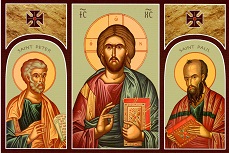
Sermon for the Conversion of St. Paul
Acts 9:1-22 + Matthew 19:27-30
Imagine witnessing an execution. A public execution. The execution of a man who has not been accused of any form of violence whatsoever. The only charge against him is speaking against the religious teachings of the priests who are currently in power, telling people about the love of God in sending His Son to save those very people from their sins, and about God’s judgment against those who reject Him. He’s being put to death by having people throw rocks at him until they cause enough bruises and break enough bones to kill the peaceful man, who is praying for his executioners even as the stones are flying. And you’re not witnessing it from afar, with horror or with sadness. You’re standing right there in the midst of the angry stone-throwers, approving of their actions. And not only approving of their actions, but already planning how you will find other people, fellow Jews, both men and women, who are just like this peaceful man, so that you can arrest them, tie their filthy hands together, and have them tried and executed in a similar way. Imagine being that angry at these Christians, that vengeful, that violently determined to snuff out their lives. Why? Because they have dared to confess out loud the name of Jesus of Nazareth as the Son of David, as the crucified and risen Christ. And why are you so determined? Because you are absolutely convinced that they have insulted your God and are illicitly subverting His teaching and leading His people astray.
That was Saul. Saul the Pharisee. Saul the Hebrew of Hebrews. Saul, the Roman citizen, or Paul according to his Roman name, born in Tarsus, but brought up in Jerusalem at the feet of Gamaliel, taught according to the strictness of Jewish law, and as zealous toward God as anyone has ever been. Zealous, but not according to knowledge. Zealous for the truth while being ignorant of the truth. In other words, he thought he knew God rightly. He thought that the God of Abraham, Isaac, and Jacob supported his endeavors to snuff out these Christians. But, of course, he was wrong.
Now, God could have justly struck Saul dead for his crimes against His beloved Christians, which, as Jesus Himself says in our text, were actually crimes against Him. Why do you persecute Me? I strongly suspect that many of those early Jewish Christians were praying imprecatory Psalms against Saul, that is, those Psalms where the believers plead with God to rain judgment down on their enemies and His. But it’s as Jesus said in the second lesson you heard tonight: Many who are first will be last, and many who are last will be first. Judas Iscariot, one of the first and most prominent of Jesus’ followers, ended up last—cast into outer darkness—for his betrayal and unbelief. While Saul, who began, not as a follower but as a persecutor of Jesus, Saul, who had done things that were especially offensive to God, who once described himself as the least of the apostles, who am not worthy to be called an apostle, because I persecuted the church of God—Saul became among the first in God’s kingdom, perhaps the most famous of the apostles and by far the most prolific writer of the New Testament Scriptures. Saul the last, Saul the least, Saul the persecutor became Paul the first, Paul the believer, Paul the bold confessor of Christ, and as a result, also Paul the persecuted, suffering the same kind of persecution for Christ that he had once carried out against Christ.
What a story! A story, first and foremost, of grace, of God’s free favor toward a man who by no means deserved it, of grace that burned through Saul’s unbelief and stubborn resistance as he went from “kicking against the goads,” that is, resisting the Holy Spirit who had been urging him, “goading” him, through the Word of Christ that was being preached, to the message of the cross, to the true faith, to no longer resist, but to give in to grace, to repent and believe that Jesus was the Christ, that even his sins had been atoned for by Jesus, that the Gospel promise was meant even for him, that God would forgive even a persecutor of Christ. The word of Christ, spoken directly by Christ, and the word of Christ, spoken by Ananias, brought about the miracle we call conversion.
And someone will ask, why did God give Saul a special vision of Jesus to bring about his conversion? Should we all expect such a vision in connection with our conversion? Should anyone? Absolutely not! Unless that person is called to be a founding apostle of the Christian Church. The truth is, Saul had to see the risen Lord Jesus, not for his conversion, not to become a believer, but for the witness he would have to give to the world. Paul would go on to be an apostle in the truest sense, an eyewitness of Jesus’ resurrection, called and later taught directly by Jesus just as the Eleven had been. Paul would be one of the chosen apostles who, together with the Old Testament prophets, would form the very foundation on which the Church of Christ was to be built.
Now, Saul didn’t cooperate with God the Holy Spirit in His conversion; he didn’t use any natural power that he had to choose Jesus. But after he was converted, after the Old Man was drowned in the waters of Baptism and a New Man was created there, Saul the believer did work together with the Holy Spirit. He immediately stopped persecuting the Christians and instead began to preach the crucified and risen Christ in the synagogues, knowing that most of the Jews would turn against him, knowing that many of the Christians would struggle to accept him, knowing that some of the very Gentiles to whom he was being sent would imprison him, torture him, and eventually kill him. As the Lord told Ananias, I will show him how much he must suffer for my name’s sake. But it didn’t matter. From that moment on, Saul’s life had a new purpose, a new direction, and for the next 25 years or so, for the rest of his earthly life, he would willingly and gladly work harder than the other apostles and suffer more. He would rely, not on himself and his strength, but on God and His strength, whose grace was sufficient for Him, so that, spurred on by God’s grace, Paul would pour out his life as a drink offering, until there was nothing left. Because, while he was still God’s enemy, Christ died for him. And then He took him and goaded him until he gave in. He forgave and justified him by faith alone and took him into His kingdom and even made him into a minister of the New Testament.
Now, what would the Lord teach you through the example of His dealings with St. Paul? You (probably) can’t exactly relate to him as a murderer and violent persecutor of the Church. You can’t relate to him as one who was enabled to see the Lord Jesus with his eyes and receive His teaching directly from heaven. But some of you may be able to relate to him as someone who was once zealous for God but not according to knowledge. A few of us can relate to him as a called preacher of the Gospel, and all of us can relate to him as a wretched sinner upon whom God had mercy and who then devoted the rest of his life to serving the Lord Jesus.
Your conversion was no less of a miracle than the conversion of St. Paul. You were God’s enemy, too, when you were born, and part of you, the Old Man that clings to you throughout this earthly life, is still God’s enemy, not zealous for God, not trusting in God, but eager to go his own way, believe his own beliefs, and live for himself and for a good life here in this dying world. But God had mercy on you. Long before you were born, He gave His Son into death on the cross. He made the plans for your conversion before the foundations of the world were laid, how He would find you with the Gospel, how He would goad you to faith by His Word, and how He would preserve you in the faith by Word and Sacrament, through all the troubles and trials of this life, how He would change you from a self-serving creature into a person who is driven by His love to love both Him and your neighbor and to extend God’s kingdom. Just like He did with the Apostle Paul.
This applies to all of us, to pastors and to non-pastors. But pastors have even more to learn from the conversion of St. Paul. God’s choice of Saul was no accident. The Lord had been preparing Saul both for his conversion and for his particular ministry since the day he was born in Tarsus to a Jewish family that had the advantage of Roman citizenship. He saw to Saul’s extensive training in both Jewish law and Gentile culture, and we can see from the book of Acts and from Paul’s own epistles how he applied his training and experience in the course of his ministry. The Lord even used Saul’s misguided zeal and violent past to fire him into the exceedingly humble, zealous, and devoted minister he became. In some ways, Saul is very similar to the sinful woman who washed Jesus’ feet with her tears, who loved Jesus so much because He had forgiven her of so much. So it was with Paul.
And so it is with every minister whom the Lord calls. He has wonderfully prepared each of us for the particular ministry and timing and location into which He has called us. He formed you in the womb and then formed you further with all your life experiences. He knew your strengths. He knew your weaknesses. He knew your character and personality. He knew your sins, and He still wanted you to be called His child and to be given the humbling task of ministering to His children. Take comfort in that! And let the mercy God has shown us with regard to our own sins inspire us and spur us on to serve Him gladly, eagerly, and tirelessly, being willing, as Paul was, to become the objects of scorn and shame and even worse forms of persecution, rejoicing with Paul that I have been crucified with Christ; it is no longer I who live, but Christ lives in me; and the life which I now live in the flesh I live by faith in the Son of God, who loved me and gave Himself for me. Amen.