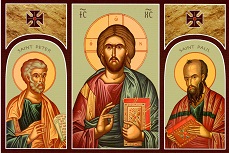
Table of Duties: Secular Authorities

Sermon (audio)
Download Sermon

Service(video)
[vimeo https://vimeo.com/689114151 w=540&h=360]
Download Service Download Bulletin Download Hymn

Sermon for Midweek of Reminiscere – Lent 2

Small Catechism Review: The Table of Duties

As we consider our duties in the world as Christians, we sometimes speak of the two kingdoms and the three estates. There are the kingdoms of this world, on the one hand, with their rulers and with their rules, and there is the kingdom of heaven on the other hand. Jesus, for example, recognized the authority of Pontius Pilate as a ruler of this world. As He said as He stood before Him, You could have no power at all against Me unless it had been given you from above. At the same time, Jesus said, You are right in saying that I am King. My kingdom is not of this world. God is the true King over both these kingdoms, the One who rules them both and establishes their authority, as Jesus is called in the book of Revelation, the faithful witness, the firstborn from the dead, and the ruler over the kings of the earth.

Then we speak of the three estates where God has established duties for His children, either as authorities in the estates or as those under authority. We speak of the ecclesiastical estate, that is, the Church, which we talked about last week; the domestic estate, that is, the home, which we’ll talk about next week; and then there’s the civil or secular estate, that is, the kingdoms and governments and civil affairs of this world. That civil estate is our brief focus this evening.

Where do secular authorities come from? Well, they may come from a line of kings, going back generations. Or they may be elected. Or they may be conquerors or emperors or dictators. God’s Word has not set up any specific or any ideal form of government. But ultimately, the estate of “ruler” and the rulers themselves come from God, as Paul writes to the Romans, there is no authority except from God, and the authorities that exist are appointed by God.

God raises up earthly kingdoms and earthly rulers to carry out certain purposes for this life: 1) To preserve a degree of order in the world, mainly so that His Gospel can go out and reach the people of every nation. 2) To judge between the righteous and the unrighteous, because God knew that sinners of all times would need to be forced to work together and to get along with one another, or else chaos and anarchy and untamed violence would erupt, as it did in the days leading up to the Flood. 3) To reward people for good behavior, because, by nature, we need some incentive to do good. 4) To deter bad behavior, because, by nature, we all look out for number one. 5) To protect the innocent, who will always fall prey to the violent and to the conniving or there is no check on the wickedness of the wicked. And 6) To punish the guilty, even God’s own people when they rebel against Him, as Israel did time and time again during the Old Testament period.

The tools of the secular authorities are laws, and certain tools to enforce those laws. Threats of punishment. Fines. Imprisonment. Physical violence. Even the death penalty, as it says in the passage from Romans 13: those who resist will bring judgment on themselves. For the authority does not bear the sword in vain; for he is God’s minister, an avenger to execute wrath on him who practices evil.

Whether or not the secular authorities acknowledge God and seek to do His will, He uses them and guides and governs them. He did it with Pharaoh in Egypt. He did it with the nations that Israel confronted on their way to the Promised Land. He did it with the Assyrians and the Babylonians and the Medes and Persians and the Greeks and the Romans, as we’re learning about in our study on the Book of Daniel. The Lord remains King over the kings of the earth, and they carry out His purposes, wittingly, or more often unwittingly. Rulers do not have to be Christians to serve as God’s ministers of justice in the world.

Meanwhile, God has given His Christian people certain duties to fulfill with regard to the secular authorities, as outlined in the Bible passage from Romans 13 cited by Luther in the Table of Duties.

Let every soul be subject to the governing authorities. For there is no authority except from God, and the authorities that exist are appointed by God. Therefore whoever resists the authority resists the ordinance of God, and those who resist will bring judgment on themselves.

Our duty as Christians is to be subject to the governing authorities. Now, that’s not quite as simple as it sounds, because you have various levels of authority, and maybe even competing authorities. State government? Federal government? Local government? And how far does their authority extend? Are citizens to submit to every whim of everyone who holds the office of “ruler”? Not necessarily.

What’s clear is that we are not to “resist” the authorities, that is, stand against them or rebel against them. As it affects most areas in our everyday life, it is the Christian’s duty to submit, to obey, and not to resist authority. We are not to have the reputations of hooligans or of lawbreakers, or of people who are trying to bring down the government, or as those who believe we answer to no one. Instead, we are to have the reputation of obedient citizens who honor those who govern us. And we are to be known as those who practice good and not evil.

So much more could be said about our duty as Christian citizens to the secular authorities, but these midweek services are only meant to serve as a general review of our Christian duties. Where you have failed to do your duties, where I have failed to do mine, let us repent and look to Christ, who fulfilled His duties perfectly and gladly, including His duty to His Father to suffer and die for our sins. Throughout this Lenten season, let us keep our eyes fixed on Jesus fulfilling all His blessed duties for us, so that we have all the motivation we need for fulfilling our duties to Him. Amen.


Posted in Sermons | Tagged , | Comments Off on Table of Duties: Secular Authorities

Know your place in Christ’s kingdom

Sermon (audio)
Download Sermon

Service(video)
[vimeo https://vimeo.com/687706787 w=540&h=360]
Download Service Download Bulletin

Sermon for Reminiscere

1 Thessalonians 4:1-7  +  Matthew 15:21-28

In this world, everyone has a place. Everyone has a certain position, and expectations from that position, based on any number of factors. Sometimes your place is determined and defined by God’s Word. Often, it’s simply determined by the culture and times in which we live. For example, God’s Word determines that it is not the place of a woman to be the head of a church or the head of her husband. It’s a man’s place to be that. But it wasn’t God’s Word that determined that a woman’s place was to cover her head, or to sit or eat separately from the men, or to not have a job outside the home, or not to vote in a national election; those things have been the determinations of various human societies of the world in various cultures and at various times in history. And many of those things have changed over time. Another example. God’s Word never determined that a person’s “race,” if we even want to use that term, a person’s color or ethnic origin gave them the place of a second-class citizen, or worse, a slave. It was human society at certain times in history that assigned a person such a place. Throughout history, rich people have a had a place in their culture, and poor people have had a different place. There was one place for highborn nobles and another place for lowborn commoners. There was a place for landowners and a different place for servants.

Whether your place in life is established by God or is simply an expectation of your culture, it’s important to know your place. And I can’t think of a better example of a person who knew her place than the Canaanite woman we encounter in today’s Gospel. Non-Christians generally despise this story, and some Christians struggle with it, with how Jesus interacted with the woman. But there’s no need for us to struggle. On the contrary, we have every reason to rejoice at this Gospel and at what the Lord teaches us through it about our place in His kingdom.

Matthew tells us that Jesus departed to the regions of Tyre and Sidon. We’re not told why. Mark adds the detail that He entered a house there and wanted no one to know it, but He could not be hidden. From what He says in our text, it appears that He went to these regions, just north of the territory of Israel, looking for some of the “lost sheep of the house of Israel,” for some of the Jews who had strayed outside the land if Israel itself. Does that mean He wasn’t actively seeking the Gentiles? Yes, actually, that’s what it means. At that time, in that place, Jesus was not focusing on the non-Jews. The Jews had been given a place in God’s kingdom—given to them by God Himself, not because they deserved it or were better than anyone else, but only because of God’s grace, His undeserved favor given first to Abraham, and then to the descendants of Abraham, Isaac, and Jacob. The Gentiles, too, had been given a place, a place passed on to them, not by God, but by their unbelieving ancestors, generation to generation to generation. A place outside of God’s kingdom. And this helps us to understand everyone’s behavior in the events that follow.

Behold, a woman of Canaan came out of the same territory and was crying out to him, saying, “O Lord, Son of David, have mercy on me! My daughter is dreadfully tormented by a demon.” A woman of Canaan. A non-Jew. Jesus had tried to stay hidden, but word got out that He had come up from Israel, and this woman rushed to find Him. And she calls out to him as Lord, Son of David. It seems out of place, doesn’t it? She isn’t a descendant of Israel. She has no physical bond with the children of Israel or the house of David. It’s a wonder she even knew who David was, and it’s a wonder of wonders that she had heard and believed that this Jesus was the promised Son of David, that is, the promised Christ.

But maybe the greatest wonder of all is that this non-Jewish woman believed that the Son of David would allow her, a non-Jew, to plead with Him for her daughter. She believed it was her place to pray to Jesus and to expect His help.

But he did not say a word in reply. Hmm. How to interpret the Lord’s silence? Silence is not always easy to interpret. One interpretation is that Jesus doesn’t think enough of her even to pay attention to her, even to spare a reply. But that’s not the only possible interpretation.

Meanwhile, she keeps crying out, and it’s bothersome to Jesus’ disciples, who came and begged him, “Send her away! She is crying out after us!” It seems to them that this Gentile woman, this nobody, just doesn’t know her place. Her place is to not bother Jesus. Her place is to be quiet. Her place is to take Jesus’ silence as a dismissal. Her place is to expect no good from Jesus. She’s a non-Jew, after all.

But he answered, “I was sent only to the lost sheep of the house of Israel.” The disciples ask Jesus to send the woman away, but He doesn’t. He seems to be supporting the Jewish notion that the Christ was to be the King of the Jews and, not the King, but the Conqueror of everyone else. You see, later on, when so many Gentiles would flood into the kingdom of God and so many Jews would be cut off from it because they didn’t accept Jesus as their king, they would complain that God was supposed to give Israel preference. He was supposed to come to Israel and be Israel’s Savior. And here Matthew, the Evangelist who wrote especially to the Jews, silences their complaint. Because Jesus did come to the Jews and focused on the Jews and gave them all the attention they could possibly get. They were thrown out of God’s kingdom, not because Jesus didn’t pay enough attention to them, but because of their own stubbornness, self-righteousness, and unbelief.

As for the Gentiles, why were they accepted? Why were they given a place in the kingdom of God? The Gentiles’ acceptance is vindicated by the actions of the woman in our Gospel. She isn’t part of the lost sheep of Israel. At least, not biologically speaking. But she’s still convinced it’s her place to keep begging Jesus for help. She came and fell down before him, saying, “Lord, help me!

But he answered, “It is not right to take the children’s bread and throw it to the dogs.” To people who think they deserve God’s help, to people who think highly of themselves, to people who demand respect from God and from the world, those words sound harsh. How dare Jesus compare the children of Israel to children sitting at a table, while comparing the Gentiles to little beggar dogs? Is that really their place?

And yet, the Canaanite woman is pleased to have such a place. She said, “Yes, Lord. But the dogs do eat from the crumbs that fall from their masters’ table.” She knows her place in the world, in history, in the kingdom of God. The Jews had been given a special place. But instead of being jealous, instead of demanding a better place for herself as a Gentile, she is content with her place, because she knows that she’s a sinner who deserves nothing from God. But if God will give her a place at His table, even as a Gentile, even as a dog begging at the table, she knows she will receive God’s help—all the help she needs, and more, because God is so abundantly good that the crumbs of His grace will be enough to save her and her daughter from the devil’s power.

Then Jesus answered her, “Oh, woman, great is your faith! Let it be done for you as you wish.” And her daughter was healed at once. And so the flood of Gentiles who would eventually enter the Christian Church—Gentiles like you and I—was vindicated. God’s righteousness and His gracious choosing of the Gentiles was vindicated, and His rejection of Israel because of their stubborn unbelief, was also vindicated. The Jews squandered their place, the privileged place they had been given, while the Gentiles, like this woman, took advantage, in a good way, of God’s gracious offer of free forgiveness and a place in His kingdom through faith in Christ Jesus.

So learn your place, too, and embrace it. By birth, your place was outside of God’s kingdom, a sinner who deserved nothing from God but wrath and condemnation. By your own actions, the sins you’ve committed in thought, word, and deed, you’ve proven that that’s the place where you belong, by nature. But in the Gospel, Christ offers you a much better place—the place of a beloved child, a son of God, a brother of Christ. Jew or Gentile no longer matters. Male or female. Slave or free. Rich or poor. This “race” or that one. All that matters is faith in Christ. But there can be no faith where there is a sense of entitlement or a refusal to humble oneself before God. So cast aside all notions of grandeur, all ideas that you deserve a better place than you’ve been given. Live confidently and contentedly in your place in this life, whatever it may be, because God has given every baptized believer the same love, the same forgiveness, the same salvation, and the same eternal life. Know your place in Christ’s kingdom, and know that you can and should always ask for the Lord’s help in every need, and keep asking, and keep expecting His help in due time, and He will give it, not because you deserve it, but because He has graciously promised it, for Christ’s sake. Amen.


Posted in Sermons | Tagged , , , | Comments Off on Know your place in Christ’s kingdom

Table of Duties: Preachers and Hearers

Sermon (audio)
Download Sermon

Service(video)
[vimeo https://vimeo.com/686543930 w=540&h=360]
Download Service Download Bulletin Download Hymn

Sermon for Midweek of Invocavit – Lent 1

Small Catechism Review: Table of Duties, Part 1

Now that we’ve finished reviewing the Small Catechism itself, there remains a series of Bible passages that Luther tacked right onto the end of the catechism, and we intend, with the Lord’s help, to spend this Lenten season focusing on this section.

We call this section the Table of Duties, because it lists very simply the general duties Christians have been given by God in His Word. So this is a fitting theme for the Lenten season as we double down on the Christian life, as we sharpen our focus on leading a life of repentance, faith, and love. Of what are we to repent? And how are we to love? Well, our sins are our failures to do the duties God has given us to do. But while some duties are shared in common by all Christians, others are not. You can’t fail at loving your spouse if you don’t have a spouse. You can’t raise your children well if you don’t have children. And so we break down the duties God has given us into different vocations and estates, and we apply them accordingly.

We’ll look at the Table of Duties in five parts, for each of the five Wednesdays of Lent, before Holy Week begins. The first part applies in one way or another to all Christians. This evening, let’s take just a very brief moment to consider the Word of the Lord with respect to preachers of the Word on the one hand, and hearers of the Word on the other.

The Table of Duties mentions only the preachers. The heading is: Bishops, Pastors, and Preachers, and the Bible passages are taken from 1 Timothy 3 and Titus 1:

A bishop must be blameless, the husband of one wife, temperate, sober-minded, of good behavior, hospitable, able to teach; not given to wine, not violent, not greedy for money, but gentle, not quarrelsome, not covetous; one who rules his own house well, having his children in submission with all reverence; not a novice; one who holds fast the faithful word as he has been taught, that he may be able, by sound doctrine, both to exhort and convict those who contradict (1 Tim. 3[:2-4, 6a; Titus 1:9]).

Those verses tell the preacher what some of his duties are. We could cite other passages as well. When Jesus says to Peter, “Feed My lambs. Tend My sheep. Feed My sheep,” He is laying out the preacher’s duty, to feed Jesus’ little lambs (both young and old) with the nourishing food of His Word, rightly handing out Law and Gospel—the Law to those who need to hear the Law, the Gospel to those who have been crushed by the Law and who need to hear the Gospel. He has put the preachers in charge of His house, not as lords, not as kings or rulers of an earthly kind, but as stewards, to give the members of His household their food in due season. As Jesus says to His apostles, The kings of the Gentiles exercise lordship over them, and those who exercise authority over them are called ‘benefactors.’ But not so among you; on the contrary, he who is greatest among you, let him be as the younger, and he who governs as he who serves.

It’s always Christ who places preachers into their positions, who gives them as gifts to His flock, to shepherd His flock as overseers. Preachers of Christ are to be blameless, above reproach, and all those other things the Apostle Paul spelled out. In particular, they are to be able to teach, always guarding closely both their doctrine and their life, so that their doctrine is pure and sound and plain to understand, and so that they may be examples to the believers in faith, in purity, and in love.

Every preacher will have different gifts, a different personality, different strengths and weaknesses. That’s OK, as long as he faithfully fulfills the duties the Lord has given him. And if he stumbles in any way in any of these duties, or falls into sin in some other way, he needs to repent and turn to Christ for forgiveness, just like anyone else.

Now let’s turn for a moment to the hearers of the Word. What does God’s Word say to them—to you, and to me, when a preacher is preaching to me?

The first duty of the hearer is almost too obvious to mention, but I’ll mention it anyway. It’s what you’re all doing right now: hearing. Christians are to hear God’s Word. My sheep hear My voice, Jesus said. And the Father proclaimed from heaven, twice: This is My beloved Son. Hear Him!

But how do you hear Him? As Jesus said to the first preachers He sent out, “He who hears you,” says Christ, “hears Me. He who rejects you rejects Me.” So if anyone would follow Christ, he must hear, and listen, and pay attention to what he hears.

For those who hear the Word from a preacher sent by Christ, St. Paul says this, as he wrote to the Thessalonian hearers of the Word in 1 Thessalonians 5: We urge you, dear brothers, to recognize those who work among you and who are over you in the Lord and who admonish you. Esteem them even more highly on account of their labor, and be at peace with them.

That sums it up pretty well, actually. The writer to the Hebrews puts it this way: Remember your leaders, who have spoken the word of God to you. Consider the outcome of their conduct and imitate their faith. And: Obey your leaders, and be submissive to them, for they watch out for your souls, as those who must give account. Let them do so with joy and not with grief, for that would be unprofitable for you.

Finally, for this evening at least, St. Paul gives this command to the hearers of the Word: Even so the Lord has commanded that those who preach the gospel should live from the gospel. In other words, the hearers of the Gospel are to provide a living for the preacher, to see that he is taken care of physically, even as he sees that you are taken care of spiritually. That’s something you here have done wonderfully and abundantly, but it isn’t always like that everywhere. And when you carry out this duty of love, whether for your pastor here or for other preachers of the Gospel elsewhere, you can know for certain that it is a pleasing thing in the sight of God, because He has given hearers this duty, and He’s pleased when they carry it out.

So much more could be said about preachers and hearers, but these midweek services are only meant to serve as a general review of our Christian duties. Where you have failed to do your duties, where I have failed to do mine, let us repent and look to Christ, who fulfilled His duties perfectly and gladly, including His duty to His Father to suffer and die for our sins. Throughout this Lenten season, let us keep our eyes fixed on Jesus fulfilling all His blessed duties for us, so that we have all the motivation we need for fulfilling our duties to Him. Amen.

Posted in Sermons | Tagged , | Comments Off on Table of Duties: Preachers and Hearers

Little sins that aren’t really little

Sermon (audio)
Download Sermon

Service(video)
[vimeo https://vimeo.com/685230430 w=540&h=360]
Download Service Download Bulletin

Sermon for Invocavit – Lent 1

2 Corinthians 6:1-10  +  Matthew 4:1-11

There is a lot of evil behavior in the world. War and bloodshed, lies and deception, adultery, violence, and injustice. It’s easy, at least for us Christians, to see Satan behind all those things, as the terrible instigator of evil in the world.

But that’s not where we find Satan in the Gospel, is it? We see the devil hard at work trying to get the Son of God to sin, but his temptations seem like nothing so terrible, certainly nothing that would cause great harm to the world. Just some seemingly minor sins directed against…God. Is that so terrible, compared to all the rest of the evil and wickedness we see in the world? Turning stones into bread? Taking a ride—literally—on angels’ wings? Bowing down for a moment before the devil, with no one else even watching? For that matter, go all the way back to the Garden of Eden. Was taking a bite out of a piece of fruit really worthy of death?

But therein lies the deception, the lie propagated from the mouth of the liar since the beginning: That, as long as Satan isn’t tempting you to do the big and terrible things that cause even unbelievers to cringe, it’s no big deal to be tempted. It’s no big deal to fall into sin.

The truth is, those “little sins” committed against God, in secret, are behind all the rest. What’s more, to consider those sins against God, that don’t hurt anyone else, to be “little,” is just more evidence of the utter depravity of our race, and the utter corruption of our flesh, as if a sin against God were a small thing, while a sin against another human being—that’s the really big deal. Do you think of God as being so small? So insignificant? So harmless? The devil wants you to, because, if he succeeds at that, he’s already won.

See how the devil attacked the Son of God in the Gospel, not with the “big” temptations to do “big” sins, but with three little temptations to commit three “little” sins that would have sealed your eternal condemnation in hell, if Jesus had stumbled even a little.

First, remember the context of these temptations. It’s the beginning of Jesus’ ministry. He has just been baptized by John the Baptist. The Holy Spirit has just descended on Him, like a dove, and He has just heard those astonishing words spoken from heaven, This is My beloved Son, with whom I am well-pleased. Then we’re told that Jesus was led up by the Spirit into the wilderness to be tempted by the devil.

The devil was the one who tried to get Jesus to sin. But God was the one who arranged for the temptations to happen, not unlike the case of Old Testament Job. Jesus had truly humbled Himself when He became man. In that state of humiliation, He set aside the use of His divine knowledge and power. He relied on His Father’s Spirit-inspired Word, and was “led by the Spirit” out into the wilderness, to be tempted for 40 days, even as the people of Israel were tempted in the wilderness for 40 years.

The first temptation had to do with hunger. Jesus had fasted for 40 days. He ate nothing and drank nothing. His survival itself was miraculous, but it does say at the end that He was hungry. Now, maybe you recall that the great prophet and mediator of the first covenant, Moses, also fasted for 40 days in the wilderness, on top of Mt. Sinai. It says that he ate no bread and drank no water for those 40 days. And do you know how much hunger he suffered because of it? None, as far as we know. It appears that the Lord kept His servant Moses from suffering the bitter pangs of hunger.

But here is Jesus, the very Son of God, His “beloved Son,” for whom the Father does not provide any bread and whom the Father does allow to suffer hunger in the wilderness.

The devil tried to capitalize on Jesus’ physical weakness and suffering. If You are the Son of God, command that these stones become bread. Such a small thing. It wouldn’t have hurt anyone, right? But what’s behind that temptation? The devil wants Jesus to be unhappy with His Father and with what His Father has provided. He wants Jesus to feel miffed that His Father was making Him suffer, to grumble and complain about this unfair treatment, and then, to step out of His state of humiliation for a moment and to pit His own divine power as the Son of God against the divine will of His Father.

Instead, Jesus threw a passage of Scripture back at the devil, It is written, ‘Man shall not live by bread alone, but by every word that proceeds from the mouth of God.’ Jesus already knew the lesson that Israel never learned. That whatever God speaks—that is right. Whatever God does—that is the definition of goodness and love.

“No,” Jesus says, “I will not complain or grumble against My Father. I won’t call Him evil. I won’t even think it. And I certainly won’t step out of this state of humiliation to provide a meal for Myself, in rebellion against My Father. If I don’t suffer as the rest of men suffer, then I am not tempted as the rest of men are tempted. And if I’m not tempted like them, then I can’t stand against temptation for them or help them when they’re tempted.” No, to do this little thing would have big consequences.

The second temptation recorded in Matthew’s Gospel has the devil taking Jesus up to a ledge high up on the temple in Jerusalem. If You are the Son of God, throw Yourself down. For it is written: ‘He shall give His angels charge over you,’ and, “In their hands they shall bear you up, lest you dash your foot against a stone.”

So the devil knows the Scriptures! He knows how to cite them, how to use them against people. Remember that when you hear preachers out there in other churches using the Bible and you’re tempted to think, there must not be much difference between their church and ours. They quote from the Bible! Yes, they quote from it. It was there in the devil’s foul mouth, too. Having the Word of God and teaching it correctly, in context and in harmony with the rest of the Word of God, are two different things.

Here the devil used the Word of God out of context, to try to convince Jesus, first, that He should forget the sinfulness in putting your life in danger for no good reason, and second, that it would all be fine if He jumped off the ledge, because He had the Lord’s promise to send His angels to catch Him. God will take care of you, no matter what you do.

The devil probably won’t tempt you to “jump off a ledge, it’ll be fine.” He may tempt you in similar ways: Don’t worry about studying too hard in school or working too hard at your job. God will see that you succeed at whatever you do. Go ahead and eat to the point of gluttony and obesity; God will take care of you. Watch that dirty video, do the drugs, drink too much; it’ll be OK. Stay home from church. God will provide for you. Didn’t Jesus promise that He won’t let anyone snatch you from His Father’s hand?

But Jesus knew better. It is written again, ‘You shall not tempt the LORD your God.’ Jesus didn’t fall for the little lie that it’s OK to put God to the test. Neither should you!

The third temptation had the devil showing Jesus all the kingdoms of the world and their glory. And he said to Him, “All these things I will give You if You will fall down and worship me.”

I don’t think the devil would have much success if he stood before us and asked us to bow down to him, in return for riches and power and glory. So he doesn’t. What does he say? You can have a better life, if you just set aside God’s commandments once in a while. You can have a prosperous, fun, happy, comfortable earthly life if you just don’t worry so much about what God says. You can have that boy or that girl for a husband or wife, if you just don’t worry about the differences in your beliefs. You can have the praise of your teachers and of your classmates, if you just keep nodding your head when they tell you the earth is millions of years old, or that that boy is actually a girl. You can have a big church, if you just compromise a little on doctrine. You can have the support of your community, if you just go along with the culture in its sick praise for the mental and spiritual disorder of transgenderism, if you just concede that homosexuality is natural, sex outside of marriage is fine, abortion is good.

The devil offers much. But even if he could give you earthly happiness, which he usually doesn’t do, the devil would happily take your soul to hell at the end of the day. And then you would realize how not worth it it was to bow down to him for a moment of earthly gain, in whatever way you bowed down to him.

So repent of every sin, both “big” and “small.” And look to Jesus for salvation, who was offered far more than you could ever be offered, for just a moment on His knees before the devil. But, of course, He knew better. Away with you, Satan! For it is written, ‘You shall worship the LORD your God, and Him only you shall serve.’

Jesus defeated the devil. He defeated Him with perfect faith in His Father, with perfect devotion to His Father’s will, with perfect love for His Father’s Word. Where every other man in history has fallen, Jesus is the Man—the Second Adam—who stood firm against the devil. And He did it in mankind’s place, to earn our salvation. Now we have a Champion, a Hero, the perfect Man to whom we imperfect men can flee at all times for refuge, to hide ourselves in His righteousness.

That’s what we get when we’re baptized. We get credited with the perfect record of Christ against all the devil’s temptations, instead of having to answer for all the times we’ve allowed ourselves to be led astray. And every absolution and preaching of the Gospel and every believing reception of that preaching and of the Holy Sacrament is a reapplication of Christ’s holy victory over the devil.

Now, having been brought into Christ through Holy Baptism, we are not only covered with His victory over the devil, but we are also initiated into the ongoing fight against temptation to commit both the “little” sins and the “big” ones, knowing that none are truly little.

Trust in Christ, both for forgiveness and for the strength to resist temptation and to lead a life that is truly Christian in nature. It is your calling as a Christian, as one who is to follow in the footsteps of Christ, who resisted temptation for your salvation. Use and rely on the Word of God, as Jesus did. And as He promises through His apostle: God is faithful, who will not allow you to be tempted beyond what you are able, but with the temptation will also make the way of escape, that you may be able to bear it. Amen.

Posted in Sermons | Tagged , , , | Comments Off on Little sins that aren’t really little

Preparation for Holy Communion

Sermon (audio)
Download Sermon

Service(video)
[vimeo https://vimeo.com/684074610 w=540&h=360]
Download Service Download Bulletin

Sermon for the First Day of Lent

Small Catechism Review: Christian Questions and Answers

You heard about fasting this evening from the prophet Jonah and from the prophet Joel, and from the Lord Jesus Himself. You know that many Roman Catholics practice some sort of fast during this Lenten season, and some Lutherans, too. You may know that yesterday, the day before the 40-day Lenten fast began, many people around the world—many of whom consider themselves devout Roman Catholics—celebrated Marti Gras, Fat Tuesday, or in South America, Carnaval. Pastor Marin explained a little bit to me about how Carnaval is celebrated in parts of Colombia. People parading through the streets naked, engaging in pagan sex rites and devil worship. People eat and drink in excess and participate in all kinds of debauchery and sin, thinking that the ashes of Ash Wednesday and the accompanying fast will wash it all away. They plan to party, and then they plan to “repent” afterward.

But planned repentance is no repentance at all. And fasting as a way to atone for sin is worse than useless, just as fasting as a way to “encounter God,” as I heard on the radio this morning, is useless.

As we discussed last week, fasting can serve a good purpose, or any outward discipline that helps you to focus on serious things, spiritual things, on the Word of God, on repentance and faith and the Christian life. But when it comes to the Lord’s Supper, it isn’t fasting that truly gets you ready. It’s faith. And how do you examine yourself, to test whether you are in the faith? For that, Luther prepared some sample questions you might ask yourself, or that the pastor might use to examine his sheep, both initially, when they become communicant members of his congregation, as we’ll do with our two confirmands, and periodically with everyone, to help his people make sure they’re approaching the Lord’s Table worthily.

Now, Luther assumes several things with the questions he prepared. He assumes that we’re talking about baptized Christians. He also assumes that these Christians have been instructed in the Ten Commandments, the Creed, the Lord’s Prayer, the words of Baptism, and the Sacrament of the Altar. That’s exactly what we do in confirmation classes and why we have confirmation classes. And so, as we finish going through the Six Chief Parts of the Catechism, we’re finally ready to ask these questions.

Do you believe that you are a sinner?

Yes, I believe it; I am a sinner.

How do you know that?

From the Ten Commandments; I have not kept them. This is why it’s important to know and review often the Ten Commandments. Because it’s easy to say, “I’m a sinner.” We all know that to be true in theory. But to really know that you’re a sinner, you have to know what makes you a sinner. You have to have some idea how you’ve sinned against God and your neighbor. And the Ten Commandments are an excellent summary, a mirror to show you your sins.

Are you also sorry for your sins?

Yes, I am sorry that I have sinned against God. It isn’t enough to know that you have sinned; that’s not yet repentance. Many people know that they’ve sinned, and they laugh about it or joke about it, or they plan to keep on committing those same sins over and over. But the first part of repentance is contrition, sorrow over sins. Wishing you hadn’t done that thing, or said that thing, or dwelled on that sinful desire in your heart.

What have you earned from God with your sins?

His wrath and displeasure, temporal death and eternal condemnation. There’s no room here for joking or lightheartedness. Also no room for pride, no room for comparing yourself to others, no room for thinking you’re still a decent person who deserves something good from God. No, if you examine yourself rightly, then this is the answer you’ll give.

Do you also hope to be saved?

Yes, that is my hope. But why? Because you think everyone will be saved? Everyone goes to heaven? Is that where you find your hope and comfort? No.

In whom, then, do you take comfort?

In my dear Lord Christ. As the Apostle says, Salvation is found in no one else, for there is no other name under heaven given among men by which we must be saved.

Who is Christ?

The Son of God, true God and man. Not just any Jesus Christ is the object of faith, but the one revealed in Scripture as both true God and true man.

How many Gods are there?

Only one, but there are three persons: Father, Son, and Holy Spirit. You don’t have to comprehend everything about the Holy Trinity. But this much at least you must know and believe if you are to approach the Lord’s Table worthily.

What did Christ do for you so that you take comfort in Him?

He died for me and shed His blood on the cross for the forgiveness of sins.

Did the Father also die for you?

No. The Father is God only, as is the Holy Spirit; but the Son is both true God and true Man. He died for me and shed His blood for me.

How do you know this?

From the holy Gospel, from the words of the Sacrament, and by His body and blood, given to me as a pledge in the Sacrament.

What are these words?

Our Lord Jesus Christ, on the night in which He was betrayed, took bread, gave thanks and broke it and gave it to His disciples and said: “Take eat; this is My body, which is given for you. This do in remembrance of Me.” In the same way also He took the cup after supper, gave thanks and gave it to them, saying: “Take and drink of it, all of you; this cup is the New Testament in My blood, which is shed for you for the forgiveness of sins. This do, as often as you drink it, in remembrance of Me.”

Do you believe, then, that the true body and blood of Christ are in the Sacrament?

Yes, I believe it.

What moves you to believe this?

The words of Christ: “Take, eat, this is My body! Drink of it, all of you, this is My blood!”

What should we do when we eat His body and drink His blood and in this way receive His pledge?

We should remember and proclaim His death and the shedding of His blood, as He taught us: “This do, as often as you drink it, in remembrance of Me.”

Why should we remember and proclaim His death?

So that we may learn to believe that no creature could have made satisfaction for our sins—only Christ, true God and Man, could do that; and so that we may learn to be terrified by our sins, and learn to regard them as serious; and that we may find joy and comfort in Christ alone, and thus be saved by this faith.

What moved Christ to die and make satisfaction for your sins?

His great love for His Father, for me and for other sinners…As Paul writes to the Galatians, I live by faith in the Son of God, who loved me and gave Himself for me.

Why, then, do you wish to go to the Sacrament?

That I may learn to believe that Christ, out of great love, died for my sins; and then, that I may also learn from Him to love God and my neighbor.

Are those answers your answers? If so, then you are prepared for the Lord’s Supper. If not, then you need to pause and take some time to reflect on the state of your heart, to see where and why your answers are different.

Finally, Luther adds two questions aimed at the Christian’s motivation and desire for the Sacrament—or lack thereof.

What should admonish and encourage a Christian to receive the Sacrament of the Altar often?

For God’s sake, both the command and the promise of the Lord Christ should drive him to the Sacrament; then also his own need that hangs around his neck, because of which the command, invitation, and promise are given.

But what should a person do if he can’t feel this need, or if he can’t find in himself any hunger or thirst for the Sacrament?

To such a person no better advice can be given than this: First, he should put his hand on his chest to see if he, too, has flesh and blood, and he should believe what the Scriptures say about it in Galatians 5 and Romans 6. Second, he should look around to see if he is also still in the world, and he should consider that there will be no shortage of sins and troubles, as the Scriptures say in John 15-16 and in 1 John 2 and 5. Third, he will, for this very reason, also have the devil near him, who, with his lies and murdering day and night, will grant him no peace, within or without, as the Scriptures picture him, a liar and a murderer from the beginning who goes around like a roaring lion, looking for someone to devour.

And so we do well to begin another Lenten season today, remembering that we do, in fact, have flesh and blood and all the weaknesses that go along with it, remembering that we do still live in a world that is hostile to faith and to God and to the people of God, and remembering that our enemy, the devil, always has us in his sights. So turn to the Lord again today. Seek His forgiveness in Christ Jesus and in the Sacrament Christ has given us. And receive from Him, not only the forgiveness of sins, but the strength to walk in His footsteps, abounding in love and bearing the cross with patience. Amen.

Posted in Sermons | Tagged , , | Comments Off on Preparation for Holy Communion