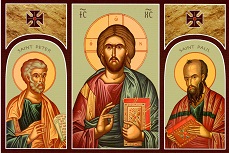
Sermon preached by Bishop James Heiser, based on 1 Corinthians 2:1-16. Audio only.
| Sermon (audio) | ||
|---|---|---|
| Download Sermon | ||
| Download Bulletin | ||
Sermon preached by Bishop James Heiser, based on 1 Corinthians 2:1-16. Audio only.
| Sermon (audio) | ||
|---|---|---|
| Download Sermon | ||
| Download Bulletin | ||
| Sermon (audio) | ||
|---|---|---|
| Download Sermon | ||
| Service(video) | ||
|---|---|---|
| [vimeo https://vimeo.com/573694812 w=540&h=360] | ||
| Download Service | Download Bulletin | |
Romans 6:3-11 + Matthew 5:20-26
Whether or not a person believes in God, or in the existence of the human soul, everyone, and I mean everyone, is aware of the common problem that plagues humanity. Our common problem is death. And everyone, by nature, also has a sneaking suspicion, deep down in their hearts, that God does exist, and that the soul does exist and that, after our bodies stop working, we will have to answer to God. Atheists deny all that, of course, claiming that neither God nor the soul exists and that everything just comes to an end when we die. Agnostics claim not to know about God or the soul, claim that such things are unknowable. But for the rest of humanity, those who are not so foolish as to deny God’s existence, the question has always been, what is required for the soul (and possibly even the body) to escape torment after death and to be allowed into the kingdom or the realm of God the Creator, to live in blessedness and happiness with Him in His kingdom? In other words, what’s the price of admission?
Most of humanity, for thousands of years, has had a basic answer to that question. Do these or those good works. Offer this or that sacrifice. Be good. Work hard. And God will let you into His kingdom. Even some who call themselves Christians mimic that basic answer. There’s a phrase in a song of the famous country artist Alan Jackson that’s always made me cringe. There’s a lot of “workin’ hard to get to heaven, where I come from.” That about summarizes it. You gotta work hard to get to heaven. Right?
The great Lutheran professor and author Philip Melanchthon wrote about that basic human answer in the Apology of the Augsburg Confession, where he refers to it as an “opinion of the Law”: Works, he writes, are recognizable among human beings. Human reason naturally admires works. Reason sees only works and does not understand or consider faith. Therefore, it dreams that these works merit forgiveness of sins and that they justify. This opinion of the Law naturally sticks in people’s minds. It cannot be driven out, unless we are divinely taught.
Thank God, we are divinely taught today in the Gospel as Jesus opens His mouth and preaches the Sermon on the Mount. Ironically, He doesn’t tell His disciples at that time what the answer to the question is, how can we enter the kingdom of God? But He does slam the door on any notion of workin’ hard to get to heaven. I say to you that unless your righteousness exceeds the righteousness of the scribes and Pharisees, you will by no means enter the kingdom of heaven.
We see part of an answer there. You have to have a righteousness that exceeds, that goes beyond, the righteousness of the scribes and Pharisees. Well, what was their righteousness like? It was externally flawless. No one worked harder than they did to get to heaven. But according to Jesus, being externally flawless just isn’t good enough. No, the price of admission into God’s kingdom is higher than that.
What do You mean, Jesus? Well, He explains what He means in the next words. You have heard that it was said to men of old, ‘You shall not murder,’ and, ‘Whoever murders will be subject to judgment. He’s quoting the Fifth Commandment, of course. Most people agree that murderers are not righteous enough to get to heaven, but most people also are under the impression that they aren’t murderers, because most people haven’t actually taken the life of another human being. Oh, is that what you thought?, Jesus implies, that you aren’t murderers? That you haven’t broken the Fifth Commandment? That you’re righteous?
No, He says, there are other ways to break the Fifth Commandment. But I say to you that whoever is angry with his brother without cause will be subject to judgment; and whoever says to his brother, ‘Raca!’ will be subject to the council; and whoever says, ‘You fool!’ will be subject to hellfire. Murder is an outward sin that will get you condemned in the judgment of both God and man. Man’s judgment may possibly also have some condemnation for certain slanderous or insulting words that are spoken. But man’s judgment can’t condemn you for the anger or hatred that comes up out of your heart, while God’s judgment can and will condemn you for it. Hellfire is the opposite of being admitted into God’s kingdom.
So the commandments imply much more than the big outward sins that they forbid or the big outward good works that they require. Jesus goes on after our Gospel to treat the Sixth Commandment in the same way: You have heard that it was said to those of old, ‘You shall not commit adultery.’ But I say to you that whoever looks at a woman to lust for her has already committed adultery with her in his heart. The same application can be made to the Fourth Commandment, and to the Seventh, and the Eighth. The Ninth and Tenth Commandments make it absolutely clear that sins of the heart are just as much condemned by God as sins of the hand, because coveting is, by definition, a sin of the heart. And Moses explicitly commanded the people of Israel about both sins of the heart and good works of the heart: You shall not hate your brother in your heart…, nor bear any grudge against the children of your people, but you shall love your neighbor as yourself: I am the LORD.
And if unrighteous thoughts, words, and deeds against one’s brother or against one’s neighbor prevent a person from entering the kingdom of God, you’d better believe that sinful thoughts, words, and deeds that are directly against God do the same thing. The first three commandments also must be obeyed, even as we’re beginning our focus on the Ten Commandments this morning with the First Commandment: You shall have no other gods. What does this mean? We should fear, love, and trust in God above all things. In short, to be righteous enough before God to enter His kingdom, you have to be perfectly righteous on the inside and on the outside, toward God and toward your neighbor. That is the high price of admission into God’s kingdom. Anything short of it, and there is no kingdom of heaven for the soul, or the body. Only eternal death and hellfire.
But “all have fallen short,” says the Apostle Paul in Romans chapter 3. So how can anyone enter the kingdom of heaven? How can anyone afford the price of admission? The Christian answer is: You have to die. You have to die, and then, somehow, you have to come back to life and enter the kingdom of heaven as a perfect person, as a truly righteous person, inside and out. And God, in His mercy, has provided a way for all people to die and to live again in righteousness.
That way is Holy Baptism. As Jesus Himself told Nicodemus, Truly, truly, I say to you, unless a person is born again, of water and the Spirit, he cannot enter the kingdom of God. Being born again means that the person you were had to die. That death and rebirth are exactly what St. Paul points to in today’s Epistle: Do you not know that all of us who were baptized into Jesus Christ were baptized into his death? So, then, we were buried with him through baptism into death, in order that, just as Christ was raised from the dead through the glory of the Father, so we, too, should walk in a new life.
Holy Baptism is God’s answer to man’s unrighteousness. In order to live eternally, you either have to be righteous, or you have to be counted as righteous through faith in Christ Jesus. He truly is the Righteous One. He provided perfect obedience to God’s commandments, inside and out, for all mankind, and He paid the righteous price for the unrighteousness of all mankind with His death on the cross. Baptism, combined with faith, is what unites unrighteous sinners to the righteous Lord Jesus, and in this way God has promised to count the baptized as righteous in His sight. The high price of admission into God’s kingdom has been paid by Jesus for everyone. To be baptized and to believe is to use that payment made by Jesus to enter God’s kingdom even now, before you die, so that when your body dies, your soul is already there in His kingdom.
But we shouldn’t imagine that, since God has already counted believers in Christ to be righteous through faith, He is no longer concerned about your thoughts, words, and deeds, your attitudes and your behavior. We shouldn’t imagine that God doesn’t care whether or not you murder, whether or not you hate or burn with anger, whether or not you say cruel and hurtful words to your neighbor, and especially to your brother, to your fellow Christian. He certainly does! As we confess about Baptism in the Small Catechism, baptizing with water signifies that the Old Adam in us should, by daily contrition and repentance, be drowned and die, with all sins and evil desires, and that a New Man, in turn, should daily emerge and arise, to live forever before God in righteousness and purity.
Christ fulfilled the righteous requirements of the Law for us, so that we don’t have to pay our own price of admission into God’s kingdom. But those who have died with Christ to sin, those who will live with Him forever in perfect righteousness and holiness in heaven—how can we serve sin now? If we died with Christ to hatred and unjust anger, to nastiness and bitterness and pride, how can we continue to live with those things?
No, God has united us with His Son Jesus and has given His Holy Spirit to live within us, so that we should walk in a new life, a new life of obedience, a new life of righteousness. By daily contrition and repentance, we bury those sins, again and again. And each day we determine to rise again, to live according to the New Man, to count ourselves dead to sin but alive to God. Just because we aren’t working hard to get to heaven doesn’t mean that we don’t have to work hard to live as God has called us to live. The one who seeks to enter God’s kingdom through faith alone in Christ works harder at keeping God’s commandments than the one who is trying to buy a place in heaven with his works, because we are working in the service of the God who loved us and gave His Son for us. We are working in the service of the God whose favor has already been won for us by Jesus, the God whom we love because He first loved us. No one trying to pay his own way into heaven, or even part of his own way, can love God like that. But those who trust in Jesus have the assurance of being counted righteous even now, through faith, so we have a real motivation and real power to live for God every day until we meet our Maker.
And we will meet Him. There is a God, and there is a soul. There is an eternal death and torment for the unrighteous and an eternal life of true happiness for the righteous. Turn away from the “opinion of the Law” that seeks to work hard to get to heaven, and trust in Christ for the righteousness that counts before God, which He will share with you for free. Then work hard, not to get to heaven, but as a child of heaven. With such a life your Father will be well-pleased, for Jesus’ sake. Amen.
| Sermon (audio) | ||
|---|---|---|
| Download Sermon | ||
| Service(video) | ||
|---|---|---|
| [vimeo https://vimeo.com/570972657 w=540&h=360] | ||
| Download Service | Download Bulletin | |
1 Peter 3:8-15 + Luke 5:1-11
The ministry of Christian clergy is essential. And so is the witness of lay Christians, non-pastors, in the world. In each case, there is a identifiable call from God. Today’s Gospel focuses on the one, the Epistle on the other.
We turn first to the Gospel from Luke 5. Jesus had a very important lesson to teach His early disciples. Simon Peter, James and John had already met Jesus, already spent some time learning from Him, already accompanied Him to the wedding at Cana, where they witnessed His first miracle. They had learned from Him as students, as disciples, as any Christian might learn from Jesus, if He were here in person. But this account recorded in Luke 5 marks the time when these three disciples went from being part-time learners to full-time seminary students.
The Lord chose the location for His preaching on purpose, on the shores of the Sea of Galilee where Simon Peter, James, and John were docked with their boats, washing their nets after fishing all night long. Yes, He wanted to preach to the crowds. But He also wanted both to recruit His new seminary students and to teach them about the ministry to which they were being called, which, in turn, helps us to understand the office of the ministry. And if you think that doesn’t apply to you because you’re not ministers, just turn to the back of your service folder, to the top, where we confess just how vital the ministry is to the Christian Church. It is the means by which God the Holy Spirit works justifying faith. Without the ministry, there would be no faith. Without faith, there would be no Christians.
Now, what does Jesus do in our Gospel? First, He gets into Peter’s boat and asks him to put out a little way from the shore, so that Jesus can preach to the crowds on the shore without being smothered by them.
There’s already a lesson in that about the ministry. Just as Peter’s boat became the pulpit, while Jesus was the actual Preacher, so in the ministry of the Church, ministers’ mouths and brains and hands and hearts become the tools and instruments for Jesus to address both the world and His own precious sheep. But those tools, those pulpits, those men, are faulty and frail, even as Peter confesses himself to be at the end of our Gospel, a sinful man. That’s why we use vestments for the clergy, to hide the man and to mark the man as someone who has been called, ordained, and authorized to speak for Jesus, in spite of his personal sins and flaws, to remind us all that, when this ordained man speaks according to the Word of God, it’s really Jesus doing the preaching by His Spirit, just as He once preached from Simon’s boat. The man is covered up in somewhat elegant robes and especially the symbol of the stole, to emphasize his office as a minister of Christ, serving under His yoke, or, if you will, serving as the pulpit of Jesus, who wishes to rebuke sin, to call people to repentance and faith, to forgive sins, to comfort and strengthen believers, and to urge the forgiven to a new and holy life of love and obedience, who wishes to teach people about God through the minister as His pulpit.
Next, after He finished preaching to the crowds, Jesus asked Peter to put out into deeper water and to let down the nets for a catch. Peter was reluctant at first, since the best fishing was done at night or in the very early morning (as the boys and I can attest from our recent trip to Wisconsin), and even then they had come up with nothing the night before when they were fishing on their own. Still, even though Peter didn’t understand the use of fishing at this moment, even though he didn’t expect to catch anything, he thought highly enough of Jesus to listen to His word and do what He said anyway. Peter let down the net, and you know how it turned out. They didn’t just catch a bunch of fish. The boat started creaking and tipping over as it was being pulled down into the lake by the weight of the fish in the net, so that it took two boats—Peter’s and the boat that belonged to James and John—to haul the net to shore, and still they barely made it, because both boats were starting to sink from the weight.
What lessons were those first disciples to learn from those events? What lessons are there for us? First, that ministers are sent at Jesus’ own command, as Peter was. It isn’t good enough for a man to feel called by Jesus to preach. Who could ever rely on such a feeling and know for certain that it came from God? Since when do feelings qualify a person for public office, especially since that’s never how Scripture describes God’s call? No, a man has to be legitimately called to the office and installed or ordained into it. How many false teachers are out there calling themselves Christians who simply took it upon themselves to preach and teach and claim to speak for Jesus? But Peter knew he was called to let down the nets, because he heard Jesus tell him to do it, just as Peter knew by the end of this encounter that Jesus was calling him into the ministry when Jesus told him in no uncertain terms, “From now on you will catch men.” There were several other repetitions of that call, like when the twelve were designated “apostles,” that is, those who are sent. Or in the upper room on Easter Sunday, when Jesus told the eleven, As the Father has sent Me, so I am sending you. And again on that mountain in Galilee, “Go and make disciples of all nations, baptizing and teaching.” And finally at the Ascension, “You will be My witnesses.”
Today, Jesus calls no one directly or “immediately.” The last man called directly by Jesus was a man named Saul who is better known as the Apostle Paul. Every other legitimate bishop, pastor, elder, or deacon in the Church has been called by Jesus indirectly or “mediately,” through the Church, through the clergy and the laity working together to call and ordain a man who has been instructed, examined, and approved for ministry in the Church. Ministers are called mediately, but that doesn’t make their ministry any less valid. They still preach at Christ’s command and with His authority.
Second, we learn from this part of the account that the “fishing” Jesus does through the ministry of His ministers is “net fishing,” not bait fishing. We don’t lure people in with false promises, or with fun programs, or exciting youth groups, or popular music. We preach the Gospel of Christ crucified. Period. That is, as Paul calls it, the “power of God for salvation to all who believe.” We teach God’s Word. We call to repentance and faith in Christ. We administer the Sacraments. Beyond that, we leave it to Jesus to bring people into the boat, into the Church. He has to bring them. The Father has to draw them. The Spirit has to convince them. Our own ideas, our own methods and devices may attract people to something, but it won’t be to Jesus, as we learn in the Gospel that Peter and the others caught nothing when they went fishing on their own. That was no coincidence. It was part of the lesson Jesus wanted to teach.
Third, we learn that the ministry of the Word will be successful in the world, as we see by the enormous weight of the fish in Peter’s net. What does that mean, “successful,” though? It doesn’t mean that every preaching of the Gospel will bring in more and more people. Here and there the Gospel is preached, sometimes bringing in thousands of people at once, as on the day of Pentecost. Sometimes bringing in no one at all, as when Jesus preached to the rich young man, or to Pontius Pilate, or when Paul preached to governors Felix and Festus and King Herod. There is no divine promise that churches will always grow and thrive with large numbers where the Gospel is preached. There is simply the divine command to preach, and the divine assurance that God will fill the Gospel nets where and when it pleases Him, and that the collective nets being let down around the world will bring in the full number of the elect.
So much for the call to the Holy Ministry and the role of the clergy. What about the laity, those who are not called to preach and to act in the stead of Christ? Well, the same Peter who was called by Jesus in today’s Gospel reminds us in today’s Epistle that all Christians have been called by God to a holy calling, even though it isn’t the call into the holy ministry. In chapter 2 of his first Epistle, he said this to the Christian laity: You also, as living stones, are being built up a spiritual house, a holy priesthood, to offer up spiritual sacrifices acceptable to God through Jesus Christ…You are a chosen generation, a royal priesthood, a holy nation, His own special people, that you may proclaim the praises of Him who called you out of darkness into His marvelous light. And how were you called? “He has called me by the Gospel,” through the preaching of those whom Jesus has called to preach.
Then, in today’s Epistle, Peter expands on that calling into His marvelous light. You were called to this, he says. Called to what? To be of one mind. Be sympathetic. Show brotherly love. Be compassionate. Be friendly. Do not repay evil with evil or insults with insults, but on the contrary, pronounce a blessing. As surely as God called Peter, James, and John to preach the Gospel, so you have all been called to this, and to do it even if you have to suffer for it. Do you think that’s not meaningful? To be like Jesus in the world? To show people a little glimpse of what God is like through your example as Christians? Friends, this is the tool the Lord often uses to make people willing to listen to the preacher, just as the bad examples of Christians often keep people away from church. You can’t do anything about the bad examples of others. But you can determine not to be one of them.
What else are you called to? Peter says to the Christian laity, Always be ready to give a defense, with meekness and fear, to everyone who asks you for an explanation of the hope that is in you. “Why do you go to church so faithfully? Why do you work so hard at your job or in school? Why are you so kind and considerate? Why do you treat people with such patience and respect? Why do you still praise God when you’re suffering? Why do you seem to be at peace when the world is crumbling around you?” If you’re living according to your calling, if you’re living as one who has hope, it’s like a light shining in the dark place. People will see that light, and sometimes they’ll ask you, why? Or, how? At that point, the Lord Jesus has made you into His pulpit, and you have a wonderful opportunity to give a defense, even a very simple one, to explain your hope in the God who called you out of darkness into His marvelous light, the God who gave His Son up to be crucified for the sins of all, that all might believe in Him and have the sure hope of eternal life.
Yes, the ministry of the clergy is essential. And so is the witness of lay Christians in the world. Together, Christian clergy and Christian laity become God’s answer to the First Petition of the Lord’s Prayer: Hallowed be Thy name. How is God’s name made holy? When God’s Word is taught purely and correctly, and when we, as the children of God, also lead holy lives according to it. Help us to do this, dear Father in heaven! Amen.
There is no regular Divine Service at Emmanuel today due to the pastor’s absence. Here is a link to the service for Trinity 4 from 2020. https://www.godwithuslc.org/the-christian-life-begins-and-ends-with-mercy/
There is no regular service at Emmanuel today due to the pastor’s absence. Here is a link to our service for Trinity 3 from 2020. https://www.godwithuslc.org/two-kinds-of-lost-one-desire-of-god-to-find-them