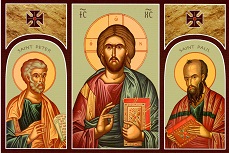
The contrasts of Christ’s Advents

Sermon (audio)
Download Sermon

Service(video)
[vimeo https://vimeo.com/376676489 w=540&h=360]
Download Service Download Bulletin

Sermon for Ad Te Levavi – Advent 1

Jeremiah 33:14-18  +  Romans 13:11-14  +  Matthew 21:1-9

“It’s high time to awake out of sleep,” St. Paul wrote in today’s Epistle, because the King is coming. His Advent—His arrival—is nearer now than when you first believed. This short, four-Sunday season of Advent is a season of preparing—preparing, not for Christ’s first Advent when He came into the world some 2,020 years ago, that would be silly; you can’t prepare for something that’s already happened—but preparing for the King’s arrival at the end of the world. For that, we must all be ready. And to be ready, unlike the world around us that focuses on eating, drinking, and being merry, the Church places a special focus on repentance during this season. That’s why you see purple on the altar.

Still, just because we’re focused on Christ’s second Advent doesn’t mean we forget about His first. Today’s Gospel is all about Christ’s coming to Jerusalem on Palm Sunday, at the beginning of Holy Week, as He was about to wrap up the time of His first Advent and bring it to its perfect fulfillment in His death and resurrection. This morning we’re going to focus especially on the contrasts of Christ’s advents, His advent on Palm Sunday and His advent at the end of the age.

The first contrast we notice: He came the first time in humility, riding on a donkey; He’ll come again in great glory, riding on a cloud. It had to be that way in order for our King to show us who our God is. He is a God who humbles Himself, who lowers Himself down to our level, and then even further down, to the level of the lowliest criminal and the most hated Teacher the world has ever known, because that’s what it took to save our lowly, sinful race: the humiliation of God so that man could be lifted up out of sin and shame and death. But when He comes again, it won’t be with gentleness and lowliness; it will be with glory and power, as the mighty King, riding on a cloud to bring judgment on the world.

That’s another contrast. He came the first time to be judged; He’ll come again to judge. King Jesus rode into Jerusalem at the beginning of Holy Week, knowing that in five days’ time He would be standing before the Jewish Council, before Pontius Pilate and before King Herod to be judged and condemned to death. He allowed the world to judge Him. He took on Himself the condemnation and the death sentence that you and I deserve so that we wouldn’t have to face eternal death and condemnation in hell. And as a result, we now live in a time of grace, when God offers His enemies forgiveness and salvation through faith in Christ, even as the unbelieving world continues to judge and condemn Christ and His Christians. But when He comes again, the world won’t be allowed to judge anymore. He will be the Judge, and He will bring final and eternal condemnation on all His enemies who have still rejected Him and mistreated His Christians.

The first time Christ came as King to sit on an invisible throne; the next time He will come to sit on a glorious throne. We talked about this a couple of weeks ago. We heard in the Gospel, Tell the daughter of Zion, ‘Behold, your King is coming to you. And we heard in our First Lesson from Jeremiah, In those days and at that time I will cause to grow up to David A Branch of righteousness; He shall execute judgment and righteousness in the earth. Jesus did execute judgment and righteousness in the earth as King. He still does, in fact. But not from a position of secular authority; He didn’t come to kick kings off their thrones or judges off their benches or presidents out of their White Houses. He ruled spiritually, in the hearts of men. And when He sat down at the right hand of God the Father, He began His rule over the affairs of the world in secret, behind the scenes, so that He is even now doing what is just and right, even as He uses the wickedness of men and even of the devil to accomplish His good purposes. He hides His rule behind the Means of Grace and the ministry of the Word, forgiving sins, but through humble ministers who speak absolution; justifying sinners, not in a visible courtroom, but in God’s invisible courtroom, through Word, water, bread and wine; condemning sin, through preaching. Christ’s rule is mostly invisible to us. But when He comes again, He will judge openly. He will speak to us openly. He will execute righteousness openly. And wickedness will no longer be allowed to prosper.

Jeremiah also prophesied, In those days Judah will be saved, And Jerusalem will dwell safely. The first time Christ came to bring salvation and safety to His people first, by making atonement for their sins, and second, by bringing people to the safety of faith in Him who even now makes us safe from the accusations of the Law, from the power of the devil, and from the sting of death. But when He comes again, He will bring salvation and safety to His people in a different way, by completely removing sin from us, and by removing us from the presence of the devil and of the wicked. There will be no more death or dying, no more sin or sinning, no more enemies who can hurt or harm us when He comes again.

For now, there is still sin in the world, in Christians, too, as we struggle against our sinful flesh. The first time, Christ came to begin His Church’s cleansing; when He comes again, He’ll finish His Church’s cleansing. You heard Paul say to the Romans, The night is far spent, the day is at hand. Therefore let us cast off the works of darkness, and let us put on the armor of light. Let us walk properly, as in the day, not in revelry and drunkenness, not in lewdness and lust, not in strife and envy. But put on the Lord Jesus Christ, and make no provision for the flesh, to fulfill its lusts. There is Jesus, through the Apostle Paul, cleansing His Church’s behavior. The flesh is still with us and would gladly walk in works of darkness, in revelry and drunkenness, lewdness and lust. But Christ our King is cleansing us through His Word and Spirit, giving us strength and zeal to fight against the flesh and to live as children of the light. That’s still part of the work of His first Advent. But at His second Advent, He will cleanse His Church perfectly, and we will put on the Lord Jesus Christ perfectly, with no more sin to weigh us down.

When Christ came the first time, He came to enter the city of Jerusalem, as you heard in today’s Gospel, the city made up of believers and unbelievers, the city that would eventually reject Him and be destroyed. But when He comes again, He will bring with Him the New Jerusalem, the home of righteousness, the dwelling place of believers only. As John wrote in the Revelation, Now I saw a new heaven and a new earth, for the first heaven and the first earth had passed away. Also there was no more sea. Then I, John, saw the holy city, New Jerusalem, coming down out of heaven from God, prepared as a bride adorned for her husband. And I heard a loud voice from heaven saying, “Behold, the tabernacle of God is with men, and He will dwell with them, and they shall be His people. God Himself will be with them and be their God. And God will wipe away every tear from their eyes; there shall be no more death, nor sorrow, nor crying. There shall be no more pain, for the former things have passed away.

When Christ came the first time, the multitudes sang His praises. Hosanna to the Son of David! ‘Blessed is He who comes in the name of the LORD!’ Hosanna in the highest! We still sing those praises, and the same will be true when Christ comes again. But there is still a contrast we can observe. When Christ came the first time, the people sang His praises with partial knowledge of their King, not really understanding just who Jesus was or what He was about to do for them. Even now, as Paul says to the Corinthians, we only know in part and we prophesy in part. But when that which is perfect has come, then that which is in part will be done away…For now we see in a mirror, dimly, but then face to face. Now I know in part, but then I shall know just as I also am known. When Christ comes again, we who have believed in Him now will sing our Hosanna’s with a full knowledge of our King and of His great love for us. If the crowds outside of Jerusalem could sing, Blessed is He, how much more loudly can we sing it, who know Him better? And how much more loudly still we will be sing it when we know Him perfectly, when He comes again?

Let these contrasts between Christ’s first and second advents serve to work repentance in you, and faith, and love, and eager expectation of His coming. And as we spend this little season preparing for that coming, you’ll find that it also turns out to be the best possible preparation for celebrating the beginning of His first Advent, even His coming at Christmas. Amen.

Posted in Sermons | Tagged , , , | Comments Off on The contrasts of Christ’s Advents

The Thanksgiving of the reconciled

Sermon for Thanksgiving

1 Chronicles 16:7-36  +  Colossians 1:9-23

This is the last service of the year—of the Church year. So what better time to come together once more for thanksgiving, to recognize the Lord’s bountiful goodness over the past year, especially since our sinful flesh is so thankless and ungrateful and would gladly enjoy all of God’s benefits without stopping for even a moment to recognize the Giver?

The first thing we should give thanks for is the ability and the opportunity to give thanks. A lot of people have stopped giving thanks on Thanksgiving altogether, because they fail to recognize that all things come from God. They can’t begin to grasp the concept of being thankful for what they have, because they have no One to be thankful to, or they actually think that they deserve all the good things they have. Others do give thanks, but they give thanks to a false god who hasn’t done anything for them, to a god who hasn’t given His only-begotten Son into death for their sins. A generic god is worthless. A god who is not Father, Son, and Holy Spirit is an idol. So all such misdirected thanksgiving amounts to nothing more than idolatry.

To thank God, you first have to know who God is. Listen to how King David began his Psalm of thanksgiving as he brought the ark of the covenant into the tabernacle newly brought to Jerusalem: Oh, give thanks to the LORD! Call upon His name; make known His deeds among the peoples! Sing to Him, sing psalms to Him; Talk of all His wondrous works! How can you give thanks to the LORD—Jehovah, Yahweh, the great I AM—if you don’t know His name? How can you make known His deeds among the peoples if you don’t know His deeds? How can you talk of all His wondrous works if you don’t know what they are?

And after you know that, then you have to know how you, a poor, miserable sinner, can approach Him, how you can call upon Him, how you can worship Him at all. David sang, Glory in His holy name; Let the hearts of those rejoice who seek the LORD! Seek the LORD and His strength; Seek His face evermore! How do you seek the LORD, who is invisible? Where do you go? On what basis will He receive you or listen to you or accept you? David gives the answer: Remember His covenant forever, The word which He commanded, for a thousand generations, The covenant which He made with Abraham, And His oath to Isaac, And confirmed it to Jacob for a statute, To Israel for an everlasting covenant…Sing to the LORD, all the earth; Proclaim the good news of His salvation from day to day. Out of all the nations of the earth, Israel had the right to approach God and the knowledge of how to approach Him, because God had made a covenant with them: to be their God, to hear their prayers, to help them, to forgive them, and to save them. That first covenant pointed ahead to Christ, who was the true Heir of the first covenant and the Author of the New Testament in His blood.

St. Paul, in our Second Lesson, described how we have been given the ability to give thanks to God: Giving thanks to the Father who has qualified us to be partakers of the inheritance of the saints in the light. He has delivered us from the power of darkness and conveyed us into the kingdom of the Son of His love, in whom we have redemption through His blood, the forgiveness of sinsYou, who once were alienated and enemies in your mind by wicked works, yet now He has reconciled in the body of His flesh through death, to present you holy, and blameless, and above reproach in His sight.

You, dear saints—you do know God, because you know and believe what’s written about Him in Holy Scripture. And you do know how you can approach Him, because you have believed in Jesus Christ, His only Son, our Lord, through whom we have access to God, so that He hears our prayers and accepts our thanksgiving. You know better than to approach God by yourself, on your own merits, or clinging to your sins. You know you have no access to God, except by one route, by one Way: through Jesus Christ, who died for you and rose again and now stands at the right hand of God to intercede for you at all times. You can give thanks to God, because you have been reconciled to God through the death of Christ as the cause and through faith in Christ as the means. So give thanks to the Lord for that above all, for your place in His family as His dearly loved children who have been reconciled to Him through faith in Christ Jesus.

Then, just as David recounted many of the blessings God had given to His reconciled people of Israel, so it’s fitting for us, for those who have been reconciled through Christ by faith, to recount some of His blessings. I say “some,” because every moment, every breath, every molecule, every opportunity comes from God.

Give thanks to the Lord for the heavens and the earth, for good and bad weather, for the harvests that feed all the creatures of the world and that superabundantly fill the shelves in our grocery stores and in our pantries. Give thanks for wood and stone, metal and plastic, cement and asphalt, and for the skill of those who put them together to build our houses and our cars and our stores and our roads.

Give thanks to the Lord for your fellow man, for those who provide useful services to our society, for kind neighbors who make our lives pleasant and for difficult neighbors who help us appreciate how patient God has been with us. Give thanks to the Lord for your family and for daily opportunities to show them love. And give thanks for faithful friends. Give thanks to the Lord for your body, with all its warts and wrinkles and weaknesses, and for the promise of the resurrection of the body, when all its weaknesses will be changed into strength.

Give thanks to the Lord for the ministry of Word and Sacrament, for your Baptism, for Christ’s body and blood offered here every Sunday. Give thanks for our diocese, for its solid confession of the Christian religion, and for all its pastors and parishes. Give thanks, as I do, for each and every member at Emmanuel, both near and far, all 38 of them.

Give thanks for this beautiful church building, and let me give you an extra reason why. For the past seven years, since Thanksgiving, 2012, against all human odds, the Lord has provided our church with daily bread to such a degree that we have so far paid $26,000 in a down payment toward our mortgage, plus $233,000 toward the principal of our mortgage, plus $83,000 in interest. That’s $342,000! Now, $72,000 of that came from God’s providence through the sale of our adjacent property. The rest has come from God’s providence of daily bread to our families here at Emmanuel who have given regular offerings and substantial special offerings, not to mention the tens of thousands of dollars He has dropped in our lap from elsewhere, from other Christians around the country, some of whom we have never even met. We still owe about $16,000. Now, some of you know this, but others may not, and I’ve now been given permission to tell you. As of this January, about six weeks from now, the remainder of that debt, however much is left, will be paid off, and our church will be debt free, thanks to God’s providence through our brother Chuck, in memory of Jan.

In summary, give thanks to the Lord for His promise to provide our daily bread, and for faithfully providing it year after year after year. As we close out another Church year today, it is meet, right, and salutary that we, the ones who have been reconciled to God through Christ, that we, the ones who have received such great benefits from the God who is Father, Son, and Holy Spirit, should come together to give Him thanks. And so we do! Amen.

Posted in Sermons | Tagged , | Comments Off on The Thanksgiving of the reconciled

Preserving faith for the long wait

Sermon (audio)
Download Sermon

Service(video)
[vimeo https://vimeo.com/375279666 w=540&h=360]
Download Service Download Bulletin

Sermon for Last Sunday after Trinity (Trinity 27)

1 Thessalonians 5:1-11  +  Matthew 25:1-13

We’re waiting for the Last Day, as Jesus told us to do—waiting for Him to come back, although He hasn’t told us when it will be. Last week in the Gospel, Jesus pictured the Last Day for us as a day when the Lord will highlight the good works done by His people, for His people, and the lack of good works done by unbelievers for His people. But the verses of today’s Gospel actually come before those verses, and with good reason: today’s Gospel doesn’t highlight our works at all. It highlights our faith, which is where the works come from in the first place. It highlights our faith, and the necessity of preserving it all the way up until the Bridegroom’s arrival, preserving it, even if our wait for the Bridegroom is long.

Then the kingdom of heaven—Then the Christian Church—shall be likened to ten virgins who took their lamps and went out to meet the bridegroom.

The Church will be like a group of girls—probably teenage girls—whose task it is to sit out near the road and wait for the bridegroom to come by, and then to join him with the light of their lamps for the final leg of his procession to the wedding hall. It’s not a practice we’re familiar with in our culture, but it was obviously common enough at Jesus’ time for this parable to make perfect sense to the hearers. Some say that, in that culture, the bridegroom would pick up his bride along the way and that the two would go together to the wedding, accompanied by these virgins with their lamps, but Jesus’ parable doesn’t include the bride, and maybe that’s because of how confusing it would be to consider the Church, which is the Bride of Christ, separately from the individuals who make up the Church. In effect, the ten virgins in our Gospel make up the Church and are all supposed to go in with the Bridegroom, into the wedding hall, into eternal life. But not all ten end up going in with Him.

All ten are invited. The Gospel invitation has reached them. “Repent and believe in Jesus Christ, the Son of God, crucified and risen from the dead and coming again!” Now, we know that many who hear the Gospel invitation turn it down. They spend their lives refusing to repent of their sins, refusing to look to Christ for forgiveness. We aren’t talking about them here. We’re talking about sinners who hear the Gospel and believe it, who make a beginning within the Christian Church. They have been baptized. They walk in communion with the Holy Christian Church. And they’ve all been given a task. Watch! Watch for the coming of the Bridegroom. Be ready to greet Him when He comes. Let that be the overarching goal of your life, to watch and be ready, because He will surely come, and He’ll come at a time, at an hour, that no ones knows.

Also, we’re not talking about those who might be called “nominal Christians,” the people you meet on the street who may say, (if you ask), “I’m a Christian,” but who never darken the doorway of a Christian church. No these are the ones who actually go out to meet the Bridegroom and wait for His coming—at least for a while. They believe in Him. They believe He’s coming again. And they’re all eager to meet Him and to go in with Him. In other words, Jesus is talking about people like us in this room.

What’s the difference between the five wise and the five foolish, then? The five wise virgins think to themselves, “You know, He told us He’s coming tonight, but He didn’t tell us at what time. In fact, He told us He might be delayed. It might be late. Wouldn’t it be a good idea to bring along enough oil to last late into the night, in case He doesn’t come early, at 7 or 8? Wouldn’t it be smart to make preparations, not only for an early arrival, but also for a midnight arrival? That way, we’ll be ready, no matter when He comes.”

The five foolish virgins didn’t think, didn’t listen when the Bridegroom informed them that He might come late in the evening. They went out to wait for Him, figuring He would come soon—soon by human reckoning, soon enough that they wouldn’t need extra oil for their lamps, at least.

But what does it mean to bring along extra oil for their lamps? And what is that burning flame that they must all have in order to accompany the Bridegroom into the wedding hall? The burning flame is faith. Faith in Christ crucified and risen again, faith in Christ as the Savior from sin, faith in Christ as the sure refuge against wrath and condemnation, faith in Christ for the free-of-charge forgiveness of sins. It’s more than a knowledge of Christ. It’s a genuine reliance on Him, true confidence in Him and in Him alone, that for His sake alone, God will show mercy to you, who deserve only His wrath and punishment. Today’s Gospel gets at the heart of the matter, the source of the good works and the actual thing by which we are justified before God and so permitted to enter His kingdom: faith.

But as Jesus warns in our Gospel and in the rest of Scripture, faith is not and has never been self-sustaining. The Holy Spirit kindles it in our hearts through the Word of God, brings us to trust in Jesus for entrance into His eternal kingdom. Faith comes by hearing! But if it’s then left alone, it will die out like any flame will eventually die out if it’s not given the fuel it needs to keep burning.

That fuel, the oil for the lamps, the spiritual milk that sustains and feeds our precious faith is the Word of God—the Word as it’s preached, and taught, and spoken in connection with water and bread and wine, according to Christ’s command; the Word as it’s then meditated upon and pondered.

The wise virgins are the Christians who make wise use of the Means of Grace now, while it’s available to them, as much as it’s available to them. They use the ministry of the Word regularly, and as they do, their faith sends down roots that grow deeper and deeper. Their knowledge of God and of His workings in the world and of His plan of salvation grows richer and richer. Their understanding of their enemies—the devil, the world, and their own sinful flesh—grows keener and keener. And their ability to stand in the face of hardship, trial, persecution, and opposition grows stronger and stronger. You will need all those things in order to endure the last times of this world before the Bridegroom comes. And they only come from the ministry of the Word. How much strength and knowledge and understanding and faith will you need to make it another year? Another ten years? How about 20 or 30 or 80—to make it all the way to the end, holding onto Christ by faith? The answer is, as much as possible. As much as the Lord provides. Even if you think you have a pretty strong faith now, it’s wise to make as much use of the ministry of the Word as possible, while you still can.

Just as it’s unwise not to. The foolish virgins are the Christians who think they stand firm. Who may be very excited, at first, to hear the Gospel, to have been baptized, to learn the Catechism, to receive the Lord’s Supper. They see the filthiness of the world and they’re ready for Jesus to come back. But then He doesn’t. And they keep waiting. And He doesn’t come. And so, instead of continuing steadfastly in the use of the Means of Grace, they come to church less often, and when they do come, they listen half-heartedly, or not at all.

And so plays out the tragedy. So many around the world don’t have ready access to the pure preaching of the Gospel or the right administration of the Sacraments. But many who do, take it for granted and don’t use them. They foolishly assume that what they already have in their lamps will be sufficient to keep their lamps burning when the Bridegroom comes.

But that’s not how it turns out in Jesus’ parable. The cry came at midnight, Behold, the bridegroom is coming; go out to meet him! And only the five wise virgins, who had brought along extra oil, had enough left to keep their lamps lit. Only those Christians who will have used the opportunities the Lord will have provided to fortify their faith along the way will be able to meet Him and to enter eternal life with Him. The five foolish virgins found that their supply of oil was running out. It was insufficient. And it was too late to do anything about it. Those Christians may try running to those who sell oil, to the ministers of the Word who might yet preach the Gospel to them. But when Christ finally does comes down from heaven, He tells us ahead of time, that, at that time, there will be no more time, no more chances, no keeping the dying flame of faith alive, and thus no entrance into eternal life, only the bleak reality of the Lord’s answer, Assuredly, I say to you, I do not know you, followed by an eternity spent in outer darkness—the same fate as all those who never believed in the first place.

Five out of ten don’t make it all the way to the wedding hall. Is that really the percentage of Christians who won’t remain in the Christian faith till the end? I don’t know. But it’s a sobering prospect, isn’t it? A sobering parable? But the fact that you’re here listening to it, if you are listening, means that it isn’t too late. Jesus sends out this warning, and sends His Spirit to bring it home for us. And by the very act of listening to it, pondering it, considering it, you are adding a little more oil to your reserves, so that you can last a little while longer as you wait for Christ to come.

Take advantage of these opportunities to add extra oil—as many opportunities as you’re given, because you don’t know how soon or how late Christ is coming, and you may need every bit of strength from His Means of Grace that’s He’s provided you with in order to make it to the end. Never take what you have for granted, because there are Christians all around the world who would give every last penny to be where you are, to have the access that you have to the ministry of the Word. Learn the Bible. Learn the Catechism. Learn the Christian Confessions contained in our Book of Concord. Learn it a little better this year than last. As Paul wrote in today’s Epistle, Let us who are of the day be sober, putting on the breastplate of faith and love, and as a helmet the hope of salvation. For God did not appoint us to wrath, but to obtain salvation through our Lord Jesus Christ, who died for us, that whether we wake or sleep, we should live together with Him. Amen.


Posted in Sermons | Tagged , , , | Comments Off on Preserving faith for the long wait

When the Son of Man comes in His glory

Sermon (audio)
Download Sermon

Service(video)
[vimeo https://vimeo.com/373762573 w=540&h=360]
Download Service Download Bulletin

Sermon for Second to Last Sunday after Trinity (Trinity 26)

2 Thessalonians 1:3-10  +  Matthew 25:31-46

When the Son of Man comes in His glory, and all the holy angels with Him, then He will sit on the throne of His glory. We could stop right there today and just think about that day when Jesus returns. As you know, the Son of Man already sits on a throne at the right hand of God, the Father Almighty. But it’s a throne that’s invisible to us. It’s a throne that still permits the nations of the earth to plunge into every form of evil. It’s a throne that still allows the demons to exert their foul influence on the governments of the world, spewing lies and hatred, pursuing violence and lawlessness, plotting against all that is good, and seeking to destroy the people of God. It’s a throne that sees to it that the Gospel is preached in the world, and that His people are preserved in faith and given the strength they need for each day, but this throne also sees to it that those who preach the Gospel, and those who hear it, must be hated for it, and must sometimes lose their earthly lives for it.

So some days, some weeks, depending on what’s going on in the world or here at home, it’s all I want to do, to think about the image of the Son of Man coming in His glory, sitting no longer on His invisible throne, but on His glorious throne, with which He will put an end to all the attacks on His people and to all the hardships His people suffer.

Imagine how much more we might focus on that day if things were really bad!

The truth is, you and I don’t feel the tenth of the world’s hatred, not yet. We feel some of it. We see some of it. We know that some Christians throughout the world are really feeling it, and we know that, at times in this world’s history and in certain places, the hatred for Christians has been rabid and deadly. But you and I, so far, for all the daily struggles we still experience, are still able to live in relative peace and safety. We’re still free to gather here on a Sunday morning, without having to answer to anyone, without fearing any physical harm to ourselves or any loss of our property. So far, you and I in this room, at least, haven’t had to stand before a judge and hear him pronounce sentence against us for being Christians.

For as dreadful as such a thing would be, there awaits something far more dreadful, and that is to be found on the left side of the Son of Man when He comes in His glory and sits on His glorious throne, because that Judge’s sentence will be permanent.

Polycarp knew that. He was one of the famous early martyrs of the Christian Church, bishop of Smyrna in the early-to-mid-second century. When threatened with being burned alive if he refused to curse Christ, he said this: “You threaten me with fire which burns for a time, and after a little while is extinguished, but you are ignorant of the fire of the coming judgment and of eternal punishment, reserved for the ungodly. So what are you waiting for? Do what you will!”

Polycarp was right. It’s better to be burned alive here on this earth, where the burning will quickly be over than to face the burning flames of everlasting condemnation which will be pronounced on the day when the Son of Man comes in His glory.

Today’s Gospel both informs us about that day and prepares us for it.

The first thing to note is that there will be no trial. The Judge isn’t coming looking for evidence or waiting for the accused to defend themselves or to explain themselves. No one will be “given his day in court.” There will be no hearing. As soon as He appears, All the nations will be gathered before Him, and He will separate them one from another, as a shepherd divides his sheep from the goats. That’s because your day in court is happening right now. All people are being evaluated and judged right now.

Now, the Law says, He who does these things shall live by them. And Cursed is everyone who does not continue to do all that is written in the Book of the Law. Well, you’d have to be delusional to think that you’ve continued to do all that is written in the Ten Commandments. That’s why the verdict has already been declared: By works of the Law no flesh will be justified. And As many as are of the works of the law—that is, all who are judged by their works, judged according to the Law—are under the curse.

When the Son of Man comes, He will speak to those on His left: Depart from Me, you cursed, into the everlasting fire prepared for the devil and his angels. These are the ones who were judged already in this life by their works, both the evil they did and the good they failed to do. Paul mentions some of the evil in today’s Epistle: It is a righteous thing with God to repay with tribulation those who trouble you. All those who have troubled God’s people through the ages will depart into the everlasting punishment. But so will those who simply failed to help God’s people in their time of need. That’s the list of things Jesus mentions in our Gospel. I was hungry and you gave Me no food; I was thirsty and you gave Me no drink; I was a stranger and you did not take Me in, naked and you did not clothe Me, sick and in prison and you did not visit MeInasmuch as you did not do it to one of the least of these, you did not do it to Me. And the context makes clear that “the least of these” refers to “these My brothers,” these My Christians. When the Son of Man comes, it will be clear that He has loved His Christians all along and will hold the world responsible for not loving His people, too.

“His people,” the sheep on the right, are those who are not judged according to the Law, but whose names have been written in the Book of Life. Now, everyone, from the time of birth, is judged according to the Law, judged by whether or not they’re righteous, holy, and clean, inside and out. And everyone fails that judgment. But that’s why Jesus came the first time, to be righteous, holy, and clean in our place and to suffer for our sins. Now the Gospel He has commanded to be preached in the world offers forgiveness, rebirth, justification before God’s judgment seat, through faith in Christ. He sends His ministers to baptize in His name, to cover His people with Himself as with a shield against the Law’s accusations. He sends His ministers to hand out His body and blood, in which are life and peace and safety from all condemnation, not only on the day when the Son of Man comes, but starting now. There is now no condemnation for those who are in Christ Jesus.

So why does Jesus, in our Gospel, focus only on the good works of believers for believers? For I was hungry and you gave Me food; I was thirsty and you gave Me drink; I was a stranger and you took Me in; I was naked and you clothed Me; I was sick and you visited Me; I was in prison and you came to Me. First, because they’re a necessary product of faith. If you’ve been saved by grace, through faith, then you are, as Paul writes to the Ephesians, God’s workmanship, created in Christ Jesus for good works, which God prepared beforehand that we should walk in them. If you abide in Christ, and He in you, then you will bear much fruit. So the good deeds Christians do are not the cause of our salvation, but the sign of our faith, which is the cause of our salvation in that it’s what connects us to Christ Jesus.

Second, Jesus focuses on these good works because He is very serious about them; He wants them done. He wants His people focused on helping His people, focused on doing good to our fellow Christians, all of them, elderly men and women, nursing babies, and everyone in between. When Christian parents care for their own children, they’re caring for Jesus. When Christian children honor their parents or treat their own brothers and sisters with kindness, they’re doing it to Jesus. When church members care for one another, they’re caring for Jesus. When offerings are given so that the Gospel can continue to be preached, they’re given for Jesus. When Christians hear of other Christians in need and they find a way to help, they’re helping Jesus. Christians do all sorts of good works for our neighbors in general, but the ones done to help our fellow Christians are the ones Jesus promises to highlight when He comes again in glory.

And finally, Jesus focuses on these particular good works, because this is the special sign He’s given for the world to know His disciples by. Jesus said on the night in which He was betrayed, A new commandment I give to you, that you love one another; as I have loved you, that you also love one another. By this all will know that you are My disciples, if you have love for one another.

But your love for one another will always flow from faith in Christ. Where love for your fellow Christian begins to grow cold, it’s a symptom of a faith that needs attending. It’s a warning sign to return again to repentance, to prayer, to the Means of Grace, to seek God’s forgiveness for your faltering love, to be renewed in love by the love of God for you in Christ Jesus. Remember that the Son of Man is coming in His glory and concentrate each day until then on doing the works that He promises to praise when the Son of Man comes.

That should be enough to keep you occupied for now, if you’re focused on those things, to keep you busy so that you don’t spend too much time focusing on all the evil in the news and in the world, except to the extent that, when you see a fellow Christian suffering from some of that evil, you do what you can to help him or her, even if a prayer is all you can offer. It’s not that the evil in the world will decrease before Christ’s coming. On the contrary, it will grow worse. But it will help to focus, not on the evil you’re suffering, but on the good you might do for a fellow Christian who’s suffering. And then, maybe when you least expect it, the day we’ve all been longing for will come. The Son of Man will come in His glory and sit on His glorious throne. And finally you’ll hear the words we all long to hear: Come, you blessed of My Father, inherit the kingdom prepared for you from the foundation of the world! Amen.


Posted in Sermons | Tagged , , | Comments Off on When the Son of Man comes in His glory

Living in exile from the city of God

Sermon (audio)
Download Sermon

Service(video)
[vimeo https://vimeo.com/372226789 w=540&h=360]
Download Service Download Bulletin

Sermon for the Third to Last Sunday after Trinity (Trinity 25)

1 Thessalonians 4:13-18  +  Matthew 24:15-28

In his monumental work The City of God, St. Augustine divided all people into two “cities,” two groups: the city of God, and the city of man; the heavenly city and the earthly city. The city of God is made up of those who worship and serve the true God—Father, Son, and Holy Spirit. The city of man is made up of those who, ultimately, worship and serve man. Both cities exist here on earth, but you can’t see their walls or count their citizens. In a sense, the cities are invisible.

Still, there was a time in history when God chose a visible city, with visible walls, to represent the invisible city of God: Jerusalem. The Old Testament Scriptures even refer to Jerusalem as the city of God, as we sang in today’s Gradual.

That’s what makes today’s Gospel so devastating as Jesus predicts the corruption and the impending destruction of the city of God, of Jerusalem, and even warns His people to flee from it, to flee from the city of God before they were caught up in its destruction. We’ll see that Jesus was not referring only to the city of God that was Jerusalem, but also to the city of God that is the visible Christian Church that has become apostate, the Church that has fallen away, and His warning to flee from the city of God has an application in our time as well, because mingled with the horror of that city’s impending destruction and the anxiety involved with fleeing and living for a while in the “mountains of Judea” is also the promise that God will still be with us and provide for us all the way up until Christ comes again at the end of the age, as Paul mentioned in today’s Epistle.

In Matthew 24, Jesus mentions the “abomination of desolation standing in the holy place,” which Daniel, too, had prophesied. An abomination is something that God despises and hates, and it was a common word used in the Old Testament to describe idols and idolatry in general: false worship, false doctrine that portrayed a god who does not save sinners by grace alone, through faith alone, in Christ alone; false doctrine that portrays a divine spirit who deals with men, not through the Word of God, not through the divinely instituted ministry of the Word, the appointed Means of Grace, but directly and inwardly.

That abomination was firmly set in place in Jerusalem and in her temple in the decades after Christ’s crucifixion and resurrection. Some of the Jews listened to the Gospel for a while, but eventually the city as a whole—the city of God—rejected their God. They rejected their Savior, who was the true Temple where God is to be worshiped. They kept looking for an earthly savior who would save them, not from sin, death and the devil, but from the Romans. So God caused those very Romans to bring destruction on Jerusalem and her earthly temple. That happened first in 70 AD, and again in the 130’s AD when Emperor Hadrian stamped out the Third Jewish Revolt and exiled all Jews from Jerusalem permanently.

But all who heeded the warning of Jesus and His instructions—let those who are in Judea flee to the mountains—were spared from Jerusalem’s demise. But a time of great tribulation came upon those Christians for the next 250 years or so. They were spared from the wrath of God that was poured out on Jerusalem, but that doesn’t mean they lived in safety. The citizens of the city of God had to keep fleeing from one place to another as the Roman empire ramped up its persecutions, and many Christians became martyrs for the Christian faith: tortured in unspeakable ways, imprisoned, and finally killed. For most of that time, there was practically nowhere in the world where it was legal or safe to be a Christian.

According to the promise of Jesus, those days were cut short (although 250 years is a pretty long time to live in that kind of earthly instability). In the fourth century, Emperor Constantine became a Christian and ended the bloody persecution of Christians throughout the world. The “great tribulation” came to an end. But Christ hadn’t returned. So Jesus’ prophecy in Matthew 24 still had a spiritual meaning and a spiritual fulfillment that would yet take place. They should expect another “abomination of desolation” to be set up in the holy place, in the city of God.

Now, the days of earthly Jerusalem’s importance are past. It will never again be called by God “the holy city,” and “the holy place” will never again be located in a Jerusalem temple. The holy city is now the Holy Christian Church, and the holy place is the hearts of Christians, whom God has sanctified for Himself through Holy Baptism. As St. Paul wrote to the Corinthian Christians, Do you not know that you are the temple of God and that the Spirit of God dwells in you? If anyone defiles the temple of God, God will destroy him. For the temple of God is holy. And you are that temple.

The abomination that would be set up in the visible Christian Church is idolatry, specifically, the exaltation of man over God, and it’s summed up well in the Roman papacy, which has its seat in Rome, which also came to be known as the “city of God.” As Lutherans, we’ve recognized that now for about 500 years. It doesn’t matter which pope we’re talking about, or how different one is from another. What the papacy represents is manmade doctrine, manmade forms of worship, and the worship of man. It represents all the false doctrine that has invaded and now desolated Christendom, every teaching of man that obscures or darkens the work of Christ and faith in Christ, whether in the Roman Church or outside of it. The Gospel is clear: that all have sinned against God and deserve His wrath, that Christ has come and suffered for all sin and risen from the dead, that God offers forgiveness of sins and eternal life to sinners for the sake of Christ alone, through faith alone, apart from all our works and obedience, that God sends His ministers to call all men to repent of their sins and believe in Christ Jesus, and that God the Holy Spirit will work through Word and Sacrament to gather His Church, to create and preserve faith until Christ comes again for the resurrection and for judgment. That is the simple Gospel of Christ. Wherever human works are added as a cause of our salvation, wherever human doctrine is exalted above divine doctrine, wherever sinners are directed to seek peace with God apart from Christ or apart from His Means of Grace—that is of the devil. It’s an abomination in the sight of God. It causes desolation—devastation within the Christian Church.

The first Lutherans didn’t immediately try to flee from Rome. As you know, they tried to reform it. But when that failed, they realized that they had to heed Jesus’ words and “flee to the mountains,” to flee from the pope’s mangled institution. They couldn’t, in good conscience, remain under the Roman bishops. They couldn’t hold onto the earthly safety and prosperity that came with loyalty to the Roman papacy. Instead, they lived in exile. And with exile comes instability and confusion and uncertainty. Fleeing involves scattering, a few here, a few there, in pockets of refugees throughout the world.

That’s where we live, in exile, outside the earthly city of God, with instability and confusion and uncertainty. A few scattered Christians, here, there, and throughout the world. We’re still living in the midst of the “great tribulation.” Just as the early Church had to fight two battles at once, against persecution from without and against false doctrine from within, so it is today. In some parts of the world, Christians are treated brutally and shamefully. In our country, we’re only seeing the first beginnings of that kind of persecution. But we’re already deeply mired in false doctrine that has largely corrupted the American churches. The spirit of antichrist still calls out all around us, “Here is Christ, in the one big church! Come back! And don’t let doctrine get in your way! Come back to the safety of Jerusalem, the safety of Rome, the safety of Constantinople, the safety of the big and glorious Lutheran synod! Think of all the nice things you and your children are missing out on by your picky doctrinal positions! Think of all the good you’re failing to do for the poor and for the oppressed by remaining in your tiny little church!”

Dear Christians, that’s all part of the great tribulation, and it’s the life that we citizens of the city of God, living in exile from the earthly city of God—which has actually become the city of man—will continue to live until Jesus comes for us. We’re constantly surrounded by false prophets who are always shouting, either, “Here’s Jesus, over here in the big church! There’s Jesus, over there, in the desert, by yourself, away from organized religion entirely!” “Over here, in the inner room of your heart, in your feelings, in your emotions, in your dreams! That’s where you’ll find Jesus!”

Do not believe it, Jesus says. You won’t find Jesus attached to manmade doctrine or the worship of man. You won’t find Him in your emotions. You won’t find Him floating around somewhere in the air. You will find Him as He comes through His Holy Spirit, where two or three are gathered in His name, where His Word is rightly preached and His Sacraments are rightly administered. There is Jesus. There is His catholic Church. There are His elect, living the life of waiting in exile until Christ comes again.

And when He comes again, there will be no doubt about where He is. For as the lightning comes from the east and flashes to the west, so also will the coming of the Son of Man be. For wherever the carcass is, there the eagles will be gathered together. The eagles don’t think to themselves, let’s go find a carcass over in such and such a place. Instead they’re constantly flying around, watching, waiting, without knowing where the carcass will appear, waiting and watching until it does. Then they know where to go. Then they know where to gather.

Such is the life of Christians, living as exiles of Jerusalem. We don’t expect to find Jesus in Jerusalem or in Rome or in any human institution, and so we cannot be permanently tied to any human institution, including this church building, including this diocese of which we’re so gladly a part. Instead, we fly around, following where the Word of Christ is preached in its truth and purity. And then, when Christ appears in the clouds with all His saints, we will fly to Him and gather to Him, to meet the Lord in the air. And thus we shall always be with the Lord. Amen.

Posted in Sermons | Tagged , , | Comments Off on Living in exile from the city of God