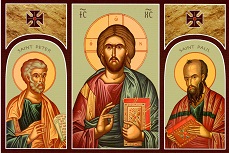
The glory that awaits beyond the cross


Right Click to Save

Sermon for the Transfiguration of Our Lord

2 Peter 1:16-21  +  Matthew 17:1-9

We have a very special miracle before us today in the Transfiguration, the climax of the Epiphanies of our Lord. All of Jesus’ miracles pointed to His divinity. You see Him calm the wind and the waves, and you have to conclude, this man is God. You see Him drive out demons, and you have to conclude, this man is God. You see Him change water into wine, heal sickness and blindness and deafness and paralysis and leprosy and you have to conclude, this man is God. In all those miracles, the evidence of Jesus’ true identity was there, but in all those miracles, Jesus still looked like Jesus. He still looked like any other man.

Not today. Not at the Transfiguration. For that brief moment on top of the mountain, Jesus looked like no other man. He looked like God. He allowed His disciples to see the visible manifestation of His divine glory, and to hear the Father’s voice, giving His seal of approval to His Son, to the work He had done and to the work He was about to do.

Why now? Why at this point in His ministry, some six months before His crucifixion? Because of what happened six days earlier.

Matthew, Mark and Luke all record the transfiguration, and they all begin by connecting it with what happened about a week earlier. Jesus had asked His disciples who the people said He was: John the Baptist, Elijah, Jeremiah, some other prophet, some other mere human being. But you, Jesus asked, who do you say that I am? That’s when Peter answered, “You are the Christ, the Son of the living God!” And Jesus praised His answer and praised His Father for revealing that hidden truth to His disciples. He promised to build His Church, and the gates of hades will not overcome it. Then He proceeded to explain to His disciples that He must suffer and die and rise again from the dead. That made no sense. The Son of the living God should not have to suffer and die. Peter tried to tell Jesus He was wrong, to which Jesus replied, “Get behind Me, Satan! You are an offense to Me, for you are not mindful of the things of God, but the things of men.” Then followed even more confusing teachings, that they and all who would consider themselves disciples of Jesus, the Christ, the Son of the living God, would have to suffer, too, would have to deny themselves, take up their own crosses, and follow Jesus. Finally, He told them, after all is done, the Son of Man will come in His Father’s glory to reward each one according to his works.

That’s a lot to take in, a lot of seemingly contradictory things all said at once. The all-powerful Son of God is powerless to stop His own death? The beloved followers of Jesus must suffer and turn their backs on their earthly life in order to gain a heavenly one? We have to go through our whole life on earth in humility, in shame, in self-denial, and then face death before we get to join Jesus in glory? Is that what you’re telling us, Jesus? They needed to see what was awaiting them at the end of the road, that the hard life of suffering and self-denial to which they were being called for the sake of Jesus would be worth it in the end.

So up the mountain they go, just Peter, James, John and Jesus. Matthew tells us that Jesus was transfigured before them. His face shone like the sun, and His clothes became as white as the light. Here, for a moment, the curtain is pulled back—the curtain that veiled Jesus’ divine glory during His entire life on earth. Remember, Jesus had told His disciples six days earlier that one day He would come in His Father’s glory to reward them according to their works. Here is glimpse of that glory that awaits at the end of the age. For a moment, three disciples—only three! —get to see it with their own eyes.

And then Moses and Elijah appeared to them, talking with Jesus. Two Old Testament prophets who were great prophets in their own right, but also mere shadows, pointing to the great Prophet Himself. Each of them had performed great miracles. Each of them had been mostly alone in leading God’s people, a great burden of loneliness placed on them both. They had both been, at times, rejected by God’s people. At the end of his service, Moses had died without entering the promised land. At the end of his service, Elijah was taken up alive into heaven. You can see Jesus prefigured in them both.

But now they are talking with Jesus in the glory of the mountain. They suffered for the sake of Christ, too, and were now living in glory. They had been weak and confused at times and almost willing to throw in the towel. But they had persevered, and now they understood what it had all been about.

Peter thinks they should all stay here together on the mountain. Let’s put up shelters!, he suggested. He still didn’t understand. The glory of the mountain wasn’t supposed to last, yet. Neither Jesus nor His disciples had finished their earthly mission, as Moses and Elijah had. They had not yet completed the days of their suffering in humility and shame. This vision on the mountain was to assure them of what awaited. It was to show them that it would all be worth it in the end. As St. Paul once wrote to the Romans, I consider that the sufferings of this present time are not worthy to be compared with the glory which shall be revealed in us.

God the Father interrupted Peter. While Peter was still speaking, behold, a bright cloud overshadowed them; and suddenly a voice came out of the cloud, saying, “This is My beloved Son, in whom I am well pleased. Hear Him!” All of Jesus’ talk about suffering and dying and rising again, all His admonitions to deny themselves, take up their cross and follow Jesus, all the promises about glory and rewards at the end…All of it was confirmed by God the Father Himself. This was the way. Jesus Himself is the way, and the truth, and the life. No one comes to the Father except through Him.

Hear Him! Those words thundered down from heaven. And what important words they are! You can’t see Jesus’ glory yet, but you can hear what Jesus says. Believe what He says, about the cross and about the resurrection. It’s hearing the words of Jesus that will sustain you through this earthly life into the next life. Which words? The ones you pick and choose? The ones you like? The ones your reason can grasp? Well, obviously, all of them. Hear everything Jesus says. Honestly, there aren’t even many “Christian” churches around these days where they are willing to hear Jesus in everything.

But as for you, hear Him! His words will never pass away. His words about His own suffering and death—you know the purpose behind it all. It was to bear the sins of the world and to receive the punishment for them, so that all sinners might be saved through faith in Jesus Christ and Him crucified. His words about His own resurrection—you know that it’s true, as all those eyewitnesses testified. His words about your self-denial, your cross, losing your earthly life in order to gain life—He says it all for your good. Because the path of the Christian cannot be different than the path of the Christ. As Jesus said elsewhere, A disciple is not above his teacher, nor a servant above his master. It is enough for a disciple that he be like his teacher, and a servant like his master. If they have called the master of the house Beelzebub, how much more will they call those of his household! Therefore do not fear them. For there is nothing covered that will not be revealed, and hidden that will not be known.

Do not fear them. Do not be afraid. That’s what Jesus told His disciples after the vision of the transfiguration was over. That’s what He tells you, too, as you go down the mountain, as you face a world that is still hostile and rabid against Christ and against anyone who speaks His truth in the world. Now is not the time to experience the glory of being God’s children, to experience peace and safety and comfort and to be loved by the people of this world. Now is the time to hear Him, to hear Jesus. Now is the time to receive His Sacrament and the strength it provides. Now is the time to be bold in living lives of service, lives of love, lives in which we are not afraid to speak the truth of Christ, no matter what cross it may bring. All this is done in great humility and weakness. But the Gospel assures us that Jesus Christ is still God, that the glory is real, and that it surely awaits all those who remain faithful till the end. Amen.


Posted in Sermons | Tagged , , | Comments Off on The glory that awaits beyond the cross

Faith that defies gravity

Sermon for the week of Epiphany 4

Romans 4:16-25  +  Matthew 14:22-33

Another storm on the Sea of Galilee, another miracle—two of them, actually—and, once again, the appearance of fear, doubt, and panic. The main point is similar to the main point in the Gospel from this past Sunday. But there is a little twist in this account that’s well worth considering.

It had been a very long day, including the feeding of the 5,000. When night fell, Jesus sent His disciples across the sea, while He stayed behind by Himself for a while to pray.

They spent the whole night rowing, but the boat was “tossed by the waves because the wind was contrary.” It was the fourth watch, almost morning, but they hadn’t gotten very far. Then, in the moonlight, they looked back over the waters and saw what they thought must have been a ghost, because it was walking on top of the water, and people just don’t do that kind of thing. It was Jesus. He called out to them, “Be of good cheer! It is I; do not be afraid.”

Peter wanted to make sure he wasn’t just hearing things or seeing things. Lord, if it is You, command me to come to You on the water.” “Come,” Jesus said. So Peter got down out of the boat, walked on the water and came toward Jesus. It’s one thing for the All-powerful Son of God to defy gravity, but it’s another thing when a simple human being does it. And notice where the power was. Peter didn’t just get it in his head that he could walk on water, too. He didn’t just believe he could do it. He very wisely waited for Jesus’ command, for Jesus’ word telling him he could come out and walk on the water. Once he had it, he had something to put his faith in.

That’s an important lesson about faith. Real faith is always based on a specific command or promise of God. If God hasn’t said it, you have no right to believe it. But if God has said it, you can bet your life on it, even if it defies all logic, even if it defies the laws of gravity.

So Peter was doing well for a while. His faith was focused on Jesus’ power and Jesus’ word to him, empowering him to walk on the water. But when Peter saw that the wind was boisterous, he was afraid and began to sink.  Peter focused on the wind, and faith took backseat to his logic. “How can I possibly stay on my feet? How am I able to walk on water, anyway? Hey, what I’m doing is impossible. That wind! Those waves! I can’t do this; I can’t walk on water. Oh, man. Now I’m sinking. It’s getting worse. See, I knew it, I can’t walk on water! I’m going to drown!”

Peter took his eyes off Jesus. He looked away, with his heart, focusing on the problem, on the crisis of wind and waves, allowing his heart to be pried off of Jesus’ word. That’s the definition of doubt: to stop trusting in what Jesus says, and to start thinking that maybe Jesus won’t do what He said He would do. That’s a formula for disaster.

As we learned on Sunday, the real danger in any danger is not the danger itself. It’s that the danger will scare us away from trusting in Jesus’ word and promise.

Crises are bound to come into every believer’s life. There’s a right way and a wrong way to handle a crisis. Peter showed us here – the wrong way: Take your eyes off Jesus. Look at the problem, focus on the problem, see the wind and the waves as bigger than Jesus, more powerful than Jesus, more real than Jesus’ word. Isn’t that just what we tend to do in a crisis? Forget everything else! Deal with the problem! Obsess over the problem! Try to figure it out, find a solution! Dwell on the problem! When I figure it out, when the wind dies down, then, then I’ll listen to God’s Word again. What foolishness! Just the opposite of what the real solution is!

Peter’s panic didn’t completely drive him to despair. He didn’t sit there, sinking down into the water, thinking, “Oh, I let Jesus down. He’ll never help me now. I’m just going to sink down and drown, I guess.” No. What did he do? Even then, as he sank deeper and deeper into the dark waters, with all of his doubt still intact, Peter looked back to Jesus to save him. “Lord, save me!” he cried out. He doubted Jesus’ word and was suffering for it, but Peter didn’t lose sight of Jesus as his Savior.

And Jesus did save him, in more ways than one. Immediately Jesus stretched out his hand and caught him. He didn’t let Peter drown. He didn’t make him splash around in the water for a while, gasping for air until he had learned his lesson. Immediately, he saved his sinking saint.

And then he refocused Peter’s faith. “You of little faith,” he said, “why did you doubt?”  “Don’t you know by now, Peter, that if I say something, it will always be the truth? That if I promise something, it will always come to pass? Don’t you know that My Word is more reliable than your own senses and more powerful than anything in all creation? Why did you doubt?”

Peter didn’t answer, but we know what the answer is, because we, too, are sinful human beings, easily fooled into believing that our problems are more real than Jesus. Like Peter, we’re sinful, weak human beings who know how easy it is to let the noise of problems and crises drown out the Word of God. What specific promise of Jesus gets obscured in your heart at times when the wind howls and the waves crash? That He really is working all things together for your good? That He won’t allow you to be tempted beyond what you can bear? That He will provide for all your bodily needs? That He will be there on the other side of death to receive you into His heavenly kingdom?

Jesus had all of His disciples, and you and me, in mind on that night out on the water of Galilee. As soon as He and Peter climbed into the boat, the wind died down. That wind had been there for a reason: to teach us how easily our faith can lose its focus on Jesus and start to sink, so that we know what to do when we do start to sink, and so that, just maybe, we won’t allow the wind to distract us in the future.

When the walls are closing in around you…When it gets harder and harder to breathe…When you’re sinking into despair or depression or a pit of hopelessness…When you’re surrounded by evil…When, on your deathbed, the devil tries one last time to accuse your conscience… You remember this miracle of the sinking saint! You remember to focus on Jesus and His Word which pries your faith off of the wind and the waves and refocuses it on Him! And if you have doubted and have already begun the sinking process, don’t wallow in self-pity or let the guilt of your doubt pull you down into the dark waters. Even as you’re sinking, you do as Peter did and look up to Jesus! “Lord, save me!” Remember the body and blood of your Savior, given and shed for you for the forgiveness of sins and given to you in His Sacrament to give you miraculous power over sin, and fear and doubt. Amen.

Posted in Sermons | Tagged , | Comments Off on Faith that defies gravity

The real danger of any danger


Right Click to Save

Sermon for the Fourth Sunday after Epiphany

Romans 13:8-10  +  Matthew 8:23-27

The Holy Spirit puts special emphasis on the story you heard today in the Gospel, when Jesus calmed the storm on the Sea of Galilee. Matthew, Mark and Luke all record this event. It was important. It was another great Epiphany of the Lord Jesus: Jesus has authority over the wind and the waves.

Does that strike you? I wonder. We’ve known Jesus through the Holy Scriptures for so long, we’ve come to expect it of Him, that He can speak a word to the roaring winds, and they listen. That He can talk to the waves of the sea, and they immediately obey. That’s awesome power—power His disciples had seen before, but still not quite on this scale. They had seen six jars of water changed into wine. They had seen people with illnesses made whole. They had seen demons forced to obey the authority of the Son of God (as we heard this morning in the Sunday School lesson). They had seen another kind of miracle at sea, the first miraculous catch of fish. Amazing, all of it. But there is something special about being able to stare up at the raging sky and tell it to shush, something about staring at the raw forces of nature and being able to tell them to behave. Not with magic or with a spell. But by the divine power that brought the earth into existence with a word, that set the sun and the moon and the planets in their places in the solar system, and that brought out the stars by name throughout all the galaxies of the universe. That’s power.

That’s who Jesus is. So, does it make any sense to be afraid of a storm, knowing that Jesus is the ruler of the wind and the waves, and knowing that Jesus is the one who initiated this voyage across the sea, as all three Gospels record? It was Jesus who got into the boat. It was Jesus who said, “Let’s cross over to the other side” of the lake.

Ah, but the disciples didn’t know yet, at the beginning of the voyage, that Jesus could actually calm the wind and the sea! Maybe not. But they should have. They had seen all those other miracles. They had heard all His preaching. He had already promised to give them everlasting life, and to make them His apostles to go out into the world and “catch men.” They had already confessed Him (privately) to be the Christ. They had left their livelihoods behind in order to follow Him. They had already put their faith in Him and were resting their eternal souls on Him as the Savior sent from God. Does it make any sense to think that a storm out at sea might just be able to undo all that Jesus had promised and all that He had already done? Could a storm stand in His way? Or could He simply allow them to perish at sea, after promising to make them workers in His kingdom?

No, their fear makes no sense. Fear never makes sense for the Christian.

Oh, it makes perfect sense for the non-Christian. If you don’t know who the true God is, if you’re living in rebellion against your Creator, if you’ve recreated a god in your own image who has no basis in reality, if you’re still wallowing in the filth of your sins, unclean, unclaimed, unwashed in the baptismal blood of Christ…then you must be afraid of literally everything. And if you’re not, you should be. Because our God is a consuming fire, as the writer to the Hebrews says. It is a fearful thing to fall into the hands of the living God.

But the one who has heard and believed the Gospel that God loved the world so that He gave His only-begotten Son that whoever believes in Him should not perish but have everlasting life, the one who has received Christ’s baptism, who confesses Him as Lord, who knows Him to be the great King who rules over the vast galaxies of the universe and also over the tiniest atoms that make up our bodies—why should a Christian ever panic? Why should we ever be afraid? If God is for us, as St. Paul writes, who can be against us? Who shall separate us from the love of Christ? Shall tribulation, or distress, or persecution, or famine, or nakedness, or peril, or sword? No, he says, in all these things we are more than conquerors through Him who loved us.

But our Gospel today shows us the flaw that still plagues God’s children, the senseless fear of little children who normally trust their parents, but who, in a moment of crisis, in a moment of danger, suddenly stop trusting them. I would guess that all parents have seen it. We’ve seen it. In a moment of crisis, even Christians are sorely tempted to revert back to our default, spiritual fetal position, if you will—in which we believe that there is no God who can help, no God who can save. I’m on my own. I’m all by myself. Either I figure it all out myself, or all hope is lost. If God is there, He must not care. Or He must be sleeping.

And that’s just where we find Jesus during the storm at sea, while His disciples were panicking and terrified. He was asleep in the back of the boat.

How could He sleep through all that? Well, for one thing, He was actually tired! He had spent the day there by the sea, healing the people, teaching the people. It was exhausting. But more importantly, His own perfect trust in His Father’s providence allowed Him to sleep, because while He, the Son of God, had become a man and now needed sleep in this state of humiliation, God the Father is always awake. As the Psalm says, I will lift up my eyes to the hills—From whence comes my help? My help comes from the LORD, who made heaven and earth. He will not allow your foot to be moved; He who keeps you will not slumber. Behold, He who keeps Israel shall neither slumber nor sleep. Or again, I will lie down in peace, and sleep. For You alone, O LORD, make me dwell in safety. And again, The LORD is my light and my salvation; whom shall I fear? The LORD is the strength of my life; of whom shall I be afraid? Jesus was not only the divine Author, but also the perfect human pray-er of those Psalms. He shows us what perfect faith, perfect trust looks like.

And then the Holy Spirit shows us what imperfect faith looks like in the disciples. “Lord, save us! We are perishing!” It seems like they said it as a last resort, after all their efforts against the storm had failed to keep the boat safe. It should have been their first resort, and not with the fear of, “We are perishing!” But with the trust of the Psalmist, As for me, I will call upon God, and the LORD shall save me.

That wasn’t the faith the disciples demonstrated. But Jesus got up, spoke one word to the wind and another to the waves. And all was still. And for as important and as impressive as it was for the disciples to learn the almighty power of Jesus, the more important lesson was about to follow as Jesus spoke to them: “Why are you fearful, O you of little faith?”

Why are you fearful? You shouldn’t be. But sometimes you are and all the time the devil wants to take advantage of the danger to drive you away from faith. You see, the real danger of any danger is not the danger itself. The real danger is that the danger will scare you out of trusting in the Lord Christ to help.

As today’s Gospel shows us, nothing is out of Christ’s control. Even now He rules over all things, though the time has not yet come for Him to make all things right. There are still lots of perils and dangers in this world, but there is no good reason for the Christian to fear. Christ has made you His friends and companions. He’ll help you face the danger. He’ll help you bear up under the burden. He may remove it entirely. Or, if not—because He has never promised in His Word to spare you from all grief in this sin-filled world—He’ll give you the wisdom and the courage and the strength you need in the hour of trial. He’ll forgive you your sins. He’ll be your loving God and Father, your truest Friend and Companion.

Remember what Jesus did that day on the Sea of Galilee with those fearful disciples of little faith. He saved them. He patiently taught them and slowly built up their faith, so that, eventually, they learned not to be so afraid.

Now, maybe next time you’re in danger, you won’t be quite as afraid. Now, maybe next time, you’ll remember not to panic, not to forget about God, not to turn to Him as a last resort, but to go to Him first, not in fear and terror, but in childlike trust. Amen.

Posted in Sermons | Tagged , , | Comments Off on The real danger of any danger

Luther Sermon for Epiphany 4

Luther’s Sermon for the FOURTH SUNDAY AFTER EPIPHANY.
Text: Matthew 8:23-27 (KJV)

I. OF FAITH AND UNBELIEF.

1. This Gospel, as a narrative, gives us an example of faith and unbelief, in order that we may learn how mighty the power of faith is, and that it of necessity has to do with great and terrible things and that it accomplishes nothing but wonders; and that on the other hand unbelief is so fainthearted, shamefaced and trembling with fear that it can do nothing whatever. An illustration of this we see in this experience of the disciples, which shows the real state of their hearts. First, as they in company with Christ entered the ship, all was calm and they experienced nothing unusual, and had any one asked them then if they believed, they would have answered, Yes. But they were not conscious of how their hearts trusted in the calm sea and the signs for fair weather, and that thus their faith was founded upon what their natural eyes saw. But when the tempest comes and the waves fill the boat, their faith vanishes; because the calm and peace in which they trusted took wings and flew away, therefore they fly with the calm and peace, and nothing is left but unbelief.

2. But what is this unbelief able to do? It sees nothing but what it experiences. It does not experience life, salvation and safety; but instead the waves coming into the boat and the sea threatening them with death and every danger. And because they experience these things and give heed to them and turn not their fear from them, trembling and despair can not be suppressed. Yea, the more they see and experience it the harder death and despair torment them and every moment threatens to devour them. But unbelief cannot avoid such experiences and cannot think otherwise even for a second. For it has nothing besides to which it can hold and comfort itself, and therefore it has no peace or rest for a single minute. And thus will it also be in perdition, where there will be nothing but despair, trembling and fear, and that without end.

3. But had they had faith, it would have driven the wind and the waves of the sea out of their minds, and pictured before their eyes in place of the wind and tempest the power and grace of God, promised in his Word; and it would have relied upon that Word, as though anchored to an immovable rock and would not float on the water, and as though the sun shined brightly and all was calm and no storm was raging. For it is the great characteristic and power of faith to see what is not visible, and not to see what is visible, yea, that which at the time drives and oppresses us; just as unbelief can see only what is visible and can not in the least cleave to what is invisible.

4. Therefore God bestows faith to the end that it should deal not with ordinary things, but with things no human being can master as death, sin, the world and Satan. For the whole world united is unable to stand before death, but flees from and is terrified by it, and is also conquered by it; but faith stands firm, opposes death that devours everything, and triumphs over it and even swallows the unsatiable devourer of life. In like manner no one can control or subdue the flesh, but it reigns everywhere in the world, and what it wills must be done, so that the whole world thereby is carnal; but faith lays hold of the flesh and subdues and bridles it, so that it must become a servant. And in like manner no one can endure the rage, persecution, and blasphemy, infamy, hatred and envy of the world; every one retreats and falls back exhausted before it, it gets the upper hand over all and triumphs; and if they are without faith it mocks them besides and treads all under its feet, and takes pleasure and delight in doing so.

5. Further, who could conquer Satan with his innumerable, subtle suggestions and temptations, by which he hinders the truth and God’s Word, faith and hope, and starts so many false doctrines, sects, seductions, heresies, doubts, superstitions and innumerable abominations? The whole world compared with him is like a spark of fire compared with a fountain of water. All must be here subject to him; as we also see, hear and understand. But it is faith that keeps him busy, and it not only stands before him invulnerable, but also reveals his roguery and puts him to shame, so that his deception fails and he faints and falls; as now takes place with his indulgences and his papacy. Just so no one can allay and quiet the least sin, but it bites and devours the conscience, so that nothing avails even if the whole world were to comfort and support such a person, he must be cast down into perdition. Here faith is a hero, it appeases all sins, even if they were as many as the whole world had committed.

6. Is there now not something almighty and inexpressible about faith that it can withstand all our powerful enemies and gain the victory, so that St. John says in his first Epistle 1 John 5:4: “This is the victory that hath overcome the world, even our faith?” Not that this is done in peace and by quietly resting; for it is a battle that is carried on not with out wounds and shedding of blood. Yea, the heart so severely experiences in this battle sin and death, the flesh, Satan and the world, that it has no other thought than that it is lost, that sin and death have triumphed, and that Satan holds the field of battle. The power of faith however experiences but little of that. This is set forth in our narrative, when the waves not only dashed into the boat, but even covered it, so that it was about to go under and sink, and Christ was lying asleep. Just then there was no hope of life, death had the upper hand and had triumphed; life was lying prostrate and was lost.

7. As it went here, so it goes and must go in all other temptations of sin, Satan, etc. We must experience how sin has taken captive the conscience and nothing but wrath and perdition wish to reign, and how we must be eternally lost. Satan must start so many things by his error and false teaching that it appears God’s Word must fall to the ground and the world must glory in falsehood. Likewise the world must rage and persecute to such an extent that it appears no one can stand or be saved, or even confess his faith; but Cain will rule alone and will not rest until his brother is dead, so that he may never be in his way. But we must not judge and act according to appearance and our experience, but according to our faith.

8. Therefore this Gospel is a comforting example and doctrine, how we should conduct ourselves, so that we may not despair in the agony of sin, in the peril of death, and in the tumult of the world; but be assured that we are not lost, although the waves at once overwhelm our little boat; that we will not perish, although we experience in our evil conscience sin, wrath, and the lack of grace; that we will not die, although the whole world hates and persecutes us, although it opens its jaws as wide as the rosy dawn of the morning. These are all waves that fall over your little bark, cause to despair, and force you to cry out: “Save, Lord; we perish”. Thus you have here the first part of this Gospel, faith, how it should thrive and succeed, and besides, how incapable and fainthearted unbelief is.

II. OF LOVE.

9. The second part of our text, treating of love, shows forth Christ in that he rises, breaks his sleep for their sake, takes to heart their need as though it were his own, and ministers to them help out of free love without any merit on their part. He neither receives nor seeks any reward for his help, but permits them to enjoy and use his power and resources. For as we have often heard it is characteristic of Christian love to do all freely and gratuitously, to the praise and honor of God, that a Christian lives upon the earth for the sake of such love, just as Christ lived solely for the purpose of doing good; as he himself says: “The Son of man came not to be ministered unto, but to minister.” Matthew 20:28.

III. THE SPIRITUAL MEANING OF THIS NARRATIVE.

10. Christ pictured to us in this narrative the Christian life, especially the office of the ministry. The ship signifies Christendom; the sea, the world; the wind, Satan; his disciples are the preachers and pious Christians; Christ is the truth, the Gospel, and faith.

11. Now, before Christ entered the ship with his disciples the sea and the wind were calm; but when Christ with his disciples entered, then the storm began, as he himself says, Matthew 10:34: “Think not that I came to send peace on the earth: I came not to send peace but a sword.” So, if Christ had left the world in peace and never punished its works, then it would indeed have been quiet. But since he preaches that the wise are fools, the saints are sinners and the rich are lost, they become wild and raging; just as at present some critics think it would be fine if we merely preached the Gospel and allowed the office of the ministry to continue in its old way. This they would indeed tolerate; but that all their doings should be rebuked and avail nothing, that they call preaching discontent and revolution, and is not Christian teaching.

12. But what does this Gospel say? There was a violent tempest on the lake when Christ and his disciples were in the ship. The sea and the wind allowed the other ships to sail in calm weather; but this ship had to suffer distress because of Christ being in it. The world can indeed tolerate all kinds of preaching except the preaching of Christ. Hence whenever he comes and wherever he is, there he preaches that he only is right and reproves all others; as he says in Matthew 12:30: “He that is not with me is against me”, and again, John 16:8: “The spirit will convict the world in respect of sin, and of righteousness and of judgment;” he says that he will not only preach, but that he will convict the whole world and what is in the world. But it is this convicting that causes such tempests and dangers to this ship. Should he preach that he would allow the world to go unpunished and to continue in its old ways, he would have kept quiet before and never have entered the world; for if the world is good and is not to be convicted then there would never have been any need of him coming into the world.

13. Now it is the consolation of Christians, and especially of preachers, to be sure and ponder well that when they present and preach Christ, that they must suffer persecution, and nothing can prevent it; and that it is a very good sign of the preaching being truly Christian, when they are thus persecuted, especially by the great, the saintly, the learned and the wise.

And on the other hand that their preaching is not right, when it is praised and honored, as Christ says in Luke 6:22-26: “Woe unto you, when all men shall speak well of you; for in the same manner did their fathers to the false prophets. Blessed are ye, when men shall hate you, and when they shall separate you from their company, and reproach you, and cast out your name as evil, for the Son of man’s sake; in the same manner did their fathers to the prophets.” Behold our preachers, how their teachings are esteemed; the wealth, honor and power of the world have them fully under their control, and still they wish to be Christian teachers, and whosoever praises and preaches their ideas, lives in honor and luxury.

14. Hence, people have here an example where they are to seek their comfort and help, not in the world; they are not to guard the wisdom and power of men, but Christ himself and him alone; they are to cleave to him and depend on him in every need with all faithfulness and confidence as the disciples, do in our text. For had they not believed that he would help them, they would not have awakened him and called upon him. True their faith was weak and was mingled with much unbelief, so that they did not perfectly and freely surrender themselves to Christ and risk their life with him, nor did they believe he could rescue them in the midst of the sea and save them from death. Thus it is ordained that the Word of God has no master nor judge, no protector or patron can be given it besides God himself. It is his Word. Therefore, as he left it go forth without any merit or counsel of men, so will he himself without any human help and strength administer and defend it. And whoever seeks protection and comfort in these things among men, will both fall and fail, and be forsaken by both God and man.

15. That Jesus slept indicates the condition of their hearts, namely, that they had a weak, sleepy faith, but especially that at the time of persecution Christ withdraws and acts as though he were asleep, and gives neither strength nor power, neither peace nor rest, but lets us worry and labor in our weakness, and permits us to experience that we are nothing at all and that all depends upon his grace and power, as Paul confesses in Corinthians 1:9, that he had to suffer great affliction, so as to learn to trust not in himself but in God, who raised the dead. Such a sleeping on the part of God David often experienced and refers to it in many places, as when he says in Psalm 44:23: “Awake, why sleepest thou, O Lord? Arise, cast us not off forever.”

16. The summary of this Gospel is this, it gives us two comforting, defying proverbs, that when persecution for the sake of God’s Word arises, we may say: I indeed thought Christ was in the ship, therefore the sea and wind rage, and the waves dash over us and threaten to sink us; but let them rage, it is ordained that the wind and sea obey his will. The persecutions will not continue longer than is his pleasure; and although they overwhelm us, yet they must be subject to him; he is Lord over all, therefore nothing will harm us. May he only give us his help that we may not despair in unbelief. Amen.

17. That the people marveled and praised the Lord that the wind and sea were subject to him, signifies that the Gospel, God’s Word, spreads farther through persecution, it thus becomes stronger and faith increases; and this is also a paradoxical characteristic of the Gospel compared with all worldly things which decrease through every misfortune and opposition, and increase through prosperity and peace. Christ’s kingdom grows through tribulations and declines in times of peace, ease and luxury, as St. Paul says in 2 Corinthians 12:9: “My power is made perfect in weakness, etc.” To this end help us God! Amen.

Posted in Sermons | Tagged , , | Comments Off on Luther Sermon for Epiphany 4

Salvation by faith in Christ, salvation by faith for all


Right Click to Save

Sermon for the Third Sunday after Epiphany

Romans 12:16-21  +  Matthew 8:1-13

Our Gospel is a simple lesson—a beautiful lesson! — about the power, the goodwill and the kindness of Jesus, and about the faith that relies on His power, His goodwill, His kindness, and especially, on His Word.

At the same time, it’s a lesson about healing, a lesson about salvation, taught through the leper who was cleansed and through the centurion whose servant was healed. Very simply, salvation is by faith in Jesus. Salvation by faith is for all.

First, we’re confronted with the leper in the Gospel, the man who was infected with that terrible, ugly skin disease that forced him to live in pain and in isolation. Now, God uses outward, physical things to teach us about inner, spiritual things. (We see that here and we’ll see it again when we come to the Roman centurion.) Leprosy portrays on the outside what is true for all men by nature on the inside. We are all born with ugly, rotting, diseased souls. The sores that this man wore on the outside are symbolic of the sores we all bear on the inside. Not the kind of sores that come from injuries—that come from other people hurting us. No, these sores come from our own spiritual disease, from hearts that are turned inward as we look out for ourselves, chasing after whatever we can get for ourselves, clinging to whatever we can keep for ourselves, getting angry about any injury that we see others committing against ourselves, turning our own reason into divine truth, turning ourselves into our own gods.

Leprosy was an object lesson in sin, especially original sin. The leper’s leprosy called out to him 24/7/365, you are unclean. Your imperfections are not just skin deep. You are diseased from within. You are not worthy to enter God’s presence or to dwell with God’s people. And what his leprosy called out to him, it also called out to everyone who encountered him: what I am on the outside, you are, too, on the inside.

But the kindness and goodness of Jesus, and the signs and wonders He had done in Israel, even the great Sermon on the Mount that He had just finished preaching, also called out to that leper, and to everyone in Israel, “There is One who can help! There is One who can heal, both inside and out. There is One whose Word can make you clean! His name is Jesus of Nazareth.”

That Gospel, that good report about Jesus, worked faith in the leper’s heart, faith so solid, so steady, that he knew without a doubt that Jesus could heal him, could make him clean. And faith so simple and childlike that he could phrase his request so humbly, “If you are willing, You can make me clean.” He yielded himself entirely to the goodwill of Jesus. And he rested all his hope on the Word of Jesus, waiting expectantly on that Word of healing. And, of course, he wasn’t disappointed. “I am willing. Be cleansed.”

This is why Jesus had come, to show the goodwill of God in His own Person, to teach men that they are lost, but that He had been sent to find them, to save them. During those brief years of His life on earth, really, just the brief three years of His ministry, He gave men a taste of His goodness, a sign of His goodwill, and He refused no one, because the whole point was to show mankind that faith in Jesus is what heals. Faith in Jesus is what saves. Physical healing pointed to all the healing—both physical and spiritual—that Jesus does now and will do at the resurrection of the dead.

Tell no one, Jesus told the leper. But go your way, show yourself to the priest, and offer the gift that Moses commanded, as a testimony to them. Why tell no one? Because, while the testimony of the leper would be good, the testimony of Moses would be even better. It was the Law of Moses that condemned the leper as unclean, that forced him to live in isolation. But now the Law of Moses could no longer condemn him as unclean. Because the Law of Moses has been satisfied. The leper has been cleansed of his leprosy; the sinner has been cleansed of his sins by faith in Christ Jesus. Jesus didn’t come to preach that the Law of Moses was bad, or that it had no right to condemn, but that, since He Himself has fulfilled the Law, He has the right to forgive sins, to cleanse and to justify the ungodly by faith in His blood. The unclean are no longer unclean when they believe in Jesus. Salvation is by faith in Jesus.

The kindness and the goodwill of Jesus and the Word of His promise of salvation by faith have brought you here, to the Holy Christian Church. You who have been baptized in the name of Jesus have received cleansing. Baptism hasn’t removed the disease of original sin, but it has removed sin’s power to condemn you who believe in Jesus. And one day, when Jesus comes again, you will have that uncleanness removed from your flesh, too, as the leper did. First the spiritual healing, now, through the forgiveness of sins, then the complete healing, both spiritual and physical.

Now you, God’s baptized children, may ask Him for help, too, like the leper did. Certain things God has already told you He is willing to do, like hear your prayers, like forgive you your sins, like give you the fruits of the Spirit. In other things, He hasn’t told you what He is willing to do. What then? Don’t try to bargain with God. “If You do this for me, then I’ll…” Instead, entrust all to His goodness, to His power, to His good and gracious will. And pray that humble prayer of the leper, “If You are willing, You can…” And then really and truly leave it to His goodness and to His wisdom whether or not to grant your request. “If You are willing, You can… But if not, so be it. Thy will be done.”

Now, the leper was a son of Israel, and he demonstrated faith in Jesus and was saved by that faith. Next, we come to the Gentile, the Roman centurion. Outwardly, he was not a son of Israel, a son of Abraham. He hadn’t grown up in the church, didn’t have lifelong access to the Word of God. And there’s a lesson in that, too.

Even that outward separation between Jew and Gentile was God’s way of teaching an important spiritual truth: There is a difference, a separation between God’s people and the rest of the world, between the righteous and the wicked, between those who live on the inside of God’s kingdom and those who live on the outside of it, between the saved and the unsaved.

So, who gets to be included in God’s people among the saved? See what happens in our Gospel!

During his period of service in the Roman army, serving in Israel, the Roman centurion had heard the Gospel, the good report about Jesus. And it gave him such confidence in the power and greatness of Jesus that he already knew for a fact that whatever Jesus spoke carried with it the full power and authority of God. He knew that Jesus could grant any request, with no trouble at all. And he knew that, even though he wasn’t worthy to have Jesus come under his roof, he could approach Jesus for help without fear. Speak a word, and my servant will be healed.

Jesus marveled at the centurion’s faith. Most of “God’s people” Israel hadn’t believed in Jesus at all. Some in Israel had shown faith in Jesus, like the leper. But no one had shown such complete trust in Jesus’ Word and authority as this Roman centurion had, even though he was not part of “God’s people” by birth. As Jesus said, Assuredly, I say to you, I have not found such great faith, not even in Israel!

And then what lesson does Jesus go on to teach? I say to you that many will come from east and west, and sit down with Abraham, Isaac, and Jacob in the kingdom of heaven. But the sons of the kingdom will be cast out into outer darkness. There will be weeping and gnashing of teeth.

Here Jesus opens wide the kingdom of God to the Roman centurion, to the Ethiopian eunuch, even to us Americans—to all who will believe in Him as the Son of God, to all who will trust in Him for healing and salvation. And He describes the blessedness of being in His kingdom as “sitting down” (at the banquet table) with Abraham, Isaac, and Jacob, where everyone is equal, everyone is happy, everyone is blessed. At the same time, He excludes from His kingdom all who will not believe, including those who were physically born to Israel, and He describes the sorrow and the raging anger of all those who will be forever cast out into the darkness.

In short, salvation is by faith in Christ. Salvation by faith is for all. You were right to come to Jesus for the cleansing of Holy Baptism. You’re right to keep coming to Him for help, for mercy, for forgiveness, and for strength. Trust in Him. Trust in His Word.

And as long as you continue to live in this fallen world, with all its ugliness and wickedness—which we witnessed again on display in the protests on Friday at the inauguration, yesterday in those disgusting women’s demonstrations promoting the murder of infants, and the ugliness that is continually on display on social media—remember that, as those who have been saved by faith in Christ and included in God’s people, you have a responsibility to the people of this world who are not God’s people, because God would have them saved by faith, too. His Word is powerful to convert sinners from their unbelief. But as we preach the Word of Christ, let us also be careful to live according to the Word of Christ. Take the Apostle’s words in today’s Epistle to heart: Repay no one evil for evil…If it is possible, as much as depends on you, live peaceably with all men…Do not be overcome by evil, but overcome evil with good. May God give you wisdom and strength to put those words into practice. Amen.

Posted in Sermons | Tagged , , | Comments Off on Salvation by faith in Christ, salvation by faith for all