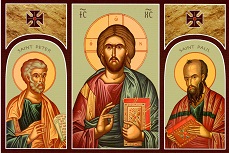
Sermon for the Principal Christmas Service
Text: John 1:1-14 (KJV)
Christ’s Titles of Honor; His Coming: His Incarnation; and the Revelation of His Glory
CHRIST’S TITLES OF HONOR AND HIS ATTRIBUTES
1. This is the most important of the Gospels of the church year, and yet it is not, as some think, obscure or difficult. For upon it is clearly founded the important article of faith concerning the divinity of Christ, with which all Christians ought to be acquainted, and which they are able to understand. Nothing is too great for faith. Therefore let us consider this Gospel lesson in the simplest manner possible, and not as the scholastics did with their fabricated subtleties, conceal its doctrine from the common people and frighten them away from it. There is no need of many fine and sharp distinctions, but only of a plain, simple explanation of the words of the text.
2. In the first place, we should know that all that the apostles taught and wrote, they took out of the Old Testament; for in it all things are proclaimed that were to be fulfilled later in Christ, and were to be preached, as Paul says in Rom. 1, 2: “God promised afore the Gospel of his son Jesus Christ through his prophets in the Holy Scriptures.” Therefore all their preaching is based upon the Old Testament, and there is not a word in the New Testament that does not look back into the Old, where it had been foretold.
Thus we have seen in the Epistle how the divinity of Christ is confirmed by the Apostle from passages in the Old Testament. For the New Testament is nothing more than a revelation of the Old. Just as one receives a sealed letter which is not to be opened until after the writer’s death, so the Old Testament is the will and testament of Christ, which he has had opened after his death and read and everywhere proclaimed through the Gospel, as it is declared in Rev. 5, 5, where the Lamb of God alone is able to open the book with the seven seals, which no one else could open, neither in heaven, nor on earth, nor under the earth.
I. CHRIST’S FIRST TITLE OF HONOR AND ATTRIBUTE: HE IS THE WORD.
3. That this Gospel may be clearer and more easily understood, we must go back to the passages in the Old Testament upon which it is founded, namely, the beginning of the first chapter of Genesis. There we read, Gen. 1, 1-3: “In the beginning God created the heavens and the earth, and the earth was waste and void; and darkness was upon the face of the deep; and the Spirit of God moved upon the face of the waters. And God said, Let there be light, and there was light,” etc. Moses continues how all things were created in like manner as the light, namely, by speaking of the Word of God. Thus: “And God said, Let there be a firmament.” And again: “God said, Let there be sun, moon, stars,” etc.
4. From these words of Moses it is clearly proved that God has a Word, through which or by means of which he spoke, before anything was created; and this Word does not and cannot be anything that was created, since all things were created through this divine utterance, as the text of Moses clearly and forcibly expresses it, when it says: “God said, Let there be light, and there was light.” The Word must therefore have preceded the light, since light came by the Word; consequently it was also before all other creatures, which also came by the Word, as Moses writes.
5. But let us go farther. If the Word preceded all creatures, and all creatures came by the Word and were created through it, the Word must be a different being than a creature, and was not made or created like a creature. It must therefore be eternal and without beginning. For when all things began it was already there, and cannot be confined in time nor in creation, but is above time and creation; yea, time and creation are made and have their beginning through it. Thus it follows that whatever is not temporal must be eternal; and that which has no beginning cannot be temporal; and that which is not a creature must be God. For besides God and his creatures there is nothing. Hence we learn from this text of Moses, that the Word of God, which was in the beginning and through which all things were made and spoken, must be God eternal and not a creature.
6. Again, the Word and he that speaks it, are not one person; for it is not possible that the speaker is himself the Word. What sort of speaker would he be who is himself the Word? He must needs be a mute, or the word must needs sound of itself without the speaker. But Scripture here speaks in strong and lucid words: “God said.” And thus God and His Word must be two distinct things.
If Moses had written: “There was an utterance,” it would not be so evident that there were two, the Word and the Speaker. But when he says: “God said,” and names the speaker and his word, he forcibly states that there are two: that the speaker is not the word, and the word is not the speaker, but that the word comes from the speaker, and has its existence not of itself but from the speaker. But the speaker does not come from the word, nor does he have his existence from it, but from himself. Thus, the words of Moses point conclusively to the fact that there are two persons in the Godhead from eternity, before all creatures, that the one has its existence from the other, and the first has its existence from nothing but itself.
7. Again, the Scriptures firmly and everlastingly maintain that there is only one God, as Moses begins, saying: “In the beginning God created the heavens and the earth.” And Deut. 6, 4, “Hear, 0 Israel; Jehovah our God is one God.” Thus the Scriptures proceed in simple, comprehensible words, and teach such exalted things so plainly that every one may well understand them, and so forcibly that no one can gainsay them. Who is there that cannot here understand from these words of Moses, that there must be two persons in the Godhead, and yet but one God, unless he wishes to deny the plain Scriptures?
8. Again, who is there so subtle as to be able to contradict this doctrine? He must distinguish or keep apart the Word from God, the speaker; and he must confess that it was before all creatures, and that the creatures were made by it. Consequently he must surely admit it to be God, for besides the creatures there is nothing but God; he must also admit that there is only one God. Thus the Scriptures forcibly conclude that these two persons are one perfect God, and that each one is the only true, real, and perfect God, who has created all things; that the Speaker has his being not from the Word, but that the Word has its being from the Speaker, yet he has his being eternally and from eternity, and outside of all creation.
9. The Arian heretics intended to draw a mist over this clear passage and to bore a hole into heaven, since they could not surmount it, and said that this Word of God was indeed God, not by nature, however, but by creation. They said that all things were created by it, but it had also been created previously, and after that all things were created by it. This they said from their own imagination without any authority from the Scriptures, because they left the simple words of the Scriptures and followed their own fancies.
10. Therefore I have said that he who desires to proceed safely on firm ground, must have no regard for the many subtle and hair-splitting words and fancies, but must cling to the simple, powerful, and explicit words of Scripture, and he will be secure. We shall also see how St. John anticipated these same heretics and refuted them in their subterfuges and fabrications.
11. Therefore we have here in the Books of Moses the real gold mine, from which everything that is written in the New Testament concerning the divinity of Christ has been taken. Here you may see from what source the gospel of St. John is taken, and upon what it is founded; and therefore it is easy to understand.
This is the source of the passage in Ps. 33, 6: “By the Word of Jehovah the heavens were made.” Solomon in beautiful words describes the wisdom of God, Prov. 3, 22, saying that this wisdom bad been in God before all things; and he takes his thoughts from this chapter of Moses. So almost all the prophets have worked in this mine and have dug their treasures from it.
12. But there are other passages by this same Moses concerning the Holy Ghost, as for example in Gen. 1,2: “And the Spirit of God moved upon the face of the waters.” Thus the Spirit of God must also be something different from him who breathes him into existence, sends him forth, and yet he must be before all creatures.
Again, Moses says in Gen. 1, 28-31: “God blessed the creatures, beheld them, and was pleased with them.” This benediction and favorable contemplation of the creatures point to the Holy Ghost, since the Scriptures attribute to him life and mercy. But these passages are not so well developed as those which refer to the Son; consequently they are not so prominent. The ore is still halfway in the mines, so that these passages can easily be believed, if reason is so far in subjection as to believe that there are two persons. If anyone will take the time and trouble to compare the passages of the New Testament referring to the Holy Ghost with this text of Moses, he will find much light, as well as pleasure.
13. Now we must open wide our hearts and understanding, so as to look upon these words not as the insignificant, perishable words of man, but think of them as being as great as he is who speaks them. It is a Word which he speaks of himself, which remains in him, and is never separated from him.
Therefore according to the thought of the Apostle, we must consider how God speaks with himself and to himself, and how the Word proceeds from within himself. However, this Word is not an empty sound, but brings with it the whole essence of the divine nature. Reference has been made in the Epistle to the brightness of his glory and the image of his person, which constitute the divine nature, so that it accompanies the image in its entirety and thus becomes the very image itself. In the same manner God of himself also utters his Word, so that the whole Godhead accompanies the Word and in its nature remains in, and essentially is, the Word.
14. Behold, here we see whence the Apostle has taken his language, when he calls Christ an image of the divine essence, and the brightness of divine glory. He takes it from this text of Moses, when he says that God spoke the Word of himself; this can be nothing else than an image that represents him, since every word is a sign which means something. But here the thing signified is by its very nature in the sign or in the Word, which is not in any other sign. Therefore he very properly calls it a real image or sign of his nature.
15. The word of man may also in this connection be used in a measure as an illustration; for by it the human heart is known. Thus we commonly say: I understand his heart or intentions, when we have only heard his words; as out of the fullness of the heart the mouth speaks, and from the word the heart is known, as though it were in the word. In consequence of this experience the heathen had a saying: Qualis quisque est talia loquitur. (As a man speaks, so is he). Again: Oratio est character animi (Speech is an image of the heart). When the heart is pure it utters pure words, when it is impure it utters impure words. With this also corresponds the gospel of Matthew, 12, 34, where Christ says: “Out of the abundance of the heart the mouth speaketh.” And again, “How can ye, being evil, speak good things?” Also John the Baptist says, John 3, 31: “He that is of the earth is of the earth, and of the earth he speaketh.” The Germans also have a proverb: “Of what the heart is full, overfloweth out of the mouth.” The bird is known by its song, for it sings according to its nature. Therefore all the world knows that nothing represents the condition of the heart so perfectly and so positively as the words of the mouth, just as though the heart were in the word.
16. Thus it is also with God. His word is so much like himself, that the Godhead is wholly in it, and be who has the word has the whole Godhead. But this comparison has its limits. For the human word does not carry with it the essence or the nature of the heart, but simply its meaning, or is a sign of the heart, just as a woodcut or a bronze tablet does not carry with it the human being, but simply represents it. But here in God, the Word does not only carry with it the sign and picture, but the whole being, and is as full of God as he whose word or picture it is. If the human word were pure heart, or the intention of the heart, the comparison would be perfect. But this cannot be; consequently the Word of God is above every word, and without comparison among all creatures.
17 There have indeed been sharp discussions about the inner word in the heart of man, which remains within, since man has been created in the image of God. But it is all so deep and mysterious, and will ever remain so, that it is not possible to understand it. Therefore we shall pass on, and we come, now to our Gospel, which is in itself clear and manifest.
“In the beginning was the Word.”
18. What beginning does the Evangelist mean except the one of which Moses says: “In the beginning God created the heavens and the earth?” That was the beginning and origin of creation. Other than this there was no beginning, for God had no beginning, but is eternal. It follows, therefore, that the Word is also eternal, because it did not have its origin in the beginning, but it was already in the beginning, John says. It did not begin, but when other things began it was already in existence; and its existence did not begin when all things began, but it was then already present.
19. How prudently the Evangelist speaks; for he does not say: “In the beginning the Word was made,” but it was there,” and was not made. The origin of its existence is different from the beginning of creation. Furthermore he says: “In the beginning.” Had he been made before the world, as the Arians maintain, he would not have been in the beginning, but he would have himself been the beginning. But John firmly and clearly maintains: “In the beginning was the Word,” and he was not the beginning. Whence has St. John these words? From Moses, Gen. 1, 3 “God said, Let there be light.” From this text evidently come the words: “In the beginning was the Word.” For if God spoke, there had to be a Word. And if he spoke it in the beginning, when the creation began, it was already in the beginning, and did not begin with the creation.
20. But why does he not say: Before the beginning was the Word? This would have made the matter clearer, as it would seem; thus St. Paul often says: Before the creation of the world, etc. The answer is, because, to be in the beginning, and to be before, the beginning, are the same, and one is the consequence of the other. St. John, as an Evangelist, wished to agree with the writings of Moses, wished to open them up, and to disclose the source of his own words, which would not have been the case had he said: “Before” the beginning. Moses says nothing of that which was before the beginning, but describes the Word in the beginning, in order that he can the better describe the creation, which was made by the Word. For the same reason he also calls him a word, when he might as well have called him a light, life or something else, as is done later; for Moses speaks of a word. Now not to begin and to be in the beginning are the same as to be before the beginning.
But if the Word had been in the beginning and not before the beginning, it must have begun to be before the beginning, and so the beginning would have been before the beginning, which would be a contradiction, and would be the same as though the beginning were not the beginning. Therefore it is put in a masterly way: In the beginning was the Word, so as to show that it has not begun, and consequently must necessarily have been eternal, before the beginning.
“And the Word was with God.”
21. Where else should it have been? There never was anything outside of God. Moses says the same thing when he writes: “God said, Let there be light.” Whenever God speaks the word must be with him. But here he clearly distinguishes the persons, so that the Word is a different person than God with whom it was. This passage of John does not allow the interpretation that God had been alone, because it says that something had been with God, namely, the Word. If he had been alone, why would he need to say: The Word was with God? To have something with him, is not to be alone or by himself.
It should not be forgotten that the Evangelist strongly emphasizes the little word “with.” For he repeats it, and clearly expresses the difference in persons to gainsay natural reason and future heretics. For while natural reason can understand that there is but one God, and many passages of Scripture substantiate it, and this is also true, yet the Scriptures also strongly oppose the idea that this same God is only one person.
22. Thus arose the heresy of Sabellius, who said: The Father, Son, and Holy Ghost are only one person. And again Arius, although he admitted that the Word was with God, would not admit that he was true God. The former confesses and teaches too great a simplicity of God; the latter too great a multiplicity. The former mingles the persons; the latter separates the natures. But the true Christian faith takes the mean, teaches and confesses separate persons and an undivided nature. The Father is a different person from the Son, but he is not another God. Natural reason can not comprehend this; it must be apprehended by faith alone. Natural reason produces error and heresy; faith teaches and maintains the truth; for it clings to the Scriptures, which do not deceive nor lie.
“And God was the Word.”
23. Since there is but one God, it must be true that God himself is the Word, which was in the beginning before all creation. Some change the order of the words and read: And the Word was God, in order to explain that this Word not only is with God and is a different person, but that it is also in its essence the one true God with the Father. But we shall leave the words in the order in which they now stand: And God was the Word; and this is also what it means; there is no other God than the one only God, and this same God must also essentially be the Word, of which the Evangelist speaks; so there is nothing in the divine nature which is not in the Word. It is clearly stated that this Word is truly God, so that it is not only true that the Word is God, but also that God is the Word.
24. Decidedly as this passage opposes Arius, who teaches that the Word is not God, so strongly it appears to favor Sabellius; for it speaks as though it mingled the persons, and thereby revokes or explains away the former passage, which separates the persons and says: The Word was with God.
But the Evangelist intentionally arranged his words so as to refute all heretics. Here therefore he overthrows Arius and attributes to the Word the true essential of the Godhead by saying: And God was the Word; as though he would say: I do not simply say, the Word is God, which might be understood as though the Godhead was only asserted of him, and were not essentially his, as you, Arius, claim; but I say: And God was the Word, which can be understood in no other way than that this same being which every one calls God and regards as such, is the Word.
Again, that Sabellius and reason may not think that I side with them, and mingle the persons, and revoke what I have said on this point, I repeat it and say again:
“The same was in the beginning with God.”
25. The Word was with God, with God, and yet God was the Word. Thus the Evangelist contends that both assertions are true: God is the Word, and the Word is with God; one nature of divine essence, and yet not one person only. Each person is God complete and entire, in the beginning and eternally. These are the passages upon which our faith is founded and to which we must hold fast. For it is entirely above reason that there should be three persons and each one perfect and true God, and yet not three Gods but one God.
26. The Scholastics have argued much pro and con with their numerous subtleties, to make this doctrine comprehensible. But if you do not wish to become entangled in the meshes of the enemy, ignore their cunning, arrogance, and subtleties, and hold to these divine words. Press into them and remain in them, like a hare in a rocky crevice. If you come out and deign to listen to human talk, the enemy will lead you on and overcome you, so that you will at last not know where reason, faith, God, or even yourself are.
27. Believe me, as one who has experienced and tried it, and who does not talk into an empty barrel; the Scriptures are not given us for naught. If reason could have kept on the right road, the Scriptures would not have been given us. Take an example in the case of Arius and Sabellius. Had they clung to the Scriptures and disregarded reason, they would not have originated so much trouble in the church. And our Scholastics might have been Christians, had they ceased fooling with their subtleties and had clung to the Scriptures.
“All things were made through him.”
28. Has this not been put clearly enough? Who would be surprised, if stubborn men reject every effort to convince them of their error, however plainly and earnestly the truth may be told them, when the Arians could evade this clear and explicit passage and say: All things are made by the Word, but the Word was itself first made, and afterwards all things were made by it? And this in opposition to the direct words: “All things were made through him.” And there is no doubt that he was not made and cannot be counted among the things that were made. For he who mentions all things excludes nothing, as St. Paul also explains Psalm 8, 6, when he says, in Heb. 2,8: “Thou didst put all things in subjection under his feet. For in that he subjected all things unto him, he left nothing that is not subjected to him.” Again, 1 Cor. 15, 27: “For he put all things in subjection under his feet. It is evident that be is expected who did subject all things unto him.”
So also the words, “All things were made through him,” must certainly be understood to except him by whom all things were made, and without whom is nothing that is made. This passage is also based upon the first chapter of Genesis, 1, 7, where all created things are mentioned which God had made, and in each case it is said: “And God said, and it was so,” in order to show that they were all made by the Word. But St. John continues and explains himself still more fully when he says:
“And without him was not anything made that hath been made.”
29. If nothing was made without him, much less is he himself made without whom nothing was made; accordingly the error of Arius should never have attracted any attention, and yet it did. There is no need of comment to explain that the Word is God and the real Creator of all created things since without him nothing was made that ever was made.
30. Some have been in doubt about the order of the words in this text; the words “that was made”, they take with the following words, in this way: “That which was made, was in him life.” Of this opinion was St. Augustine. But the words properly belong to the preceding words as I have given them, thus: “And without him was not anything made that hath been made.” He means to say that none of the things that art; made, are made without him; so that he may the more clearly express that all things were made through him, and that he himself was not made. In short, the Evangelist firmly maintains that the Word is true God, yet not of himself, but of the Father. Therefore we say: Made through him, and Begotten of the Father.
II. CHRIST’S SECOND TITLE AND ATTRIBUTE: IN HIM WAS LIFE.
31. On this passage there is generally much speculation, and it is often taken to mean something hard to understand in reference to the twofold existence of creation; in this the Platonic philosophers are famous. They maintain that all creation has its being first in its own nature and kind, as it was created. Secondly, all creation has its being in divine Providence from eternity, in that he has resolved in himself to create all things. Therefore as he lives so all things are living in him; and this creative existence in God, they say, is nobler than the existence in its own kind and nature. For in God things do live which in themselves have no life, as stones, earth, water, and the like.
And therefore Saint Augustine says that this Word is an image of all creation, and like a bed- chamber is hung with images which are called Ideas (Greek for images), according to which the created things were made, each one according to its own image. Concerning these John is to have said: “In him was life.” Then they connect these words with the preceding ones, thus: That which was made was life in him, that is, all that was ever created, before it was created, had its life in him.
32. But this is going too far and is a forced interpretation of this passage. For John speaks very simply and plainly, and does not mean to lead us into such hair-splitting, subtle contemplations. I do not know that the Scriptures anywhere speak of created beings in this way. They do say that all things were known, elected, and even ready and living in the sight of God, as though creation bad already taken place, as Christ says of Abraham, Isaac, and Jacob in Luke 20,38: “He (God) is not the God of the dead, but of the living; for all live unto him.” But we do not find it written in this sense that all things live in him.
33. This passage also implies something more than the life of the creature, which was in him before the world. It signifies in the simplest manner that he is the fountain and cause of life, that all things which live, live by him and through him and in him, and besides him there is no life, as he himself says in John 14, 6: “I am the way, the truth, and the life.” Again, John 11, 25: “I am the resurrection and the life.” Consequently John calls him in 1 John 1, 1. “The Word of Life;” and he speaks especially of the life which man receives by him, that is, eternal life; and it was for this very life that John set out to write his Gospel.
34. This is also apparent from the context For he himself explains the life of which he speaks, when he says: “And the life was the light of men.” By these words he undoubtedly shows that he speaks of the life and the light Christ gives to man through himself. For this reason also he refers to John the Baptist as a witness of that light. It is therefore evident how John the Baptist preached Christ, not in lofty terms of speculation, as some fable; but he taught in a plain, simple way how Christ is the light and the life of all men for their salvation.
35. Therefore it is well to remember that John wrote his Gospel, as the historians tell us, because Cerinthus, the heretic, arose in his day and taught that Christ did not exist before his mother Mary, thus making a simple human being or creature, of him. In opposition to this heretic he begins his Gospel in an exalted tone and continues thus to the end, so that in almost every letter he preaches the divinity of Christ, which is done by none of the other Evangelists. And so he also purposely introduces Christ as acting strangely towards his mother, and “Woman, what have I to do with thee?” he said to her in John 2, 4. Was not this a strange, harsh expression for a son to use in addressing his mother? So also on the cross he said: “Woman, behold thy son,”‘ John 19,26. All this he does in order to set forth Christ as true God over against Cerinthus; and this he does in language so as not only to meet Cerinthus, but also Arius, Sabellius and all other heretics.
36. We read also that this same pious John saw Cerinthus in a bathing-house and said to his followers: “Let us flee quickly hence that we be not destroyed with this man.” And after John had come out, the bathing-house is said to have collapsed and destroyed this enemy of the truth. He thus points and directs all his words against the error of Cerinthus, and says: Christ was not only before his mother, nay, he was in the beginning the Word of which Moses writes in the very beginning, and all things were made by him, and he was with God and the Word was God, and was in the beginning with God; and thus he strikes Cerinthus as with thunderbolts.
37. Thus we take the meaning of the Evangelist in this passage to be simply and plainly this: He who does not recognize and believe Christ to be true God, as I have so far described him, that he was the Word in the beginning with God, and that all things were made by him; but wishes to make him only a creature of time, coming after his mother as Cerinthus teaches, is eternally lost, and cannot attain to eternal life; for there is no life without this Word and Son of God; in him alone is life. The man Christ, separate from, and without, God, would be useless, as he says himself in John 6, 55, 63: “The flesh profiteth nothing. My flesh is meat indeed, and my blood is drink indeed.”
Why does the flesh profit nothing, and yet my flesh is the only true meat? The plain reason is, because I am not mere flesh and simply man, but I am God’s son. My flesh is meat not because it is flesh, but because it is my flesh. This is as much as to say: He who believes that I, who am man, and have flesh and blood like other men, am the Son of God, and God, finds in me true nourishment, and will live. But he who believes me to be only man, is not profited by the flesh, for to him it is not my flesh or God’s flesh.
He also says: “Ye shall die in your sins, except ye believe that I am he,” John 8, 24. Again: “If the son shall therefore make you free, ye shall be free indeed.” This is also the meaning of the following passage, “In him was life.” The Word of God in the beginning, who is himself God, must be our life, meat, light, and salvation. Therefore we cannot attribute to Christ’s human nature the power of making us alive, but the life is in the Word, which dwells in the flesh and makes us alive by the flesh.
38. This interpretation is simple and helpful. Thus St. Paul is wont to call the doctrine of the Gospel “doctrina pietatis,” a doctrine of piety–a doctrine that makes men rich in grace. However, the other interpretation which the heathen also have, namely, that all creatures live in God, does indeed make subtle disputants and is obscure and difficult; but it teaches nothing about grace, nor does it make men rich in grace. Wherefore the Scriptures speak of it as “idle.”
Just as we interpret the words of Christ, when he says: “I am the life,” so also should we interpret these words, and say nothing philosophically of the life of the creatures in God; but on the contrary, we should consider how God lives in us, and makes us partakers of his life, so that we live through him, of him, and in him. For it can not be denied that through him natural life also exists, which even unbelievers have from him, as St. Paul says: “In him we live, and move, and have our being; for we are also his offspring.” Acts 17,28.
39. Yes, natural life is a part of eternal life, its beginning, but on account of death it has an end, because it does not acknowledge and honor him from whom it comes; sin cuts it off so that it must die forever. On the other hand, those who believe in him, and acknowledge him from whom they have -their being, shall never die; but this natural life of theirs will be extended into eternal life, so that they will never taste death, as John says, 8, 51: “Verily, verily, I say unto you, if a man keep my word, he shall never see death.” And again, John 11, 25: “He that believeth on me, though he die, yet shall he live.” These and similar passages are well understood when we rightly learn to know Christ, how he has slain death and has brought us life.
40. But when the Evangelist says: “In him was life.” and not, “In him is life,” as though he spoke of things past, the words must not be taken to mean the time before creation, or the time of the beginning; for be does not say: “In the beginning life was in him,” as he has just before said of the Word, which was in the beginning with God; but these words on earth, when the Word of God appeared to men and among men; for the Evangelist proposes to write about Christ and that life in which he accomplished all things necessary for our life. Just as he says of John the Baptist: “There came a man, sent from God;” and again: “He was not the Light, etc.;” even so he afterward speaks of the Word: “And the Word became flesh, and dwelt among us;” “He was in the world;” “He came unto his own, and they that were his own received him not,” etc. In the same manner does Christ also speak of John the Baptist: “He was the lamp that burneth and shineth,” John 5,35.
41. So he says also, here : “In him was life;” and Christ also says of himself: “When I am in the world, I am the light of the world,” John 9, 5. The words of the Evangelist therefore simply refer to the sojourn of Christ on earth. For as I said at first, this Gospel is not as difficult as some think; it has been made difficult by their looking for great, mysterious, and mighty things in it. The Evangelist has written it for ordinary Christians, and has made his words perfectly intelligible. For whoever will disregard the life and sojourn of Christ upon earth, and will wish to find him in some other way, as he now sits in heaven, will always fail. He must look for him as he was and as he sojourned on earth and he will then find life. Here Christ was made our life, light and salvation; here all things occurred that we are to believe concerning him. It has really been said in a most befitting manner: “In him was life,” not, that he is not our life now, but that he does not now do that which he then did.
42. That this is the meaning can be seen from the words of the text when it says: “John the Baptist came for witness, that he might bear witness of the light, that all might believe through him.” It is sufficiently clear that John came solely to bear witness of Christ, and yet he has said nothing at all of the life of the creatures in God supporting the above philosophical interpretation; but all his teaching and preaching were concerning the life of Christ upon earth, whereby he became the Life and Light of men. Now follows:
III. CHRIST’S THIRD TITLE OF HONOR AND ATTRIBUTE: HE WAS THE LIGHT.
A. Christ was the light of men.
“And the Life was the Light of men.”
43. Just as the word “life” was interpreted differently from the meaning intended by the Evangelist, so was also the word “light.” There has been much foolish speculation as to how the Word of God in its divinity could be a light, which naturally shines and has always given light to the minds of men even among the heathen. Therefore the light of reason has been emphasized and based upon this passage of Scripture.
44. These are all human, Platonic, and philosophical thoughts, which lead us away from Christ into ourselves; but the Evangelist wishes to lead us away from ourselves into Christ. For he would not deal with the divine, almighty and eternal Word of God, nor speak of it, otherwise than as flesh and blood, that sojourned upon earth. He would not have us diffuse our thoughts among the creatures which he has created, so as to pursue him, search for him, and speculate about him as the Platonic philosophers do; but he wishes to lead us away from those vague and highflown thoughts and bring us together in Christ.
The Evangelist means to say: Why do you make such extensive excursions and search for him so far away? Behold, in the man Christ are all things. He has made all things; in him is life, and he is the Word by whom all things were made. Remain in him and you will find all; he is the life and the light of ail men. Whoever directs you elsewhere, deceives you. For he has offered himself in this flesh and blood, and he must be sought and will be found there. Follow the testimony of John the Baptist; he will show you no other life or light than this man, who is God himself. Therefore this light must mean the true light of grace in Christ, and not the natural light, which also sinners, Jews, heathen, and devils have, who are the greatest enemies of the light.
45. But let no one accuse me of teaching differently from St. Augustine, who interpreted this text to mean the natural light. I do not reject that interpretation, and am well aware that all the light of reason is ignited by the divine light; and as I have said of the natural life, that it has its origin in, and is a part of, the true life, when it has come to the right knowledge, so also the light of reason has its origin in, and is part of, the true light, when it recognizes and honors him by whom it has been ignited.
It however does not do this of itself, but remains separate and by itself, becomes perverted, and likewise perverts all things; therefore it must become extinguished and die out. But the light of grace does not destroy the natural light. To the light of nature it is quite clear that two and three make five. That the good is to be encouraged and the evil avoided is also clear to it; and thus the light of grace does not extinguish the light of nature, but the latter never gets so far as to be able to distinguish the good from the evil. It is with him as one who wishes to go to Rome with Rome behind his back; for he himself well knew that whoever would go to Rome must travel the right way, but he knew not which was the right road. So it is also with the natural light; it does not take the right road to God, nor does it know or recognize the right way, although it knows well that one must get on the right road. Thus reason always prefers the evil to the good; it would never do this if it fully realized with a clear vision that the good only should be chosen.
46. But this interpretation is out of place in this connection, because only the light of grace is preached here. St. Augustine was only a man, and we are not compelled to follow his interpretation, since the text here clearly indicates that the Evangelist speaks of the light of which John the Baptist bore witness, which is ever the light of grace, even Christ himself.
47. And since this is an opportunity, we shall further describe this deceptive natural light, which causes so much trouble and misfortune. This natural light is Ike all the other members and powers of man. Who doubts that man with all his powers has been created by the eternal Word of God like all other things, and is a creature of God? But yet there is no good in him, as Moses says, Gen. 6,5: “Every imagination of the thoughts of man’s heart was only evil continually.”
48. Although the flesh was created by God, yet it is not inclined to chastity, but to unchastity. Although the heart was created by God, it is not inclined to humility, nor to the love of one’s neighbor, but to pride and selfishness, and it acts according to this inclination, where it is not forcibly restrained. So it is with the natural light; although it is naturally so bright as to know that only good is to be done, it is so perverted that it is never sure as to what is good; it calls good whatever is pleasing to itself, is taken up with it, and only concludes to do what it has selected as good. Thus it continues to pursue the evil instead of the good.
49. We shall prove this by examples. Reason knows very well that we ought to be pious and serve God; of this it knows how to talk, and thinks it can easily beat all the world. Very well, this is true and well said; but when it is to be done, and reason is to show how and in what way we are to be pious and serve God, it knows nothing, is purblind, and says one must fast, pray, sing, and do the works of the law; it continues to act the fool with works, until it has gone so far astray as to imagine that people are serving God in building churches, ringing bells, burning frankincense, whining, singing, wearing hoods, shaving their heads, burning candles, and other innumerable tomfoolery, of which all the world is now full and more than full. In this monstrously blind error reason continues, even while the bright light shines on, that enjoins piety and service to God.
50. When now Christ, the light of grace, comes and also teaches that we are to be pious and serve God, he does not extinguish this natural light, but opposes the way and manner of becoming pious and serving God as taught by reason. He says: To become pious is not to do works; no works are good without faith.
51. Then begins the fight. Reason rises up against grace, and cries out against its light, accuses it of forbidding good works, protests against not having its own way and standard of becoming pious, being thus set aside; but continually rages about being pious and serving God, and so makes the light of grace foolishness, nay error and heresy, and persists in persecuting and banishing it. See, this is the virtue of the light of nature, that it raves against the true light, is constantly boasting of piety, piety, and is always crying “Good works!” “Good works!” but it can not and will not stand to be taught what piety is and what good works are; it insists that which it thinks and proposes must be right and good.
52. Behold, here then you have the cause and origin of all idolatry, of all heresy, of all hypocrisy, of all error, of which all the prophets have spoken, on account of which they were killed, and against which all the Scriptures protest.
All this comes from the stubborn, self-willed arrogance and delusion of natural reason, which is self-confident and puffed up because it knows that we ought to be pious, and serve God; it will neither listen to, nor suffer, a teacher to teach them, thinks it knows enough, and would find out for itself what it is to be pious and serve God, and how it may do so. Therefore divine truth cannot and must not submit to reason; for this would be the greatest mistake and be contrary to God’s honor and glory. In this way contentions and tribulations arise.
53. Therefore it is clear, I think, that John does not speak here of the false light, nor of that bright natural light, which rightly claims that we must be pious, for it is already here, and Christ did not come to bring it, but to dim and blind this false, selfwilled arrogance, and to set in its place the light of grace, to wit, faith. And this also the words themselves indicate when they say: “The life was the light of men.” If it is the light of men, it must be a different light from the one that is in men, since man already has the light of nature in him, and whatever enlightens man, enlightens the light of nature in man, and brings another light, which surpasses the light that is in man.
He does not say, that it is the light of irrational animals, but of man, who is a rational being. For there is not a man found in whom there is not the natural light of reason, from which cause alone he is called man and is worthy to be a man. If the Evangelist would have us understand by this light the natural light of reason, he would have said: The life was a light of darkness; as Moses writes in Gen. 1, 2: “And darkness was upon the face of the deep.” Therefore this light must be that which was revealed in Christ on earth.
54. Notice also the order of the words. John puts the Life before the Light. He does not say: “The light was the life of men;” but on the contrary: “The life was the light of men;” for the reason that in Christ there is reality and truth, and not simply appearance as in men. St. Luke speaks of Christ’s external life thus, 24, 19: “He was a prophet mighty in deed and word;” and Acts 1, 1: “Jesus began both to do and teach,” where “doing” precedes the “teaching”; for where there is only teaching without doing there is hypocrisy. Thus John says of John the Baptist, “He was the lamp that burneth and shineth,” John 5, 35; for to be simply shining and not burning is deceptive. In order, therefore, that Christ may here also be recognized as the true, unerring light, John says that all things were life in him, and this same life afterwards was the light of men.
55. It follows then that man has no other light than Christ, God’s son in the flesh. And whosoever believes that Christ is true God, and that in him is life, will be illumined and quickened by this life. The light supports him, so that he may remain where Christ is. As the Godhead is an eternal life, this same light is an eternal light; and as this same life can never die so also this light can never be extinguished; and faith in it cannot perish.
56. We may also especially notice that the Evangelist assigns life to Christ, as the eternal Word, and not to Christ the man; for he says: “In him,” eminently in the Word, “was the life.” Although Christ died as man, yet he ever remained alive; for life could not and cannot die; and consequently death was overcome and was swallowed up in life, so much so that his humanity soon again became alive.
This same Life is the light of men; for he who recognizes and believes in such a life in Christ, indeed passes through death, yet never dies, as has been stated above. For this Light of life protects him, so that death cannot harm him. Although the body must die and decay, the soul will not feel this death, because it is in that light, and through that light, that it is entirely comprehended in the life of Christ. But he who does not believe this, remains in darkness and death; and although his body is united to him, even as it will be forever at the day of judgment, yet the soul will nevertheless taste and feel death, and will die eternally.
57. From this we may realize how great was the harm which Cerinthus threatened, and which all do who believe and teach that Christ is only man and not true God. For his humanity would profit us nothing if the divinity were not in it. Yet, on the other hand, God will not and cannot be found, save through and in his humanity, which he has set up as an ensign for the nations, gathering together the dispersed of Judah from the four corners of the earth, Is. 11, 12.
58. See now, if you will believe that in Christ there is such life that remains even in death, and has overcome death, this light will lighten you aright, and will remain a light and life within you even at the time of your death. It follows then that such Life and Light cannot be mere creatures, for no creature can overcome death, either in itself or in another. Behold, how easy and becoming this interpretation of the light is, and how much better it is for our salvation; but how very far they are from it who wish to make of this light only the natural light of reason. For this latter light does not improve any one, nay, it leads only farther away from Christ into creation and to false reason. We must enter into Christ, and not look at the lights which come from him, but gaze at his light, which is the origin of all lights. We must follow the streams which lead to the source and not away from it.
B. Christ was the light that shineth in the darkness.
“And the light shineth in the darkness and the darkness apprehended it not.”
59. This passage has also been interpreted with such lofty ideas, and made to mean that reason has a natural light, as I have just mentioned, and that the same is kindled by God; and yet reason does not recognize, understand, nor feel him, the real Light, by whom it is kindled; therefore it is in darkness, and does not behold the Light from which nevertheless it receives all its vision.
60. 0, that this interpretation, that reason has a natural light, were rooted out of my heart! How deeply it is seated there. Not that it is false or wrong in itself, but because it is out of place and untimely in this Gospel connection, and it will not allow these blessed and comforting words of the Gospel to remain simple and pure in their true meaning. Why do they not thus speak also of the natural life? For even the natural life is surely quickened by the divine life, just as much as the light of reason is kindled by the divine light.
They might just as well say that life quickens the dead and the dead apprehend it not, as to say that the light illumines dark reason and reason apprehends it not. I might also say that the eternal will makes the unwilling willing, and the unwilling do not apprehend it; and in like manner we might speak of all our other natural gifts and powers. But how does reason and its light fall on such speculations? The Platonic philosophers with their useless and senseless prating first led Augustine to his interpretation. The glitter was so fascinating that they were even called the divine philosophers. Augustine then carried us all with him.
61. What more can their talk teach than this, that reason is illumined by God, who is inconceivable and incomprehensible light? Just so life is given by God, who is inconceivable life, and all our powers are made powerful by God, who is inconceivable power. And as he is near to the light of reason with his inconceivable life, and to the powers with his inconceivable power, as St. Paul says, “In him we live, and move, and have our being”, Acts 17,28. Again, “Am I a God at hand, saith Jehovah, and not a God afar off? Do not I fill heaven and earth?” Jer. 23,23.24.
Thus we have just heard in the Epistle that “He upholds all things by the word of his power,” Heb. 1, 3. Therefore he is not only near to the light of reason and illumines it, but he is near also to all creatures, and flows and pours into them, shines and works in them, and fills all things. Accordingly we are not to think that St. John speaks here of the light of reason; he simply sets mankind before him, and tells what kind of light they have in Christ, aside from and above the light of nature.
62. It is also a blind and awkward expression to say of the natural light that the darkness apprehended it not. What else would this be than to say that reason is illumined and kindled by the divine light, and yet, remains in darkness and receives no light? Whence comes this natural light? There can never be darkness where a light is kindled; although there is darkness from the want of the light of grace. But here they are not speaking of the light of grace, and so they can not refer to like or spiritual darkness. Therefore it is a contradiction of terms to say that the light illumined the darkness, and the darkness apprehended it not, or the darkness remained. One might as well say that life is given to a dead person, and the dead person does not apprehend it nor receive it, but remains dead.
63. But if some one should say that we are not able to apprehend him who gives light and life, then I really hear, what angel does apprehend him? What saint apprehends the one who offers him grace? Verily he remains concealed and unapprehended: but this does not mean, as the Evangelist here says, that the Light is not apprehended in darkness; but as the words read, it means: The Light shineth into the darkness, but the darkness remains darkness and is not illuminated; the Light shines upon the darkness, and yet the darkness remains; just as the sun shines upon the blind, and yet they do not perceive it. Behold how many words I must waste in order to remove this foreign and false interpretation of our text!
64. Therefore let us cling to the simple meaning the words convey when we do no violence to them. All who are illumined by natural reason apprehend the light, each one being illumined according to his talent and capacity. But this Light of grace, which is given to men aside from and above the natural light, shines in darkness, that is, among men of the world, who are blind and without grace; but they do not accept it, yea, they even persecute it. This is what Christ means when he says, John 3, 19: “And as this is the judgment, that the light is come into the world, and men loved the darkness rather than the light.” Behold, Christ was upon earth and among men before he was publicly preached by John the Baptist; but no one took notice of him. He was the Life and Light of men. He lived and did shine; yet there was nothing but darkness, and the darkness did not perceive him. Everybody was worldly blind and benighted. Had they apprehended who he was, they would have given him due honor, as St. Paul says: “Had the rulers of this world known the wisdom of God, they would not have crucified the Lord of glory,” 1 Cor. 2, 8.
65. Thus Christ has always been the Life and Light, even before his birth, from the beginning, and will ever remain so to the end. He shines at all times in all creatures, in the Holy Scriptures, through his saints, prophets, and ministers, in his word and works; and he has never ceased to shine. But in whatever place he has shone, there was great darkness, and the darkness apprehended him not.
66. St. John may have indeed directed these words thus against the followers of Cerinthus, so that they saw the plain Scriptures and the truth that enlightened them, yet they did not apprehend their darkness. So it is at all times, and even now. Although the Scriptures are explained to blind teachers so that they may apprehend the truth, yet they do not apprehend it, and the fact remains that the light shineth in the darkness and the darkness apprehends it not.
67. It is especially to be observed that the Evangelist here says the light shineth, phaenei, that is, it is manifest and present to the eyes in the darkness. But he who receives nothing more from it remains in darkness; just as the sun shines for the blind man, but he does not on that account see any better. So it is the nature of this light that it shines in darkness, but the darkness does not on that account become brighter. In believers, however, it not only shines, but it makes them transparent and seeing, it lives in them, so that it can properly be said that “The life is the light of men.” On the other hand, light without life is a shining of darkness; therefore no light is of any use to unbelievers, for however clear the truth is presented and shown to them, they still remain in darkness.
68. Let us then understand all these sayings of the Evangelist as common attributes and titles of Christ, which he wishes to have preached in the Church as a preface and introduction of that which he proposes to write of Christ in his whole Gospel, namely, that he is true God and true man, who has created all things, and has been given to man as Life and Light, although but a few of all those to whom he is revealed receive him.
This is what our Gospel lesson contains and nothing more. In the same manner St. Paul also composes a preface and introduction to his Epistle to the Romans, Rom. 1, 1. Now follows the actual beginning of this Gospel:
C. Christ Was the Light of Which John Bore Witness
“There came a man, sent from God, whose name was John.”
69. St. Mark and St. Luke also begin their gospels with John the Baptist, and they should begin with him; as Christ himself says: “From the days of John the Baptist until now the kingdom of heaven suffereth violence,” Math. 11, 12. And St. Peter says that Jesus began from the baptism of John, by whom he was also called and ordained to be a minister, Acts 1, 22. And St. John the Baptist himself testifies, “I have beheld the Spirit descending as a dove out of heaven,” John 1, 32, and he heard the Father’s voice saying. “This is my beloved Son, in whom I am well pleased,” Math. 3,17. Then Christ was made a teacher, and his public ministry began; then only began the Gospel of Christ. For no one except Christ himself was allowed to begin the exalted, blessed, comforting mission of the Word. And for his sake John must first come and prepare the people for his preaching, that they might receive the Life and the Light.
70. For, as we have heard, Christ is everywhere the Light which shines in the darkness and is not apprehended; so he was especially and bodily in his humanity present among the Jews, appeared to them; but he was not recognized by them. Therefore his forerunner, John, came for the sole purpose of preaching him, in order that he might be recognized and received. This passage therefore fittingly follows the former one. Since Christ, the shining Light, was not recognized, John came to open the eyes of men and to bear witness of the ever present, shining light, which afterwards was to be received, heard, and recognized itself without the witness of John.
71. It is my opinion that we have now passed through the most difficult and most glorious part of this Gospel; for what is said henceforth is easy, and is the same as that which the other Evangelists write of John and of Christ. Although, as I have said, this part is in itself not difficult, yet it has been purposely made so by natural and human interpretations. A passage naturally becomes difficult when a word is taken from its ordinary meaning and given a strange one. Who would not wish to know what a man is, and would not imagine all manner of wonderful things, if he were told that a man is something different from what all the world thinks? This is what happened here to the clear, simple words of the Evangelist.
72. Still John uses a peculiar style, since he always, because of Cerinthus, directs the testimony of John the Baptist to the divinity of Christ, which is not done by the other Evangelists, who only refer to Christ, without especially emphasizing his divinity. But here he says, John came to bear witness of the Light, and to preach Christ as the Life, the Light, and as God, as we shall hear.
73. What, therefore, was said about John the Baptist in Advent, is also to be understood here, namely that, like as he came before Christ and directed the people to him, so the spoken word of the Gospel is simply to preach and point out Christ. It was ordained by God for this purpose alone, just as John was sent by God. We have also heard that John was a voice in the wilderness, signifying by his office the oral preaching of the Gospel. Since the darkness was of itself unable to apprehend this Light, although it was present, John must needs reveal it and bear witness of it. And even now the natural reason is not able of itself to apprehend it, although it is present in all the world: the oral word of the Gospel must reveal it and proclaim it.
74. We see now that through the Gospel this light is brought to us, not from a distance, nor do we need to go far to obtain it; it is very near us and shines in our hearts; nothing more is needed than that it be pointed out and preached. And he who now hears it preached, and believes, finds it in his heart; for as faith is only in the heart, so also this light is alone in faith. Therefore I say it is near at hand and within us, but of ourselves we cannot apprehend it; it must be preached and believed. This is also what St. Paul means when he says, referring to Deut. 30,11-14: “Say not in thine heart, Who shall ascend into heaven? (that is, to bring Christ down), or, Who shall descend into the deep? (that is, to bring Christ up from the dead). But what saith it? The word is nigh thee, in thy mouth, and in thy heart; that is, the word of faith, which we preach.” Rom. 10, 6-8. Behold this is the light which shineth in darkness, and is not recognized until John and the Gospel come and reveal it. Then man is enlightened by it, and apprehends it; and yet it changes neither time, nor place, nor person, nor age, but only the heart.
75. Again, as John did not come of himself, but was sent by God, so neither the Gospel nor any sermon on this Light can come of itself or from human reason; but they must be sent by God. Therefore the Evangelist here sets aside all the doctrines of men; for what men teach will never show Christ, the Light, but will only obstruct it. But whatsoever points out Christ is surely sent by God, and has not been invented by man. For this reason the Evangelist mentions the name and says: His name was John. In Hebrew John means grace or favor, to signify that this preaching and message was not sent on account of any merit of ours; but was sent purely out of God’s grace and mercy, and brings to us also God’s grace and mercy. Thus St. Paul says: “How shall they preach, except they be sent?” Rom. 10, 15.
76. From all this we learn that the Evangelist speaks of Christ in a manner that he may be recognized as God. For if he is the light which is everywhere present and shines in darkness, and it needs nothing more than that it be revealed through the Word, and recognized in the heart through faith, it must surely be God. No creature can to such a degree be so near in all places, and shine in all hearts. And yet the Light is God in a way as to be still man, and be preached in and by man. The words follow:
” The same came for witness, that he might bear witness of the Light, that all might believe through him.”
77. From what has now been said, it is clear that the Gospel proclaims only this Light, the man Christ, and causes the darkness to apprehend it, yet not by reason or feeling, but by faith. For he says: “That all might believe through him.” Again: “He came for a witness, that he might bear witness.” The nature of bearing witness is that it speaks of that which others do not see, know, or feel; but they must believe him that bears testimony. So also the Gospel does not demand a decision and assent according to reason, but a faith which is above reason, for in no other way can this light be recognized.
78. It was said plainly enough above, in what way the light of reason is in conflict with and rages against this Light, to say nothing of its being adhered to or apprehended by it. For it is positively written: “The darkness apprehendeth the light not;” therefore reason with its light must be taken captive and blinded; as is said in Isaiah, 60,19: “The sun,” that is, thy reason, “shall be no more thy light by day; neither for brightness shall the moon give light unto thee; but Jehovah will be unto thee an everlasting light and thy God thy glory,” that is, through the Gospel or Word of God, or through the witness of John, which demands faith, and makes a fool of reason. Consequently witness is borne of this Light through the Word, that reason may keep silent and follow this testimony; then it will apprehend the Light in faith, and its darkness will be illumined. For if reason were able to apprehend this Light of itself, or adhere to it, there would be no need of John or his testimony.
79. Therefore the aim of the Gospel is to be a witness for reason’s sake, which is self-willed, blind and stubborn. The Gospel resists reason and leads it away from its own light and fancy to faith, through which it can apprehend this living and eternal Light.
“He was not the Light, but came that he might bear witness of the Light.”
80. Dearly beloved, why does he say this, and repeat the words that John was only a witness of the Light? 0, what necessary repetition! First of all to show that this Light is not simply a man, but God himself ; for, as I have said, the Evangelist greatly desires to preach the divinity of Christ in all his words. If John, the great Saint, be not that Light, but only a witness of it, then this Light must be something far different from everything that is holy, whether it be man or angel. For if holiness could make such a light, it would have made one of John. But it is above holiness, and must therefore be above the angels, who are not more than holy.
81. In the second place, to resist wicked preachers of man, who do not bear witness of Christ, the Light, but of themselves. For it is true indeed, that all who preach the doctrines of men make man the light, lead men away from God to themselves, and set themselves up in the place of the true Light, as the pope and his followers have done. Therefore he is the Antichrist, that is, he is against Christ, the true Light.
82. This gospel text allows of no other doctrine beside it; it desires only to testify of Christ and lead men to him, who is the Light. Therefore, 0 Lord God, these words, “He was not the Light,” are truly worthy to be capitalized and to be well remembered against the men who set themselves up as the light and give to men doctrines and laws of their own fabrication. They pretend to enlighten men, but lead them with themselves into the depths of hell; for they do not teach faith, and are not willing to teach it; and no one teaches it except John, who is sent of God, and the holy Gospel. Truly much could be said on this point.
83. In short, he who does not preach the Gospel to you, reject and refuse to hear him. He, however, preaches the Gospel who teaches you to believe and trust in Christ, the eternal Light, and not to build on any of your own works. Therefore beware of everything told you that does not agree with the Gospel; do not put your trust in it, nor accept it as something external, as you regard eating and drinking, which are necessary for your body, and which you may use at your pleasure or at the pleasure of another; but by no means as something necessary to your salvation. For this purpose nothing is necessary or of use to you except this Light.
84. 0, these abominable doctrines of men, which are now so prevalent and which have almost banished this Light! They all wish to be this light themselves, but not to be witnesses of it. They advocate themselves and teach their own fancies, but are silent about this Light, or teach it in a way as to preach themselves along with it. This is worse than to be entirely silent; for by such teaching they make Samaritans who partly worship God and partly worship idols, 2 Kings 17,33.
D. He Was the Light That Lighteth Everyone.
“There was the true Light, which lighteth every man, coming into the world.”
85. Neither John nor any saint is the Light; but John and all evangelical preachers testify of the true Light. For the present enough has been said of this Light, what it is, how it is recognized by faith, and how it supports us eternally in life and death, so that no darkness can ever harm us. But what is remarkable is, that he says: “It lighteth every man, coming into the world.” If this be affirmed of the natural light it would be contradicted when he says that it is: “the true Light.” He had said before: “The darkness apprehends it not”; and all his words are directed toward the Light of grace. Then follow the words: “He was in the world, and the world knew him not,” and “His own received him not.” But he whom the true Light lighteth, is illumined by grace, and recognizes the Light.
86. Again, that he does not speak of the light of grace is evident when he says: “It lighteth every man, coming into the world.” This manifestly includes all men who are born into the world. St. Augustine says it means that no man is illumined except by this Light; it is the same as though we were to say of a teacher in a place where there is no other teacher: This teacher instructs all the city, that is, there is no other teacher in that city; he instructs all the pupils. By it is not said that he teaches all the people in the city, but simply that he is the only teacher in the city, and none are taught but by him.
So here the Evangelist would have us know that John is not the Light, nor any man, nor any creature; but that there is only one Light that lighteth all men, and that no man comes into the world who can possibly be illumined by any other light.
87. And I cannot reject this interpretation; for St. Paul also speaks in like manner in Rom. 5, 18: “As through one trespass the judgment came unto all men to condemnation; even so through one act of righteousness the free gift came unto all men unto justification of life.” Although all men are not justified through Christ, he is, nevertheless, the only man through whom justification comes.
So it is also here. Although all men are not illumined, nevertheless this is the only light through which all illumination comes. The Evangelist has used this manner of speech freely, and had no fear that some might take offense because he says “all men.” He thought he would anticipate all such offense, and explains himself before and afterwards, and says: “The darkness apprehended him not, and his own received him not.” These words are sufficient proof to prevent anyone from saying that the Evangelist meant to say that all men are illumined; but he did wish to say that Christ is the only Light that lighteth all men, and without him no man is lighted.
88. If this were said of the natural light of reason, it would have little significance, since it not only enlightens all men who come into the world, but also those who go out of the world, and even devils. For this light of reason remains in the dead, in devils, and in the condemned, yea, it becomes brighter, that they may be all the more tormented by it. But since only human beings who come into this world are mentioned, the Evangelist indicates that he is speaking of the Light of faith, which lightens and helps only in this life; for after death no one will be illumined by it. The illuminating must take place in this life through faith in the man Christ, yet by his divinity. After this life we shall clearly see his divinity without the humanity and without faith.
89. Therefore the Evangelist is careful to form his words so as not by any means to reject the man Christ, and yet so as to declare his divinity. For this reason it was necessary for him to say “all men,” so as to preach only one light for all, and to warn us not to accept in this life the lights of men or any other lights.
One man is not to lighten another, but this light alone is to lighten all men; and ministers are to be only forerunners and witnesses of this Light to men, that all may believe in this Light.
Therefore, when he had said: “Which lighteth every man,” he realized that he had said too much, and so he added: “coming into the world,” so that he might make Christ the Light of this world. For in the world to come this light will cease and will be changed into eternal glory, as St. Paul says: “When he shall deliver up the kingdom to God,” I Cor. 15,24; but now he rules through his humanity. When he delivers up the kingdom, he will also deliver up the Light; not as though there were two kinds of light, or as though we were to see something different from what we now see; but we shall see the same Light and the same God we now see in faith, but in a different manner. Now we see him in faith darkly, then we shall see him face to face. just as though I beheld a gilded picture through a colored glass or veil, and afterwards looked at it without these. So also St. Paul says: “Now we see in a mirror, darkly; but then face to face,” 1 Cor. 13,12.
90. Behold, you now know of what the Evangelist speaks, when he says that Christ is the Light of men through his humanity, that is, in faith, by means of which his divinity is reflected as by a mirror, or is seen as in a glass or as the sun shines through bright clouds. But let us remember that the Light is attributed to his divinity, not to his humanity; and yet his humanity, which is the cloud or curtain before the Light, must not be thought lightly of.
91. This language is sufficiently plain and he who has faith understands very well what is the nature and character of this Light. It matters not if he who does not believe does not understand it. He is not to understand it, for it is better that he knew nothing of the Bible and did not study it, than that he deceive himself and others with his erroneous light; for he imagines it to be the light of Scripture, which, however, cannot be apprehended without true faith. For this Light shines in the darkness, but is not apprehended by it.
92. This passage may also mean that the Evangelist has in mind the preaching of the Gospel and of faith in all the world, and so that this Light shines upon all men throughout the world, just as the sun shines upon all men. St. Paul says: “Be not moved away from the hope of the Gospel which ye heard, which was preached in all creation under heaven,” Col. 1, 23. Christ himself says: “Go ye into all the world, and preach the Gospel to the whole creation,” Mark 16,15. The Psalmist also says: “His going forth is from the end of the heavens, and his circuit unto the ends of it; and there is nothing hid from the heat thereof,” Ps. 19, 6. How this is to be understood has been explained in the sermon on the Epistle for Christmas. Is. 9, 2.
93. By this easy and simple interpretation we can readily understand how this Light lighteth every man, coming into the world, so that neither Jews nor anyone else should dare to set up their own light anywhere. And this interpretation is well suited to the preceding passages. For even before John or the Gospel bore witness of the Light, it had shone in darkness and the darkness apprehended it not; but after it has been proclaimed and publicly witnessed to, it shines as far as the world extends, unto all men, although all men will not receive it; as follows:
II. THE COMING OF CHRIST.
“He was in the world, and the world was made through ,him, and the world knew him not.”
94. All this is said of Christ as man and refers especially to the time after his baptism, when he began to give light according to John’s testimony. He was ever in the world. But what place of the world knew it? Who received him? He was not even received by those with whom he was personally associated, as the following shows:
“He came unto his own, and they that were his own received him not.”
95. This also is said of his coming as a preacher, and not of his being born into the world. For his coming is his preaching and illumining. The Baptist says: “He it is who coming after me is preferred before me, the latchet of whose shoe I am not worthy to unloose,” Math. 3, 11; Luke 3, 16; Mark 1, 7; John 1, 27. On account of this coming John is also called his forerunner, as Gabriel said to his father Zacharias: “He shall go before his face in the spirit and power of Elijah; to make ready for the Lord a people prepared for him,” Luke 1, 17. For, as has been said, the Gospels begin with the baptism of Christ. Then he began to be the Light and to do that for which he came. Therefore it is said that he came into the world to his own people and his own received him not. If this were not said of his coming to give light by preaching, the Evangelist would not thus reprove them for not having received him.
96. Who could know that it was he, if he had not been revealed? Therefore it is their fault that they did not receive him; for he came and was revealed by John and by himself. Therefore John says, “That he should be made manifest to Israel, for this cause came I baptizing with water,” John 1, 31. And he says himself, “I am come in my Father’s name, and ye receive me not; if another shall come in his own name, him ye will receive,” John 5, 43. This is also evidently said of the coming of his preaching and of his revelation.
97. He calls the Jews his own people because they were chosen out of all the world to be his people, and he had been promised to them through Abraham, Isaac, Jacob and David. For to us heathens or Gentiles there was no promise of Christ. Therefore we are strangers and are not called “his
Page 209 —————————
own”; but through pure grace we have been adopted, and have thus become his people; though, alas, we also allow him to come daily through the Gospel and do not esteem him. Therefore we must also suffer that another, the Pope, comes in his place and is received by us. We must serve the bitter foe because we will not serve our God.
98. But we must not forget in this connection that the Evangelist refers twice to the divinity of Christ. First, when he says: “The world was made through him.” Secondly, when he says: “He came unto his own.” For it is the nature only of the true God to have his own people. The Jews were always God’s own people as the Scriptures frequently declare. If then they are Christ’s own people, be must certainly be that God to whom the Scriptures assign that people.
99. But the Evangelist commends to every thoughtful person for consideration, what a shame and disgrace it is that the world does not recognize its Creator, and that the Jewish people do not receive their God. In what stronger terms can you reprove the world than by saying that it does not know its Creator? What base wickedness and evil report follow from this fact alone! What good can there be where there is nothing but ignorance, darkness and blindness? What wickedness where there is no knowledge of God! 0, woe! What a wicked and frightful thing the world is! The one who knew the world and duly pondered this, would fall the deeper into perdition. He could not be happy in this life, of which such evil things are written.
“‘But as many as received him, to them gave he the right to become children of God, even to them that believed on his name.”
100. We see now what kind of a Light that is of which the Evangelist has hitherto been speaking. It is Christ, the comforting light of grace, and not the light of nature or reason. For John is an Evangelist and not a Platonist. All who receive the light of nature and reason receive him according to that light; how could they receive him otherwise? Just as they receive the natural life from the divine life. However, that light and that life do not give them any power to become the children of God. Yea, they remain the enemies of this Light, do not know it, nor acknowledge it. Therefore there can be no reference in this Gospel to the light of nature, but only to Christ, that he may be acknowledged as true God.
101. From now on this Gospel is familiar to all, for it speaks of faith in Christ’s name, that it makes us God’s children. These are excellent words and powerfully refute the teachers of the law, who preach only good works. Good works never bring about a change of heart. Therefore, although the work righteous are ever changing and think they are improving their deeds, in their hearts they remain the same, and their works only become a mantle for their shame and hypocrisy.
102. But, as has often been said, faith changes the person and makes out of an enemy a child, so mysteriously that the external works, walk and conversation remain the same as before, when they are not by nature wicked deeds. Therefore faith brings with it the entire inheritance and highest good of righteousness and salvation, so that these need not be sought in works, as the false teachers of good works would have us believe. For be who is a child of God has already God’s inheritance through his sonship. If then faith gives this sonship, it is manifest that good works should be done freely, to the honor of God, since they already possess salvation and the inheritance from God through faith. This has been amply explained heretofore in the sermon on the second Epistle for this day.
“Who were born, not of blood, nor of the will of the flesh, nor of the will of man, but of God.”
103. To explain himself, the Evangelist here tells us what faith does, and that everything is useless without it. Here he not only does not praise nature, light, reason, and whatever is not of faith, but forcibly overthrows each. This sonship is too great and noble to originate from nature or to be required by it.
104. John mentions four different kinds of sonship: one of blood, another of the will of the flesh, a third of the will of man, the fourth of this will of God. It is evident that the sonship of blood is the natural sonship. With this lie refutes the Jews who boasted that they were of the blood of Abraham and the patriarchs, relying on the passages of Scripture in which God promises the blessing and the inheritance of eternal salvation to the seed of Abraham. Therefore they claim to be the only true people and children of God. But here he says, there must be more than mere blood, else there is no sonship of God. For Abraham and the patriarchs received the inheritance, not for blood’s sake but for faith’s sake, as Paul teaches in Heb. 11, 8. If mere blood-relationship were sufficient for this sonship, then Judas, the betrayer, Caiaphas, Ananias, and all the wicked Jews who in times past were condemned in the wilderness, would have a proper right to this inheritance. For they were all of the blood of the patriarchs. Therefore it is said, they were born, “not of blood, but of God.”
105. The other two relationships or sonships, to wit, of the will of the flesh.” and “of the will of man” I do not yet sufficiently understand myself. But I see very well that the Evangelist thereby wishes to reject everything which is of nature and which nature can accomplish, and that he would retain the birth by God alone. Therefore there is no danger in whatever manner we explain these two parts and variously attribute them to nature outside of grace. It is all the same. Some understand the sonship of the will of the flesh to come not of blood, but through the law of Moses He commanded that the nearest kin to the wife of a deceased husband marry the widow, and raise a name and heir to the deceased one, that the name of his friend be not put out of Israel. To this interpretation belongs also the step-relationship, which comes of the will of the flesh, and not of blood-relationship.
106. But the Evangelist here calls by the name of flesh man, as he lives in the flesh, which is the common Scriptural designation. Therefore the meaning is: not as men have children outside of their own line of descent, which is carnal and human, and takes place in accordance with man’s free will. But what is born in the line of ancestral blood, takes place without the free will, according to nature, whether a man wills it or not.
107. The third kind of sonship mentioned is “of the will of man.” This is taken to mean the sonship of strangers, commonly called “adoption,” as when a man chooses and adopts a strange child as his own. Though you were Abraham’s or David’s real child, or step-child, or you had been adopted, or you were a stranger, it would all be of no benefit to you unless you were born of God. Even Christ’s own friends and relatives did not believe in him, as we are told, John 7, 5.
108. But those who wish may explain this relationship as follows: “Those born of blood” may mean all those who belong to the blood-relationship, whether it be a full or a step-relationship; “those born of the will of the flesh” may include all those who are not born of blood, or those who have been adopted into the relationship. But “those who are born of the will of man” are spiritual children of those who are the disciples or followers of a teacher. Thus the Evangelist rejects everything that might be accomplished by blood, flesh, nature, reason, art, doctrine, law, free will, with all their powers, so that no one may presume to help another by means of his own doctrine, work, art, or free will, or be allowed to help any man upon earth to the kingdom of God; he is to reject everything, except the striving after the divine birth.
I am also inclined to think that “man” in the Scriptures usually means a superior, who rules, leads, and teaches others. These are properly and before all others rejected, since no relationship is more stubborn, more insolently presumptuous, and confides more in itself than this, and does most strenuously oppose grace at all times, and persecutes the Lord of grace. In this respect let every one have his opinion, as long as he bears in mind that nothing avails which is not born of God. For if something else would have availed anything, the Evangelist would without doubt have put it side by side with the divine birth, especially as he looks for it so carefully, and would not have exalted only this divine birth.
109. The divine birth is therefore nothing else than faith. How can this be? It has been explained above how the light of grace opposes and blinds the light of reason. If now the Gospel comes and bears witness to the light of grace, that man must not live and do according to his fancy, but must reject, put away, and destroy the light of nature, if this man accepts and follows such testimony, gives up his own light and fancy, is willing to become a fool, allows himself to be led, taught and enlightened be will be entirely changed, that is, in his natural light. His old light is extinguished and a new light, to wit, faith is kindled. He follows this new light in life and in death, clings solely to the witness of John or the Gospel, even should he be compelled to abandon all he had and could do before.
Behold, he is now born again of God through the Gospel, in which he remains, and lets go his own light and fancy, as St. Paul says: “For in Christ Jesus I begat you through the Gospel,” 1 Cor. 4, 15; again, “Of his own will he brought us forth by the word of truth, that we should be a kind of first fruits of his creatures,” Jas. 1, 18. Therefore St. Peter calls us “new born babes,” I Pet. 2, 2. It is for this reason also that the Gospel is called the womb of God, in which we are conceived, carried and born as a woman conceives, carries and bears a child in her womb. Isaiah says: “Hearken unto me, 0 house of Jacob, and all the remnant of the house of Israel, that have been borne by me from their birth, that have been carried from the womb,” Is. 46, 3.
110. But this birth properly shows its power in times of temptation and death. There it becomes evident who is born again, and who is not. Then the old light, reason, struggles and wrestles and is loath to leave its fancies and desires, is unwilling to consider and resort to the Gospel, and let go its own light. But those who are born again, or are then being born again, spend their lives in peace and obedience to the Gospel, confide in and cling to the witness of John, and let go, their light, life, property, honor, and all they have. Therefore they come to the eternal inheritance, as real children.
111. But when this light, reason and man’s old conceit are dead, dark, and changed into a new light, then the life and all powers of man must be changed and be obedient to the new Light. For where the will goes reason follows, and love and pleasures follow the will. And so the whole man must be hid in the Gospel, become a new creature and put off the old Adam, as the serpent puts off its old skin. When the skin becomes old the serpent seeks a narrow crevice in the rock, crawls through it, sheds its old skin, and leaves it on the outside.
Thus man must resort to the Gospel and to God’s Word, confidently trusting their promises, which never fail. In this way he puts off the old Adam, sets aside his own light and conceit, his will, love, desire, speech, and his deeds, and becomes an entirely new man, who sees everything in a different manner than before, judges differently, thinks differently, wills differently, speaks and loves and desires differently, acts and conducts himself differently than he did before. He now understands whether all the conditions and works of men are right or wrong, as St. Paul says: “He that is spiritual judgeth all things, and he himself is judged of no man,” 1 Cor. 2, 15.
112. He now sees clearly what great fools they are who pretend to become pious through their good works. He would not give one farthing for all the preachers, monks, popes, bishops, tonsures, cowls, incense, illuminations, burning of candles, singing, organs, prayers, with all their external performances; for he sees how all this is simple idolatry, and foolish dissimulation, just as the Jews prayed to Baal, Astaroth, and the calf in the wilderness, which they looked upon as precious things in the old light of stubborn, self-conceited reason.
113. From this it is evident that no blood, nor relationship, nor command, nor doctrine, nor reason, nor free will, nor good works, nor exemplary living, nor Carthusian orders, nor any religious orders, though they were angelic, are of any use or help to this sonship of God; but they are only a hindrance. For where reason is not first renewed and in agreement with the new birth, it takes offense, becomes hardened and blinded, so that it will scarcely, if ever, be able to be righted; but thinks its doings and ways are right and proper, storming and raving against all who disregard and reject its doings. Therefore the old man remains the enemy of God and of grace, of Christ and of his light, beheads John and destroys his testimony, the Gospel, and sets up his own human doctrines. Thus the game goes on even now, in full splendor and power, in the doings of the pope and his clergy, who together know nothing of this divine birth. They prattle and speak nonsense in their doctrines and commandments of certain good works, with which they hope to attain grace, though still clad in the old Adam.
114. But what is here said remains unchangeable: Not of blood, not of the will of the flesh nor of man, but of God, is this new birth. We must despair of our own will, works, and life, which have been poisoned by the false, stubborn, selfish light of reason; in all things listen to the voice and testimony of the Baptist; believe and obey it. Then the true Light, Christ will enlighten us, renew us, and give us power to become the sons of God. For this reason he came and was made man, as follows:
III. CHRIST’S INCARNATION.
“And the Word became flesh, and dwelt among us, and we beheld his glory, glory as of the Only Begotten from the Father, full of grace and truth.”
115. By “flesh” we understand the whole man, body and soul, according to the Scriptures, which call man “flesh,” as above, when it is said: “Not of the will of the flesh”; and in the Creed we say: “I believe in the resurrection of the body” (German: flesh), that is, of all men. Again Christ says: “Except those days had been shortened, there would be no flesh saved,” that is, no man, Math. 24, 22. Again: “He remembered that they were but flesh, a wind that passeth away, and cometh not again,” Ps. 78,39. Again: “Thou gavest him authority over all flesh, that to all whom thou hast given him, he should give eternal life,” John 17, 2.
116. I speak of this the more fully because this passage has occasioned so much offense on the part of heretics at the time when there were learned and great bishops. Some, as Photinus and Appollinaris, taught that Christ was a man without a soul, and that the divine nature took the place of the soul in him. Manichaeus taught that Christ did not have true, natural flesh, but was only an apparition, passing through his mother, Mary, without assuming her flesh and blood, just as the sun shines through a glass, but does not assume its nature. In opposition to all these the Evangelist uses a comprehensive word, and says: “He became flesh,” that is, a man like every other man, who has flesh and blood, body and soul.
117. Thus the Scriptures, one part after another, had to be tried and confirmed, until the time of the Antichrist, who suppressed them not in parts, but in their entirety. For it has been prophesied that at the time of Antichrist all heresy should be united into one parasitic whole and devour the world. This could not have happened at a better time than when the Pope set aside the whole Scriptures, and in their place set up his own law. Therefore bishops are now no more heretics, nor can they become heretics; for they have no part of the book by which heretics are made, to wit, the Gospel. They have piled up all heresy within and among themselves.
118. In times past, heretics, however bad they were, still remained in the Scriptures, and left some parts intact. But what is left since this divine birth and faith are no more acknowledged and preached, and in their stead only human law and works? What matters it, whether Christ is God or not God, whether he was flesh or a mere apparition, whether he had a soul or not, whether he had come before or after his mother, or whether all error and heresy which have ever been, would prevail? We would have no more of him than all those heretics and do not need him. He seems to have become man in vain, and all things written about him seem to be to no purpose, because we have ourselves found a way by which we may by our own works come to the grace of God!
119. Therefore there is no difference between our bishops and all heretics that have ever lived, except this that we name Christ with our mouth and pen, for the sake of appearance. But among ourselves we speak of him, and are as little benefited by him, as though he were one with whom all heretics might play the fool. Thus St. Peter has prophesied and said: “These shall be false teachers among you, who shall privily bring in destructive heresies, denying even the Master that bought them.” (2 Peter 2, 1).
120. What does it profit, though Christ be not what the heretics make him, if he is no more to us than to them, and does no more for us? What does it profit to condemn the heretics, and know Christ aright, if we have no different faith in him than they had? I see no reason for the need of Christ, if I am able to attain grace by my works. It is not necessary for him to be God and man. In short all that is written about him is unnecessary; it would be sufficient to preach God alone, as the Jews believe, and then obtain his grace by means of my works. What more would I want? What more would I need?
121. Christ and the Scriptures are not necessary, as long as the doctrine of the pope and his schools exist. Therefore I have said that pope, bishops, and schools are not good enough to be heretics; but they surpass all heretics, and are the dregs of all heresies, errors, and idolatry from the beginning, because they entirely suppress Christ and the Word of God, and only retain their names for appearance’s sake. This no idolater, no heretic, no Jew has ever done, not even the Turk with all his violent acts. And although the heathen were without the Scriptures and without Christ before his birth, yet they did not oppose him and the Scriptures, as these do. Therefore they were far better than the Papists.
122. Let us be wise in these times in which Anti-Christ is powerful, and let us cling to the Gospel, which does not teach us that reason is our light, as men teach us, but which presents Christ as indispensable to our salvation, and says: The Word, by which all things were made, is life, and the life is the light of men. Firmly believe that Christ is the Light of men, that without him all is darkness in man, so that he is unable to know what to do or how to act, to say nothing about being able to attain the grace of God by his own works, as the foolish schools with their idol, the Pope, teach and deceive all the world.
123. He came that he might become the Light of men, that is, that he might become known; he showed himself bodily and personally among men and was made man. He is the light on the candle-stick. The lost piece of money did not of itself and with light in hand go after and seek the lighted candle, but the candle with its light sought the piece of money and found it; it has swept the house of this whole world in every nook and corner with its broom; and it continues to seek, sweep and find even until the last day.
124. But that the Word and not the Father was made flesh, and that both are one complete, true God, is a great mystery. Yet faith apprehends it all, and it is proper that reason should not apprehend it; it happened and is written that reason should not apprehend it, but become altogether blind, dazzled and stupefied, changing from its old false light into the new light.
125. Yet this article is not opposed to the light of reason, which says that we must serve God, believe, and be pious, which accords with this article. But if reason is called on to say exactly who this God is, it is startled and says: “This is not God,” and so makes a God according to its fancy. Therefore when it is informed that this Word is God and that the Father is the same God, it doubts, hesitates and imagines the article to be wrong and untrue, continues in its conceit and fancy, and thinks it knows better what God is and who he is than any one else.
126. Thus the Jews continue in their opinion, and do not doubt at all that God is to be believed and honored; but who this God is, they explain according to their own fancy, claim to be masters themselves, and even make God a liar. See then, thus reason does to all of God’s works and words, continues to cry that God’s work and Word are to be honored, but claims that it is its privilege and judgment to say what is God’s work and Word. It would judge God in all his works and words, but is unwilling to be judged by him. What God is or is not, must be according to its caprice.
127. Consider whether God does not justly express his anger in the Scriptures against such immeasurable wickedness, whether he does not rightly prefer open sinners to such saints. What would you think more vexatious than such wicked presumptuous? I say this that we may recognize the delicious fruit to which the pope and his schools attribute so much, and which of itself and by its own exertions, without Christ, provides the grace of God. They are God’s greatest enemies, and would annihilate him, in order that they might be God themselves, and succeed in making men believe that the grace of God is obtained as they prescribe. This surely is real darkness.
128. See, in this way reason must make idols, and cannot do otherwise; it knows very well how to talk of God’s honor, but goes and bestows the same honor on him whom it fancies to be God. Such a one is certainly not God, but is reason’s fancy and error, of which the prophets in various ways complained. Nor does it improve the matter, if any one were to say, as the Jews do: “Yes, I mean the God who has created the heavens and the earth; here I cannot be mistaken, and must be right.” In Isaiah 48, 1 God himself answers: “Hear ye this, who swear by the name of Jehovah, and make mention of the God of Israel, but not in truth, nor in righteousness.” And Jeremiah 5, 2 says: “And though they say, as Jehovah liveth; surely they swear falsely.”
129. How is this to be accounted for? It happens thus that he who does not accept God in the particular manner in which God has revealed himself, will profit nothing, if he afterwards accepts God in the manner which he has selected for himself. If Abraham had said that it was neither God nor God’s work that commanded him to sacrifice his son Isaac, but would have followed his reason and have said he would not sacrifice his son, but would serve the God who made heaven and earth in some other way, what would it have profited him? He would have lied; for he would in that very thing have rejected the God who created the heavens and the earth, and would have devised another God, under the name of the God who had created the heavens and the earth, and would have despised the true God, who had given him the command.
130. Behold, thus they all lie who say, they mean the true God who created the heavens and the earth, and yet do not accept his work and Word, but exalt their own opinion above God and his Word. If we truly believed in the God who had created heaven and earth, they would also know that the same God is a creator of their imagination, makes, breaks and judges it as he pleases. But as they do not allow him to be a creator of themselves and their fancies even in a small degree, it cannot be true that they believe him to be the creator of all creation.
131. Perhaps you will say: What if I were deceived, and he were not God? I answer: Do not worry, dear soul; a heart that does not trust in its own fancy God will not allow to be deceived; for it is not possible that he should not enter such a heart and dwell there. Mary says: “He hath filled the hungry with good things,” Luke 1, 53. The Psalmist says: “He satisfieth the longing soul,” Ps. 107, 9. But if any is deceived it is certain that he trusted in his own fancy, either secretly or openly. Therefore a hungry soul always stands in fear in those things that are uncertain, whether they be of God. But selfconceited persons are immediately taken with them, thinking it sufficient if the things glitter and take their fancy. Again what is certain to be of God, the simple accept at once, but the arrogant persecute it.
132. Now there is no surer sign of a thing of God than that it is against or beyond our fancy. Likewise the arrogant think, there is no surer sign that a thing is not of God than that it is against their fancy. For they are makers and masters of God, and so make those things God and of God which accord with their fancy. Therefore all those who depend upon themselves must be deceived, and all those who are simpleminded, and not preoccupied with themselves, are safe; they are they who keep the true Sabbath. Where this fancy goes so far as to employ the Word of God in defense of its arrogance and to apply the Scriptures according to its own light, there is neither hope nor help. Such people think the Word of God on their side, and they must safeguard it. This is the last fall, and is the real mischief of Lucifer, of whom Solomon speaks: “A righteous man falleth seven times, and riseth up again; but the wicked are overthrown by calamity.” Prov. 24,16.
133. Of this there is now enough; let us come back again to the Gospel. John says: “And the Word became flesh, and dwelt among us;” that is, he lived among men upon earth, as other men do. Even though he was God, he became a citizen of Nazareth and Capernaum, and conducted himself as other men did. Thus St. Paul says: “Who, existing in the form of God, counted not the being man equality with a thing to be grasped, but emptied himself, taking the form of a servant, being made in the likeness of men; and being found in fashion as a man, he humbled himself, becoming obedient even unto death, yea, the death of the cross.” Phil. 2, 6- 8.
134. Now this “likeness” and “dwelling” of Christ must not be understood of his human nature, in which he has been made like unto men. But these words must be understood as referring to his external being and mode of living such as eating, drinking, sleeping, walking, working, resting, hearth and home, walking, and standing, and all human conduct and deportment, by which no one could recognize him as God, had he not been so proclaimed by John in the Gospel.
IV. THE REVELATION OF CHRIST’S GLORY.
135. He says further: “We behold his glory,” that is, his divinity through his miracles and teachings. The word “glory” we have heard before in the Epistle, where it was said of Christ, that Christ is the “brightness of the Father’s glory,” which means his divinity. Our word “glory” comes from the Latin “gloria.” The corresponding word in Hebrew is “Cabod” and the Greek word is “Doxa.” Thus we speak of a ruler or a great man having achieved an accomplishment with great glory, and that everything passed off gloriously, when it has passed off well, successfully, and bravely.
Glory does not only mean a great repute, or far-famed honor, but it means also the things which give occasion for the fame, such as costly houses, vessels, clothes, servants, and the like, as Christ says of Solomon: “Consider the lilies of the field, how they grow; they toil not, neither do they spin; yet I say unto you, that even Solomon in all his glory was not arrayed like one of these,” Math. 6, 28-29. In the book of Esther we read: “King Ahasuerus made a great feast . . . . when he showed the riches of his glorious kingdom,” 1, 3-4. Thus we say: This is a glorious thing, a glorious manner, a glorious deed, “gloriosa res”. This is also what the Evangelist means when he says: “We have seen his glory,” to wit, his glorious being and deeds, which are not an insignificant, common glory, but the glory as of the only begotten of the Father.
136. Here he expresses who the Word is, of whom he and Moses have been speaking, namely, the only begotten Son of God, who has all the glory of the Father. He calls him the only begotten, so as to distinguish him from all the children of God, who are not natural children as this one is. With these words is shown his true divinity; for if he were not God, he could not in preference to others be called the only begotten Son, which is to say that he and no other is the Son of God. This can not be said of angels and pious men. For not one of them is the Son of God, but are all brethren and creatures of a like creation, children elected by grace, and not children born out of God’s nature.
137. But the expression, “We beheld his glory”, does not refer only to bodily sight; for the Jews also saw his glory, but did not regard it as the glory of the only begotten Son of God: it refers to the sight of the faithful, who believe it in their hearts. Unbelievers, who beheld only the worldly glory, did not notice this divine glory. Nor can these two tolerate each other. He that would be glorious before the world for God’s sake, will be glorious before God.
“Full of Grace and Truth.”
138. These two words are commonly used together in the Scriptures. “Grace” means that whatsoever Christ does is ever pleasing and right. Furthermore, in man there is only disfavor and guile; all that he does is displeasing to God. In fact, he is fundamentally untrue and puts on a vain show, as the Psalmist says: “All men are liars”, 116, 11. And again: “Surely every man at his best estate is altogether vanity.” Ps. 39, 5.
139. This passage is opposed to the presumptuous Papists and Pelagians, who find something outside of Christ, which they claim is good and true; and yet in Christ alone is grace and truth. It is indeed true, as has been said above, that there are some things outside of Christ which are true and pleasing, as the natural light, which teaches that three and two are five, that God should be honored, and the like.
But this light never accomplishes its end; for as soon as reason is to act, and make use of its light, and exercise it, it confuses everything, calls that which is good bad, and that which is bad good; calls that the honor of God which is his dishonor, and vice versa. Therefore man is only a liar and vain, and unable to make use of this natural light except against God, as we have already said.
140. It is unnecessary to look for the armor in this Gospel; it is all armor and the chief part, upon which is founded the article of faith that Christ is true God and true man, and that without Grace, nature, free will, and works are nothing but deception, sin, error and heresy in spite of Papists and Pelagians.