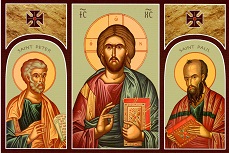
Peter is still hauling them in

right-click to save, or push Play

Sermon for Trinity 5

Jeremiah 16:14-21  +  1 Peter 3:8-15  +  Luke 5:1-11

Jesus said to Peter at the end of the Gospel, “Do not be afraid.  From now on, you will catch men.” And you know what? Jesus told the truth.  From then on, Peter began to catch men, and he has been hauling them in ever since.

Peter?  Where is Simon Peter?  How is he catching men today?  Let’s go back to our Gospel and see.

As He often did, Jesus taught His disciples a lesson about the kingdom of God in today’s Gospel using picture language and analogies. In this case, the analogy of a fisherman going out in a boat, casting a net to catch fish.  You have three or four basic parts to this analogy:  The fish, the net, and the fisherman who casts the net.  The fish are hauled into a boat, which would be the kingdom of God.

You see at least three parts right away at the beginning of the Gospel. There was a great number of people (like the great number of fish that Peter caught), pressing around Jesus (the Fisherman), to hear the Word of God—that’s the net.  It’s really just that simple.  Jesus preached the Word of God to the crowds gathered around, and many of them believed the Word and were “caught” out of death and brought to spiritual life, “caught” out of Satan’s kingdom and brought into the kingdom of God.

Jesus was sent by God the Father as both priest and prophet.  As priest, to offer up one holy sacrifice of atonement, once for all, the sacrifice of Himself as the Redeemer, as the one who made atonement for the sins of mankind.  As prophet, Jesus was sent to preach the Word of God, to preach the Law and the Gospel, to proclaim the truth—that all are sinners who must repent and believe the good news of salvation through faith alone in Christ Jesus.  It’s by preaching that people are brought to faith in Jesus and saved.

So, which of these two “offices” is our text talking about today?  Priest or prophet?  Prophet, right?  Not priest.  So when Jesus sends Peter out into the deep waters to catch fish, he isn’t sending Peter to make atonement for sins or to make sacrifices to God.  He’s sending Peter out to preach the Word of Christ, who is our great High Priest, who offered Himself up on the altar of the cross to make atonement for sin.  He’s sending Peter out as a “caster of the net,” or in other words, as a “minister of the Word.” We learn in today’s Gospel about the role of the ministry of the Word in the kingdom of God.

What is that role?  Well, it’s a humble role.  As Jesus directs Peter to take the boat out for a catch of fish, Peter admits, they worked hard all night trying to catch fish, and didn’t catch a thing.  The ministers of the Word don’t know where the fish are or how many they will catch in any given day.  They don’t know where to steer the boat.  All they see is water.  All they see is the sea.  They know fish are out there, but where?  Only God knows.  And that’s the way it’s supposed to be.  They go at Jesus’ Word, not knowing where they are going.  They simply open their mouths as Jesus’ gives them opportunity.

What is the role of the ministry?  It’s a humble role, because the ministers of the Word have no power of their own to bring people to faith and catch them for eternal life.  The power is never in the minister.  It’s only in net, only in the Word.  Paul said to the Romans, “I am not ashamed of the gospel of Christ, for it is the power of God to salvation for everyone who believes.”

What is the role of the ministry?  It’s a humble role, because, when Peter saw the great catch of fish they brought, he fell on his knees before Jesus in horror.  He had no right to claim that catch of fish as his own.  It was all Jesus’ doing.  Jesus demonstrated that He was the Almighty Lord of nature, which also meant He was the Holy One in whose presence no sinner can stand.  And Peter knew he was nothing but a sinful man.  He knew his sins.  He felt his sins.  Ministers of the Word are not holier than other men.  Peter was a sinful man, as are all the ministers of the Word.

But see, Jesus came to save sinners, like the Apostle Peter, who would deny Jesus three times, like the Apostle Paul, who would spend years persecuting and killing Christians before his conversion.  Jesus came to save sinners like me, and like all of you.  He gave His life for sinners.  He calls sinners to repent and believe in Him for forgiveness.  And as Peter himself would one day declare to a group of “fish,” “whoever believes in Him will receive remission of sins.”

Jesus didn’t “depart from” Peter, as Peter begged Him to.  No, He announced peace to Peter, as He announces peace to all who repent.  And He did even more.  He called Peter to this ministry of the Word.

Now, if Jesus had wanted to catch men for His kingdom without using sinful men as ministers of the Word, He could have easily chosen to send His holy angels to preach the Gospel.  They are sinless.  They are perfect servants of the Lord, and they would have gladly done it.  But in His grace, Christ has specifically chosen not to send angels for this ministry.  They serve Him in many ways, but not for this—not for casting the net that brings men into His kingdom.  For that, He has chosen only sinful men, like Peter.

You want an example? Years later, after Jesus died and rose again and ascended into heaven, there was a Gentile named Cornelius who worshiped the God of Israel, but had not completely embraced the Jewish faith; he was not circumcised.  And he didn’t know Jesus as the Christ.  God had mercy on him.  God wanted to catch Cornelius for His kingdom.  God even sent an angel to Cornelius’ house.  But for what purpose?  To preach the Word?  To cast the Gospel net and bring Cornelius into the kingdom of Christ?  No!  All the angel did was to point Cornelius to Peter—to send for Peter.  “He will tell you what you must do,” the angel said.  And then the angel was gone.  God directed Cornelius to the ministry of the Word.  That is how Jesus has chosen to go fishing for men.

So while the ministry of the Word has a humble role in God’s kingdom, it also has a vital role.  Christ has provided this ministry for His Church, and the Church is authorized to call ministers, in the name of Jesus, to cast the net of the Word, to cast it here within the Church and to cast it out into the world.  Have you sinned?  Do you need forgiveness?  God directs you here, to the ministry of the Word, where He will absolve you, he will speak forgiveness to you through your pastor and give you His body and blood.  Do you know a Christian who has distanced him or herself from the ministry of the Word?  Direct them back to it!  Do you know someone who may not be a Christian at all?  Then you are God’s angel, God’s messenger to direct them to the place where God has established His ministry.

This is Christ’s lasting gift to His Church and to the world.  This is how Christ has chosen to be present among us and working with us to grow His kingdom until He comes again.

Now, we may look out at the world, and at the immorality that surrounds us.  We may look at our culture as it changes and degenerates into Sodom and Gomorrah all around us.  We may look out at the world and despair.  Or just as bad, we may look out at our culture and imagine that we need to tweak something, either the message or the ministry of it, in order to “reach” the fish.  But we shouldn’t.  We dare not.  We need not.  There is only one net, and there is only one thing to do with it, and that’s cast it out into the darkness, into the deep, and trust in the power of the Gospel, the power of the Holy Spirit to catch men, where and when it pleases God.

As for us, we give thanks to God today for the ministry of the Word, the ministry by which He has caught us for eternal life, the ministry by which He will keep catching men until the nets are good and full.   And even if they don’t look full to us, remember, there is only one net.  It’s Peter’s net.  Not, Peter the man, but Peter as he represents the ministry of the Word.  One net, one ministry, one Holy Christian and apostolic Church, since the time of Christ and lasting until the end of the world.  When you understand that, when you understand our tiny place in that great and ongoing catch of fish, all you can do is stand back in awe as Jesus’ disciples did, and give humble thanks to God for His grace and mercy in establishing this ministry on earth, and among us.  Amen.

Posted in Sermons | Tagged , , , | Comments Off on Peter is still hauling them in

Christ commands His brothers to become like our Father

right-click to save, or push Play

Sermon for Trinity 4

Isaiah 58:6-12  +  Romans 8:18-23  +  Luke 6:36-42

I think you all know and would agree that our congregation takes a very firm stance on how sinners are justified before God: only by faith in Christ.  Faith alone saves because to have faith is to rely on God’s promise to forgive us our sins only because of Jesus.  Faith doesn’t sacrifice anything to God, because there is only one sacrifice that avails before Him—the sacrifice of Jesus on the cross. Faith isn’t a work we offer up to God.  Faith isn’t working; faith is resting—resting on God’s mercy and on God’s promises, all wrapped up in Jesus.  You know that. You confess that.  The Christian life is a life of resting, a life of faith toward God.

But toward our neighbor, it’s just the opposite.  As far as our neighbor is concerned, the Christian life is not at all a life of resting.  It is a life of hard work and service and sacrifice, a life filled with compassion and with deeds that flow from that compassion.  Faith, as Luther says, is inward and upward—directed toward God, offering Him nothing, but receiving everything.  But love—love is outward and downward—directed toward our neighbor.  Love isn’t worried about receiving from our neighbor, but only about giving.  As we have said many times, God doesn’t need your service.  But your neighbor does.

And so Christ, in our Gospel, spells out for us Christians how we are to treat our neighbor.  And here, he is especially referring to our neighbor who hates us.  Our neighbor who is our enemy.  Right before our Gospel, Jesus says, Love your enemies, do good to those who hate you, bless those who curse you, and pray for those who spitefully use you. Why?  Because that’s what your Father does, and if you are His children, then you will do as He does.  Christ commands His brothers—His Christians—to be merciful, like our Father.

Now, people who hate God and love themselves and their own works very much will take the words of our Gospel and twist them to make salvation by works.  Judge not, and you will not be judged; condemn not, and you will not be condemned, forgive and you will be forgiven; give, and it will be given to you.  “See!  You have to do these works and follow these rules if you want to be saved!”  Wrong.  Jesus is talking to His disciples, to people who have already been saved, already forgiven, already justified, already adopted as God’s children, so that He can say to them, Be merciful, just as your Father also is merciful.  God is not the Father of unbelievers, but of those who have been born again of water and the Spirit, of those who believe in Christ.  Faith alone saves and receives God’s full forgiveness and brings one into God’s family.

But faith is never alone, because the one who has come to know God as a gracious Father through faith in Jesus Christ wants nothing more than to be like his Father.

And that means, mercy.  Sympathy.  Compassion. Toward those who treat you well, but also toward those who treat you terribly.  Mercy and compassion begin in the heart.  It isn’t just a matter of deeds.  It’s a matter of caring about your neighbor—that is, the person or persons next to you.  Next to you here, in church.  Next to you in your house.  Next to you in school, or where you work, or at the store, or at the park, or on the street; the one next to you who’s showing you love and respect, and the one next to you who’s showing you hatred and contempt.  How should you look at such a person?  You should look at him as your Father looks at His enemies—with sympathy, mercy, and compassion.

Mercy then shows itself in judging not and condemning not.  Someone who is caught in a sin will throw that back at you.  “Don’t judge me!  You’re not allowed to judge me!”  But see, Jesus doesn’t say, “Tell other people not to judge you,” or “Don’t let anyone judge you!”  He says, “Judge not.”  Know your place.  God has given certain offices for judging. Among them, judges!  Imagine going up to a judge in court and quoting Jesus’ words to him. Judge not!  You would rightly be held in contempt of court.  Other offices for judgment are parents with their children, and pastors in the realm of spiritual judgment.  Christ commands all His people to watch out for false teachers, and the only way to determine if someone is a false teacher is by judging his doctrine according to God’s Word.  Christ has also commanded that, if you see your brother caught in a sin, you go to him privately, in love, and rebuke him.  Gently.  Those are all forms of judging others that God has commanded.

But your place is not to go around playing the critic, trying to find things in others that need correcting.  Your place is not to look at your neighbor and form a judgment about him or her, as if you knew his or her heart.  Your place is not to assume the worst about your neighbor, or to critique your neighbor’s behavior or appearance.  Rather, go around with mercy in your heart toward your neighbor, with sympathy and compassion. Assume the best. Ignore the worst.

Mercy shows itself in forgiving.  Jesus says in Luke 17, If your brother sins against you, rebuke him; and if he repents, forgive him. And if he sins against you seven times in a day, and seven times in a day returns to you, saying, ‘I repent,’ you shall forgive him.” You shall do this, Jesus says.  If you call yourself a Christian, if you call Jesus your Lord, then you will forgive the one who repents, because this is what your Lord commands.  More than that, this is what you hope for from God Himself, isn’t it?  That, when you fall into sin and repent before God—that He’ll forgive you.   Right?  Every time, right?  Even though you don’t deserve His forgiveness, right?  Do you think your neighbor can possibly sin against you worse than you have sinned against God?  I tell you, no.  So be merciful, even as your Father is merciful.

And “give,” Jesus says.  Give generously.  Give, and it will be given to you: good measure, pressed down, shaken together, and running over will be put into your bosom. For with the same measure that you use, it will be measured back to you.  Stinginess is not a quality of your Father, is it?  He receives nothing from anyone, but gives generously to all—even to the unthankful and the wicked.  He doesn’t wait for people to trust in Him or love Him or treat Him well.  “Become like that,” Jesus says to His brothers.  Give of your time and of your possessions, give of your mercy, without expecting anything in return from your neighbor.  Instead, trust Jesus’ promise that you won’t run out, because the same Father who calls you to be like Him has promised to “reimburse” you, as it were.  Either you trust Him, or you don’t.  But He is altogether trustworthy.

So, be merciful like your Father.  Judge not, condemn not, forgive and give. Then, at the end of the Gospel today, Jesus adds this parable:

“Can the blind lead the blind? Will they not both fall into the ditch? A disciple is not above his teacher, but everyone who is perfectly trained will be like his teacher. And why do you look at the speck in your brother’s eye, but do not perceive the plank in your own eye? Or how can you say to your brother, ‘Brother, let me remove the speck that is in your eye,’ when you yourself do not see the plank that is in your own eye? Hypocrite! First remove the plank from your own eye, and then you will see clearly to remove the speck that is in your brother’s eye.”

Would you try to help someone else?  Would you try to teach someone else the right way to go, making them your disciples?  Then you first must be perfectly trained by your Teacher, who is Christ.  You can’t lead others or teach others or help others unless you yourself have been led by the Word and teaching of Christ, unless you yourself have been helped by Christ.  And you can’t help your neighbor with the little sins in his or her life unless you yourself recognize your own big sins against God, and continually go back to Him for forgiveness and mercy.  Then and only then will you know what mercy looks like, and you will be able to show it to your neighbor, even as you have received it and continue to receive it from God.

For that purpose, here is the Sacrament again, where God’s mercy is on display in the body of Christ, given for you, in the blood of Christ, shed for you for the forgiveness of sins.  Here we learn firsthand about our Father’s heart of mercy toward sinners and His willingness to sacrifice His Son for the unthankful and the wicked.  Here we receive mercy and forgiveness for our great sins.  And even as we receive forgiveness here from God, and rest in His promises by faith, so we are also strengthened and built up in love, to grow into the image of our Father’s mercy. Faith alone justifies.  And those who have faith will hear the admonition of our brother, Jesus Christ, to become merciful, even as our Father is merciful. Amen.

Posted in Sermons | Tagged , , | Comments Off on Christ commands His brothers to become like our Father

Luther Sermon for Trinity 26

Sermon for the Twenty-Sixth Sunday after Trinity. A Sermon by Martin Luther, taken from his Church Postil.

Text: Matthew 25:31-42 (KJV)

1. The words of this Gospel are in themselves clear and lucid They have been given both for the comfort and encouragement of believing Christians, and for the warning and terror of others, if perchance, they might be of help to them. While most lessons almost exclusively teach and inculcate faith, this one treats only of the works, which Christ will examine at the last day, that it may be seen that he wishes them to be remembered and performed by those who wish to be Christians and be found in his kingdom.

2. And Christ himself gives this admonition here in the strongest terms that can be given, both in the consoling promise of a glorious, eternal reward, and in the most terrible threatenings of eternal wrath and punishment upon all who despise the admonition; so that whoever is not moved and aroused by these words can certainly never be moved by anything. For Christ says, he will himself come visibly in his majesty, at the last day, with all the angels, and that he will transplant all who have believed in him and have exercised love toward his followers, into his father’s kingdom of eternal glory all who believe in him and love his saints; and that he will also cast into hell forever all who live not as Christians, and who separate themselves from him and all his saints.

3. Now, had it not been told us we should be inquisitive beyond measure to know what would happen on the last day, and what Jesus would say and do on that day. Here we are now told, and have set before us first of all, death, which no one can escape; but after that the day of judgment. Then it shall come to pass that Christ will bring together by means of the resurrection all who have ever lived upon earth; and at the same time he will descend in great inexpressible majesty, sitting upon the throne of judgment, with all the heavenly host hovering around him; and all the good and bad will appear, so that we shall all stand exposed before him, and no one will be able to conceal himself.

4. The appearance of this glory and majesty will immediately become a great terror and pain to the condemned, as we read in today’s Epistle lesson, !est they shall suffer punishment, even eternal destruction from the face of the Lord and from the glory of his might, when he shall come to be glorified in his saints, 2 Thess. 1, 9-10. For even if there were no more than a single angel present, there would not remain in his presence one fickle, wicked conscience, were it possible to escape, any more than a thief and a rascal can bear to come before a human judge. If he could escape, he would much prefer it, if only for the purpose that he might escape public disgrace, to say nothing of his being compelled to hear the judgment passed upon him.

What a terrible sight this will be, when the ungodly shall see not only all God’s angels and creatures, but also the Judge in his divine majesty, and shall hear the verdict of eternal destruction and hell fire pronounced upon them forever! This ought surely to be a strong, powerful admonition for us to live as Christians, so that we may stand in honor and without fear at the right hand of this majestic Lord, where there will be no fear nor terror, but pure comfort and everlasting joy.

5. For he will then, as he says here himself, immediately separate the goats from the sheep. And this will take place publicly in the presence of all angels, men, and creatures, and before the whole rabble of an ungodly world, that it may be seen who have been pious, honest Christians, as well as who have been false hypocrites. This separation cannot take place in the world until that day, not even in the assembly that constitutes the Christian Church. The good and the bad must remain together in this world, as the parable of the wedding guests says, Mat. 22, 10; or as Christ himself had to tolerate Judas among his Apostles. Christians are even now grieved that they must remain here in the midst of a crooked, perverse, ungodly people, which is the kingdom of Satan, Phil. 2, 15.
6. While they have their sufferings here upon earth, they will have also their comfort on the coming day of judgment, when Christ will separate them from the other flock, so that after that day no false, ungodly men, nor death, nor devil can ever touch them or offend them.

7. Then he will pronounce the verdict in the very words in which he has already prepared it and set it forth, and he will certainly not change it. And the words are peculiar in this that he makes them depend upon the deeds and works here mentioned, which they have or have not done, and which are the basis and cause of his judgment. And all these words set forth at length the works which have been done as well as those which have been neglected. And all this shall happen in the twinkling of an eye, when the hearts of all men shall be revealed before all creatures; and as it is preached here, so there all will be forthwith executed.

8. You may ask why Christ there especially examines works called deeds Of mercy, or the neglect of such works? Six different kinds are mentioned in the text, although many more might be given; yet were one to judge critically in the matter, there are no more works than those implied in the fifth commandment: Thou shalt not kill; in which we are commanded in general, as Christ himself explains it, not to be angry with our neighbor, but to be kind to him and ready to serve and assist him, supply his wants in times of need, whether in hunger, thirst, nakedness, suffering, imprisonment, sickness or other troubles, and to do this even to those who may have given us occasion for anger or for unmerciful acts, and thus do not appear to be worthy of our love and benevolence. For that is a poor virtue which does good only to those we love, or from whom we hope to receive kindness and thanks in return.

But one might, as has been said, add to those works of mercy many more from other commandments; for example from the sixth, that one is to assist his neighbor, to protect his wife, children and domestics, and to keep them under proper restraint and in honor; also from the seventh, eighth and last commandments, that is, to help save and maintain the goods and property, house, home and good report of his neighbor; also to help protect and defend the poor, the oppressed and the down-trodden.

9. Now Christ says also in Mat. 12,36, that men must give an account on the day of judgment not only of the transgressions of these commandments, but also of every idle word they have spoken. Then where shall the works of the first table, the greatest commandment, as right teaching, faith, prayer, hearing and preaching of God’s Word, and the like, find their place? Why does he pronounce such a harsh and severe judgment only upon those who have omitted to do the works of the fifth commandment? Because these works appear almost the same as those which the heathen do. For the Turks do more works of this kind and boast more of them than we who are called Christians. Among them each one regards his neighbor as his brother and shares with him whatever he has. Nay, they regard it the greatest unfaithfulness and most shameful vice not to share bread with a neighbor in times of hunger. Why does he so highly extol these works which shine so brightly also among the Turks and among the heathen? Certainly he does not mean to say that those also who are not Christians merit eternal life by reason of such works?

10. For Christ himself shows that he is speaking of the works of believing Christians, when he says: “I was hungry and ye gave me to eat,” etc.; “what ye have done unto the least of these my brethren ye have done unto me.” For there is no doubt that he who performs such works of mercy to Christians, must himself be a Christian and a believer; but he who does not believe in Christ, will certainly never be so kind toward a Christian, much less toward Christ, so that for his sake he would show mercy to the poor, and needy; therefore he will refer to these works at the judgment, and accordingly pronounce the verdict to both parties, to those who have done, and those who have not done these works, as a public testimony of the fruits of their faith or of their unbelief.

11. It seems as though he meant hereby to show that many Christians, after receiving the preaching of the Gospel, of the forgiveness of sins and grace through Christ, become even worse than the heathen. For he also says in, Mat. 19, 30, “Many that are first shall be last; and the last shall be first.” Thus it will also be at the end of the world; those who should be honest Christians, because they heard the Gospel, are much worse and more unmerciful than they were before, as we see too many examples of this even now.

Aforetime when we were to do good works under the seduction and false worship of the Papacy, every one was ready and willing; a prince, for example, or a city, could give more alms and a greater endowment than now all the kings and emperors are able to give. But now all the world seems to be learning nothing else than how to estimate values, to rake and scrape, to rob and steal by lying, deceiving, usury, overcharging, overrating, and the like; and every man treats his neighbor, not as though he were his friend, much less as his brother in Christ, but as his mortal enemy, and as though he intended to snatch all things to himself and begrudge everything to others.

12. This goes on daily, is constantly increasing, is a very common practice and custom. among all classes of people, among princes, the nobility, burghers, peasants, in all courts, cities, villages, yes in almost every home. Tell me, what city is now so strong and pious as to be able to raise an amount sufficient to support a schoolmaster or a preacher? Yes, if we did not already have the liberal alms and endowments of our forefathers, the Gospel would long ago have disappeared in the cities on account of the burghers, and in the country because of the nobility and peasants, and poor preachers would have nothing to eat nor to drink. For we do not love to give, but would rather take even by force what others have given and endowed. Therefore it is no credit to us that a single pulpit or school is still maintained. Yea, how many there are among the great, the powerful, and the rich, especially in the Papacy, who would like to see nothing better than all preachers, schools, and arts exterminated.

13. Such are the thanks to the blessed Gospel, by which men have been freed from the bondage and plagues of the Pope, that they must become so shamefully wicked in these last times. They are now no more unmerciful, no more in a human, but in a satanic way; they are not satisfied with being allowed to enjoy the Gospel, and grow fat by robbing and stealing the revenues of the church, but they must also be scheming with all their power how they may completely starve out the Gospel. One can easily count upon his fingers, what they who enjoy the Gospel are doing and giving, here and elsewhere; and, were it only for us now living, there would long since have been no preacher or student from whom our children and descendants might know what we had taught and believed.

14. In short, what do you think Christ will say on that day, seated on his judgment throne, to such unmerciful Christianity? “Dear Sir, listen, you have also pretended to be a Christian and boasted of the Gospel; did you not also hear this sermon, that I myself preached, in which I told you what my verdict and decision would be: ‘Depart from me, ye cursed?’ I was hungry and thirsty, naked and sick, poor and in prison, and ye gave me no meat, no drink, clothed me not, took me not in, and visited me not. Why have ye neglected this, and have been more shameless and unmerciful toward your own brethren than the Turk or heathen?”

Will you excuse yourself by pleading: “Lord, when saw we thee hungry or thirsty?” etc. Then he will answer you again through your own conscience: Dear Sir, were there no people who preached to you; or perhaps poor students who should have at the time been studying and learning God’s Word, or were there no poor, persecuted Christians whom you ought to have fed, clothed and visited?

15, We ought really to be ashamed of ourselves, having had the example of parents, ancestors, lords and kings, princes and others, who gave so liberally and charitably, even in profusion, to churches, ministers, schools, endowments, hospitals and the like; and by such liberal giving neither they nor their descendants were made poorer. What would they have done, had they had the light of the Gospel, that is given unto us? How did the Apostles and their followers in the beginning bring all they had for their poor widows, or for those who had nothing, or who were banished and persecuted, in order that no one among them might suffer for the necessities of life! In this way poor Christians should at all times support one another. Otherwise, as I have said, the Gospel, the pulpit, churches and schools would already be completely exterminated, no matter how much the rest of the world did.

Were it not for the grace of God, by which he gives us here and there a pious prince, or godly government, which preserves the fragments still left, that all may not be destroyed by the graspers and vultures, thieves and robbers; were it not for this grace, I say, the poor pastors and preachers would not only be starved, but also murdered. Nor are there now any other poor people than those who serve, or are being trained to serve the church; and these can obtain no support elsewhere, and must leave their poor wives and children die of hunger because of an indifferent world; on the other hand the world is full of useless, unfaithful, wicked fellows among day-laborers, lazy mechanics, servants, maids, and idle, greedy beggars, who everywhere by lying, deceiving, robbing and stealing, take away the hard-earned bread and butter from those who are really poor, and yet go unpunished in the midst of their wantonness and insolence.

16. This I say, that we may see how Christ will upbraid the false liars and hypocrites among Christians, on the day of judgment, and having convicted them before all creatures will condemn them, because they have done none of the works which even the heathen do to their fellows; who did much more in their false and erroneous religion, and would have done it even more willingly had they known better.

17. Since now this terrible condemnation is justly pronounced over those who neglected these works, what will happen to those who have not only neglected the same, have given nothing to the poor Christians, nor served them; but robbed them of what they had, drove them to hunger, thirst and nakedness, furthermore persecuted, scattered, imprisoned, and murdered them? These are so unutterably wicked, so utterly condemned to the bottomless pit with the devil and his angels, that Christ will not think or speak of them. But he will assuredly not forget these robbers, tyrants, and bloodhounds any more than he will forget or pass over unrewarded those who have suffered hunger thirst, nakedness, persecution and the like, especially for his and his Word’s sake. He will not forget those to whom mercy has been shown, even though he speaks only to those who have shown mercy and have lent their aid; for he highly and nobly commends them, when he says. “Inasmuch as ye did it unto one of these my brethren, even these least, ye did it unto me.”

18. On account of this judgment fear and trembling might well seize our great spiritual prelates, as they call themselves, the popes, cardinals, bishops, canons, priests, and then whole diabolical rabble of the anti-christian crowd at Rome, and everywhere, in their monasteries and brothels, if they were not altogether hardened and deliberately given to Satan, body and soul. They think and act as though they were especially appointed to snatch to themselves every thing that belongs to the poor church, and in their own wantonness to consume, spend, waste, squander, in dissipation, gambling and debauchery, in the most shameful and scandalous manner, whatever has been given for the maintenance of students, schools and the poor people. They mock God and man, 2 Pet. 2, 13; yea, they publicly murder innocent, pious people.

19. Yea, woe, another and eternal woe, to them and to all who side with them. For it had been, better for them, had they never been born, as Christ says of Judas. Therefore they ought rather to wish that their mothers had drowned them in their first bath, or that they had never come forth from the womb, than that one of them should have become pope or cardinal or a popish priest. For they are nothing else than merely desperate and select ones, not highway robbers, but public country-thieves, who take, not the goods of the mighty and the powerful that really have something, but of the poor and wretched, of the parish churches, schools, and hospitals, whose morsels are snatched from their teeth, and whose drink is torn from their mouths, so that they are unable to maintain life.

20. Therefore let every man beware of the Pope, the bishops, and the priesthood, as he would beware of those who have already been condemned alive to the abyss of perdition. Truly Paul did not prophesy in vain, 2 Tim. 3, 1, that in the last days perilous times shall come. Yet all the world moves along indifferently and gives no heed to this terrible judgment that has already been decided against such unmerciful robbers, thieves, and murderers of poor Christians, but especially against those who pretend to be Christians, who after having received grace slide back again, and like a dog eat their own vomit, or as the swine wallow in their own filth, 2 Pet. 2:20-22, and thus, having been first, become last before anyone is aware of it.

21. The second reason why Christ especially mentions these works of mercy and their omission, from the fifth commandment, is, that he wishes to remind us, who have been called to be Christians, have received mercy through our Lord, have been redeemed from the wrath of God and the guilt of the fifth commandment and from eternal death, and on the contrary have a gracious God, who is good to us in time and in eternity, to remind us, I say, to look upon all this and regard it as having been done not only for our salvation but also for an example. For, since he has shown us such mercy as to save us, we are also to act toward our neighbor in a manner as not to transgress against the fifth fifth commandment, which especially demands love and mercy.

And we are not to do these things simply because of the commandment and of the threatening of judgment, but for the sake of the example of the excellent and great goodness God has shown. For this example cannot be without blessed results, as God’s work of redemption is not without power and good fruit. Although most people become worse from having heard the Gospel, there must nevertheless be some who rightly understand it and remain faithful to it; for he says that he will separate them into two flocks; therefore there must also be pious ones who have kept this commandment.

22. Therefore see to it that you are among those who are kind and merciful here upon earth for Christ’s sake, or who even suffer for his sake, then you may joyfully await the last day, and need not be afraid of the judgment; for he has already selected you and placed you among those who shall stand at his right hand.

23. For we, who are Christians, should hope for the coming of this judgment and desire it with our whole heart; as we pray for it in the words: Thy kingdom come, thy will be done, deliver us from evil; so that we may also hear the glad and welcome words: Come, ye blessed, into the kingdom of my Father. This is the verdict we await; for this reason we are Christians, and just for the sake of this hope we are so severely oppressed, first by Satan and by our own flesh, which would not have us believe this and rejoice over it; then by the tyranny and enmity of the world. For we must constantly see and hear the maliciousness which Satan and the world practice against the Gospel. There is so much misery upon earth that we ought to be tired of this life and cry aloud: Come, dear Lord, and deliver us.

24. For there are certainly souls who are joyfully and with a good conscience awaiting the judgement of Christ; for they are in the rank and fellowship of those who believe in Christ, and who show fruits of faith through charity and beneficence toward the poor, or through patience in suffering with them. For, as I have said, he who does not have faith will not do works of mercy to Christians, but he who does them, will do them because he believes that he has a faithful Savior and Redeemer in Christ, who has reconciled him to God. Therefore he must have also a kind, loving heart toward his neighbors, even toward his enemies, and serve them in every time of need. Yea, he endures also, as I have just said, those things which come upon him from the world and the devil on account of his faith.

Whosoever is thus minded, I say, let him be joyful and of good courage; for he has already the blessed and joyful verdict: Come, thou blessed one, for thou hast also been one of the least of my brethren, who hast thyself suffered hunger and thirst, or who hast served the other hungry and thirsty ones, and hast shown mercy, as I have done.

25. Behold, therefore, the separation of the sheep and goats is already made in this life, so that every one can experience it internally and must indicate and show it also externally. For they who have not faith will surely do none of these things — they will neither comfort themselves with the grace of Christ, nor think of exercising mercy; they pass by the Word of God and their neighbor, as though they neither saw nor heard anything; they do not care to know that there is a Lord whom they are to serve and who will demand such service from them. For if they would consider that they must die, and appear before this judgment seat, they would not at the time defraud any one of a farthing. But, on the contrary, they think best to turn their eyes away from death and to keep the heart from thinking of it.

26. The world is so blind and hardened, that it can see before its eyes the great mass of men of all kinds who have passed away, and who are daily passing away, but is unwilling to behold it with seeing eyes, and to heed it, but continues securely and gaily in its wickedness. Furthermore, when it hears of the terrible judgment and condemnation that shall come upon it, it gives no heed to the consolation and example offered through Christ, but practices all kinds of unmercifulness, strives to hear and will have nothing else than the terrible, irrevocable verdict pronounced upon it from the judgment seat of Christ, and immediately after be cast from his presence into eternal hell-fire.

27. Wherefore he who may yet be converted and is ready to listen, will have enough, both to frighten and warn him, and to animate and persuade him to accommodate himself to the Word and example of Christ, while there is time and opportunity, so that he need not hear with the world this dreadful judgment, but may have joy and comfort in mercy with all Christians. Nor did Christ spare his Apostles, but earnestly admonished them, when he said in Luke 21, 34-36: “Take heed to yourselves, lest haply your hearts be overcharged with surfeiting, and drunkenness, and cares of this life,” which, he shows, will be most prevalent at the end of the world, “and that day come on you suddenly as a snare; but watch ye at every season, making supplication, that ye may prevail to escape all these things that shall come to pass, and to stand before the Son of man,” etc.

28. Notice, however, as I said, that he wishes to distinguish the good works of the Christians from the works of the Turks and the heathen. For he speaks of the works done unto him, of which both parties claim to be ignorant, the wicked excusing themselves, because they had not seen him, etc. But herewith he has most beautifully explained the fifth commandment, that it means, he who fulfills it can be none else than a believing Christian, who did it unto Christ. Thus the woman who anointed his head and feet, Mat. 26, 10-13, fulfilled this commandment and is praised by him when he says: “She has wrought a good work upon me. For ye have the poor always with you, and if ye wish ye can always do good unto them, but me ye have not always. Verily I say unto you, wheresoever this Gospel shall be preached in the whole world, that also which this woman hath done shall be spoken of for a memorial of her.” Again in Mat. 10, 42: “And whosoever shall give to drink unto one of these little ones, who believe in me, a cup of cold water, he shall in no wise lose his reward.”

29. We should therefore impress the fact upon our hearts and consider that it is a great and fine thing to do good to a Christian; but on the contrary also, what it is to do evil to him, as I said of the Pope, the bishops, the tyrants, and feudal nobility, who take from the feet of Christ what they have not given him the food, the drink, the lodging and the support of the poor, who are poor for Christ’s sake, because they are not in the position, as ministers, sextons and school masters, to rule the world; nor are they able to engage, in any other business in which they might gain a livelihood; for then they would also have been made the partakers of power and would receive enough. But since they have no part in the government, the world gives them nothing for their services. As they receive nothing for God’s nor Christ’s sake, they can have nothing, and must leave behind them poor, wretched widows and orphans.

30. Those in other positions and offices, who have plenty in all respects, do not wish and cannot attend to the duties and the services of the church, neither do they know how. And when ministers and pastors engage in worldly trades and pursuits, they step outside of their proper calling. Therefore they must be supported, if they are to have anything to eat, from beggary, of which Christ here speaks; but he makes it so precious that whosoever gives meat or drink to the least of his members on earth, he recognizes the same as though it had been done and given to himself. Do we wish then to be Christians, and expect from Christ the honor to be praised and rewarded in the presence of all creatures, we must, indeed, cheerfully and gratuitously give to those who are to perform the duties of their office gratuitously, because they can have no share in secular matters. This we are to do in order to escape the curse and wrath that will come upon those who would not have mercy on their poor brethren, who had to suffer hunger, thirst, misery, and imprisonment in the world in order to bring us to Christ.

31. But how does it happen that the righteous do not recognize and know that they have done their works unto Christ? They say: Lord, when saw we thee hungry, or athirst, etc.? The reason is, that to give something to a poor minister, chaplain, teacher, sexton is regarded as a matter altogether of too small significance to be so precious in the sight of God. Yea, the world looks upon it as so much money thrown away. Yet will any one say that the world would be so much richer, were there no pupils, schools, hospitals? Or that it is on their account any poorer, unless it were entirely heathen, or it were, as heretofore, compelled to give enough for the devil’s sake, and allow itself to be flayed to the bone by those who have cheated it of body and soul. In short, the churches and schools receive the very least from the world; yet it is jealous, complains bitterly, and makes a great cry about what they already have, although it gives nothing, and claims to make much better use of its means, when at other times it gives a hundred times as much to shameless, dissolute villains and jugglers; it soon forgets of how much it allows brother Guy to be robbed, and then even it takes a beating in the bargain. It never enters the brain of the world to think and believe that this means to give to Christ; nor is it easy for us to see it ourselves.

32. But Christ is able to speak and judge rightly in this matter, and he knows how much depends upon it. For it is truly impossible to bring up the young in the kingdom of God in any other way than by means of schools; nor is it possible to maintain the Word of God without pulpits. Where these are allowed to fall into disuse, there will be a second Sodom and Gomorrah, which will fare as those of old, who despised the Word of God, and would not listen to nor endure pious Lot. Thus also Ezekiel, 16, 48-50, prophesies of Jerusalem: “As I live, saith the Lord Jehovah, Sodom thy sister hath not done, she nor her daughters, as thou hast done, thou and thy daughters. Behold, this was the iniquity of thy sister Sodom: pride, fullness of bread, and prosperous ease was in her and in her daughters, neither did she strengthen the hand of the poor and needy. And they were haughty, and committed abomination before me; therefore I took them away as I saw good,” etc.

33. The same conditions now exist everywhere. Every peasant, burgher, nobleman is simply gathering dollars, waits and saves, eats and drinks, is insolent and mischievous as though God were nothing at all. No one cares for the despised Jesus in his poverty; nay, he is even tread under foot, until all obedience, discipline and honor are destroyed among us, as they were in Sodom and Gomorrah, and matters become so bad, as to become unbearable, because all admonition and preaching seem to be of no avail.

34. Right unwillingly do I prophesy; for I have often experienced how it came true; but the same conditions, alas, prevail now everywhere; and I fear and must almost resign myself that Germany may have the same experience as Sodom and Jerusalem, and will be a thing of the past; it will either be destroyed by the Turks or it will crumble by its own hand, unless the last day overtake it soon. For the present conditions are altogether unbearable and so exceedingly bad that they cannot become worse; and if there be still a God, he cannot thus let matters go on unpunished.

35. And now the world will not take heed, nor recognize that it must die and stand before God in judgment, but it rages against recognized truth. Let us give heed and take it to heart, that the wrath of God may not also sweep us away. For what else would God need to do to that end, than let loose both the Turks and Satan against us. The Turk would be compelled to cease doing what he has done and is still doing, were we not so hardened in blindness and impenitence, and so completely ripe for judgment. The reason is that we rage so blasphemously against God’s Word and his proffered help, and then in addition make our boast against the Turk.

36. And I hold that, if we Lutherans, as they call us, were only dead, the whole world would immediately cry, “Victory,” as though they had already devoured every single Turk. But it shall happen to them also that a hundred shall be slain by one Turk. And when the cry of murder is once heard, how unmercifully the Turks will cut in pieces all people, men, women, and children. Then shall we also begin to cry and lament. It shall come to pass that we shall do as did the Jews, put Christ out of the way. When he has been crucified, we shall be able to take care of the Turk, as Squire Caiaphas and the Jews took care of the Romans; thus the younkers at Jerusalem thought, if they could only put the prophet Jeremiah out of the way, they would surely be safe from the king of Babylon. What happened? After they had cast Jeremiah into the dungeon, the king came and led them all into captivity.

Thus I can also see that God has spun a web over Germany as it is determined to be guilty in the same manner of willful blindness, defiance, wickedness, contempt, and ungratefulness in opposing the precious Gospel. It is determined to be guilty of foolishness before God, for which it will have to pay dearly. May God preserve us, and grant us and our little flock that we may escape this terrible wrath, and be found among those who honor and serve our dear Christ, and await the judgment at his right hand joyously and blissfully. Amen.

To THE READER: If It should happen that another Sunday after Trinity should follow the 26th, which is very seldom the case, then it might be well to use the last preceding Epistle and Gospel for the 27th Sunday after Trinity, and on the Sunday preceding the 27th take the following text for the Epistle and the Gospel: Epistle, 2 Peter 3, 3; Gospel, Matthew 24,37-51.

Posted in Sermons | Tagged , , , | Comments Off on Luther Sermon for Trinity 26

Luther Sermon for Trinity 25

Sermon for the Twenty-Fifth Sunday after Trinity. A Sermon by Martin Luther, taken from his Church Postil. It was first published in 1525.

Text: Matthew 24:15-28 (KJV)

1. In this chapter there is a description of the end of two kingdoms; of the kingdom of the Jews, and also of the kingdom of the world. But the two Evangelists, Matthew and Mark, unite the two–and do not follow the order as Luke did, for they have nothing more in view than to relate and give the words of Christ, and are not concerned about what was said either before or after. But Luke takes special pains to write clearly and in the true order, and relates this discourse twice; first briefly in the 19th chapter, where he speaks of the destruction of the Jews at Jerusalem; afterwards in the 21st chapter he speaks of both, one following the other.

2. Notice therefore that Matthew unites the two and at the same time conceives the end, both of the Jewish nation and of the world. He therefore cooks both into one soup. But if you want to understand it, you must separate and put each by itself, that which really treats of the Jews, and that which relates to the whole world. This we wish to do now.

3. Notice, first, how Christ prophecies in this chapter concerning the final destruction of the Jewish nation, which the Jews did not at all believe, even though they had been clearly told through great signs and words, the promises of God which he made to the fathers, like unto which had happened to no other people upon the earth. For this reason they strongly insisted and depended upon it, thought it will continue forever, as they think even at the present time; that their kingdom is not destroyed but has only disbanded a little and shall be reestablished. They cannot get it out of their minds that they are not completely ruined.

4. For this reason God announced besides his miracles with clear and plain prophesies that their kingdom shall have an end and that God had abolished the external reign of the law, meats, offerings, etc., and would establish another which shall endure forever, as the angel announced to the virgin concerning Christ, as recorded in Luke 1, 33. “And he shall reign over the house of Jacob forever; and of his kingdom there shall be no end.”

5. Among the various passages which treat of the end of Judaism there is especially one that is introduced by Christ, namely: the prophet Daniel, 9, 25f., speaks of the terrible abomination, standing where he ought not, when he says concerning the Jewish nation, “Know therefore and discern, that from the going forth of the commandment to restore and to build Jerusalem unto the anointed one the Prince, shall be seven weeks, and three-score and two weeks,” that makes together seventy weeks or 490 years, “And after the three-score and two weeks, shall the anointed one be cut off, and shall have nothing: and the people of the Prince that shall come shall destroy the city and the sanctuary; and the end thereof shall be with a flood, and even unto the end shall be war; desolations are determined. And he shall make a firm covenant with many for one week: and in the midst of the week he shall cause the sacrifice and the oblation to cease; and upon the wing of abominations shall come one that maketh desolate; and even unto the full end, and that determined, shall wrath be poured out upon the desolate.”

6. The Prophet Daniel desired to know the definite time when this should come to pass, but he could not learn it, and although the angel pointed out a definite time, it was nevertheless too dark for the prophet to understand, hence he said before: But at last, at the last time, you shall see everything, that is, your prophecy, that is to be revealed to you, shall transpire at the end of time. For when Christ sent out the Gospel through the ministry of himself and of the Apostles, it lasted three or three and a half years, that it almost amounts to the calculation of Daniel, namely the 490 years. Hence he also says, Christ shall take a half a week, in which the daily offerings shall cease; that is, the priesthood and reign of the Jews shall have an end; which all took place in the three and a half years in which Christ preached, and was almost completed in four years after Christ, in which the Gospel prospered the most, especially in Palestine through the Apostles (that when they opened their mouth, the Holy Ghost fell as it were, from heaven, as we see in the Acts of the Apostles), so that a whole week, or seven years, established the covenant, as Daniel says; that is, the Gospel was preached to the Jews, of which we spoke before. Now, when the time came that a new message or sermon began, there must also begin a new kingdom, that is, where Christ rules spiritually in our hearts through the Word and faith. If this is now to continue, then the other must be set aside and has no more authority and must cease. This is the part of the prophecy of the prophets, which Christ is explaining.

7. The other treats of the abomination of desolation. Here Christ now says, When ye shall see this one standing in the temple, then take heed (he wants to say) for that is a sure sign from Daniel’s prophecy that his kingdom is now at an end; and do not let yourselves be deceived because the Jews and weak Christians think that it shall never be destroyed.

8. But the abomination of which Daniel writes is that the Emperor Cajus, as history tells, had put his image in the temple at Jerusalem as an idol, for the people to worship, after everything there had been destroyed. For the Scriptures call idolatry really an abomination, because God abhors and abominates it, inasmuch as he is the enemy of no sin so much as of this. The others he does truly punish, but he does not cast the people away if they repent, as he says in Psalm 89, 31- 34: “If they break my statutes, and keep not my commandments; then will I visit their transgression with the rod, and their iniquity with stripes. But my loving kindness will I not utterly take from him, nor suffer my faithfulness to fail. My covenant will I not break, nor alter the thing that is gone out of my lips.” But this sin, called idolatry, which is really unbelief and denial of God, which he cannot at all endure, condemns man completely. For where this remains in the heart of man, so that he teaches and believes correctly, indicates that our works are nothing, and that we shall be acceptable to God and serve him aright alone through faith, then there will be a truly godly character; there light and truth abide. Although along side of faith there runs a sense of the weakness of the flesh. It is not an abomination before God, but only a daily sin that God will punish unto repentance; yet he keeps the people, spares them and forgives them, when the people turn to him and learn to acknowledge his goodness. On the other hand, where this faith and doctrine do not exist, everything is lost; for it is impossible for man not to establish for himself a false worship and choose his own opinion and work, and worship it, so that he really denies God and his Word, and God is entirely turned aside; so that his grace cannot operate. Such abomination is generally the most beautiful and the greatest holiness in the eyes of the world, which outwardly appears in beautiful works and customs; but inwardly is full of filthiness, as we can see at the present day in our orders and church services where they are at their best. However there are again some Christians who are not like these in their works and ways; but are truly holy before God.

9, Now Christ says, when the abomination, that is, this idol, shall stand in the temple, the kingdom shall finally be made desolate and destroyed, so that it can never be rebuilt again, as Luke expresses it clearly in these words, 21, 20f: “But when ye see Jerusalem compassed with armies, then know that our desolation is at hand. Then let them that are in Judea flee unto the mountains; and let them that are in the midst of her depart out; and let not them that are in the country enter therein. For these are days of vengeance, that all things which are written may be fulfilled.” And further, “Woe unto them that are with child and to them that give suck in those days! And pray ye that your flight may be not in the winter, neither on a Sabbath: for then shall be great tribulation, such as had not been from the beginning of the world until now, no, nor ever shall be.”

10. All this pertains still to the Jewish nation. For if this should come upon us at the end of the world, then would we, according to the text, have to be in the land of Judea, because he really points to that country. It is also true, when he says that no greater calamity has been or can be upon the earth than was at the time of the destruction of Jerusalem; as we see in history, how unmercifully they were slaughtered and even killed one another, cast themselves into the fire, and permitted themselves to kill one another. Yea, the famine was so great that they ate the strings of cross-bows and even their own children. It was so shameful and abominable that like pity and distress shall never be heard again.

11. But they themselves wanted it, hence God permitted them to be thus blighted and destroyed. He would gladly have had mercy upon them and preserved them, but they brought themselves to such distress with their stiff-neckedness, that they killed and consumed one another; that as they began it, all such murder and bloodshed had to increase. Thus the death of Christ and of all the prophets is most abominably avenged on them, and that without ceasing, they raged against the Word of God, and persecuted and drove away the Apostles, as St. Paul says in 1 Thess. 2, 15-16, that the wrath of God finally came upon them.

12. When such fearful wrath and abominable plagues are at hand, says Christ, then flee wherever ye are able to flee; for these words, “Then flee unto the mountains, he that is in Judea, and he that is upon the housetop,” etc.; then; “He who is in the field,” etc., are all written or spoken symbolically, as if to say, hasten quickly away; the sooner the better, and let no one find or overtake you. This also came to pass. After the Jews had been sufficiently warned by many signs, that they should submit themselves to the Romans, and they would not; then the disciples and apostles fled away and followed this saying of Christ, they left everything behind that was in Judea and never returned to take anything.

13. “And pray ye,” he says further, “that your flight be not in the winter, neither on a Sabbath;” that is, see to it that you flee at the right time, that you be not overtaken. For he did not want to perform a miracle and keep them safely in the midst of the enemy, although he could have done so; for he had determined that everything that was there should be completely destroyed together; therefore all as one mass were only fit for destruction. If there were indeed a great multitude at Jerusalem according to the record, a million and a hundred thousand men were melted together, as many as were in the city. Therefore Jesus admonishes the disciples that they should not postpone their flight to the Sabbath, when they did not dare to journey; no to the winter, when it would be cold; but that they should depart, the sooner the better; that if they hesitate, an inconvenient time to flee would come.

14. Thus far Jesus speaks concerning the Jews. Now I have said before that Matthew and Mark unite these two ends together. Therefore it is difficult to discriminate, and yet we must discriminate between the two. Therefore notice that what had been said up to the present, all referred to the Jews; but now he weaves both together, breaks off abruptly, does not concern himself about the order in which the passages were spoken by Christ, and how they are connected with and follow one another; but leaves it to the Evangelist Luke, yet he wants to say that it shall be thus at the last day, and says:

“And except those days had been shortened, no flesh would have been saved; but for the elect’s sake those days shall be shortened.”

15. This refers to both parts and the meaning is, that the distress shall not endure long, for the sake of the godly; for the war against the Jews did not last quite two years, when peace was declared. But since all this has reference also to the end of the world, we wish to apply these passages concerning the Jews also to ourselves, so that we do justice to the Evangelist.

16. That a war shall come again as came upon the Jews, I do not expect, because the text says: There shall be such tribulation as shall never be again, as we also read and see; but another punishment shall come upon us; as that was a temporal war, so at the end of the world will a spiritual war come over the ungodly, who will be in the same condition as the Jews. Thus they will agree with one another: as that calamity came upon Jerusalem according to God’s ordering and everything was ground to powder; so abominable, and even worse, shall it be before the last day, when he shall come and make an end of the whole world.

17. For when Christ ascended into heaven, he established his kingdom not only in Judea, but extended it into all the world by means of the Gospel, which is being preached and heard everywhere. But we are doing just like the Jews, we deny and persecute the Word of God, kill the Christians who confess and preach this Gospel, as at the first the Romans, and afterwards to the present day, the Pope, bishops, princes, monks and priests do. This has now been done, for more than five hundred years, and no one was allowed to preach the Word of God, unless they repeated from the pulpit the text of the Gospel for a mere show, and afterwards brought out of it or put into it the mere doctrines of men. If anyone opposed it, they rose against him with fire and sword and suppressed it. And it avails nothing, how they are warned and frightened by words and signs; they still stand in their pride, storm and rage against it as lunatics, so that God will ever have sufficient reason to destroy them finally and eternally at the last day.

18. Therefore this passage in Daniel concerning the abomination applies also to us. For we also have indeed a real abomination or desolation sitting in a holy place, namely: in Christendom and in the consciences of men, where God alone should sit and reign, of which Daniel speaks in very clear words in the 8th and 9th chapters. For this is the real pure doctrine, if we preach that we are redeemed by Christ from sin, death, satan and all misfortune, and are planted in the kingdom of God through the Word and faith and thereby are made free from all law, and that no man, whoever he be, can enter into the kingdom of God through the works of the law nor be made free from sin. Where this is preached and believed, there Christ reigns spiritually in the heart without a medium; there is the Holy Spirit with all the treasures and fullness of the riches of God.

19. But what is the Pope doing? He is sitting not in the natural temple or God’s house, but in the spiritual, in the new and living temple of which Paul says: “If any man destroyeth the temple of God, him shall God destroy; for the temple of God is holy, which temple ye are,” I Cor. 3, 16-17. In all times many devils and heretics have tried to sit here, and all who are preaching against the true doctrine: If you want to be saved, then simply join this or that society and order, and do this or that work. They draw away the people from faith to works, although they are using the words, Christ is the Lord, but in truth deny him, for they do not say a single word that he forgives sins alone through grace, and redeems from death and hell, but they say: Through this order, through these works, we must do penance for sin, and atone for it in order to obtain grace, which is as much as to say: Christ did not accomplish it, he is not the Savior; his suffering and death cannot help, for if your works can accomplish it, then Christ cannot accomplish it only through his blood and death, or the other must be in vain. If you insist upon your works, then you drive out Christ; you deny and put to shame his precious blood and him with it; then he cannot reign in your heart through his Word, work and spirit, but my work is my idol whom I let sit in my heart and reign.

20. Thus you see whether the Pope is not the greatest arch-abomination of all abominations, to whom Christ and Daniel refer; and the true Antichrist, of whom it is written that he sitteth in the temple of God, among the people, where Christ is named and where his kingdom, spirit, baptism, Word and faith should be: because he interferes with the office and kingdom of Christ by his fanaticism of the spiritual rites of Christ, wants to rule over the consciences and govern with his propositions and works. And he can in truth be called an “abomination of desolation,” who is only destroying and laying waste everything, for as has been said: Christ and my works cannot abide together; if the one stands, the other must go down and be destroyed; wherefore the Pope has made desolate the kingdom of Christ, as far as his diocese reaches, and all who join him have denied Christ.

21. St. Paul prophesied all this, when in 2 Thess. 2, 3-4, he calls him: “The man of sin and the son of perdition, he that opposeth and exalteth himself against all that is called God or that is worshipped; so that he sitteth in the temple of God, setting himself forth as God.” But that the Papists want to turn this passage from themselves and say: Christ and Paul are speaking of the temple of Jerusalem, that Antichrist shall sit and rule there, amounts to nothing. For Christ says here, that Jerusalem together with the temple shall have an end, and after its destruction it shall never be rebuilt. Therefore since Paul is pointing to the time after the Jewish kingdom, and the destruction of the material temple, it cannot be understood otherwise than of the new spiritual temple, which as he says himself, we are. There, Paul says, the Pope shall sit and be honored, not above God, but above everything that is called God, for the name of God does indeed remain the highest honor, therefore he cannot exalt himself above the true God, but above that which is called God and is worshipped; that is, he is exalted against his preaching and honor, higher than the true God, as is apparent in that so many princes and the world are clinging to him and regard his command higher and greater than the command of God, If any man eats meat contrary to his command or goes out of the impure calling of the priest, monk, or nun, into married life, as God has commanded, or according to the institution of Christ takes the sacrament in both forms; that is the greatest sin. They regarded it much less than stealing, adultery and all open vice against the command of God, and no one is even allowed to punish them for it. Yea, that they themselves defame the Word of God, persecute and kill the Christians, they esteem as the highest service of God, as it is also the highest service they can do for their god, the Pope. Is not this exalting and honoring Anti- christ against God, so that if anyone speaks or does anything against this, if he gets into their hands, he must immediately die I I think now that enough has been pictured forth and explained concerning this abomination.

22. Now it is high time for him to run and flee, who is able to flee; let everything he has behind and depart; the sooner the better; not with his feet but with his heart, in such a way that he will be rid of the abomination and enter the kingdom of Christ through faith. But to do this reason and a keen insight are needed rightly to discern the abomination. It cannot be seen in any way better than when we compare it to Christ who teaches, as stated above, that we are reconciled to God, and are saved through his blood. But the Pope ascribes this power to our works. Thus you ever see that to be saved through works and not to be saved through works (to believe on Christ as our justification before God) are contrary to each other. If you then want to remain with Christ, you must flee from the Pope and let him go.

23. This is now the abomination of desolation that has reigned until our time; but is now revealed through the grace of God, but will never be destroyed by emperor or worldly power. It must all be higher than that material destruction, since that was such a great tribulation, that there never can be a greater physically. Therefore did God reserve the destruction of this abomination for himself, as Paul says in 2 Thess, 2, 8: “Whom the Lord Jesus shall slay with the breath of his mouth, and bring to naught by the manifestation of his coming.” Although they themselves fear evil from worldly power and insurrection, yet this shall not be so well with them. For they are not worthy of such mild punishment, and God will not grant unto them that they be destroyed through man, but will do it himself without means, through his Word. Inasmuch as it has now made a beginning and the kingdom is destroyed even to the extent that it avails nothing, nor can take captive the conscience of those who know the Gospel. However hostile the Pope rages against the Gospel; he must nevertheless fall at the feet of princes and seek help from them. Hence his power is weakened and broken by means of the Gospel; but his final destruction is reserved unto the last day. Therefore it must continue in part until Christ at his coming shall destroy and grind to powder all together from heaven.

24. But as at that time among the Jews, the days were shortened, as Christ said, so must now also the days be shortened for the elect’s sake; for we see that the government of the Pope has had opposition and has declined during the last hundred years, without, at the Council of Constance where Huss was burned at the stake, having frightened everybody that he was held as God; but the truth came finally to light, so that now it is very much despised and can endure but a little longer; hence we notice, as I said before, that our text refers not only to the Jews but also to our abomination, the Pope’s kingdom. Now Christ says further:

“Then if any man shall say unto you, Lo, here is the Christ, or, Here; believe it not.”

25. From this passage we should indeed know and understand how to conquer the Pope and his rebel horde, who abolish the kingdom of Christ, and bind the Christian life to external and visible things, as they also publicly declare: Where the Pope is, there is the Christian church. They want to lead us to the point that we should find, feel and touch it in person or state, or in a manner that is wholly external.

Thus they do in all their cloisters and institutions. Therefore they say: If you enter this calling, eat, clothe yourself, pray and fast so and so, then you will atone for your sins and be saved. Heretofore Christ pictured this beautifully to us, and pointed to all these cloisters, callings and works, by which they wish to help the soul, and warns us to be careful of them, and not to permit ourselves to be drawn from the foundation upon which we stand; that we cannot become Christians through any such thing; but are redeemed from all evil alone through his blood and are planted into his kingdom, if we believe. He thus takes from our eyes all temporal and external things, casts to the ground with one word all doctrines that do not proclaim faith in its purity, and all life that is not regulated according to the right doctrine of faith. In short, he adds: “If anyone says, here or there is Christ,” believe it not. which means: Beware of everything that leads you to works, for it surely deceives and separates you from me.

“For there shall arise false Christs, and false prophets, and shall show great signs and wonders; so as to lead astray, if possible, even the elect.”

26. These are admirable, earnest and fearful words, that these preachers of works must force this truth into the people with such a show and emphasis that even the saints who stand in faith cannot protect themselves against it, but are led astray thereby, as has been the case. For the dear fathers, Augustine, I think Jerome also, likewise St. Bernard, Gregory, Francis, Dominicus and many others, although they were godly men, have all erred here, as I have often remarked in other places. For this error, that the Christian life was bound to external things, was early introduced and they with others were swept into it, and it went so far that they were led into it by their outward conduct, as we see in the books of St. Bernard, how poorly he writes when he answered anyone on the questions, of their monastic life; but when he writes freely out of his own soul, he preaches so elegantly that it is a pleasure for him, as Augustine, Jerome, Cyprian, the great and noble martyr, and many others experienced. But when any question was laid before them concerning the law and external regulations, whether we should understand it so, or so, then they immediately stumbled and fell, so that little was needed to mislead them. Still the followers of the Pope use this as the greatest argument against us. They say, should so many holy people and teachers have erred, and should God have forsaken the world so completely? They do not see that this becomes to them a stumbling-block to cause their fall.

27. What shall we now answer them? The passage lies clearly before us. This we must believe and let it stand; we cannot get away from it, even though the holy angels in heaven were against it, for should not Christ be holier and his Word amount to more than their word? For he never at any time says: Lord of the many or of the great multitude, but of the small number, of the elect, that they should stumble, so that they would almost be led astray, and he warns us that we should not cling to this, when we see that they cling to external things. Had they then not erred, Christ could not have been right when he proclaimed it. Now if all the saints should come and bid me believe in the Pope, I would not do it, but say: Even though you are of the elect, Christ nevertheless has said that there should be abominable and dangerous times: that you also must err. Therefore we must cling alone to the Scriptures and to the Word of God, which say he is not here nor there. Where he is, there I shall be. He will not be there where my work or calling is. Now whoever teaches me otherwise deceives me; therefore I still insist that nothing avails that they propose, as for example: The holy fathers and teachers thought so, lived so, hence we also must think and live in like manner; but this avails: Christ taught and thought so, therefore we must also think the same, for he is authority, above all the saints.

“Behold, I have told you beforehand. If therefore they shall say unto you, Behold, he is in the wilderness; go not forth: Behold, he is in the inner chambers, believe it not.”

28. At the time of the holy fathers, Anthony and others,shortly after the Apostles, the fallacy already arose, of which Christ is speaking here, although Anthony strove against it, that everybody was running to the wilderness by the thousands, and it gained such favor that later Jerome and Augustine almost worshipped custom, and did not know how sufficiently to praise it. Now when we look at it in the right light, this text powerfully opposes that movement, and there were also among them many heretics and many condemned persons, and although there were godly people among them who escaped the deception, nevertheless the example was dangerous and cannot be commended. Also St. Francis was a holy man, but his example and the order he established we are not to follow. But this no one, not even the saints, has recognized; so deeply and with such great display has it taken root. The Christian life is not confined to the wilderness, but moves freely in public society as Christ and the Apostles lived, that we come before and among the world, preach and admonish openly, to bring the people to Christ; but the people who run to the wilderness, do not want to remain in the world where they must suffer so much. They choose for themselves their own strict life, want thereby to be better Christians than others, as also the cloisters do, which are designated by Christ as the “chambers.” Christ closes now and says:

“For as the lightning cometh forth from the east, and is seen even unto the west; so shall be the coming of the Son of man.”

29. By this Christ wishes to say: Only do not believe them, when they want to bind Christ to this or that, and try to lead you from faith to works. I warn you not to fall from the pure faith, for you know not it what hour I will come. When anyone neglects his looking for me, then I will come as suddenly as the lightning flashes from heaven. When anyone clings not to him by faith, he is lost. Therefore see to it, that that day does not come upon you unawares. Remain steadfast in the faith, so that if you be indolent and sleep, satan may not tare you from your faith. But these words here follow each other in disorder. For as I said, Matthew gives these passages all in a heap and not in order. Therefore it does not agree exactly with the words which follow here:

“Wheresoever the carcass is, there will the eagles be gathered together.”

30. That is, you need not ask where the place is, where Christ shall come. I am where I wish to be, hence we will meet each other, as we say: “Wheresoever the carcass is, there will the eagles be gathered together.” For as the eagle does not paint for himself the place to which it will fly, but wherever the carcass is, there they will be gathered together; thus mine own will also find me. Where I am, there shall my elect also be. This is the text concerning the end of the Jews and of the world: to which Matthew now unites the passages concerning the signs of the last day, all which Luke separates clearly. This will belong to another occasion and is elsewhere fully discussed.

Note. Some on the last Sunday of the year preach on the Gospel of John 6, where Christ feeds the multitudes with five loaves and two fishes, which is explained in the Winter Postil during Lent.–God be praised forever.

Posted in Sermons | Tagged , , , | Comments Off on Luther Sermon for Trinity 25

Luther Sermon for Trinity 24

Sermon for the Twenty-Fourth Sunday after Trinity. A Sermon by Martin Luther, taken from his Church Postil.

Text: Matthew 9:18-26 (KJV)

1. Dear friends, you know that the Gospel is nothing else than a sermon about one person who is called Christ. And although there are many other books written here and there, and many sermons preached by many different persons, both about the heathen and the Christians, yea, also about the mother of God, St. Peter, angels and many of the saints; yet they are not Gospels, for this alone is the true Gospel which sets before us Christ, and teaches the good things we may hope from him.

2. Of course there is also at times something in the Gospel on John the Baptist, Mary and the Apostles, but this is not properly the Gospel, for they are taken into consideration so as more perfectly to indicate whence Christ came and what his office is. So Luke relates the history of John the Baptist from the beginning, his conception and birth; and that of the Virgin Mary, all which is written not for their sake, but only for the sake of the one person Christ, so that everything written in the Gospel concerns this person Christ alone. In St. Paul’s Epistles there is nothing written about the saints, all there is about Christ alone. The Evangelists describe what miracles and wonders Christ performed; but they write of no work that John or Mary did; but only what Christ did, how he helped the people in body and soul, and how the people clung to him.

3. For God has decreed it is his will that all should cling to the one man Christ, to hope in him and hold fast to him if they would be saved. Thus they know nothing of any one aside from Christ, who alone has been presented unto us by God as our mercy-seat, as St. Paul writes, Rom. 3, 25. Hitherto one has clung to this saint, another to that, one has had Mary, another Saint Barbara, and there have been manifold sects and orders. But no one cared anything for Christ except for the name. We have had many mediators, all of whom we abandoned and held only to Christ. Therefore St. Paul says in Rom. 1, 2, that the Gospel was promised by God through the prophets concerning his Son. And he insists upon it so very strongly, that nothing avails in the Gospel except the one only person, Jesus Christ. He who knows this may well thank God, that he knows where to place his comfort, help and confidence, and he will then despise and cast away all sermons about other persons.

4. For this reason the Lord is pictured to us in today’s Gospel, mingling among the people, drawing all the world unto himself by his friendliness and comforting doctrine so that they may cling to him with their hearts, depend upon his goodness, and hope to receive from him both spiritual and temporal treasures. Nor do you see him take anything from those he heals and helps; yea, he receives nothing from them but scorn and mockery, as we shall hear. Good deeds proceed from him, but he receives mockery and scorn in return.

5. Now this is preached and submitted to the whole world, that they may learn to know this man aright, and to know how to become Christians, not how to become good and innocent. Other doctrines outside of the Gospel, like the books of the heathen masters, insist that the people should through them become good; again, the legends of the saints especially insist that the people are to live as the saints lived. To make good people does not belong to the Gospel, for it only makes Christians. It takes much more to be a Christian than to be pious. A person can easily be pious, but not a Christian. A Christian knows nothing to say about his piety, for he finds in himself nothing good or pious. If he is to be pious, he must look for a different piety, a piety in some one else.

6. To this end Christ is presented to us as an inexhaustible fountain, who at all times overflows with pure goodness and grace. And for such goodness and kindness he accepts nothing, except that the good people, who acknowledge such kindness and grace, thank him for it, praise and love him, although others despise him for it. This is what he reaps from it. So one is not called a Christian because he does much, but because he receives something from Christ, draws from him and lets Christ only give to him. If one no longer receives anything from Christ, he is no longer a Christian, so that the name Christian continues to be based only on receiving, and not on giving and doing, and he receives nothing from any one except from Christ alone. If you look at what you do, you have already lost the Christian name. It is indeed true, that we are to do good works, help, advise and give to others; but no one is called a Christian by reason of that, nor is he on that account a Christian.

7. Therefore, if you wish to consider the word in its true meaning, you must identify a Christian by the fact that he only receives something from Christ, and has Christ within him; for this is what the word properly means. Just as a person is called “white,” because of his white color, black because of his dark color, large because of his size. So also one is called a “Christian” because of Christ, who dwells in him and from whom he receives his blessings. So, if one is called a Christian because of Christ, he is certainly then not called a Christian because of his works. From this it also follows that no one is called a Christian by reason of his good works. If this be true, as it undoubtedly is, then it must follow that our orders and sects do not belong under the Christian name, and they do not develop Christians.

8. Therefore they are deceivers, who preach or teach in the church, and occupy themselves with commandments, works and statutes, that accomplish nothing. Although they pretend to be Christians, nevertheless they still, under this name, attempt to burden and torment us with their commands and works. By reason of my works I may well be called one who fasts, one who prays, or a pilgrim, but not a Christian. If you were to weave all your works together, and add to them all the works of others, you would still not have Christ, and from these things you could not be called a Christian. Christ is something different and higher than law and the commandments of men. He is the Son of God, who is ready alone to give and not to receive. If I am so wise as to take what he offers, I have him, and if I have him I am then justly called a Christian. Thus you have the distinction as to what a Christian is and what Christ is.

9. Now this Gospel teaches us that Christ is the greatest and highest person, renowned in all the world, not in order to terrify the people, but to pour out all earthly and heavenly gifts, so that all men may depend upon and trust in him, and continually receive from him alone what they need. If sin terrifies my conscience and preachers of the law come and want to help me with their works, they will accomplish nothing. Christ alone can help here and no one else. Yea, the others only make it worse, even if they were Peter or Paul, or even Mary, the mother of God herself. Christ alone can do this, being ordained of God to the end that he should send forth the good news in which is proclaimed how my sins are to be forgiven gratuitously, with out any work or merit on my part, only and simply out of pure grace through faith in this Christ. If now I accept what is preached I have a comfort that my sins are forgiven me before God and before the world. If I at heart hold fast to this, then I am a Christian, and for this I thank God through Christ, who at all times gives me his Holy Spirit and grace, that sin may not harm me either here or at the day of judgment.

10. If I fear death and do not like to die, I find in this Christ a comfort and medicine, so that I care nothing for death. If terrified at the anger of God, I have here a Mediator. Many a one runs into the desert or puts on garments of coarse hair, and thinks he will force God not to be angry with him; but it will amount to nothing; whoever has not this Christ, on him the wrath of God remaineth forever, for it is so decreed. John 3, 36.

11. Therefore, whoever would have a joyful conscience that does not fear sin, death, hell, nor the wrath of God, dare not reject this Mediator, Christ. For he is the fountain that overflows with grace, that gives temporal and eternal life. Only open thy heart and hold it forth and you will receive all. He gushes and flows forth, and can do nothing else but only give, flow and gush forth, if you can only believe it. You justly deserve that people should call you a Christian, when you are called a Christian by virtue of what you receive from Christ; if not, and you want to give him so much, you are no Christian. This is the rich precious word which St. Paul praises so highly, and can never sufficiently praise, that he so graciously gives us his Son, to pour out his grace over all who receive it. Rom. 3, 24 and 8, 32; Gal. 3, 25.

12. From this it further follows, when a Christian does good works and shows love to his neighbor, that he does not thereby become a Christian or pious, but before this is done he must have been a Christian and pious. He indeed does good works, but his good works do not make him a Christian. The tree brings or yields good fruit, but the fruit does not make the tree good. So also here, no one becomes a Christian through his works, but through Christ.

13. From this you understand what kind of people Christians are, and what their kingdom is, namely, that they are a multitude that cling to Christ, and have one Spirit and the same gifts with him. And through this all Christians are equal, and no one has any more of Christ than another; St. Peter is no more than the thief on the cross; Mary the mother of God is no more than the sinner, Mary Magdalene. In external acts and works, of course, there is a difference among them, for the Virgin Mary had a greater work to do than Mary Magdalene, St. Peter a greater work than the thief on the cross. This is the case when we reckon according to works; but by virtue of our works we are not Christians. The Virgin Mary is not a Christian on account of her great work that she bore in her body Christ, such a costly and inexpressible treasure, as Christ himself said to the woman, Luke 11, 27-28, who cried aloud among the people to the Lord: “Blessed is the body that bore thee, and the breasts which thou hast sucked.” “Yes, blessed are they,” said he, “who hear the Word of God and keep it.” Here you see he exalts believers above his mother. For Christians are called Christians because they believe in Christ. Virgin and mother are two very beautiful names, but they are nothing in comparison to the name of believers or Christians. Again, St. Paul is so proud, that in his Epistle to the Galatians, 2, 6, he gives the office of the great and high apostles a reputation which amounts to little before God, except as it brings a blessing and is of service to others.

14. Therefore we are all alike through faith in Christ. Although St. Peter has a stronger faith than I, it is still the same faith in Christ. For his Father offers his Son Christ to the promiscuous crowd, and whoever receives him, gets the whole Christ, whether in weakness or in strength, it makes no difference. The woman in this Gospel who had been sick for a long time lays hold of Christ as well as Mary the Virgin, his mother did. Therefore Christians have the same Spirit, one is as high-born as another, St. Peter must call me his brother, and I can also call him my brother. Yea, Christ receives us unto himself and holds us as his brothers, as after his resurrection he said to Mary Magdalene: “Go unto my brethren and tell them, I ascend unto my Father and to your Father, to my God and to your God.” John 20, 17. And St. Paul calls Christ the first-born among many brethren, Rom. 8, 29. Of this he speaks very beautifully in his First Epistle to the Corinthians, 8, 9-12, where he speaks of weak brethren thus: “But take heed lest by any means this liberty of yours become a stumblingblock to the weak. For if a man see thee who hast knowledge sitting at meat in an idol’s temple, will not his conscience, if he is weak, be emboldened to eat things sacrificed to idols? For through thy knowledge he that is weak perisheth, the brother for whose sake Christ died. And thus, sinning against the brethren, and wounding their conscience when it is weak, ye sin against Christ.”

15. The summary of this entire Gospel is, that we learn to know Christ aright, and not only that we have the mere name, but know that we have all things from him. If we are Christians we have all things, and God is our Father, and we are lords of all things in heaven and on earth; this no work of ours can bring to pass, be it as great and costly as it may. Now you see how far they are from the Christian name, who live under the dominion of the Pope. The Gospel preaches nothing but the one person, Christ; not even Mary, much less the Pope or any work, be it as costly as it can. It must offer Christ alone and no one else, whom God the Father has sent among us, only that we should draw all from him, and wait for his grace and goodness.

16. Now when they preach to you Christ as a judge, how he is to appear on the judgment day, and how you should do many good works that he may reward you for them, and you agree to this, then he will indeed be a judge to you and not a Savior. And if he be thus presented to you as people are accustomed to paint his mother showing him her breasts, this is actually to preach the devil and not Christ, who only gives but receives nothing. It is indeed true, when you have received from him, then good works will follow of themselves, without force or demand; and this is represented to us very beautifully in today’s Gospel.

17. For here, you see, Christ preaches the Gospel to the people. Now preaching is no insignificant work, for here he does us a great service, in that he becomes our teacher and instructs us, how we may come to the knowledge of himself. This is a part of his great grace and kindness. While he is here on earth he does not cease to teach, so that we may receive him as our Savior and Redeemer; afterwards he follows us with his good works which he manifests everywhere to everyone as he needs. You find no one in the Gospel who ever asked anything of the Lord, whose help was denied and not given. As many as came to him, blind, deaf, lame, palsied and dropsical, he received and helped all as they desired, and healed them from all diseases, as Luke 6, 19 says: “And all the multitude sought to touch him; for power came forth from him, and healed them all.”

PART II.–OF THE GOSPEL AND CHRIST IN DETAIL.

18. Thus he does also to this woman. The woman hears him preach, and perceives he is a good, indulgent man, who appears friendly toward all the world; then she also began to cleave to him and take courage to think, because he cut none away from him, she too was welcomed to enjoy his friendship and goodness. Therefore she lets all the Apostles go, and casts her heart’s trust and confidence only on the Lord, and says to herself:

“If I do but touch his garment, I shall be made whole.”

19. Only see what a heart the woman had. Hers is indeed a noble, great faith and confidence. She did not think otherwise in her heart than that he would certainly help her, if she only touched his garment with her hand, and yet she is not so bold as to approach him openly. She regards herself as unworthy to speak to him or look at him; for she knows that she deserved nothing, and never. did anything for the Lord. Therefore she so plans as to approach him from behind, falls down at his feet and merely touches the hem of his garment. There is nothing but mere awkwardness and unworthiness here. Who had merited that the Lord should permit the Gospel to be preached to these people? There is no preparation, no work; yet the poor woman is there and hopes to obtain great things from the Lord, that he would release her from her sickness. She had had an issue of blood for about twelve successive years. How could she earn anything under such circumstances, or how could she because of her disease be worthy of anything? Of course she was worthy, but only to receive and not to give; for at that time she was not able to give the least thing.

20. And this is the true preparation for the grace and goodness of Christ, that I feel my need of it. And then it harmonizes beautifully, that the two meet together, the rich and the poor, Christ and the sinner. Yet it is a great art, to persuade people that they are poor and in need of grace. It is a difficult matter, nor does the devil permit it to be done, but always diverts the people to their good works, that they may under no circumstances receive the idea that they stand in need of the grace and mercy of Christ.

21. The text says the wretched woman had the issue of blood for twelve years, and to cure it, had spent all her living upon physicians. And the more she spent for this purpose, the worse she became. Luke and Mark both especially refer to this, and show thereby that, the more the law and works are preached, the worse it becomes among us, and we receive nothing from it but one harm and injury after another. The conscience can never be quieted by our good works. When one sin is expelled from the conscience, another soon enters, yea, the medicine and the work often make a sin, where otherwise there is none, until we come to Christ; as this woman here who had been sick so long and would never have received help, had she never come to Christ, from whom she received her health without any work whatever; she gives him nothing, and only receives from him, and allows him to give.

22. So it goes with all sermons that do not preach Christ, and it is here indicated that we must constantly employ the Word, and always exercise ourselves in the Word without intermission, for such men we still find at all times, who have like anxious and troubled consciences. For this woman signifies all poor consciences who have an issue of blood, that is, they feel their sins. And the issue of blood flows continually and cannot cease. For flesh and blood does nothing but what they wish. Now when feeling gets the upper hand, the wretched people go to work and want to help themselves; then one does this, the other that, and none as yet has accomplished anything.

23. Hence many orders and institutions have arisen because men have conjured up so many works that all of them can scarcely be named. What was the cause of all this? Nothing but the conscience tormented with sin, that has so exercised and harassed us, that we thought thereby to redeem our souls and be free from all sins. But Christ was not in it, because we only wished to give without receiving. Therefore it has ever become worse with us, as with this woman, whom all the physicians endeavored to heal, but she never found one able to help her. Thus too we have believed all the physicians; if any one came who had accomplished some little work we welcomed him. Dear Lord, we were anxious to be well, were anxious to have a joyful conscience, and were anxious to be free from sin.

24. The physicians are the preachers of the law and the lords over Christians. If one were very anxious to be free from sin, what did they do to him? They gave him medicine from which he only became weaker and sicker. This we have seen and in part also felt a great deal, how, to our great and real injury, the people sought to be good by means of their own works, and thereby deliver themselves from sin. But it did no good, we only became more and more discouraged by sin and death, so that there were no more discouraged people to be found on earth than just the priests, the monks, the nuns, and those who go about with their good works. If one had a boil, then the druggists had to work, there was a drugging, a going and running as though the soul would immediately pass away; thus they were afraid and discouraged. And no one fears the last judgment so keenly as just these very spiritual people. This they also beautifully show, when they so treat of works that they always add one work to the other, and never constantly trust in any single work; and the more they do the worse they become, the more discouraged and unbelieving they become, and it is with them just as with this woman.

25. It is quite a beautiful parable, and is well adapted for our benefit. We have not only spent our temporal goods for this purpose. but we have also risked our lives with fasting, with castigation, and with other unbearable burdens, so that some become insane over it, and lose all their natural strength and finally lose their souls in the bargain. I have also been one of these and have been caught deeper in this drugstore than many others. I could not so quickly come to the point, to cast to the winds the law of the Pope. It was a bitter and difficult task for me to eat meat on Friday, and conclude that the law and order of the Pope amounted to nothing. God help us, how difficult it was for me, before I dared to do it! Therefore one should become free from this in his conscience, and despise the traditions of the Pope, to do which he must indeed have a strong, firm foundation in faith; if he has this not, he will think several times before he takes the risk.

26. And as it was with this woman, who spent all her living upon the physicians, and even then was not made whole, yea, only became worse, so it is with us. Here all our works, cares and labors are lost. Here all our human obedience and all our orders fall to the ground, and all we spent in that line was wholly lost. Now we see the laws and traditions of the Pope and the bishops are nothing, before which we trembled and feared. All this helped us just as much as it did this poor woman, who spent all her goods and possessions, yes, and also risked her life to this end. 0, what medicine and treatment this woman had to use! How tried, weak and sick she often became from them! Yea, if she could have become well, she would have devoured the whole drugstore. But all availed nothing, she had to bear her sickness for twelve long years.

27. But how was the poor woman at last helped? As soon as she approached the man called Christ and placed her hope and comfort in him, she became well. But who directed her to this man? Of course the physicians did not. For when our pastors preach Christ, the affairs of the Pope and all his traditions are overthrown. Who then told her? She heard it from some one who also had been healed, and that not by the physicians. He without doubt told her there was one who is called Jesus, who is a friendly, gracious man, helps everyone, and allows no one to go from his presence unassisted, and that he is sent from God just for the purpose of helping everyone. And many had told her who received help from him. So that they also brought her to him. As the woman heard these things she abandoned the physicians and went to Christ.

28. And so it takes place today. Christ is not preached, but only mere human works: do this, and do that. And in spite of this the knowledge of Christ enters among the people, what we are to expect of him, and that he alone must do everything, without our works and merit. When we hear this voice we follow him, and obey his Word, and let the physicians go for good, and care no longer for the preachers of the law or of works, nor inquire about their commandments and traditions, but we go with all the desire of our heart to this man, called Christ, and say: Yes, indeed, from this man we must receive it without any merit, yea, how foolish I acted, that I ventured so much for it! May God bless thee, my dear Pope! May God bless you, my dear bishops, monks and priests, I shall never need your medicine again, your work and merit, your commandments and traditions, you have martyred me too long with these things. I have found one who gives me all things freely, that I in time past had to buy from you with piles of money. He gives it to me without work or merit, whereas I before had to risk my body, strength, health and life for it. Good night and farewell! I will never come to you again.

29. Thus one becomes a Christian, not by the decretals of the Pope, or by means of works and human traditions, but by the grace and kindness of Christ. Now whoever has a troubled, distressed conscience, fears sin and is terrified at death, or otherwise experiences no good in himself, let him come hither to this man and confess what ails him, call upon him, and he will most certainly help. “Pour out your heart before him; God is a refuge for us,” Ps. 62. 8; 50, 15, and say to him: Behold, here is an empty vessel that needs to be filled. Fill it, 0 Lord! I am weak in faith, strengthen me; I am cold in love, warm me and make me burn, that my love may flow out to my neighbor. I have not a firm, strong faith, at times I doubt, and cannot wholly trust in God! Alas, Lord, help me, increase in me my faith and trust. I have locked up the treasure of all my goods in thee. I am poor, thou art rich, and hast mercy on the poor, I am a sinner, and thou art righteous. In me is the river of sin; in thee is all fullness and righteousness.

30. If you once learn this, the laws of the Pope cannot take thee captive. From his laws and commands you receive nothing, but like this woman you spend everything you have, your body and goods, and at last your soul besides. And then you will say: I desire him from whom I can receive something, not him to whom I must give.

31. The other Gospels write thus of this woman: When she became well Jesus felt that a power had gone out of him, and turned to the people and asked: “Who is it that touched me? And then the Disciples answered: “Master, the multitudes press thee and crush thee;” but the Lord was not satisfied with this, and replied: “Some one did touch me; for I perceived that power had gone forth from me,” Mark. 5, 25; Luke 8, 46; I know that some one has received something from me. The Lord did all this because this woman’s faith was acceptable to him, which he desired to make known to all people. For he desires nothing more than that a man trust and believe in him. It was also done for the sake of the ruler, to confirm his faith by this miracle and transaction. Therefore Mark writes thus: As the woman saw that the Lord knew it, she feared and trembled and came and cast herself at the feet of the Lord and told him all in truth that was done to her by him. Then the Lord goes to work and absolves her and says to her: “Daughter, thy faith hath made thee whole; go in peace, and be whole of thy plague.”

32. Are not these friendly words? What joy must not this woman have experienced, as she permitted another to show her a kindness? This joy and peace all receive, who look to this man for help. Now where this joy is there its works must immediately follow, which prove this joy. So the peace and joy in this woman had to become manifest. For as soon as she received the good deed from the Lord, she confessed it before all the people, and was not ashamed to have it told that she received something from him, and yet gave nothing for it. This work and thanksgiving, however, God desires from us, namely, that we confess and proclaim his kindness, grace and good deeds before all men, so that others may also come and receive his benefits as this woman did. Thus my Christian life urges me to do good to others, as God has done to me through Christ, only that thus Christ may become known; but thereby I do not become a Christian. Just as this woman is not made whole by her knowledge, for she was well before all her work and knowledge. But after she becomes well she confesses Christ, and praises him, only for the good of others, and goes and does good works, one after the other. Thus we, too, live, if we are only Christians, in order that one may serve the others wherever we can. Hence, as this woman became well before she did all her works, so we Christians must also become whole before we can do any good works.

CONCERNING THE DAUGHTER OF THE RULER.

34. As the Gospel is represented in this woman, so it is also represented to us in the daughter of the ruler. This ruler of the Synagogue whom Mark calls Jairus, had a strong faith and confidence in the Lord that he would raise his deceased daughter to life. For had he not had such a disposition of heart toward him, he would not have come to him, and requested a thing of him which was by nature impossible. Therefore in this he shows his faith. When now the Lord observed the faith in him, he could not but do his will, and immediately arose and went with him. During his journey the history of this woman takes place, who had been sick for twelve years, as we have heard.

35. And when Jesus came into the ruler’s house, and saw the flute-players and the crowd making a tumult, who were there in compliance with the law of Moses, and blew with horns and trumpets, as in our country the bells are rung, to call the people together; he commanded the people and the flute-players to give place and said: “The damsel is not dead, but sleepeth.” And they laughed him to scorn.

This means that, when the preaching of the Word goes forth thus, that Christ is the man who helps and our works will not do it, then the world cannot avoid it, it must laugh and scorn, and be offended (1 Cor. 1, 23), for it is not acceptable to the world that Christ should help us. As the people do here, who said without doubt: Alas, this is a grand master or doctor, what shall he help? for he does not know what it is to sleep or enter the grave.

36. In the world the Gospel must have the reputation of being a foolish sermon, despised and scorned; for the devil cannot hear that this preaching is honored in the world, for it brings no advantage to his kingdom, this he feels, of course, and hence he attacks it with all cunning, so that he may hinder it and cause it to be worthless among his own followers, whose hearts he has entirely blinded and possessed, that the light of the Gospel may not shine for them, as St. Paul says in 2 Cor. 4, 4. For it is impossible that the preaching of Christ should not produce some fruit. It will not be preached in vain, Is. 55, 11; although there be but few who receive it, it matters not.

37. As satan feels it is a loss to him, and that the preaching of the Word is directed against his kingdom, he has no rest, he persecutes, despises and attacks it on all sides, as he at present rages and storms in all the world. For the preaching of Christ overthrows everything pleasing to the devil and the world, and what the world regards as the most holy and costly. For the world paints for itself a god who accepts our good works, and is pleased with the mass, vigils, foundations, rosaries, caps, pates, hempen ropes, and what more be the works of fools with which the Pope is employed. Now when one comes and brings the Gospel, and preaches against this nonsense of the Pope, and he is obliged to do, and says: It is nothing, it is deception, it is opposed to Christ and the Scriptures; he must suffer himself to be called a heretic and a worthless fellow, a perverter of the people, and then they quite grandly assert: Do you want to rule the whole world? do you think you are the wisest? Our forbears also were not fools. Many holy, pious people have done these works and preached of them, should you first come to destroy all? This must not be! Then the raging and storming time begins, with persecution and death, and the devil will claim he is right, let it go as it may.

38. This is enough on today’s Gospel for the present. Mark well, that you learn from the Gospels that all things are to be found in the one person who is called Christ. And remember, too, that a Christian receives his name alone from Christ. I do not say this in vain, for I know what it costs to keep it, in temptation and in the battle of life. Let us call upon God for grace, that we may take this in earnest, and grasp it with our hearts. Amen.

Posted in Sermons | Tagged , , , | Comments Off on Luther Sermon for Trinity 24