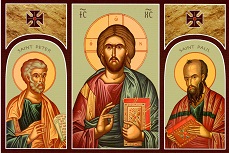
The Sacrament of the Altar

Sermon for Holy Thursday

What is this meal that we celebrate here at Emmanuel so often and that awaits us again on this Holy Thursday? What is the Sacrament of the Altar? 

It is the true body and blood of our Lord Jesus Christ under the bread and wine, instituted by Christ for us Christians to eat and to drink.

You take and eat bread.  But at the same time, whether you believe it or not, you are really and truly also taking and eating the very body of Jesus: the same body once broken on the cross, the same body that was laid in a tomb, the same body that rose from the dead, ascended into heaven and is seated at the right hand of the Father.  That’s the body that also graces our altar and enters our mouths. 

You take and drink wine.  But at the same time, whether you believe it or not, you are really and truly also taking and drinking the very blood of Jesus:  the blood of the new testament Passover Lamb, the same blood once shed by floggings and by beatings, by a crown of thorns, by nails and by spear.  The bread is not a symbol of a body that is located elsewhere, nor is the wine a symbol of the blood that poured out of Jesus’ side long ago.  The bread is his body; the wine is his blood. 

Why is he present here with the bread and wine?  What blessing do we receive through this eating and drinking?

That is shown us by these words, “Given” and “poured out for you for the forgiveness of sins.”  Through these words we receive forgiveness of sins, life, and salvation in this sacrament. For where there is forgiveness of sins, there is also life and salvation.

It’s all about the forgiveness of sins.  If you have no sins that need forgiving, then by all means, stay away from the Supper.  If you have no fear, no doubt, no weaknesses common to man, then by all means, stay away from the Supper.  If you have a faith that can never be moved or shaken or disturbed, if your “love for one another” is already perfect, if you are “fed up” with Jesus, as it were, and feel no need for this communion with him, then by all means stay away from the Supper.  It isn’t for you.  It’s only for sinners who yearn to be close to Christ, who long to be touched again by his sacrifice, who desire to receive from his hand the forgiveness of sins.

But, weren’t we already offered and given forgiveness of sins, life and salvation in the Sacrament of Holy Baptism?  Do we somehow lose that forgiveness and die again so that we need to be re-forgiven at every Communion, re-saved, resurrected to life again every week?  Or do we somehow rack up a whole host of sins during the week that make God angry with us again and that need to be erased again by the body and blood of Christ? No, no, we shouldn’t think of forgiveness that way.

The forgiveness of sins – a right standing before God, an open door to heaven is what Jesus won for you by his death on the cross as the Substitute of all men.  Where Christ is found, there is complete forgiveness – there and only there.  What joins you to Christ is faith in him for the forgiveness of sins, faith that comes from hearing his promise.  You were brought into him by baptism, through faith in his blood, and in him, your sins were counted – are counted – as forgiven – not once, not piecemeal, but always and completely.

But your faith-connection to Christ is like a slender thread, and you are literally surrounded by enemies who have targeted that thread, who seek to cut it and sever your connection to Jesus, to pull you away from him, and so to pull you away from God’s forgiveness and life. You know who those enemies are, I think.  The devil, the world and your sinful nature.  As long as you live on earth, you live in enemy territory and your faith-connection to Jesus is vulnerable, which is why Jesus wasn’t content to give you only a once-in-a-lifetime baptism, wasn’t satisfied to give you only a spoken word of absolution.  Those things tie you to Jesus, too, and to the forgiveness that is yours in him.  No, Jesus knew that the slender thread of your faith would need to be nourished by something tangible, would need to be fed and fortified by a powerful food in the face of so many and so ruthless enemies.

And so God has given a remedy against them, a medicine to save you from them, to protect and to strengthen the precious faith that clings to Christ. That remedy, that medicine, that divine food for the soul is the Sacrament of the Altar. 

How can a meal shared together in church be such a powerful medicine for the soul?  How can eating and drinking do such great things?

It is certainly not the eating and drinking that does such things, but the words “Given” and “poured out for you for the forgiveness of sins.” These words are the main thing in the sacrament, along with the eating and drinking. And whoever believes these words has what they plainly say, the forgiveness of sins.

As always, the Word of God accomplishes everything; the promise of God is what turns simple bread and wine into something much greater.  And here it’s important to keep in mind this distinction: forgiveness earned and forgiveness distributed.  Forgiveness of sins was purchased for the world at the cross of Christ.  His crucified body, his poured-out blood were the purchase price.  But you and I weren’t there.  You and I cannot receive that forgiveness from Christ unless he crosses time and space to bring it to us, and that’s precisely what he does in the Holy Supper.  His Word, joined to bread and wine, bringsCalvary’s sacrifice to you and to me. He comes to this altar and gives you himself, and with himself, the promise of forgiveness being applied to each one who eats and who drinks.

Who is worthy to participate in such a meal?  Who is properly prepared to receive this sacrament?

Fasting and other outward preparations may serve a good purpose, but he is properly prepared who believes these words, “Given” and “poured out for you for the forgiveness of sins.”  But whoever does not believe these words or doubts them is not prepared, because the words “for you” require nothing but hearts that believe.

If you understand all that’s been said so far about the Sacrament of the Altar, then there are only two reasons I can think of why a communicant member of a Lutheran church wouldn’t go to Communion often, if at all possible.  Either you don’t think you need it, or you don’t think you deserve it.

If you don’t think you need it, well, that’s a sure sign that you do need it.  Here’s Luther’s advice: If someone asks, “What, then, shall I do if I cannot feel such distress or experience hunger and thirst for the Sacrament?” Answer, “For those who are of such a mind that they do not realize their condition I know no better counsel than that they put their hand into their shirt to check whether they have flesh and blood. And if you find that you do, then go, for your good, to St. Paul’s Epistle to the Galatians. Hear what sort of a fruit your flesh is:

“Now the works of the flesh are evident: sexual immorality, impurity, sensuality, idolatry, sorcery, enmity, strife, jealousy, fits of anger, rivalries, dissensions, divisions, envy, drunkenness, orgies and things like these.”

Therefore, if you cannot discern this, at least believe the Scriptures. They will not lie to you, and they know your flesh better than you yourself. Yes, St. Paul further concludes in Romans 7:18, “I know that nothing good dwells in me, that is, in my flesh.” If St. Paul may speak this way about his flesh, we cannot assume to be better or more holy than him. But the fact that we do not feel our weakness just makes things worse. It is a sign that there is a leprous flesh in us that can’t feel anything. And yet, the leprosy rages and keeps spreading. As we have said, if you are quite dead to all sensibility, still believe the Scriptures, which pronounce sentence upon you. In short, the less you feel your sins and infirmities, the more reason you have to go to the Sacrament to seek help and a remedy.  (Large Catechism)

My friends, don’t think for a single moment that you are the great exception, that you are the sinless or the strong one who, unlike the rest of us poor sinners, could never fall away from Christ, and so who can take or leave the Sacrament of the Altar according to your whim on any given day.  When you begin to think like that, you have already begun to fall away.

But if you do know your need for Christ, your need to receive him and, with him, all his forgiveness and all his strength in the Sacrament, but you don’t think somehow that you deserve this Communion with Christ and so would consider not approaching the altar, then stop and remember – Christ wants no communion with the deserving. He wants to be associated with sinners only. Now if you doubt that word and think that Jesus is a liar who really only wants the good, strong people of this world at his table and turns sinners away, then, by all means, stay away from the Lord’s Supper. Anyone who calls Jesus a liar is not prepared for it.

But if you know your need and you trust in your Savior’s invitation, then come, take and eat – now, and whenever you feel your sin pressing hard and the world pulling you away and the devil shooting his flaming arrows at the slender thread of your faith. Come and receive the God-given medicine against sin, death and condemnation. The Sacrament of the Altar is most definitely “for you.” Amen.

Posted in Sermons | Tagged , , | Comments Off on The Sacrament of the Altar

A Lamb Goes Uncomplaining Forth

Sermon for Palm/Passion Sunday

+  John 12:12-19  +

The Gospels don’t give us the exact dates, but it was almost certainly the tenth day of “Nissan,” the first month in the Jewish calendar, roughly 1,981 years ago.  It was almost certainly a Sunday, and the people of Jerusalem were especially busy that day.  Each family was busy running to the market to select a lamb – a choice lamb without any spot or blemish, a lamb marked on the tenth day of Nissan for slaughter on the fifteenth day of the month.  This was the annual celebration of the Jewish Passover or “Pascha.”

You remember, I’m sure, the origin of Passover.  The tenth plague was about to be unleashed by God against Egyptfor keeping his people imprisoned there as slaves.  So God commanded Moses to instruct the people of Israelabout this Passover.  Each family was to choose a spotless, year-old lamb on the tenth day of the month of Nissan, and then, at twilight on the 14th day of Nissan (which, by Jewish reckoning, was now the 15th day of the month), they were to take the unsuspecting, uncomplaining lamb and slaughter it, without breaking any of its bones.  They were to roast the meat and eat it in their houses, and they were to take its blood and paint it on the doorframes of their houses, so that when the destroying angel saw the blood of the lamb, he would “pass over” their houses and spare them from death.  Over a thousand years worth of Passover lambs had been slaughtered inIsrael to commemorate this divine rescue by the blood of lambs, chosen every year on the tenth day of Nissan.

But this particular tenth day of Nissan was even more special. Jerusalemwas stirred up in anticipation.  Just a few months earlier the most amazing thing had happened in the nearby town ofBethany.  A man named Lazarus had died and had been buried for three whole days when another man named Jesus showed up and called that dead man out of his tomb.  And out he came!  The people ofJerusalemwere anxiously asking one another, “Will Jesus come toJerusalemfor the Passover Feast this year?”  Will we get a chance to see him?

Sure enough!  There he was, riding on a young donkey down the slopes of theMt.ofOlivesand up the hill towardJerusalem.  There he was, the Bread of Life, the Conqueror of Death.  Oh, how eager they were to greet him with their palms and with their praises. “Hail!  Hosanna! Save us, now!  Blessed is he who comes in the name of the Lord!  Blessed is the King of Israel!”  They were so excited about having him ride into their city, so pleased to have him as their Savior from…something.  On the same day the people of Jerusalem chose their Passover lamb, they went out to acclaim Jesus as their Messiah, on the tenth day of Nissan.

It’s ironic, isn’t it?, that they didn’t put two and two together – Jesus riding into Jerusalem on a donkey, as the prophet had said long ago, that all of this was taking place during Passover week, that John the Baptist, three years earlier had even pointed out Jesus as “the Lamb of God who takes away the sin of the world”?  Jesus’ disciples didn’t put it together either, John says.  Not until after the fact, until after Jesus’ crucifixion and resurrection.  Only then did they begin to understand and think back on these events.  On the tenth day of Nissan that year they witnessed a Lamb go uncomplaining forth, the guilt of all men bearing.  He was a Lamb without any spot or blemish, not only before men, but before God, having committed no sin, and, having been born in a miraculous way, he was even free of the blemish of original sin.  The blood of this Lamb would be spilt – though none of his bones would be broken.  His blood would serve to cover all who seek shelter under it from eternal death. On the tenth day of Nissan Jerusalem willingly chose Jesus as her King, but, most unwittingly and even unwillingly, Jerusalemalso chose Jesus as her Passover Lamb.  And on the 15th day of Nissan – Friday of that Holy Week, they slaughtered and consumed their Passover Lamb, without even realizing the link between the Passover lamb that saved Israel from death in Egypt, and Jesus, the Paschal Lamb of God who saves all who trust in him from death and hell.

This was the thing they never got about Jesus, and frankly, never sought from Jesus.  The “King” part they could go for, at least superficially, as we saw when Jesus multiplied the loaves of bread for the five thousand.  But the great secret – God’s mystery – was that the King would establish his kingdom, not by force or by might or with any earthly glory at all, but by the sacrifice of himself – that the King would reign on his throne not as a lion, but as a Paschal Lamb.  This was God’s eternal purpose for his Son, that he should be the Lamb who was slain “from the foundations of the world.”  He was the Father’s choice to save sinful man.  And, though uncomplaining like a lamb before the slaughter, Jesus was not unsuspecting. “Yea, Father, yea, most willingly I’ll bear what Thou commandest; My will conforms to Thy decree, I do what Thou demandest.”

Mingled with the joy and the awe of this Palm / Passion Sunday, there is a warning for us here as well.  It’s fine and good to take up our palm branches and sing to Jesus, “Hosanna! Save us now! Blessed is he who comes in the name of the Lord! Hosanna in the highest!”  But your Hosannas must be quickly followed up with an “Agnus Dei!”, Lamb of God who takes away the sin of the world.  Jesus wishes to be king only by being the Passover Lamb.  He wishes to have as servants in his Kingdom only those who seek him as the Passover Lamb, who look to him first, foremost and always as the one who paid the price for your sins and offers the forgiveness of sins to you, who so desperately need it.  If you look to Jesus as King apart from his Passover sacrifice, if you worship him for his greatness apart from his forgiving blood, then his kingship will be of no benefit to you, for he reigns in those who seek shelter in his blood as the Lamb.

How does one seek shelter there?  How do you take part in the Passover celebration?  Who gets to eat of the Lamb and share in the protection of his blood?  The Old Testament Passover Lamb was only for the covenant people – for the families of Israel in which all males eight days old and older had been circumcised.  The New Testament Passover Lamb is also for the circumcised, but listen to what the Apostle Paul says, In Christ you were also circumcised, in the putting off of the sinful nature, not with a circumcision done by the hands of men but with the circumcision done by Christ, having been buried with him in baptism and raised with him through your faith in the power of God, who raised him from the dead.  If you were baptized into Christ, then you have him as your Passover Lamb, too, and his blood covers your door.  His flesh he gives you for food and his blood he gives you for drink in a better Passover, a brand new covenant, not just once a year, but “whenever you do this in remembrance” of him, that you may live forever and not die at the hand of the destroying angel.

It’s no accident that the two songs we sing before receiving the Sacrament are, “Holy, holy holy! Hosanna, blessed is he!” and “O Christ, Lamb of God!”  Every Sunday we celebrate Holy Week, from the Hosanna’s of Palm Sunday to the offering of the Lamb on Thursday night and Friday, to the resurrection of the Paschal Lamb on Easter Sunday.  This is our Holy Communion with the Lamb who was chosen for us, by men and by God, on the tenth day of Nissan.

Journey with the Lamb this Holy Week, and rejoice in the Paschal mystery.  Watch your Passover Lamb…

…go uncomplaining forth, the guilt of all men bearing;
And laden with the sins of earth,
None else the burden sharing!
Goes patient on, grow weak and faint,
To slaughter led without complaint,
That spotless life to offer;
Bears shame and stripes, and wounds and death,
Anguish and mockery, and saith,
“Willing all this I suffer.” 
Amen.

Posted in Sermons | Tagged , , | Comments Off on A Lamb Goes Uncomplaining Forth

The Bold Claims That Got Jesus Killed

Sermon for Lent 5 – Judica

+  John 8:46-59  +

One week from today we approach the gates of Jerusalem once again to enter upon that Holy Week when our Lord Jesus suffered death and, as the writer to the Hebrews says, “tasted death for everyone.”  It wasn’t for killing that he was killed.  It wasn’t for theft or robbery, adultery or insurrection.  What was it that got Jesus killed?  It was the claims he had been making about himself.

Our Gospel from John 8 takes us back exactly one year before Holy Week.  That’s when, John tells us, Jesus really began to say some incredible things about himself.  That’s also when the Jews began their plot to murder him, because they were suspicious of his claims and rejected his words.  All of Jesus’ claims about himself can be boiled down to this: That he had come to give life to a world of dead sinners, and that he was the only one in all the universe who could do it.  Jesus said, “I am he,” and the Jews said, “No, you’re not.”

So what you see in our Gospel is a war of words – Jesus claiming to be telling the truth to the lying Jews, the Jews claiming that Jesus was the liar.  How would this battle be decided?  Whom would God support in this battle – Jesus or the Jews?  Whom would he “vindicate”? Whom would he glorify?  The answer is found in Holy Week. As we prepare to enter Holy Week, let’s examine together The Bold Claims That Got Jesus Killed.

Ever since the feeding of the 5,000 (which we considered last week), Jesus had been making these bold claims, “I am the true bread that came down from heaven and gives life to the world.” “If anyone is thirsty, let him come to me and drink.” “I am the light of the world. Whoever follows me will never walk in darkness, but will have the light of life.”  He spoke of his Father who had sent him into the world on a mission to redeem it from sin, and claimed that those who would not believe in him as the life-giver, sent from the Father, would die in their sins.  Those were some of Jesus’ bold claims, backed by the Old Testament Scriptures, and confirmed with many miracles.

But the Jews still wouldn’t believe, and Jesus asks them, “Why?  Can any of you prove me guilty of sin? If I am telling the truth, why don’t you believe me?”  In other words, if the Scriptures support my claims and the miracles support my claims, then, what? Have I committed some sin that would cause you to doubt me?  And of course, the answer was, no.  Jesus was the blameless, spotless Lamb of God. They couldn’t point out any sin or argue with a single doctrine he taught, and they didn’t even try.  They weren’t interested in arguing the facts with Jesus or discussing doctrine with him.  “We don’t like what you say.  Period. Don’t bother us with the facts, or with Scripture, or with doctrine.  We condemn you and that’s that.”  It’s the same thing you hear today.

So since they refused to give any valid reasons why they rejected Jesus’ claims, he tells them why they wouldn’t believe. He who belongs to God hears what God says. The reason you do not hear is that you do not belong to God. Them’s fightin’ words.  But they’re true words. When a person hears the Word of Christ and responds, “No, I don’t believe that,” he shows that he has no part with Christ, and therefore, with God.  You can’t pick and choose which claims of Jesus you’ll believe and which ones you’ll deny.  To deny his words is to deny him and the one who sent him. 

But the Jews won’t admit it.  They fight back.  “Aren’t we right in saying that you are a Samaritan and demon-possessed?”  See, instead of pointing out any sin or false teaching in Jesus, they just throw a racial slur at him and then a spiritual slur.

But Jesus goes on making his bold claims.  He claims that his Father will judge everyone who fails to glorify his Son Jesus.

On the other hand, he makes this bold claim: “I tell you the truth, if anyone keeps my word, he will never see death.”  Now, what does it mean to “keep the word” of Jesus?  It doesn’t mean to obey the law.  It’s the Gospel message that Jesus is talking about here.  To keep his Word is to accept as true and rely on the bold claims Jesus makes for himself as the One sent from God to give life to the world.  To keep his Word is to hold fast that promise of Jesus in the heart, so that when the devil comes and accuses, when the conscience condemns, when death itself approaches and terrifies – you admit, “I am a sinner, and I should surely die. But the Father sent his Son, Jesus Christ, who promised me life, and nothing in heaven or on earth can make his promise fail.”

Such a person with such a faith in the word of Jesus will never see death, will never taste death.  That doesn’t mean your body won’t wear out and stop working and turn back into dust.  It will, unless Christ returns first for the final judgment.  But to see death, to taste death is to experience the horror of death, is to feel the wrath of God and the abandonment of God and the eternal punishment of God. To taste death is to be stung with the sting of death, that is, sin and the horrible reality that sin separates you from God and binds you for all eternity to the evil one as his slave.

The bold claim of Jesus is that the one who keeps his Word will never, ever, ever taste death in that way, even when the body gives out.  Jesus calls the death of his believers a sleep from which he will one day awaken them.

Of course, Jesus’ Jewish opponents couldn’t believe that Jesus would make this kind of bold claim, to have power over death.  Even the greatest heroes the Jews could think of – Abraham and the Prophets – they all died.  What? Was Jesus claiming to be greater than they?

Oh, yes, he was making that bold claim. “Your father Abraham rejoiced at the thought of seeing my day; he saw it and was glad.”  What was Jesus saying?  How did Abraham rejoice at the thought of seeing Jesus’ day, and how did he see it?  He saw it and rejoiced by faith in God’s promise.  As you heard in the Old Testament Lesson today, “through your offspring all nations on earth will be blessed.”  Jesus was making the bold claim that he was the promised offspring of Abraham – the Christ! – through whom all nations would be blessed.  And as the Christ, Jesus was claiming to be the goal of all human history.

But more than that even.  The Jews questioned Jesus’ claim that Abraham saw him.  “You’re not even 50 years old yet!” And remember, Abraham lived about 2000 years before Jesus was born.  His answer to them is the boldest claim of all: I tell you the truth, before Abraham was born, I am!  And now there was no longer any question.  Jesus was claiming to be, not only the greatest prophet who ever lived, not only Abraham’s promised son, but Abraham’s God – the very same God who appeared to Abraham and spoke with Abraham, who had created the heavens and the earth, who wrestled with Jacob and renamed him Israel, who appeared to Moses in the burning bush and gave the Ten Commandments in the first place.  Jesus was claiming to be the very eternal God – Yahweh – whom the Jews claimed to worship – one God with the Father and the Holy Spirit.  Either Jesus’ bold claims were true and they should bow down before him in reverence and fear – or Jesus’ claims were lies, for which Jesus would have to die.

We know where the Jews came down on that one, don’t we?  They picked up stones to kill him right there, that very day, but it wasn’t time yet for Jesus to die.  One year later, it would be.  The bold claims of Jesus got him killed by the Jewish people – and God let it happen. 

The words of today’s Introit are the Messiah’s plea for God to step in and show his enemies that his bold claims were true: “Vindicate me! – Prove me right, O Lord! Defend my cause against an ungodly people; from the deceitful and unjust man deliver me!” Most of Holy Week looks like a vindication of Jesus’ enemies.  On Good Friday, it certainly looked like God was siding with them in rejecting Jesus’ bold claims.  But you have to follow Holy Week all the way to the bitter end, and to the sweet beginning of the new week. In reality, God’s true vindication of the Messiah would come on Easter Sunday.

And there you see the wisdom of God and the grace of God.  The very claims that got Jesus killed were vindicated by his death and then by his resurrection.  He claimed to be God’s chosen servant to save Israel, and by his death on the cross he became the perfect high priest before God and the atoning sacrifice for Israel and for all.  He claimed to be God, and by his resurrection was proved to be God.  He claimed to be able to keep those who keep his Word from tasting death, and by tasting death for everyone and rising back to life, he saw to it that no one who keeps his Word will ever have to taste death or be stung by it ever again.

Trust in the bold claim of Jesus: That he has come to give life to a world of dead sinners, and that he is the only one in all the universe who can do it.  Trust in his claim to be present with his life-giving body and blood in the Sacrament.  Jesus said, “I am he,” and the Jews said, “No, you’re not.”  The world still says, “No, he’s not.”  But the Scriptures say, “Yes, he is!”  Easter Sunday proclaims, “Yes, he is!”  And by the power of the Gospel, you, too, confess, “Yes, he is!”  Keep his Word, and keep it close as the world and Satan rage against you, even more brutally than they raged against Christ, with one argument after another for why the Word of Christ cannot possibly be true.  Holy Week was Jesus’ vindication.  It’s your vindication, too.  In it, you will find that Jesus is every bit the God and Savior that he claims to be.  Amen.

Posted in Sermons | Tagged , | Comments Off on The Bold Claims That Got Jesus Killed

Look to Christ for more than bread

Sermon for Lent 4 – Laetare

John 6:1-15  +  Exodus 16:2-21  +  Galatians 4:21-31

Laetare!  “Rejoice with Jerusalem,” says the Introit for today, Laetare Sunday, a quote from Isaiah 66.  But here’s the question: Why?  Jerusalem is a war zone.  It has been – almost continually – for over two thousand years.  Why would Isaiah call on his people to rejoice with Jerusalem, and why would the Christian Church continue to quote Isaiah and rejoice with Jerusalem? 

Many Evangelicals – and even Mormons, like Glenn Beck – would have you believe that the present-day city of Jerusalem holds some special place in the purposes of God.  But Scripture teaches something else.  Why did Isaiah rejoice with Jerusalem? Because God would bring its people back from captivity in Babylon.  Why did Isaiah rejoice with Jerusalem? Because the Messiah would suffer, die and rise again there, and from there the good news would go out to the nations.  Why else did Isaiah rejoice with Jerusalem?  Because he saw beyond the carnal, earthly city of Jerusalem to the spiritual Jerusalem that is from above, the covenant of grace for those who have faith in Christ, just as the Apostle Paul told us today in the Epistle.  We are not called on in the Christian Church to rejoice over that earthly city in Palestine anymore, but over the heavenly city of Jerusalem, the Bride of Christ, the Church redeemed by his blood.  Those who get stuck dwelling on the earthly Jerusalem have no reason to rejoice, because that city will be destroyed one day together with every city on earth.  Those who look to the heavenly Jerusalem that God has revealed in Scripture have every reason to rejoice, because it will never pass away.

In our Gospel today you see this same thing, an earthly reality that has a deeper, heavenly meaning.  You see Jesus multiply five loaves of bread and two fish into enough food to feed over 5,000 people, with 12 basketsful of pieces left over.  And that alone moves us to rejoice in the goodness, power and providence of Jesus.  But you can’t stop there.  God insists that you go further. If you don’t, then your rejoicing will not last, any longer than a loaf of bread will last.  This account of the feeding of the 5,000 occurs in all four Gospels, and John’s Gospel, written long after all the others, emphasizes something in this miracle that the other Evangelists don’t, a deeper meaning, a heavenly truth. It’s perfect for this Lenten season and for this Laetare Sunday!  It’s good to look to Jesus for bread, but the only ones whose rejoicing will last are those who look to Christ for more than bread.

It’s significant how John begins this account.  He speaks of the great crowd of people who followed [Jesus] because they saw the miraculous signs he had performed on the sick. And right there John alludes to the problem that will become all too clear by the end of the account: this great multitude of followers were following Jesus for the earthly benefits they hoped to get out of it.  And that’s all they were following Jesus for.

As soon as their stomachs were filled and they realized what had happened, John says they concluded that Jesus was the Prophet who was to come, the Messiah, sent from God!  Right on! Except, they had a very earthly view of the Messiah – one who would give them a nice life on earth – a chicken in every pot, as it were, bread on every table, every day.  And they were so eager to have a Messiah like that that they planned to take hold of Jesus and make him their king by force.

What did Jesus do with people like that – who sought in him an earthly Messiah, a bread king?  He ran away from them.  He abandoned them and withdrew from them.  If you read on in John 6, you see that the people were amazed that Jesus would up and leave like that.  But Jesus tells them the truth, “You came looking for me, not because you saw the signs, but because you ate bread until you were full.”  And sure enough, as soon as Jesus started teaching them about himself as the Bread of Life, sent from heaven, they didn’t want anything more to do with him.  Bread was all they ever wanted from Jesus.

Jesus fed the 5,000 earthly bread so that, having this earthly need satisfied, they might recognize him as the One sent to fulfill their greater need – a need that was much more urgent than earthly bread, because earthly bread perishes, but the bread of eternal life is forever.  They should have cared more about their souls than about their bellies.  They should have looked to Christ for more than bread.

They should have seen the twelve basketsful of pieces left over and said more than, “Hey, there are twelve baskets of pieces left over!”  They might have noticed, “Hey, aren’t there twelve apostles with Jesus, so that each one gets to carry a basket of the food that Jesus provided?”  Then they might have asked Jesus about it and he would have explained to them that these men were called by him to take the Bread of Life to the world.

They should have noted, as John did at the beginning of the Gospel, that the Feast of Passover was near – a feast that God had commanded them to celebrate every year for the past 1500 years, a feast that focused on bread (of all things!) and a lamb. But maybe God was pointing them to something besides earthly bread and an earthly lamb in the Passover feast – to the Bread of Life who is without sin, to a heavenly Lamb who takes away the sin of the world!

But the 5,000 men from Galilee didn’t make any of those connections.  And we can understand how they failed to make the connections for themselves.  What’s unforgivable – literally! – is that they didn’t care enough to ask.  Sin blinded them to Jesus’ real purpose, which was and is to redeem sinners with his blood, shed on a cross, to give forgiveness of sins, to provide eternal life, to feed people with himself, the true Bread from heaven, through the Means of Grace. Jesus wanted to give those people a loving Father in heaven and eternal rejoicing at the heavenly banquet.  But all they wanted was bread. And so all they got was bread.  Jesus rejected these people. He refused to accept their worship of him as bread king.  He wanted nothing to do with them, and most of them would die in their sins, locked out of the heavenly banquet forever.

This serves as a strong warning for us, because the same sin infects us that infected those people, and the people of Israel in the wilderness, too, who first didn’t trust God to provide bread, and then when he did, all they could think about was how cool the bread was – they didn’t even care about God’s instructions regarding the gathering of that bread.

Look to Christ for more than bread.  Earthly bread perishes – earthly everything! perishes.  But the words of Jesus will never pass away. The body and blood of Jesus are the lasting gifts he came to give. And those who cling to him in faith will never perish.  They are the true citizens of the heavenly Jerusalem.  They are the ones who will spend forever rejoicing. Amen.

Posted in Sermons | Tagged , , , | Comments Off on Look to Christ for more than bread

What it means to be free from the devil

Sermon for Lent 3 – Oculi

Luke 11:14-28  +  Exodus 8:16-24  +  Ephesians 5:1-9

It’s serious business we have before us today.  That’s always true, of course, when sinful people   like you and I come into the presence of the holy God.  But now in the season of Lent, and especially in the Gospel and in the Propers today, we’re confronted with just how serious things really are.  There is a real battle being waged, all around us, and also within us, the forces of darkness vs. the forces of light, the kingdom of the devil vs. the Kingdom of God and of his Christ. The battle is raging all the time; it’s taking place right here, right now. You and I are in the middle of it, and the question before us today is, where do you stand?  Whose side are you on?  All of you who have been baptized were washed by Christ out of the devil’s kingdom and into his own.  All of you, when you were baptized, confessed your faith in Christ, your allegiance to Christ and his kingdom. It’s time to ask, is that indeed still your faith? Is it still your confession and your allegiance?  The Gospel gives us great comfort in Jesus’ victory over the devil and in his zeal to free sinners from the devil’s influence.  But it also includes a warning.  Understand from today’s Gospel what it means to be freed from the devil.

First, understand, there can be no alliance between Christ and Satan.

The reason the Son of God appeared was to destroy the devil’s work, and today is the third Sunday in a row in which we see Jesus doing just that.  He stood up to the devil’s temptations in the desert. He makes quick work of the demons.  The ones who give him the most trouble are the people who think they’re on God’s side, but in reality, are Satan’s slaves.

The devil really does have his own army, an army made up of both demons and humans, some willing allies of the devil, some his slaves without even realizing it. When Jesus cast the demon out of that mute (and blind) man (as Matthew tells us), many were amazed at Jesus’ power and authority over the demons.  But some of them whispered in the crowd that it was by “Beelzebub, the prince of demons” that Jesus was driving out demons.  “Beelzebub” means “Lord of the flies,” or “Lord of the dung heap.”  It seems to be a derogatory title for the devil, given to him by the haughty Jews who assumed that they were far too god-fearing to be bothered by the devil.  And since they assumed they were on God’s side, and they didn’t like Jesus’ message, they whispered in the crowd that Jesus and Satan must be allies, and so Satan has given Jesus power to cast out demons.

But Jesus knew what they were saying.  And he explained to them how absurd it was to insinuate that Jesus and the devil were allies.  The demons and the devil were allies.  Jesus was the one fighting against the demons – and winning.  If the devil were turning on his own demons – firing on his own army, then his kingdom would be a joke, because Any kingdom divided against itself will be ruined.  No, Jesus says, Satan’s kingdom is no joke; on the contrary it’s dangerous and deadly.  And Jesus points out to these Pharisees the irony of their accusation.  It seems that they sent out their own exorcists to try to get rid of these demons, but their exorcists weren’t very successful.  Who was really on God’s side?  Those who claimed to be but had no power over the demons, or Jesus, who claimed to be sent from God and cast the demons out each and every time, with nothing but a word.  If I drive out demons by the finger of God, then the kingdom of God has come to you.

Only the Son of God could do what Jesus was doing.  Satan, he says, is like a strong man, well-armed, with a well-guarded house full of treasure.  Only a stronger man can beat him.  Jesus is that stronger man.  Only he can free prisoners from Satan’s control and give them their life back.  Only he can break a person’s alliance with the devil and bring him into God’s kingdom.  He and he alone can do it, because he is the Son of Man, the promised offspring of the woman who came to crush the serpent’s head.  Sin is what gives the devil power over mankind.  But Jesus came to bear the sins of men and pay the redemption price on the cross, taking away the devil’s right to accuse and torment those who trust in Jesus.

But, you see, that means that those who fight against Jesus, who speak evil of him and don’t want to be on his side – for as much as they claim to be on God’s side, they are in reality in league with the devil.  For as much as they claim to be free men, they are really still captives in the devil’s kingdom.

That includes all the very religious people of the world who deny the doctrine of Christ as the only saving doctrine.  It includes all those who fight for their god, but if that god isn’t Christ Jesus, then they still fight on Satan’s side.  It includes all the secret slanderers within the Christian church, too, those who may speak highly of Jesus but who condemn the pure gospel, who speak ill of faithful pastors and preachers when they preach the truth, who persecute faithful Christians for following Christ.  These people are serving Satan, not Jesus.  They aren’t free from the devil. Their alliance with the devil has never really ended.

Understand what it means to be freed from the devil.  It means you cannot remain neutral.  Some of the people in the crowd on the day Jesus healed the demon-possessed man spoke up, demanding a sign from heaven to prove that Jesus was promoting God’s kingdom and not the devil’s kingdom.  Jesus had an answer for them, too, “He who is not with me is against me, and he who does not gather with me, scatters.”

Notice, these people didn’t care at all what the Holy Scriptures said about the Christ. They were blind to all the miracles Jesus did in God’s name, even these miracles of casting out demons.  None of it mattered to them.  They were going to sit on the fence until they heard God speak directly to them from heaven, to tell them which way to go.

Today many people try to stay neutral when it comes to Jesus.  They don’t accuse him of being evil, they’re just not ready to follow him.  These are the Enthusiasts, as the Lutheran Confessions call them, who will never be satisfied with the Word of Christ, never convinced, always skeptical, always doubting – unless they have a personal experience to push them in one direction or another.  “Let’s just all get along,” they say, “and not worry about this doctrine or that doctrine – you can’t know which teaching is right or wrong anyway.”

But there is no such thing as “neutral” in the battle that’s being waged between the devil’s kingdom and Christ’s kingdom.  You can’t “sit it out.” All those in Christ’s kingdom actively fight alongside him. If you’re not fighting with Christ then you’re fighting against Christ.  Apathy and indifference toward God and toward your brothers and sisters in Christ is even more destructive to the soul than outright rebellion.  This includes those who come to church out of habit but not out of conviction, those who come to socialize but not with the urgent purpose to confess sin and receive absolution and to support their fellow members in love.  It includes those who were baptized long ago but are not zealous to bring others to be baptized, those who have no interest in gathering with Christ.  And by not gathering, they end up scattering.  These are the ones who have fallen into neutrality, but as Christ reveals, there is no such thing in his Kingdom.  Those who are neutral are really fighting for the devil.

Understand what it means to be free from the devil.  It means a heart will be occupied with the Holy Spirit and his fruit.  Jesus describes – as only he can – what happens with a person who has been freed from a demon.  The demon goes out and wanders around for awhile, but will then go back to the one who has been freed.  And if the demon finds a heart that is empty, swept clean and in order, a heart that is not occupied by the Holy Spirit, then the person who has been freed will not remain free for long.  The demon will return and will bring seven more demons even more wicked than himself and make that person’s life a true living hell, even worse than before.

Christ has redeemed us from the curse of the law by becoming a curse for us.  He had freed us from the devil’s kingdom by suffering the torments of hell on the cross, by rising from the dead and by calling us to faith through the Gospel.  But to be freed from the devil does not mean that the fight is over.  It means that, for you, the fight has just begun.  Christ has not freed us so that we can serve no one.  He has not freed us so that we can keep living like children of darkness.  On the contrary, there should not be even a hint of the devil’s reign in your life, not even a hint of sexual immorality, or of any kind of impurity, or of greed, because these are improper for God’s holy people.  Nor should there be obscenity, foolish talk or coarse joking, which are out of place, but rather thanksgiving …  For you were once darkness, but now you are light in the Lord. Live as children of light.

Understand what it means to be free from the devil.  It doesn’t mean that your sinful nature – the devil’s constant ally – goes away.  Your sinful nature will still rear its ugly head each and every day and fight for control over your words and actions. A Christian will struggle.  A Christian will sometimes fall in weakness, but immediately sorrow over his or her sin and repent of it.  If that is the case with you, then you still remain free from the devil’s accusations and control by faith in Christ.

But it’s when the struggle doesn’t take place that the light fades into darkness.  It’s when you let sin have free rein in your life, when you live in bitterness and anger, when you stubbornly and knowingly keep on sinning, live in it and refuse to humble yourself in contrition – that’s when the Holy Spirit leaves and the demons return and you fall captive again into Satan’s kingdom.

So, you see how serious this business is of faith in Christ, and the battle that is being waged for your soul.  The devil fights to win.  He’ll work hard to turn you against the true doctrine of Christ.  He’ll battle to lull you into sleep, apathy and neutrality so that you don’t care about the true doctrine so much anymore.  He’ll struggle to keep you from living as children of the light.

But Christ fights to win, too.  His very incarnation as the God-Man spelled defeat for the devil.  His blood shed on the cross redeemed mankind from the devil’s right to accuse and control.  His resurrection from the dead took away death’s right to keep you a prisoner.  And now he is very serious about calling you to repentance and to faith in the Gospel, calling you to fight side by side with him as he takes on the devil’s kingdom and grows his Church through the preaching of the Gospel.  Christ is very serious in his warnings, because he does not want the devil to succeed in deceiving you.  He sends you back to your baptism for comfort. He invites you to his Holy Supper for peace.  And he calls on you to get serious about his Word – Blessed, he says, are those who hear the Word of God and keep it. That’s what it means to be free and to remain free from the devil. Let the words of today’s Introit be your words every day. “My eyes are ever toward the Lord, for he will pluck my feet out of the net.” So be it, by the power of Christ. Amen.

Posted in Sermons | Tagged , , , | Comments Off on What it means to be free from the devil