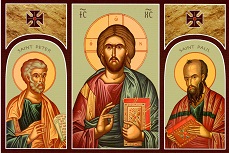
We have a Friend in high places

(audio only of tonight’s sermon, no video)

Sermon
Download Sermon

Sermon for the Ascension of Our Lord

Acts 1:1-11  +  Mark 16:14-20

Today we celebrate the day of Jesus’ ascension into heaven, the day He wrapped up His visible, earthly ministry and began His invisible, heavenly one. It’s a day for Christians to breathe a sigh of relief. Because, in spite of all the obstacles we face in this world, in spite of all the wickedness down here, Christ’s ascension reminds us that we have a Friend up there. We have a Friend in high places.

You heard in the Gospel how, on Easter Sunday, Jesus appeared alive to His disciples two days after He died on the cross. His appearance to them began with a rebuke for not believing that He had risen as He said He would. But after that, He issued and then kept repeating a great commission. Every time He appeared to them over the next forty days, He further described the mission He was sending them on. And notice, it wasn’t a mission to make the world a better place. It wasn’t a mission to get involved in the world’s politics or to infiltrate the world’s governments. It was a mission to spread a message.

In tonight’s reading from the book of Acts you heard one of those commissions: You will be my witnesses, both in Jerusalem, and in all Judea and Samaria, and to the ends of the earth. You heard another commission in Mark’s Gospel: Go into all the world and preach the gospel to every creature.

So what is “the gospel”? What is the message Jesus sent His apostles to spread? It’s summarized elsewhere as “repentance and the forgiveness of sins in Jesus’ name.”

Now, “repentance” itself can be summarized as the message of creation, sin, and judgment. It’s the message of who God is, how He made the world and all things, how all have sinned and have brought death and every form of trouble into the world, and how God has set a day of judgment, with an eternity of hellfire in store for all who have fallen short of His righteous requirements. That’s the first part of the message.

The second part of the message can be summarized as the message of Christ, the atonement, and the promise of the forgiveness of sins in His name. To be Christ’s witnesses means that the apostles were to spread the message that God had sent His Son into the world, as promised, and that, by His perfect life, His innocent death, and His glorious resurrection, He has made atonement for the world’s sins. And now the Lord Jesus, through His missionaries, holds out the forgiveness of sins to all who believe in Him. Whoever believes and is baptized will be saved; but whoever does not believe will be condemned.

That’s the message that has reached us all here, nearly 2,000 years after Christ’s ascension. But the mission includes more than just spreading a message, doesn’t it? In another one of Christ’s commissions, the one recorded at the end of Matthew’s Gospel, He put it this way: All authority has been given to Me in heaven and on earth. Go therefore and make disciples of all the nations, baptizing them in the name of the Father and of the Son and of the Holy Spirit, teaching them to observe all things that I have commanded you. There’s more than just spreading a message in that commission. There’s a “discipling” involved, a baptizing and an ongoing teaching, a gathering of people together from all nations and within all nations, a shepherding of a flock, a building that is to take place, not necessarily building church buildings or monuments or cathedrals, but the building up of a Church made of livings stones, of people gathered around the apostles’ teaching and the Lord’s Sacraments, of saints who are still living in the world but are no longer of the world.

That’s the mission Christ gave His Church to fulfill in the days and years and centuries ahead. It includes the message as well as the discipling. And then, after repeating and explaining that mission over the course of forty days, He gathered His disciples together on the Mount of Olives, and He was taken up into heaven, Mark says, and He sat down at the right hand of God. But it’s not as if Christ gave His Church that monumental task so that He could be separated from His Church or go away on vacation. No, Christ ascended on high for the very purpose of being present with His Church and helping us to carry out His mission, guaranteeing us success (as God measures success). It’s not a task we can accomplish on our own. But we have a Friend in high places.

You are Peter, Jesus said on another occasion, and on this rock I will build My Church. I will build, He said. Yes, the apostles had to spread the message and baptize and teach. But Jesus says He will be the One actually doing the gathering and the building and the discipling. Behold, He said, I am with you always, even to the end of the age. With us invisibly. With us by His Holy Spirit, whom He sent into the world on Pentecost and has left here with believers as our Helper until the end of the age. With us, to work together with us as we carry out His mission. As we heard at the end of Mark’s Gospel, they went forth and preached everywhere, and the Lord worked with them, confirming the word with the accompanying signs.

So although Jesus has sat down at the right hand of the Father, our Friend in high places is still with us, working with us. More than that, He is ruling over all things for our good. As St. Paul wrote to the Ephesians and Corinthians, God raised Him from the dead and seated Him at His right hand in the heavenly places, far above all principality and power and might and dominion, and every name that is named, not only in this age but also in that which is to come. And He put all things under His feet, and gave Him to be head over all things to the church, which is His body, the fullness of Him who fills all in all…For He must reign till He has put all enemies under His feet. The last enemy that will be destroyed is death.

Do you have troubles? Do you have uncertainties? Do you have enemies here below? It’ll be all right. You have a Friend in high places, in the highest place of all, ruling over the universe for your good, not yet removing all the wickedness from the world, but managing it so that the gates of Hades can’t prevail against His Church, and so that His people are preserved in faith and kept safe for the day of judgment, when He will remove all the wickedness from the world.

And that brings us to the last comforting truth I’d like you to think about this evening. What is our Friend in high places doing right now, in addition to working with us to carry out His mission and reigning over all things for our good? He told His disciples plainly: In My Father’s house are many mansions; if it were not so, I would have told you. I go to prepare a place for you. And if I go and prepare a place for you, I will come again and receive you to Myself; that where I am, there you may be also.

Now, we shouldn’t imagine that Jesus needs time to build and decorate mansions for us, as if the construction work took a long time. But He wants His Christians to picture it that way, to picture Him working for us, getting things ready for us, so that we understand that, even though He has ascended on high, He hasn’t forgotten about us. He won’t forget about us. On the contrary, He has His people on His mind at all times. Everything He does now He does so that you may be with Him in the end and spend eternity with Him in everlasting righteousness, innocence, and blessedness, so that, when we see Him coming down again from heaven in the same way they saw Him go up into heaven, we may follow Him where He has gone.

Yes, it pays to have a Friend in high places. If you think about all the ills that plague this present generation—loneliness, disconnection from community, disconnection from God!, purposelessness, the exaltation of sinful man above all things, the destruction of truth and the perversion of everything good—which of those ills isn’t resolved, or at least tempered, by the truth of Christ’s ascension to the right hand of God, and by the mission He gave His Church to carry out as our Friend and Savior reigns on high at the Father’s right hand? Every Christian has peace with God through the risen and reigning Christ. Every Christian has a community throughout the world of people who pray for each other and who care for each other, even though we may not know one another, yet. Every Christian has a purpose, both collective and individual, to further the mission Christ gave His Church, to spread the message, to live as disciples of Christ and as lights in the world. Every Christian has the hope of the new heavens and the new earth, the permanent home of truth and of righteousness. And every Christian has Christ’s assurance that the one who died for you and rose again is with you always, even to the end of the age. Think about these things! Give thanks to God! And rejoice in the One who has called Himself your Friend, who lives and reigns, with the Father and the Holy Spirit, in the highest place of them all! Amen.

Posted in Sermons | Comments Off on We have a Friend in high places

Only Christians have the Father’s ear

Sermon
Download Sermon

Service
[vimeo https://vimeo.com/826706285 w=540&h=360]
Download Service Download Bulletin

Sermon for Easter 5 – Rogate

James 1:22-27  +  John 16:23-30

For the third week in a row, our Gospel for the day has taken us back to the night before Jesus died, and with good reason, because it was on that night that Jesus spent a good deal of time preparing His disciples, not only for His suffering, death, and resurrection, but for life on earth after His Ascension, after He would go to the Father. That’s the same era in which you and I live—have always lived. So His words also serve to prepare us for our lives as Christians living in what we might call foreign territory, because the devil is still the prince of this world, and we’re still in danger from him at all times. Jesus assures us in today’s Gospel that, even though we’re surrounded by enemies, we have the ear of God the Father, and more than just the promise that He hears us. We even have the promise that He will grant our requests, when we ask in Jesus’ name. As Jesus explains to His disciples, Christians—and only Christians!—have the Father’s ear.

If you recall from two weeks ago, Jesus had told His disciples some things that they didn’t understand, about how they wouldn’t see Him “for a little while.” And they wanted to ask Him about it, but they were embarrassed or afraid. So He told them that He already knew what they wanted to ask, and then He went on to answer the question they never needed to ask. Our Gospel picks up from there. Jesus says to His disciples, in that day—in that time following My resurrection from the dead and after I have ascended into heaven—you will not ask me any questions. Not only because Jesus would no longer be living among them as He was then, but even more, because they would finally understand that, whether He was in the room with them or not, He already knew all things, including the questions and uncertainties that were in their hearts. They wouldn’t need to ask, we don’t need to ask, because Jesus knows the questions of our hearts and gives us the answers we need, through His Word and by His Spirit, even without hearing our questions. As the disciples said at the end of our Gospel, See, now you are speaking plainly; you are not speaking in riddles. Now we know that you know all things and that you do not need anyone to question you. By this we believe that you came forth from God.

And yet, even though He, as God, doesn’t need to hear our questions, He explains to His disciples that God the Father wants to hear our requests. Truly, truly I tell you, whatever you ask of the Father in my name, he will give you. Until now you have not asked for anything in my name. Ask, and you will receive, that your joy may be full.

Now, Jesus’ disciples had been praying to God the Father their whole lives, but never before in the name of Jesus. Let’s talk about what that means.

It means, first of all, to approach God the Father in prayer through faith in Jesus as the beloved Son of God, as the promised Messiah, as the One who gives us access to the Father through His death on the cross. It means to enter the heavenly throne room by walking through the door that is Jesus. If you try to enter by any other door, access will be denied. But if you approach God the Father through the Door He has provided, He will let you in and He will hear you and grant your requests. That’s why only Christians have the Father’s ear.

But to ask God the Father for His help “in the name of Jesus” also means to pray in the same way Jesus prayed. Humbly. Sincerely. With confidence that our Father will hear us, because we’re praying in the name of His beloved Son Jesus, to whom the Father would never deny any good thing. And since the name of Jesus has been placed on us in Holy Baptism, we should be confident that our Father in heaven thinks of each Christian in exactly the same way as He thinks of His only-begotten Son.

Third, praying in Jesus’ name also means praying for the things Jesus has taught us to pray for. Those things are summarized nicely for us in the seven petitions of the Lord’s Prayer. We are to pray for the hallowing or sanctifying of our Father’s name, for the coming of His kingdom, for His will to be done, for our daily bread, for the forgiveness of sins, for help against temptation, for deliverance from evil. Those seven petitions are general enough to leave everything up to God as to how He will grant them, and that’s intentional, because we don’t know the best way for God’s kingdom to come, so we simply pray, Thy kingdom come, and we know that He will grant us His Holy Spirit who brings the kingdom of God to us and to the world. We don’t know all the things that we specifically need each day, and so we simply pray, Give us this day our daily bread, and so on. When we ask our Father for those things, leaving it up to Him to grant them in the time and the way He sees fit, we are praying in the name of Jesus, and we can be absolutely sure that He will grant them.

Now, you can ask God the Father for other things, too, for things He hasn’t specifically promised to give, as long as you’re not asking for anything that goes against God’s will. You might well ask for healing from a specific illness, or for a certain job to come along, or a certain opportunity. You may well ask for relief from tyranny and oppression. That’s good and well, as long as, whenever you pray for something God hasn’t promised to give, you add the same phrase Jesus added, Not my will, but Your will be done.

Now, what confidence do we have that our Father will hear us and help us when we ask Him for things? First, we have Jesus’ command and promise in today’s Gospel. Ask. There’s the command. And you will receive. There’s the promise.

Not only that, but we Christians have the assurance of the Father’s love for us. In that day you will ask in my name. I am not telling you that I will ask the Father for you. For the Father himself loves you, because you have loved me and have believed that I came forth from God. You know there are different words for “love” in the Greek language. God so “loved the world” in such a way that He gave His only-begotten Son. That’s the love of commitment and devotion and genuine concern for the well-being and happiness of another. But the word Jesus uses here is the “love” of genuinely “liking someone,” the love of friendship, the love of having common likes and common interests. God the Father has called you believers in Christ His beloved friends. He likes you. Why? Because you’re so likable? No, but because you have loved me and have believed that I came forth from God. If you gave away the most precious thing you had to someone as a gift, because you knew they desperately needed that gift, and the other person looked at that gift and said, “Bah! What kind of gift is this? This thing’s worthless!” You wouldn’t like that person very much. On the other hand, if the person looked at that gift and said, “This is the most wonderful thing anyone has ever given me!” You would appreciate that, wouldn’t you? Because the thing that was so precious to you is now also just as precious to the person you gave it to. So it is with God the Father’s most precious gift of His Son. Your treasuring of Him actually causes God the Father to treasure you.

Now, how is it that you came to treasure Jesus, that you came to view Him as your friend, that you came to believe in Him? Well, that’s the Father’s doing, too. Jesus says, “No one can come to me unless the Father who sent Me draws him.” Or He said to Peter after he confessed Jesus as the Christ, the Son of the living God, Flesh and blood has not revealed this to you, but My Father in heaven. So it’s the Father’s doing that we believe in Jesus and love Jesus. And yet the Father still credits that to us, in His grace. He still treats us as His friends, as His allies. We’re on the same side, because we’re on the side of Jesus. And so the Father is committed to hearing our prayers and helping us in every need, because we’re no longer strangers and aliens and enemies of God. No, we’ve been reconciled to God through faith in His Son, and He loves us. He thinks highly of us, all because of Jesus. And so it is that Christians, and only Christians, have the Father’s ear.

You have the ear of God the Father, and a command and invitation to fill His ear with your praise and thanksgiving, with your prayers and requests. Now, as James said in today’s Epistle, don’t just be hearers of the Word, but doers of the Word. Don’t just hear that you have God’s ear. Use it! Bring your requests before Him, and not just here in church on Sunday mornings. Think throughout the day about what you need, and what others need, and about all the petitions that Jesus has taught you to make, and make those petitions throughout the day, in Jesus’ name. Things are not safe in this world. We do truly live in enemy territory, the devil’s territory, and there are troubles and temptations on every side. There are so many things we don’t know, so many things we have no control over. But we have been given a powerful tool and a mighty weapon, to ask our God in Jesus’ name, to come to our aid and to deliver us from every evil. No one else in all the world, save for Christians, has been given such a gift. So let’s use it, continually! In Jesus’ name. Amen.


Posted in Sermons | Tagged , , , | Comments Off on Only Christians have the Father’s ear

The mighty angel with the open book

Sermon
Download Sermon

Service
[vimeo https://vimeo.com/825695833 w=540&h=360]
Download Service Download Bulletin

Sermon for Midweek of Easter 4

Revelation 10:1-11

Think back to John’s vision of the seven seals. Between the opening of the sixth and seventh seals, there was a sort of interlude where John saw the 144,000 sealed on earth and then the souls of the saints who were already safely in heaven. Then the seventh seal was opened, taking us to the end of the world and then back to the beginning again with the vision of the seven trumpets.

There’s also an interlude between the sixth and seventh trumpets, divided into two parts. We have the first part before us this evening in Revelation 10: The mighty angel with the open book.

I saw still another mighty angel coming down from heaven, clothed with a cloud. And a rainbow was on his head, his face was like the sun, and his feet like pillars of fire. This isn’t one of the seven angels blowing the seven trumpets. It’s “another angel,” a mighty messenger of God, and like many of the details of this book of Revelation, people have written pages and pages giving their explanations for who they think this angel is. In the end, it isn’t the messenger himself who matters as much as what his message is, and clearly this is a divine messenger, not an evil one. Still, there are good reasons to see this as a picture of Christ Himself, the ultimate Angel or Messenger of the Lord. Clothed with a cloud, as Jesus once said He would come again with the clouds. A rainbow on his head, like a halo, like the one that surrounded the throne of God earlier in the book. His face shining like the sun, just as Jesus’ face shone at the transfiguration, and feet like pillars of fire, even as Jesus was pictured earlier having feet of burnished bronze. Whether this angel is meant to be the Lord Christ or to simply to represent Him, His power and glory are obvious. After seeing all the wickedness, false teaching, and destruction that came from the abyss and from the antichrists we talked about last week, seeing that power and glory of this messenger of God gives great comfort to the people of God. The devil and the powers of darkness are not out of God’s control.

He had a little book open in his hand. Now, the word for “book” in Greek is “biblion,” where we get our word “Bible” from. The same word is used for a book, that is, pages that are bound together, and for a scroll that you unroll or roll up. It’s the same word as the scroll that had the seven seals that only the Lamb was worthy to open. This one is called “little,” but it seems to be the very same scroll or book that the Lamb had unsealed, and so it lies open in the angel’s hand. We identified that book as the divine revelation of the things to come for the Christian Church. This is another reason to think that this mighty angel represents Christ.

And he set his right foot on the sea and his left foot on the land. This must be an angel of colossal size. While it seems like evil and the forces of evil dominate the earth, in reality, they don’t. God does. Christ does. He reigns over the land and over the sea, that is, over the whole earth. All things have been placed under His feet, as the Psalm says.

and cried with a loud voice, as when a lion roars. We aren’t told what the mighty angel cried out, only that it was loud, like the roar of a lion. We are told, by the same apostle John, what Jesus cried out with a loud voice just before He died: “It is finished!” Like the roar of a mighty lion who had just conquered His foes—conquered them, not for His own benefit, but for the benefit of His Church, of those who believe and are baptized.

When he cried out, seven thunders uttered their voices. Now when the seven thunders uttered their voices, I was about to write; but I heard a voice from heaven saying to me, “Seal up the things which the seven thunders uttered, and do not write them.” When God the Father spoke from heaven toward the end of Jesus’ earthly ministry, St. John writes that the people standing by thought that it had thundered. This may be an answer from God the Father to what God the Son cried out. But John isn’t allowed to write down what the voices said. The message here is simple. There are many things about the future that God knows but that He does not wish for us to know ahead of time. We don’t need to know those hidden things. It’s all right not to know. Trust in the God who does know, and rest in His loving care.

The angel whom I saw standing on the sea and on the land raised up his hand to heaven and swore by Him who lives forever and ever, who created heaven and the things that are in it, the earth and the things that are in it, and the sea and the things that are in it, that there should be delay no longer, but in the days of the sounding of the seventh angel, when he is about to sound, the mystery of God would be finished, as He declared to His servants the prophets.

Here the mighty angel takes a solemn oath that “the mystery of God will be finished, as He declared to His servants the prophets. What mystery are we talking about? What did God declare to the prophets that must still take place? Well, the prophets prophesied the first coming of the Christ to suffer, die, and rise again. That had already been fulfilled when John saw this vision. But there are several Old Testament prophecies that have yet to be fulfilled. (1) The spread of the Gospel of Christ to the ends of the earth. (2) The coming together of Jews and Gentiles into a new, spiritual Israel, a holy Christian Church. (3) The rising up of unbelievers against believers. And (4) the second coming of Christ to bring judgment against His enemies and to bring His believers into the new heavens and the new earth. All of this must go on until the end. All of this, swears the mighty angel, must soon be “finished,” the same word Jesus cried out from the cross before He died in reference to His work of redemption. Then a second and final “It is finished!” will ring out.

Then the voice which I heard from heaven spoke to me again and said, “Go, take the little book which is open in the hand of the angel who stands on the sea and on the earth.” So I went to the angel and said to him, “Give me the little book.” And he said to me, “Take and eat it; and it will make your stomach bitter, but it will be as sweet as honey in your mouth.” Then I took the little book out of the angel’s hand and ate it, and it was as sweet as honey in my mouth. But when I had eaten it, my stomach became bitter. And he said to me, “You must prophesy again against many peoples, nations, tongues, and kings.”

Some things God seals up and doesn’t reveal to us, like what the seven thunders spoke. We don’t need to know that. But other things He does reveal, everything we need to know about the future so that we can make it to the end of the finish line. He gives that to John to “eat,” a picture of John taking in the information God gives Him, and then to prophesy, to preach, to proclaim against many peoples, nations, tongues, and kings.

This all goes back to what we said on Sunday when Jesus promised that the Holy Spirit would come and convict the world, but He will do it through the preaching of the preachers whom Christ sends, like the Apostle John, and all those who hold that the prophetic office. We don’t preach the things God hasn’t revealed. We preach the things He has revealed to us in His Word. It tastes good, sweet as honey, when we take in God’s Word, when we come to understand how His great plan of salvation fits together. But it’s bitter in our stomachs when we realize how much evil the devil and the world will hurl against us, how much suffering and tribulation is predicted for Christians, how hard it is to preach the truth in an age that has fallen in love with lies.

Still, this chapter is a comforting chapter for Christians. It reminds us that God still rules in the midst of all the evil, that He will soon finish all He has promised to do for His Church, and that, in the meantime, His Word will continue to be preached in the world, even as it’s being preached again right now. Amen.

Posted in Sermons | Tagged , | Comments Off on The mighty angel with the open book

A very present help in times of trouble

Sermon
Download Sermon

Service
[vimeo https://vimeo.com/824566145 w=540&h=360]
Download Service Download Bulletin

Sermon for Cantate – Easter 4

James 1:16-21  +  John 16:5-15

God is our refuge and strength, a very present help in times of trouble. When those times of trouble come, when you’re facing hard times, when you have challenges confronting you—things you have to deal with, knowing you don’t have the strength to face it on your own, it sure is nice to have someone to help, someone who is knowledgeable, capable, someone you can count on, someone who is on your side and by your side. Well, that’s exactly the kind of help Jesus promises in today’s Gospel, a very present help in the times of trouble ahead, the help of the Helper, otherwise known as the Holy Spirit.

But wasn’t Jesus Himself the greatest Helper His disciples had ever known? He was! Certainly! In fact, He came to do what no other helper could ever do: He came to earth to be righteous where everyone else had sinned. He came to earth to pay for the sins of mankind, to give His life on the cross, to reconcile sinners to God, to redeem us from sin, death, and the devil. The devil was strong, but Jesus was stronger. And within three days of speaking the words of our Gospel, He would prove just how strong He was by rising from the dead.

But soon afterward, He would leave this earth. And that prospect terrified Jesus’ disciples and made them very sad. Now I am going to the one who sent me, and none of you asks me, ‘Where are you going?’ But because I have said these things to you, sorrow has filled your heart. Sorrow, because they didn’t understand that Jesus was about to die, rise again, and ascend into heaven, nor did they understand how they could face the troubles of the future without Him. On top of that, Jesus had given them the task of building His Church, and they knew they were not up to the task.

But He assured them, It is to your advantage that I go away. For if I do not go away, the Helper will not come to you. But if I go, I will send him to you. This is of those striking statements of Jesus, if you stop to think about it, that, somehow, it’s better for Jesus’ apostles, better for Christians, better for the world, for Jesus not to be here—not to be here in the same was He was here during His earthly life. When Jesus comes again to stand on the earth, then mankind’s time of grace will be over and the judgment will take place. But so much work had to be done between the time of Jesus’ ascension and His coming again, and here in our Gospel He promised His apostles that, although He would be gone (in a sense), they wouldn’t be left alone to face the world or to carry on His ministry of reconciliation. They would have a “Helper,” sent to them by the ascended Lord Christ. What the world needs during this time of the New Testament is the help of the Holy Spirit.

The word for “Helper” is a big word. It means someone who is called to your side to be on your side, to stand up for you, to advocate for you, to encourage you, to comfort you, to guide you. All of that is included in the word “Helper,” and the Helper is identified by Jesus a few verses later as the “Spirit of truth.”

We’ll be talking more about the Holy Spirit in the coming weeks. People have all sorts of wrong ideas about what the Holy Spirit does and how He does it. It’s important to listen to how Jesus describes the help that the Helper will give.

And when he comes, he will convict the world regarding sin, and regarding righteousness, and regarding judgment. Regarding sin, because they do not believe in me; regarding righteousness, because I go to my Father and you see me no more; regarding judgment, because the prince of this world is judged.

You see, the Holy Spirit isn’t a feeling you get in your heart or a “presence” that moves through a room. According to Jesus, the Holy Spirit is a preacher, a preacher who preaches through the preaching of men. Jesus says that one of the primary tasks of the Holy Spirit is to “convict” the world, that is, to rebuke the unbelieving world, to show that they are wrong about certain things.

First, that the unbelieving world is wrong about sin, in all sorts of ways. People think they aren’t sinners at all in God’s sight, or that their sins aren’t so bad. People commonly call things “sins” that aren’t sins, while they promote things that are most certainly sins in God’s judgment. And even if people recognize their sins, they turn in the wrong direction for help. But the Holy Spirit, through the preaching of the Christian Church, shows the world that they’re wrong. They are sinners, and the only way to have one’s sins washed away is through faith in Jesus.

Second, the Holy Spirit shows unbelievers that they’re wrong about righteousness. People think they’re righteous. Listen to any abortion supporter, or trans supporter, or climate change advocate, or illegal immigration proponent, any socialist or communist, and their allies in the media. If you listen to them, they are the righteous ones in the world. They are the good people, while Christians are the evil ones who need to be silenced. But the One enthroned in heaven laughs at them. There was one truly Righteous One who walked the earth. He walks it no longer. He’s ascended into heaven. He is the one of whom the Father approves, together with those who are joined to Him by faith. Jesus laughs at them, and the Spirit rebukes them.

Third, the Holy Spirit shows unbelievers that they’re wrong about judgment. The world thinks it gets to judge God, gets to judge Jesus, gets to judge Christians. And yes, for a time, the powerful people of the world seem to be successful. They prosper in their wicked schemes, while Christians suffer. But it’s temporary. The Holy Spirit shows that the ruler or the prince of this world stands judged already. And all who are on his side will share in his condemnation.

So the Holy Spirit rebukes or convicts the world. That doesn’t mean all unbelievers will be convinced that Jesus was right all along! No, it just means that the Holy Spirit will be working through the preaching of the apostles and the witness of the Church as we preach repentance, as we preach condemnation for those who remain in unbelief and the forgiveness of sins to all who believe and are baptized. It’s always the Holy Spirit working through the word, speaking to the hearts of men through the ears of men, both to unbelievers and to believers. As Jesus says through John in the book of Revelation, “He who has ears, let him hear what the Spirit says to the churches!”

But how could the apostles preach when they were so confused about so many things? That, too, would be remedied by the help of the Holy Spirit.

Jesus told His apostles: I still have many things to say to you, but you cannot bear them now. But when he, the Spirit of truth, comes, he will guide you into all truth.

Truth. That which agrees with reality. There is no such thing as “my truth” or “your truth.” There is only truth. Truth is steady, firm, stable, real. Let God be true but every man a liar. The Spirit of truth helps God’s people by guiding us into all truth.

Now, Jesus doesn’t promise that the Spirit of truth will convince the world of the truth. The farther away from God people get, the more they lose their grasp on the simplest truths. But the Helper will guide you into all truth, Jesus says. That applies first and directly to the apostles themselves. They were the first to receive the gift of the Spirit, to understand the truth of the Gospel, and to codify the truth revealed by God in the words of the New Testament Scriptures, even as the same Holy Spirit revealed God’s truth in the words of the Old Testament Scriptures, so that the whole truth has the firm and steadfast witness of God in writing forever, so that no man can come along and claim that his teachings are the truth. Your Word is truth, Jesus would pray just one chapter after our Gospel. The Roman Church likes to put the Church above the Bible, because, supposedly, the Church sat in judgment over God’s Word and told Christians what was God’s Word and what wasn’t. But that’s backwards. The apostles spoke and then wrote the truth revealed to them by the Holy Spirit, and then the same Spirit simply guided Christians then, even as He continues to guide us now, to recognize which writings genuinely came from the apostles and which ones didn’t. He guided and still guides Christians to distinguish apostolic truth from falsehood and from fables concocted without the Spirit’s guidance, always with one singular focus: to glorify Jesus. He will glorify me, for he will take of what is mine and proclaim it to you.

We’ll have more to say about the work of the Holy Spirit, but for today, let it be enough to know that you’re not alone in times of trouble, in this time of tribulation as you make your way through this life with your eyes focused on the life to come. You’re not on your own to figure out the truth, or to understand the Gospel, or even believe the Gospel. The Holy Spirit will be sent to help, has been sent to help: to be by your side and on your side, to stand up for you, to advocate for you, to encourage you, to comfort you, and to guide you, not apart from the Word of God, but through the Word of God, so that you can speak with conviction the words of the Psalm: God is our refuge and strength, a very present help in times of trouble. Amen.

Posted in Sermons | Tagged , , , | Comments Off on A very present help in times of trouble

Terror released from the Euphrates

Sermon
Download Sermon

Service
[vimeo https://vimeo.com/823585599 w=540&h=360]
Download Service Download Bulletin

Sermon for Midweek of Easter 3

Revelation 9:13-21

Last week, after the sounding of the fifth trumpet, we met the “angel of the abyss” who released thick smoke and a plague of locusts from the abyss. We suggested that this angel was either the devil himself or the devil’s right-hand man, the Antichrist, who, again, isn’t a single man in world history, but an institution within the Christian Church that outwardly seems to promote Christ, and yet subtly denies Him. That fits with the institution of the Roman papacy, which has unleashed all kinds of false doctrines among those who have failed to love the truth, causing torment to consciences with teachings that obscure the truth God’s Word and that turn people away from trusting in Christ alone for life and salvation.

This evening we hear the sixth angel sound his trumpet, and a similar kind of plague is introduced, though with important differences. In tonight’s reading from the second half of Revelation chapter 9, we hear of the terror that’s released from the region of the Euphrates River.

Then the sixth angel sounded: And I heard a voice from the four horns of the golden altar which is before God, saying to the sixth angel who had the trumpet, “Release the four angels who are bound at the great river Euphrates.”

The golden incense altar was already mentioned earlier, and we suggested that Christ Himself is the angel or messenger who stands at that altar, continually holding up His merits before God the Father and making believers acceptable to God. Here He commands the release of the four angels who are bound at the great river Euphrates. Now, the Euphrates River is one of the most famous rivers in the world. It runs through most of what we call the Middle East. It originates in Turkey, flows through Syria and Iraq, and finally empties into the Persian Gulf. The previous trumpet-sounding released heresies that came straight out of hell. This time the evil is released from what appears to be a more earth-bound location.

Is the location meant to be understood literally or figurately? It could be either. That region around the Euphrates is where all the historic enemies of the Old Testament people of God came from: the Syrians, the Assyrians, the Babylonians, and the Persians. So the naming of the river could simply indicate that enemies of the New Testament people of God will be released. But there’s a literal understanding that’s also possible. We’ll come back to that in a minute.

The four angels who were bound there at the great river may be symbolic of four world powers, or they may simply be symbolic of the fact that this evil goes out in all directions, to the four corners of the earth, and that it’s released at God’s command, and only at the time predetermined by God, not before or after.

So the four angels, who had been prepared for the hour and day and month and year, were released to kill a third of mankind.

We’ve been talking about destruction in thirds throughout this vision of the seven trumpets. This “killing” of a third of mankind could be spiritual killing, but it could also be literal killing. The locusts, if you recall, were not allowed to kill, but to torture. So the heresies represented by the locusts, the false doctrines introduced by the Antichrist within the Church, primarily harmed the souls of those who do not love the truth, but not their bodies. But these angels and their armies are allowed to kill. The damage they do affects soul and body and appears to be a punishment that especially affects Christians.

If the location around the Euphrates is meant to be taken literally, and if history can guide us to an interpretation of this murderous evil that arises and goes out from there and affects a large percentage of mankind, then the false religion of Islam and the false prophet Mohammed would seem to fit.

Islam grew up in the 600’s AD and spread throughout the Middle East, around the Euphrates River, taking root in both in Syria and in Turkey, and eventually filling the whole world. It openly blasphemes the Lord Jesus Christ. It openly rejects the Holy Scriptures of the Bible. It sets up Mohammed as a greater prophet than Jesus and openly denies that Jesus is true God and that He died on the cross for our sins. And, as I think you know, Islam, as defined by its unholy book, the Koran, calls for holy war to be waged against the infidels, against those who do not accept the teachings of Islam. Now, that doesn’t mean that all Muslims, especially modern Muslims, are out to kill non-Muslims. But historically, the wars waged by Muslims against Christians and against much of the world are well-known, making war against the soul with their antichristian doctrine and against the body with their literal armies.

Those wars characterized much of world history, from the 7th century onward, which may explain the enormous number of horsemen that John saw in his vision. Now the number of the army of the horsemen was two hundred million; I heard the number of them. And thus I saw the horses in the vision: those who sat on them had breastplates of fiery red, hyacinth blue, and sulfur yellow; and the heads of the horses were like the heads of lions; and out of their mouths came fire, smoke, and brimstone. By these three plagues a third of mankind was killed—by the fire and the smoke and the brimstone which came out of their mouths. For their power is in their mouth and in their tails; for their tails are like serpents, having heads; and with them they do harm.

The colors on the breastplates that the riders wore are basically the same color as the three things that came out of the horses’ mouths: fire (red), smoke (blue), and brimstone or sulfur (yellow). All three, coming out of the mouth, are, again, symbols of destructive doctrines that are taught. The tails that are like serpents and that have mouths remind us of the ancient serpent by whose mouth Eve was tempted and sin came into the world, bringing death on the human race, both spiritual death and physical death.

So this sixth trumpet appears to foretell the coming of this religion that grew up, not out of the Christian Church, but out of the world, a religion that is openly against Christ, even as the fifth trumpet seems to foretell the coming of a heresy that looks more Christian on the outside but that is actually against Christ. This is why some Lutheran theologians will talk about a western Antichrist and an Eastern Antichrist, one who is secretly against Christ, namely, the Roman papacy, and one who is openly against Christ, namely the religion of Islam. I think that’s a very plausible interpretation of what we see in Revelation 9, and we’ll talk about it again in the coming chapters.

Still, for as destructive as these plagues in John’s vision were, they didn’t cause the rest of the world to turn to God in repentance. As John says:

But the rest of mankind, who were not killed by these plagues, did not repent of the works of their hands, that they should not worship demons, and idols of gold, silver, brass, stone, and wood, which can neither see nor hear nor walk. And they did not repent of their murders or their sorceries or their sexual immorality or their thefts.

All the plagues God sent against Egypt didn’t cause the Egyptians to repent. Instead, they doubled down on their idolatry. So it is in these times, too. Unbelievers outside of the Church and hypocrites and false Christians within the Church ought to see all the terror and destruction both spiritual and physical that God is already punishing the world with, and they ought to repent. They ought to turn away from their idolatry, which is essentially the worship of demons, and from their murder and from their sorcery, sexual immorality, and theft. But they don’t. They double down on all these things, just as the Bible says they will. The world ought to see how the Christian Church has suffered in the world for the ways in which it has gone astray from God’s word—suffered both at the hand of Rome and at the hand of Islam—and the world should conclude, with St. Peter, that the time has come for judgment to begin at the house of God; and if it begins with us first, what will be the end of those who do not obey the gospel of God? “If the righteous one is scarcely saved, where will the ungodly and the sinner appear?” Then they should turn to God in repentance and look to Him for mercy, and they would find it, but they don’t.

As for us, whether or not we understand all the details of this chapter of Revelation, a few things are crystal clear. We should see all the punishments and judgments that have come upon the world and upon the outward Christian Church, and it should certainly lead us to live each day in repentance, turning away from every form of idolatry, every form of murder, sorcery, sexual immorality, and theft, and turning toward our merciful God to show us mercy for the sake of Christ Jesus. We should cling to God’s Word as to a light shining in a dark place, and then hold up that light for others to see by as well. We shouldn’t be afraid to confront false doctrine or to stand up for the truth revealed in the Bible, even if it means persecution or suffering here. Because, if God is for us, who can be against us? If God is for us, then no plague of locusts from hell and no armies from the Middle East can overcome us. This New Testament era has been and will be filled with all sorts of troubles, and so we are urged to pray all the more, Deliver us from evil! But the message of Revelation is that those who cling to Christ and His Word will overcome those troubles, will be delivered from evil, and will stand victorious in the end. Amen.


Posted in Sermons | Tagged , | Comments Off on Terror released from the Euphrates