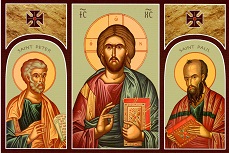
Jesus suffers the injustice of the priests

Passion History Part 4
Passion History Part 5
Sermon
Download Bulletin Download Passion History Part4 Download Passion History Part5 Download Sermon

Sermon for Holy Tuesday

What we heard about in this evening’s readings, especially how the Jewish leaders targeted Jesus in order to bring Him down, sounds, in many ways, so much like what we saw in today’s headlines. Political targeting of an opponent. Hauling your political opponent in front of a kangaroo court. Seeking out a crime to accuse someone of because you hate them and what they stand for and you want them out of the way. And justifying it all by claiming, falsely, that you’re just following the law.

Let me be very clear: I’m making zero comparisons between Donald Trump and the Lord Jesus. The comparison is between what corrupt national leaders are doing now with what corrupt Jewish leaders were doing then.

Jesus threatened the political power of the Jewish priests, their hold over the Jewish nation. They held their power, their dominion over the people of Israel, by claiming to be experts in their field. Why did they view Jesus as a threat? Well, He revealed them not to be the experts they claimed to be. He revealed that they had twisted the true religion of the Old Testament into something unrecognizable. They made sins out of things that God never called sins. They made their own traditions more important than God’s word. And they missed entirely the genuine humility and the heartfelt mercy God sought from mankind, obedience that begins in the heart and that flows from perfect devotion to God. Instead of cringing at God’s Law, which was supposed to reveal mankind’s sin, the priests bragged about God’s Law, as if they had been keeping it quite well. And because they sold themselves as experts, they were able to hold their power over the people and convince the people that they, the priests, had to be followed, because they, the priests, were so much better than everyone else.

But Jesus had exposed them for the charlatans they were. He gave the Word of God back to the people, exposing the bad interpretations of the priests. He gave the people a path to God, a path to righteousness that actually worked! The path of repentance and faith in God’s mercy in Jesus, the Christ. Instead of the people being beholden to the priests to make atonement for them day after day and year after year, they were invited to trust in Jesus, the very Lamb of God, to make atonement for them by His own blood. Instead of playing on the nationalism of the Jews, as the priests had done, Jesus made the entire Jewish culture and Old Testament priesthood irrelevant going forward, since it had all been pointing ahead to Him as its fulfillment. In doing that, Jesus was ripping away the priests’ iron grip on the people and on their power.

So Jesus had to be gotten rid of. More than that, Jesus had to be made to suffer. They had to make an example of Him, to make the people afraid of ever disagreeing with the priests, of ever questioning their authority.

Of course, Jesus could have refuted them, refuted their charges. He could have fought back against them, could have called upon 12 legions of angels to defend Him, could have called on His Father to strike them down with a plague or with leprosy or with blindness or any number of things that God did, at times, in the Old Testament when His people were being threatened.

Instead, He suffered it. He stood there and took the hatred aimed at Him. He took the abuse, both verbal and physical, the slaps, the spitting, the beatings. The unjust condemnation by His own people, by the leaders of the religion He had created, by the very men He had created. He took it in silence. The only charge He finally did answer was whether or not He was the Christ, the Son of God. To that He admitted. And for that they condemned Him.

Jesus suffered it, as the One sent to bear the sins of the world, and part of bearing the world’s sins was being on the receiving end of the world’s sins. Mankind has been behaving unjustly since the beginning of time, since the fall into sin, behaving unjustly toward other men, but even more, toward God. And so true justice would require sinners to suffer for their injustice. True justice, God’s justice, demands payment. But God, in His mercy, sent His Son, the Righteous One, to be on the receiving end of man’s injustice, the Just suffering for the unjust, to bring men to God. For all the false religion that has been spread in the world, for all the political targeting and personal targeting that all men have done, for all the abuse and violence that men have done, for all the hypocrisy men have shown, Jesus suffered it.

Watch Him suffer it. Watch Him endure it, in silence, for your salvation. Repent. Believe. And make it your daily goal to avoid all injustice and unfairness in your own behavior, and to suffer injustice yourself without bitterness, without complaint. Rejoice in that day when you are treated unfairly, and be glad, for so they treated the prophets who were before you. So they treated the Lord Jesus Himself. Leave it to Him to mete out justice in due time. And learn from Him to endure the world’s hatred with patience, knowing that your Lord endured it first, for you. Amen.


Posted in Sermons | Tagged , | Comments Off on Jesus suffers the injustice of the priests

Each Day in the Word, Tuesday, April 4th 

Mark 15:1-5

15 Immediately, in the morning, the chief priests held a consultation with the elders and scribes and the whole council; and they bound Jesus, led Him away, and delivered Him to Pilate. Then Pilate asked Him, “Are You the King of the Jews?”

He answered and said to him, It is as you say.”

And the chief priests accused Him of many things, but He answered nothing. Then Pilate asked Him again, saying, “Do You answer nothing? See how many things they testify against You!” But Jesus still answered nothing, so that Pilate marveled.

And the chief priests accused Him of many things, but He answered nothing. Then Pilate asked Him again, saying, “Do You answer nothing? See how many things they testify against You!”But Jesus still answered nothing, so that Pilate marveled. (vss 3-5)

The passivity of Jesus submission to His father’s will continues. Any man would be freaking out at such clear false accusations, but not the Son of Man. Why? Why does He say nothing? Well, as good Lutherans your answer should be “What does Holy Scripture say?”  And this is what it says:

He was oppressed and He was afflicted,

Yet He opened not His mouth;

He was led as a lamb to the slaughter,

And as a sheep before its shearers is silent,

So He opened not His mouth.

(Isaiah 53:7 NKJV, emphasis mine)

According to Isaiah, not only was the Messiah going to suffer cruel punishment on His way to the grave, but He also would do so without opening His mouth. The thought behind this phrase is that the Jesus would not speak in defense of Himself.

Whereas Jesus could have responded to His accusers with “an open mouth” and given a strong, lengthy defense of His innocence, Jesus chose to restrain Himself before His accusers and tormentors. Rather than calling twelve legions of angels to fight this battle for Him (cf. Matthew 26:53), Jesus humbly, passively submitted to His enemies. And He did it for you!

Let us pray:  Almighty and everlasting God, grant us your grace so to pass through this holy time of our Lord’s passion that we may obtain the forgiveness of our sins; through Jesus Christ, Your Son, our Lord, who lives and reigns with You and the Holy Spirit, one God, now and forever.  Amen

Posted in Devotion | Comments Off on Each Day in the Word, Tuesday, April 4th 

Jesus suffers the sins of His disciples

Passion History Part 2
Passion History Part 3
Sermon
Download Bulletin Download Passion History Part2 Download Passion History Part3 Download Sermon

Sermon for Holy Monday

We continue to watch the Lamb tonight. We watch everything He does during this Holy Week. We pay attention to everything He says. But above all, we watch Him suffer. The word “suffering,” by the way, literally means to allow something. The familiar King James verse, “Suffer the little children to come unto Me,” means, “Allow the little children to come to Me.” So when we see Jesus suffer, it isn’t just the agony of the beatings and torture that Jesus allowed to be done to Him. It’s also the other things He allowed to be done to Him, the other things He put up with, willingly, as part of the payment price for our sins. And the vast majority of the suffering we heard about this evening was caused, not by soldiers or priests or Jewish councils. No, before that, Jesus suffered the sins of His own disciples.

The ritual Passover meal had ended. Jesus had finished stooping down to wash His disciples’ feet. Imagine the good Lord kneeling before Judas and washing his feet, knowing full well what Judas was about to do. Jesus alluded to Judas’ betrayal already then. But afterward, as He sat down again to continue the common, more informal supper with His disciples, Jesus couldn’t hold in how much He was hurting, knowing that one of His twelve closest companions in the world, one of His chosen apostles, one of His friends, one of those who had been sent out to preach in Jesus’ name and to do miracles in Jesus’ name, one of those who had heard Him most and seen Him most, and known Him the best, was about to betray Him.

And that betrayal wasn’t a little slip, like sharing a friend’s secret without thinking about how it will affect your friend. Judas had actively sought out Jesus’ enemies who wanted Him dead. He had been pretending for some time that he believed in Jesus as his Lord and his God while actually disbelieving. He had made arrangements with the priests to trap Jesus in the Garden of Gethsemane and to identify Him with a kiss of friendship so that they could bind Him, arrest Him, and lead Him away to judgment. Knowing all this as He sat there at the supper table with His disciples, Jesus couldn’t contain the pain or the secret any longer: He was troubled in spirit, and testified and said, “Most assuredly, I say to you, one of you will betray Me.” And as the rest of the disciples asked in horror and confusion, “Lord, is it I?” Judas actually had the gall to ask the question himself.

But Jesus didn’t stop him from going through with it, did He? He didn’t even call out Judas by name or shame him in front of the rest of the disciples. He let him go to do what Satan had been instigating him to do. He suffered it, for you and for me, because mankind had been betraying God for thousands of year. But if we were to be forgiven, if justice were to be done, then God had to suffer the ultimate betrayal in the flesh, as a Man, in the Person of His Son.

Judas’ sin was, in a sense, the worst one that Jesus suffered, because the other eleven had a willing spirit, had a New Man, that was willing to stay with Jesus, to listen to Jesus, but their flesh, their Old Man, was weak. As Jesus told them in the Garden, “The spirit is indeed willing, but the flesh is weak.” Judas, on the other hand, didn’t even have a willing spirit. He had inwardly turned away from Christ some time ago. His spirit was with Satan again.

Still, the weakness of the other eleven caused plenty of suffering for Jesus, too, from their dispute among themselves, right there at the supper table with Jesus, about which of them should be considered the greatest, even as Jesus, who was by far the greatest, was about to lay down His life for them; to their arguing with Jesus and pridefully insisting that, even though He told them that they would all fall away that night, no, He was wrong, He didn’t know what He was talking about; to their giving in to sleep in the Garden when He had specifically pleaded with them to stay awake with Him and watch for just one hour; to Peter’s sudden misguided act of violence toward one of the servants in the Garden; to all the disciples’ abandoning Jesus, when fear for their own lives took the place of faith in the Lord of life.

Yes, there were other things that Jesus suffered in tonight’s readings, including the dread of the cup He was about to suffer and being treated like a violent criminal by those who came to arrest Him, although He had never, ever lifted a finger against anyone. But the sins of the disciples were front and center on that Thursday night of Holy Week. And Jesus suffered it, for you and for me, because mankind had been giving in to pride and fear and weakness for thousands of years. But if we were to be forgiven, if justice were to be done, then God had to suffer the pain caused by our pride, fear, and weakness in the flesh, as a Man, in the Person of His Son.

Some people are like Judas, who come to Christ, who come to His Church for a while, looking for something earthly, hoping for something that will confirm their own wrong beliefs. But eventually, when they hear the true Gospel, they go away profoundly disappointed, not wanting at all what Jesus actually offers, or they stay and pretend to believe while secretly clinging to their sin. If only they would turn and repent and see that Jesus may not offer what they want, but He offers and gives exactly what they need.

The rest of the Christians in the world are like the eleven disciples, whose spirit is indeed willing, but whose flesh is always weak. And so Jesus urges us to watch and pray so that we don’t fall into temptation.

Prayer is a powerful tool Christ has given us to beat down our sinful flesh, prayer and watchfulness. But just as necessary and even more powerful is that Supper that Jesus instituted on the same night in which He was betrayed, where the Suffering Servant kindly and gladly offers His body and blood to the very ones whose sins He suffered. For those with a willing spirit, who know and abhor the weakness of their flesh, that Supper offers both the forgiveness of sins and strength to fight and to resist temptation. It even sustains a willingness to suffer for Jesus’ sake, because you know that your Lord’s suffering wasn’t in vain. It’s the price of atonement for your sins, paid in full by the Lord who loved you and was willing to suffer for you. Amen.


Posted in Sermons | Tagged | Comments Off on Jesus suffers the sins of His disciples

Each Day in the Word, Monday, April 3rd 

Mark 14:32-42

32 Then they came to a place which was named Gethsemane; and He said to His disciples, “Sit here while I pray.” 33 And He took Peter, James, and John with Him, and He began to be troubled and deeply distressed. 34 Then He said to them, “My soul is exceedingly sorrowful, even to death. Stay here and watch.”

35 He went a little farther, and fell on the ground, and prayed that if it were possible, the hour might pass from Him. 36 And He said, “Abba, Father, all things are possible for You. Take this cup away from Me; nevertheless, not what I will, but what You will.

37 Then He came and found them sleeping, and said to Peter, “Simon, are you sleeping? Could you not watch one hour? 38 Watch and pray, lest you enter into temptation. The spirit indeed is willing, but the flesh is weak.”

39 Again He went away and prayed, and spoke the same words. 40 And when He returned, He found them asleep again, for their eyes were heavy; and they did not know what to answer Him.

41 Then He came the third time and said to them, “Are you still sleeping and resting? It is enough! The hour has come; behold, the Son of Man is being betrayed into the hands of sinners. 42 Rise, let us be going. See, My betrayer is at hand.”

As Jesus’ human nature succumbs to the reality of the weight of the worlds sins about to be fully paid for by Him, He is crushed and beaten down. His humanity’s only constant? His Father and prayer (which He will faithfully offer). Jesus takes the same three disciples who saw His glorious transfiguration, but now they witness how He is exceedingly sorrowful.

In the setting of such sorrow His disciples, rather than watching and praying, fall asleep, therefore, not lending any nearby comfort to Jesus. But the battle that Jesus fights in this hour He must of necessity fight alone. He alone must now will “to lay down His life” (Jn. 10:17-18), “to give His life as a ransom for many” (Matt. 20:28), to be made sin and a curse for us (2 For. 5:21; Gal. 3:13).

Yet, again, Jesus reveals what is impossible for man on his own, namely, trust in the Father’s will no matter what the outcome. With man, the flesh is always right there to resist or think that it can bend God toward man’s will. But with Jesus, He faithfully submits to His Father’s will for us! The disciples falling asleep reveals the weakness of man’s flesh. The two-natures of a Christian (Spirit & fallen flesh) will ever be at battle. The two-natures of Christ (God & perfect flesh) win the victory for us!

Think of it, Jesus knew exactly what the Old Testament said was going happen to the Messiah. The beatings, the stripes, the disfigurement to the point of no recognition (see Isaiah 50:6 and Isaiah 53). Only the strength of God could press on through such a horrific, inescapable outcome. And yet, Christ was not forced to do any of it, but He did it in submission to his Father’s will — and He did it for you!

Let us pray: Almighty God, grant that in the midst of our failures and weaknesses we may be restored through the passion and intersession of Your only-begotten Son, who lives and reigns with You and the Holy Spirit, one God, now and forever.  Amen

Posted in Devotion | Comments Off on Each Day in the Word, Monday, April 3rd 

Learn a lesson from the Lamb

Sermon (audio)
Download Sermon

Service(video)
[vimeo https://vimeo.com/814047356 w=540&h=360]
Download Service Download Bulletin

Sermon for Palm Sunday

Selections from Zechariah  +  Philippians 2:5-11  +  Matthew 21:1-9

From the Prophet Zechariah: Thus says the LORD God: “Sing and rejoice, O daughter of Zion! For behold, I am coming and I will dwell in your midst. Many nations will be joined to the LORD in that day, and they will become My people. And I will dwell in your midst. Jerusalem will be called the City of Truth, the Mountain of the LORD of hosts, the Holy Mountain. The streets of the city will be full of boys and girls playing in its streets. Behold, I will save My people from the land of the east and from the land of the west; I will bring them back, and they will dwell in the midst of Jerusalem. They will be My people and I will be their God, in truth and righteousness. And this will come to pass if you diligently obey the voice of the LORD your God. Rejoice greatly, O daughter of Zion! Shout, O daughter of Jerusalem! Behold, your King is coming to you; He is righteous and having salvation, lowly and riding on a donkey, a colt, the foal of a donkey. He will speak peace to the nations; His dominion will be ‘from sea to sea, and from the River to the ends of the earth,’ ” says the LORD.

Then I said to them, “If it is agreeable to you, give me my wages; and if not, refrain.” So they weighed out for my wages thirty pieces of silver—that princely price they set on me. Then they will look on Me whom they pierced. Yes, they will mourn for Him as one mourns for his only son, and grieve for Him as one grieves for a firstborn. And one will say to him, “What are these wounds between your arms?” Then he will answer, “Those with which I was wounded in the house of my friends.”

“Awake, O sword, against My Shepherd, against the Man who is My Companion,” says the LORD of hosts. “Strike the Shepherd, and the sheep will be scattered.” It will come to pass in that day that there will be no light; the lights will diminish. It will be one day which is known to the LORD—neither day nor night. But at evening time it will happen that it will be light. And in that day it will be that living waters will flow from Jerusalem, and the LORD will be King over all the earth.

_______________________________________________

We began our service with the Palm Sunday Gospel, the story of Jesus’ famous ride into Jerusalem on a donkey. He knew what He had to do. He had six more days of teaching to do, for His disciples, for His followers, and for His detractors. So much teaching, with His words, with His deeds, with His willingness to be led away to injustice, condemnation, and death. A Lamb goes uncomplaining forth. And so the Lamb taught even with His silence, as Isaiah said He would: He was led as a lamb to the slaughter, and as a sheep before its shearers is silent, so He opened not His mouth.

It was in silence that the Lamb of God rode down from the Mount of Olives into Jerusalem. He didn’t need to speak during that ride. The donkey spoke for Him—not as a donkey literally once spoke to the false prophet Balaam, but as the fulfillment of the words of the prophet Zechariah that you heard twice this morning. It told them that their King was coming to them, that He was humble and righteous and had salvation to bring for His people. The crowds also spoke. They cheered and hailed Jesus with the words of Psalm 118: Hosanna (Save!) to the Son of David! Blessed is He who comes in the name of the Lord! And Jesus silently accepted their praise and their acknowledgment that He was the Messiah and the true King of the Jews.

It was just the day before when Jesus silently accepted the worship of Mary in her home as she poured that expensive fragrant oil on His head and His feet. But He couldn’t remain silent when Judas the Betrayer criticized Mary for “this waste.” Then Jesus had to speak up to defend her, and to inform them what it was for: for the day of His burial, which would happen within a week. So, yes, Jesus knew very well why He would be riding into Jerusalem the next day, and what the end of it would be.

And still He went! And He kept going! When Thursday arrived, the Lord’s final day of freedom on this earth, what would He do with it? You heard in today’s reading: He had to celebrate the Passover with His disciples. This, too, had been prepared in advance, just as the donkey had been on Sunday. He told His disciples how to find a man who would just happen to have an available upper room in his house, during the busiest time of year in Jerusalem, that he would gladly lend to Jesus to celebrate His last Passover.

The first part of the evening was the ritual celebration of the Passover as Moses commanded it to be celebrated, with a belt on your waist, your sandals on your feet, and your staff in your hand. So you shall eat it in haste. It is the LORD’s Passover. And this night is what it was all about! When Jesus, the Lamb of God, would go into captivity and shed His blood, so that everyone who takes refuge under it, as the Israelites in Egypt once took refuge under the blood of the Passover Lamb, should be safe from the destruction of death and hell, and from the guilt of sin, which is now washed away in the blood of the Lamb when sinners are brought to Holy Baptism.

So when Jesus and His disciples finished that Passover meal, it marked the end of the Old Testament Passover as Jesus stepped forth to fulfill that shadow, the true Lamb of God who takes away the sin of the world.

But Jesus wasn’t done teaching His disciples that night. You also heard this morning what He did as soon as that first meal had ended. He got down on His hands and knees and washed His disciples’ feet. In true humility. In an expression of genuine love. And yet that would be the least service Jesus would render before the week was done.

Both Jesus and St. Paul, in today’s Epistle, spell out for us what we should learn from the Lord’s humble service. If He was willing to stoop down and serve His disciples—and us!—in such a lowly way, with such genuine love, then we who claim Him as our Lord must have the same mind toward one another. There’s no room for pride in the Christian, no place for building ourselves up. Humility was one of the hallmarks of our Redeemer during His earthly life. So it must also be the hallmark of the Christian.

Our Lord made Himself obedient to death, even the death of the cross, in humble obedience to His Father and in humble service for us. Take the time during this Holy Week to reflect on the things Christ willingly suffered for you and for me. Repent and believe in Him for salvation! Through faith in the Lamb of God, you have the forgiveness of sins now and eternal life to look forward to. Now learn from the Lamb! Learn to imitate Him in His humility, in His love, in His devotion to His heavenly Father, and in His zeal for the salvation of sinners. Amen.


Posted in Sermons | Tagged , | Comments Off on Learn a lesson from the Lamb